Explore grief healing through animal volunteering with real stories, practical ideas, and grounded support for finding purpose after pet loss.
Guides14 min read
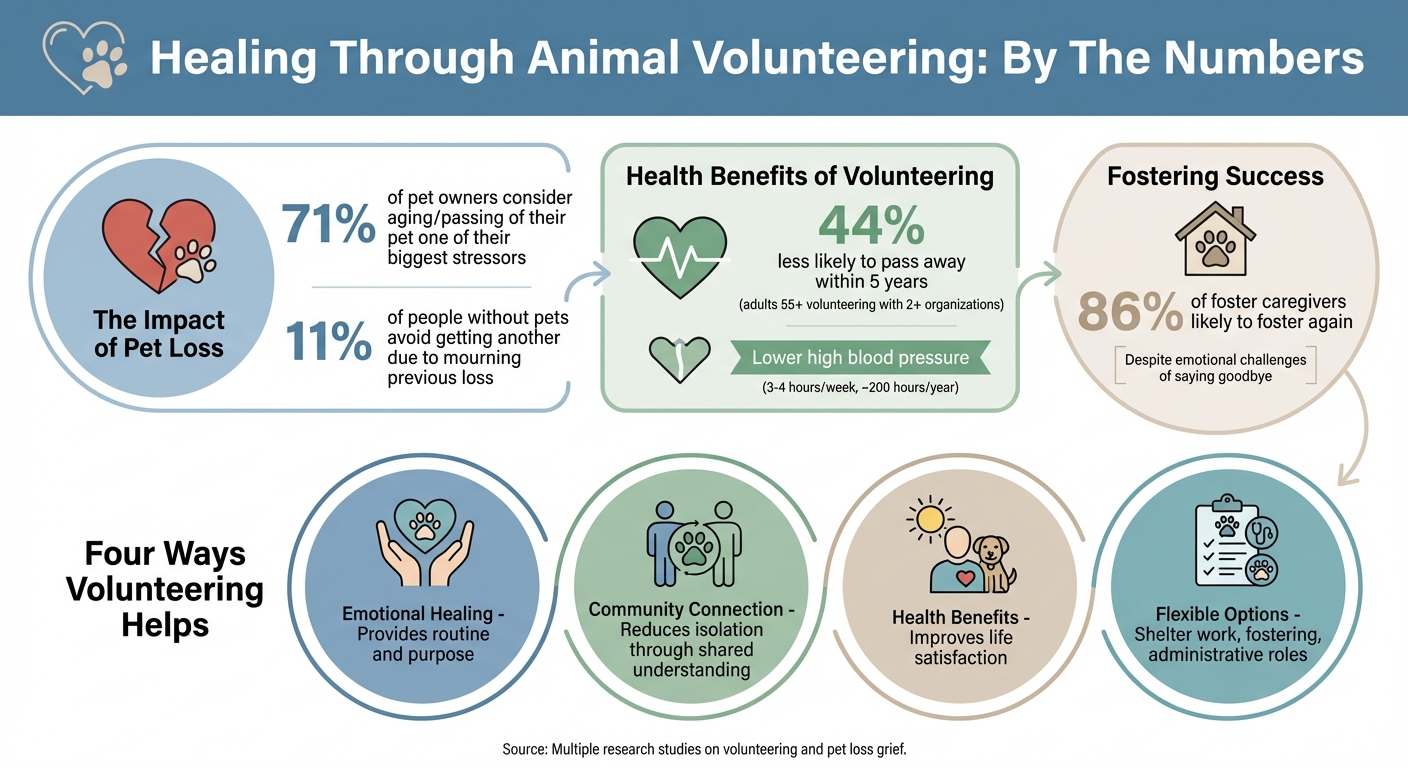
Losing a pet can feel like losing a part of your soul. For many, the grief is profound, often leaving a void that's hard to fill. But volunteering with animals offers a meaningful way to heal. By caring for shelter animals, fostering pets, or supporting rescue organizations, you can channel your love into helping animals in need while finding purpose and connection.
Here’s why animal volunteering can help with grief:
Emotional Healing: Activities like walking dogs or caring for injured animals provide routine and purpose, easing feelings of loss.
Community Connection: Volunteering connects you with others who understand your grief, reducing isolation.
Health Benefits: Studies show volunteering can improve life satisfaction and even lower health risks.
Flexible Options: From shelter work to fostering, there’s a role for every energy level and emotional state.
Real-life stories, like Maryanne Dailey’s journey of healing through shelter volunteering or Erin Yarbrough’s experience fostering after loss, illustrate how turning grief into action can transform lives - both yours and the animals you help.
How Animal Volunteering Helps Pet Loss Grief Recovery: Key Statistics and Benefits
How Volunteering With Animals Helps Grief Recovery
The Emotional Impact of Pet Loss
Losing a pet can feel like losing a part of your soul. It’s not just the emotional pain - it’s the disruption to your daily life. No more morning walks, no more feeding routines, and no wagging tail to greet you at the door. For many, this loss is profound. In fact, 71% of pet owners consider the aging or passing of their pet to be one of their biggest stressors[4]. And it doesn’t stop there - about 11% of people without pets say they avoid getting another because they’re still mourning a previous loss[4]. The silence in the house can be deafening, and the loneliness can feel unbearable. Finding a way to honor your pet’s memory while navigating grief becomes a crucial step in the healing process.
Benefits of Animal Volunteering
Volunteering with animals offers a way to channel that grief into something meaningful. It gives you a renewed sense of purpose, filling the void left by your pet’s absence. By caring for animals in need, you’re not just helping them - you’re helping yourself. This act of giving often leads to what experts call a "helper’s high", a boost in emotional well-being that comes from supporting others [1].
For older adults, the impact can be even more profound. Studies show that those aged 55 and up who volunteer for two or more organizations are 44% less likely to pass away within five years, even when considering other health factors [3]. Beyond the personal benefits, volunteering connects you with others who understand your loss, easing the isolation that grief often brings.
One of the things I've always said to my volunteers is that I want their volunteer time to be the highlight of their week... If it ever stops feeling that way, then I think that it is worth having a conversation. [1]
In these moments, volunteering becomes more than just an activity - it’s a way to honor your pet’s memory while giving back to animals in need.
Types of Animal Volunteering
Not every type of volunteering suits everyone, especially when you’re grieving. The good news? There’s a role for every energy level and emotional state.
Shelter volunteering is a popular choice. Tasks like walking dogs, cleaning pens, or sitting with nervous animals offer structure and purpose. These manageable activities can be incredibly grounding when everything else feels overwhelming.
If you’re ready for a deeper commitment, foster caregiving might be the next step. Taking in an animal temporarily allows you to experience companionship again without the long-term responsibility of pet ownership. A study of 131 foster caregivers found that 86% were likely to foster again, despite the emotional challenges of saying goodbye [5]. Interestingly, fostering dogs often brings more emotional and social benefits than fostering cats, likely because of the physical activity and social interaction involved in walking dogs [5].
For those not ready for direct animal interaction, administrative and advocacy roles are excellent alternatives. Tasks like fundraising, policy work, or crafting toys allow you to contribute to animal welfare while maintaining a safe emotional distance. The key is finding a role that aligns with your emotional capacity. Start small if needed, and adjust as you heal. These opportunities not only help animals but also pave the way for personal recovery, as we’ll see in the following case studies.
Case Study: Healing Through Shelter Volunteering
From Grief to Action: A Personal Journey
In February 2017, Maryanne Dailey lost her 14-year-old dog, Maggie. The loss left her grappling with profound grief for two years. Then, in 2019, she decided to visit the Best Friends Animal Sanctuary in Utah. This journey was her way of honoring Maggie’s memory while searching for a way to transform her pain into something meaningful.
Before starting her volunteer work at the sanctuary, Maryanne visited Angels Rest, a serene memorial site for pets. Surrounded by wind chimes, she read a heartfelt message to Maggie:
I told Maggie how much I loved her and missed her, but that I had to find a way to mend my aching heart. I asked her to help guide me toward another pet child to love, care for and embrace. [7]
This moment marked a turning point. It allowed her to begin channeling her grief into acts of kindness, turning sorrow into action.
The Healing Power of Shelter Work
Maryanne began her volunteer experience with simple, yet meaningful tasks: walking dogs, offering treats, and sitting quietly with animals that craved companionship. Her efforts reflected how acts of care can foster emotional recovery. One particular dog, a shy black pup named Donner, stood out. Donner avoided human interaction, but Maryanne approached her with patience. She sat on the floor, extended treats, and softly hummed "I See the Moon", a lullaby she used to sing to Maggie. After about 15 minutes, Donner placed her paws in Maryanne’s lap. In that moment, Maryanne realized she still had love to give.
This connection reminded her that caring for vulnerable animals could bring purpose and healing to her life.
Emotional Milestones and Reflections
The bond she formed with Donner brought back a joy Maryanne thought she had lost [7]. Eventually, she adopted Donner and renamed her Rosie Donner, deepening her sense of healing and fulfillment.
I kept thinking to myself that if I could just get to Best Friends, I would be able to say goodbye to Maggie in a way that would have a healing element, and maybe I could start to move forward.
Maryanne’s story shows how volunteering at shelters can transform grief into a renewed sense of purpose. By pouring her love into helping animals in need, she continued the legacy of care and compassion that Maggie had instilled in her.
Case Study: Finding Purpose Through Fostering
Overcoming Hesitation to Foster
Fostering can be a powerful way to transform grief into meaningful action, much like volunteering at animal shelters.
Take Erin Yarbrough, for example. In January 2026, after losing her 4-year-old dog Sonny, the law student from West Los Angeles found herself at the Best Friends Lifesaving Center. Grieving deeply, she still felt compelled to help. Despite battling guilt - worrying that fostering might feel like "replacing" Sonny - she welcomed a dog named Sid (later renamed Spud) into her home. Reflecting on her decision, she shared:
I think he was calling me to be there for other animals. He wanted me to help dogs like he helped me... I think he was telling me that I need to give what he gave to me. [6]
Similarly, in June 2022, Rocio Ritter from Northwest Arkansas faced her own hesitation after losing her 15.5-year-old dachshund, Pisa. The days felt unbearably heavy, but Rocio remembered a promise she made to Pisa during her final moments - to "do good things" and channel her pain into love. That promise led her to Hutch, a terrier mix with a fractured leg. Despite her fears, she took a leap and decided to foster him [8].
Connecting Through Caregiving
Caring for foster animals often brings structure and purpose to lives disrupted by loss.
For Rocio, looking after Hutch became part of her daily routine. She managed his splint, kept it dry during bathroom breaks, and created a peaceful environment for his recovery. These small but meaningful tasks gave her a reason to get up each day, even when grief felt overwhelming [8].
Erin had a similar experience with Spud. On days when sadness overcame her, Spud would break the tension by bringing her toys, lifting her spirits in unexpected ways. She was mindful not to place the burden of her healing on him, saying:
Spud is not expected to be a grief panacea for me... He's his own dog. [6]
Daily moments of care - like feeding, walking, and playing - slowly replaced the emptiness of loss with glimmers of happiness.
A 2026 study involving 131 foster caregivers from five U.S. shelters found that 86% of participants were likely to foster again, even though letting go of their foster animals was emotionally challenging. Interestingly, those who fostered dogs reported higher emotional and social quality of life compared to those fostering cats [9].
Honoring Their Pet’s Legacy
Fostering can also serve as a tribute to the pets we've loved and lost.
Both Erin and Rocio ultimately adopted their foster dogs. Erin renamed Sid as Spud, a nod to Sonny’s memory, while Rocio renamed Hutch as Einstein, inspired by the joy he brought into her life [6][8][10]. These decisions reflect how fostering not only helps heal but also honors the legacy of the pets who came before.
Heather Bennett found a similar path to healing in March 2026, just a month after losing her dog Louie. She began fostering a puppy named Mocha through the Humane Society for Tacoma & Pierce County, bringing moments of laughter back into her home during a time of sadness. Later, she fostered Milo, a dog rescued from neglect, which taught her family patience and gave them a fresh perspective on life. Her advice for others grieving the loss of a pet:
Don't be afraid to love them. Don't be afraid to say goodbye. Let yourself ugly cry when they leave but shake it off and get ready for your next foster! [12]
These stories show how fostering transforms grief into an enduring act of love, creating a bridge from loss to hope.
Common Themes and Challenges in Volunteering After Pet Loss
Shared Themes of Healing
Volunteering can bring a renewed sense of purpose by offering structure, connection, and moments of joy. Tasks like walking, feeding, and cleaning animals create a daily routine that helps grieving individuals stay grounded. These physical activities provide a reason to remain active, even when grief feels overwhelming.
Beyond the routine, volunteering combats isolation by connecting people to communities that understand the pain of losing a pet - a type of grief that is often overlooked. Researchers describe this as "disenfranchised grief" [13][14]. Many volunteers report feeling an improved mood and greater life satisfaction through the act of helping others. Studies even suggest that altruistic activities can boost a sense of "time affluence" and personal effectiveness [1].
One of the most profound lessons volunteers learn is how to embrace both grief and joy at the same time. They find that they can create new happy memories with animals while still cherishing the bond they had with their late pets. Clinical psychologist Emily, reflecting on the loss of her dog Barney, shared this insight:
I've realised that [grief] is certainly not linear... I have found it helpful to still find ways of honouring them in your life
This ability to carry grief alongside hope allows volunteering to become a healing bridge between loss and renewal. However, these benefits also come with emotional challenges that volunteers must navigate carefully.
Emotional Risks and Boundaries
While volunteering can be deeply rewarding, it also brings emotional risks that require thoughtful boundaries. Familiar settings, like favorite walking paths, or animals with traits similar to a lost pet can trigger painful memories. For those who foster animals, the repeated process of letting go after each adoption can be particularly difficult, leading to ongoing worries about the animals’ futures [11].
Another challenge is compassion fatigue, which can arise from witnessing the suffering of neglected or abused animals. This emotional toll can be heavy, especially when dealing with cases like puppy mill rescues. Tamara Daily, a psychology professor in Ohio who studied foster volunteers, shared how she coped by keeping a photo collection of every foster dog she cared for. This helped her focus on the positive difference she had made [11]. Kirsten Peek, Media Relations Manager at Humane World for Animals, acknowledged the emotional strain but emphasized its worth:
Fostering is really important and worth it, despite the emotional pain that sometimes happens
To avoid burnout, setting boundaries is essential. Hilary Hager, Senior Director of Outreach and Engagement at the Humane Society of the United States, underscores the importance of personal responsibility:
The volunteer program's role is to ask, but it's the volunteer's responsibility to say no
Experts suggest balancing responsibilities by alternating between high-needs animals (those requiring medical or behavioral care) and low-needs animals. Choosing tasks with clear start and end points - like a single dog walk - can also help volunteers manage their emotional energy without becoming overwhelmed [1][11].
Vlogmas day 8| Volunteering & pet loss grief
Conclusion: Honoring a Pet's Legacy Through Service
The bond you shared with your pet doesn’t end when they’re no longer with you - it transforms, finding new ways to express itself. Volunteering with animals can be a heartfelt way to channel that love, offering support to creatures in need. Take Emily from North Wales, for example. After losing her senior dog Barney in March 2026, she began volunteering at Jackson's Animal Rescue. This journey led her to adopt a 12-year-old stray cat named Clement, giving another senior pet a new lease on life in Barney’s honor [2]. Her story is a beautiful reminder that honoring a pet’s memory can open the door to new beginnings.
Healing doesn’t look the same for everyone. Catherine Sanderson, for instance, found solace after her dog Daisy passed from terminal bone cancer in November 2022 by fostering 18 dogs over two years [3]. Others find purpose in volunteering at shelters, organizing donation drives, or advocating for animal welfare. The key is finding an approach that feels right to you and reflects the unique spirit of your pet.
Volunteering doesn’t just help animals - it can also profoundly benefit your own well-being. Research indicates that dedicating three to four hours a week (around 200 hours a year) to volunteering can lower high blood pressure in adults over 50 [1]. Additionally, people aged 55 and older who volunteer with two or more organizations are 44% less likely to pass away over a five-year period [3]. These statistics highlight the physical and emotional benefits of giving your time to others.
Hilary Hager, Senior Director of Outreach and Engagement at the Humane Society of the United States, captures this sentiment perfectly:
When it feels like you can't help yourself, maybe sometimes it can help to help others. And by helping others, you wind up helping yourself.
Your pet’s legacy lives on through every act of kindness you extend, every animal you care for, and every life you touch. Their memory becomes a source of compassion and action, creating a ripple effect of love.
For those navigating the pain of losing a pet, To Lose A Dog by Isaac H offers a heartfelt exploration of the human–animal bond. This memoir combines the story of Isaac and his English Bulldog, Franki, with practical advice on coping with grief, caregiving, and celebrating your pet’s memory. By carrying forward your pet’s legacy, you can find healing and understanding. Pre-order the $22 hardcover at toloseadog.com to save $6 and gain access to a private grief support community. Delivery is expected in Q1 2026.
FAQs
How does volunteering with animals help people heal after losing a pet?
Volunteering with animals can be a comforting and healing experience for anyone mourning the loss of a beloved pet. Taking care of shelter animals - whether it’s feeding, walking, or simply spending quality time with them - provides a sense of structure and purpose. It’s a way to channel grief into something positive, shifting the focus from loss to the rewarding act of helping animals thrive.
Studies have shown that spending time with animals can lower stress levels, boost mental well-being, and instill a sense of achievement. For many, the emotional connection formed with these animals offers companionship and support, helping to rebuild confidence and ease feelings of isolation. Personal accounts often reveal that volunteering not only brings a sense of purpose but also leads to new friendships, and in some cases, the adoption of a new furry friend.
For those seeking more support in coping with the loss of a pet, To Lose A Dog provides heartfelt advice and practical tips to help navigate grief and rediscover the joy of bonding with animals.
What types of animal volunteer opportunities are available?
Volunteering with animals opens the door to a wide range of roles, each offering a unique way to bond with animals while discovering a sense of purpose and healing. These roles typically fall into three main areas: working directly with animals, supporting their care, and behind-the-scenes contributions.
If you enjoy hands-on interaction, you might participate in therapy visits to hospitals, schools, or nursing homes, join an animal-assisted crisis response team, or take part in programs like "read-to-a-dog" events at libraries. For those drawn to caregiving, roles could include fostering pets, transporting animals, assisting with feeding and grooming, or even helping to build and maintain shelters. Prefer to work from a distance? Behind-the-scenes opportunities let you manage tasks like social media, data entry, or coordinating volunteers - all vital to animal welfare efforts.
For anyone grieving the loss of a pet, volunteering can be a meaningful way to reconnect with animals and find solace. The memoir To Lose A Dog shares touching stories and practical advice, offering guidance on coping with loss and forming new connections with animal companions.
What emotional challenges can arise when volunteering with animals after losing a pet?
Volunteering with animals after the loss of a beloved pet can be a bittersweet experience. On one hand, spending time with animals can bring a sense of comfort and connection, but on the other, it may stir up fresh waves of grief. Seeing the quirks and behaviors of other animals might remind you of your lost companion, making those emotions of longing and sadness feel even more pronounced. It’s not unusual to feel conflicted - perhaps even guilty - when forming new bonds or offering care to animals in need.
There’s also the emotional weight that comes with the work itself. Caring for animals with behavioral challenges, witnessing their pain, or saying goodbye when they’re adopted can tug at your heart in unexpected ways. These moments can leave you feeling raw and might even bring back memories of your own loss. While volunteering offers a chance to heal and find purpose, it’s important to acknowledge that it often involves navigating a mix of emotions along the way.
Frequently Asked Questions
Is it too soon to volunteer with animals right after my dog died?
There is no universal timeline, and the right moment is different for everyone. The draft stories suggest starting small — a single dog walk or a one-time shelter visit — lets you test your emotional readiness without overcommitting. If being around dogs triggers overwhelming pain rather than any comfort, that's useful information, not failure; administrative roles like fundraising or toy-making let you contribute while keeping a safer emotional distance.
Will fostering a dog feel like I'm replacing the one I lost?
The fear of replacement is one of the most common hesitations grieving owners face, and it makes complete sense. Fostering is a temporary caregiving role, not a declaration that your bond with your previous dog is over or lesser. Many foster volunteers — including those profiled here — found that caring for a new animal deepened, rather than erased, their sense of connection to the dog they lost.
What is compassion fatigue and how do I know if volunteering is making my grief worse?
Compassion fatigue is emotional exhaustion that builds when you repeatedly absorb the suffering of others — including animals — without adequate recovery time. Warning signs include dread before volunteer shifts, emotional numbness, or crying that feels uncontrollable rather than releasing. Experts recommend alternating high-needs animals with lower-needs ones, choosing tasks with clear endpoints, and treating persistent distress as a signal to scale back rather than push through.
How do I find a reputable animal shelter or rescue to volunteer with?
Start with established organizations like Best Friends Animal Society or your local Humane Society affiliate, both of which have structured volunteer programs with onboarding and support. Calling ahead to ask how they support volunteers emotionally — especially those dealing with loss — is a reasonable and telling question; shelters with good programs will have a real answer.
Can volunteering with animals replace grief counseling or a pet loss support group?
Volunteering offers real psychological benefits — structure, purpose, reduced isolation — but it works best alongside, not instead of, dedicated grief support. Pet loss grief is a recognized form of bereavement, and a counselor or support group specifically focused on pet loss can address guilt, shock, and social dismissal in ways that a volunteer shift cannot. The two approaches complement each other well.
Reserve the paperback at the pre-order price, with clear shipping and cancellation terms.
Pre-order price: $24.99 (save $5 off retail price)
First copies out of the print run, estimated to ship December 2026, shipped directly to you
Email updates on the book's progress until it reaches you
$24.99$29.99
Save $5
Charged today · Cancel any time before it ships
US shipping is $4.90. Other countries are calculated at checkout.
Estimated to ship December 2026US shipping is $4.90. Other countries are calculated at checkout.
Not today?
If the timing is wrong, or you are buying for someone who is not ready yet, leave your email. I will write once, when copies start shipping, and that is the only time you will hear from me.