Understand the science of grief after pet loss, validate your pain, and find practical ways to cope, honor your dog, and heal.
Guides11 min read
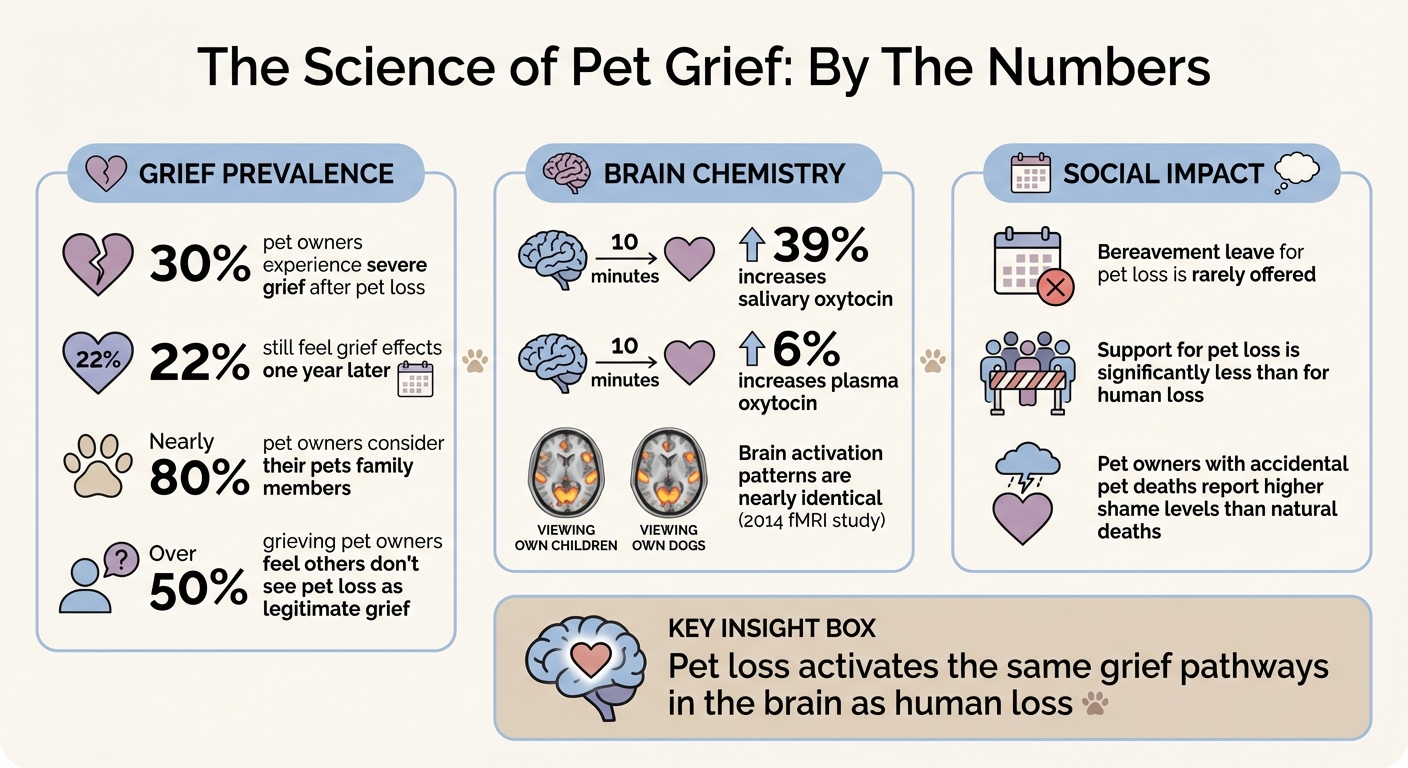
Losing a pet can be as emotionally challenging as losing a loved one. Research confirms that the bonds we form with pets are deeply rooted in our biology, activating the same brain systems responsible for attachment in human relationships. This explains why 30% of pet owners experience severe grief after their loss, and over 22% still feel its effects a year later. However, society often underestimates this pain, leaving many to navigate their grief without adequate support.
Key points:
Pets stimulate feel-good hormones (like oxytocin), creating bonds similar to those between parents and children.
Brain imaging studies show pet loss activates the same grief pathways as human loss.
Disenfranchised grief - where society minimizes the loss - makes healing harder.
Guilt, especially around euthanasia or sudden loss, is common but can be managed with rituals and support groups.
Understanding the science behind pet grief can validate your feelings and guide you toward meaningful ways to honor your pet’s memory. Whether through creating tributes or seeking support, healing is about cherishing the bond you shared while finding ways to move forward.
Pet Loss Grief Statistics and Brain Science Facts
The Brain Science of Pet Grief
Oxytocin and Pet Attachment
When you pet, talk to, or even make eye contact with your dog, your brain releases oxytocin - a hormone that strengthens emotional bonds. Produced in the hypothalamus, oxytocin plays a key role in forming deep connections. Even just 10 minutes of interaction with your pet can increase salivary oxytocin by 39% and plasma oxytocin by 6% [5].
Oxytocin also helps reduce stress by calming the amygdala and suppressing the HPA axis, which makes you feel safer and more at ease during these moments with your pet. Interestingly, studies show that owners who engage in extended eye contact - or "long-gaze" interactions - with their dogs experience significantly higher increases in urinary oxytocin compared to those with shorter gazes [5].
"The hormone increases revealed in human-animal interactions indicates that people and their pets are forming attachment bonds as parents and children do." - CABI Digital Library [1]
When a pet passes away, the sudden drop in oxytocin disrupts the brain's reward system, setting off the GRIEF system - a response that exists across mammals [6]. The abrupt decline in oxytocin, along with dopamine and prolactin, directly contributes to the overwhelming emotional and physical distress you feel. This dramatic shift in neurochemical balance creates the foundation for the brain's struggle to process the loss.
How the Brain Processes Pet Loss
When grieving a pet, your brain faces a conflict: attachment pathways that still anticipate your pet's presence clash with memory circuits that confirm their absence [8].
"The result is a grieving brain that is at odds with itself. It's simultaneously managing threads of attachment (that feeling that a loved one is still here) and conflicting threads of memory (the knowledge that someone has died)." - Care Dimensions Bereavement Team [8]
This internal conflict often leads to what’s described as "grief fog" - a state of confusion, difficulty concentrating, and exhaustion. As the prefrontal cortex struggles to process emotions and the nucleus accumbens yearns for the lost bond, the amygdala loses its ability to regulate emotions, intensifying feelings of anxiety and depression [7][9].
A 2014 study by Stoeckel and colleagues used fMRI scans to compare brain activity when women looked at photos of their own children versus their dogs. The results showed nearly identical activation patterns in the brain's affiliation and reward centers, offering neurobiological proof that pet bonds are processed similarly to maternal bonds [1]. While the brain eventually adapts through neuroplasticity, this adjustment takes time, which is why the grief can feel so intense in the beginning [8].
Social and Psychological Impacts of Pet Grief
When Society Dismisses Pet Grief
The loss of a pet is often categorized as disenfranchised grief, meaning it’s a type of loss that society doesn’t widely recognize or validate [4]. Even though nearly 80% of pet owners consider their pets to be family members [10], over 50% of grieving pet owners feel that others don’t see the loss of a pet as a legitimate reason to grieve [1].
"Pet loss is a disenfranchised type of grief. This means in our society it is not recognized as an important death." - Lisa Hutchison, Licensed Mental Health Counselor [4]
This lack of recognition shows up in many ways. Bereavement leave for pet loss is rarely offered, and people often expect you to "move on" quickly [4]. Comments like "it was just a pet" or "you can always get another one" can feel dismissive, leaving you shocked, angry, or even suppressing your emotions entirely [4]. Many grieving pet owners choose not to share their feelings on social media, fearing judgment or ridicule from those who don’t understand the deep bond between humans and their pets [1].
Studies highlight that support for pet loss is far less than what’s offered for human loss [1]. This lack of validation can be especially tough for individuals who live alone or have limited social connections, as their pets often provide their primary source of love and companionship [2][3]. Without societal acknowledgment, feelings of isolation and personal guilt can deepen, making the grieving process even harder.
Guilt and Regret After Pet Loss
Guilt is one of the most common emotions tied to pet loss, even when the decisions made were the best ones under the circumstances. Unlike human loss, pet owners frequently face the heart-wrenching responsibility of deciding when euthanasia is necessary, which can lead to endless "what if" scenarios [11].
"Guilt is the biggest emotion I see with pet loss, even if people know they've made the right decision. It's still just an enormous burden for some people." - Joelle Nielsen, MSW, LSW, Ohio State University Veterinary Medical Center [11]
This guilt often comes from the unique dynamic between pets and their owners. Pets depend entirely on their humans for care and protection, so when a pet dies - especially suddenly or due to an accident - owners may feel they’ve failed in their role as protector [1]. These feelings not only amplify the pain of loss but can also spark harsh self-criticism. Research shows that pet owners whose pets die accidentally report significantly higher levels of shame compared to those whose pets pass away naturally [1]. The distinction is important: guilt focuses on a specific action ("I should have noticed the signs sooner"), while shame is tied to a deeper sense of personal failure ("I’m a bad owner for letting this happen") [1].
To help ease guilt, consider using quality-of-life scales to guide decisions about euthanasia in a more objective way [11]. Creating rituals - such as planting a tree or displaying cherished photos - can also help shift your focus from the pain of their passing to the joy they brought during their life [11]. If you’re struggling, pet-loss support groups or counselors can provide a safe space to process your emotions and honor the special bond you shared with your pet [4].
How to Process and Heal from Pet Loss
Maintaining Connection with Your Deceased Pet
The idea of "absolute closure" after losing a pet is misleading. Instead, many find comfort in maintaining a bond through memories - a concept supported by the continuing bonds theory. This approach allows your pet to live on in the shared experiences you hold dear [13].
"Your memories allow your pets to live on in you. Embracing these memories, both happy and sad, can be a very slow and, at times, painful process that occurs in small steps." - American Veterinary Medical Association (AVMA) [13]
The silence that follows their absence - sometimes referred to as "the presence of absence" [13] - can feel overwhelming. But rather than avoiding thoughts of your pet, consider honoring their memory. Look through old photos, write letters to them, or create tributes that celebrate your bond. This isn’t about dwelling in sadness; it’s about adapting to the loss while cherishing the joyful moments you shared.
Practical Steps for Grieving Pet Owners
Preserving memories is just one part of the healing process. Practical steps can also help you navigate grief in a meaningful way. The Ohio State University Veterinary Medical Center has been offering support through its "Honoring the Bond" program since 2009. Led by social worker Joelle Nielsen, this program provides veterinary social work services and even hosts an annual remembrance ceremony to help pet owners cope with their loss [11]. Programs like this are vital, especially since society often underestimates the depth of pet grief.
"You must allow yourself to feel sadness and anger to work through your grief." - Joelle Nielsen, MSW, LSW, Honoring the Bond Program Coordinator [11]
There are many ways to honor your pet's life. You could plant a tree, make a donation in their name, or create a photo album filled with their best moments [11][13]. Journaling can also be therapeutic - write down funny stories or favorite memories to shift your focus from the pain of loss to the joy they brought into your life. If you have other pets, pay attention to their behavior, as they may also experience grief [12][6]. And while it may be tempting to adopt a new pet right away, give yourself and your family time to heal before making that decision [11].
For more science-backed advice on coping with pet loss, visit To Lose A Dog.
Pet loss grief; the pain explained | Sarah Hoggan DVM | TEDxTemecula
Conclusion: Honoring Your Pet's Memory
Losing a pet isn't just emotionally difficult - it triggers a very real physiological grief response. Studies using brain imaging show that losing a pet activates the same neural circuits as losing other deeply meaningful relationships [1]. The bond you shared with your pet was built on powerful interactions that released oxytocin, prolactin, and dopamine, creating an attachment comparable to the connections we form with romantic partners [1]. Yet, society often minimizes this pain, labeling it as "disenfranchised grief", which can make the experience feel isolating. But science confirms that your grief is both valid and deeply felt.
This loss is more than just emotional - it's woven into your daily routines and the quiet moments you once shared. The silence, the absence of those routines, and the weight of difficult decisions all highlight the depth of your connection. Understanding the science behind this bond can help guide you toward healing practices that honor both your pet's memory and the emotional impact of their loss.
"It is essential that those grieving the death of their pet be supported and reassured that there is no right or wrong way to grieve, with all options recognized as legitimate in the experience and expression of one's grief." - Lori R. Kogan, Professor of Clinical Sciences, Colorado State University [14]
Creating rituals or tributes in your pet's memory isn’t about finding "closure." Instead, it’s about maintaining a meaningful connection with them. Whether it’s holding a memorial, donating to a cause in their name, or displaying a favorite photo, these acts help shift the relationship from physical presence to a cherished memory. Modern grief research supports these practices as a way to bridge the gap between loss and lasting remembrance [14][3].
For more insights into coping with the loss of a pet, visit To Lose A Dog. This resource blends heartfelt storytelling with evidence-based strategies, offering guidance on grief, end-of-life decisions, and building lasting connections with the animals we hold dear. It’s a compassionate companion for navigating this challenging time, combining science and practical advice to support your healing journey.
FAQs
Why is losing a pet so emotionally painful?
Losing a pet can be an incredibly painful experience because the connection we share with our animals often mirrors the bonds we have with people. Pets bring unconditional love, companionship, and emotional support into our lives, becoming part of our daily routines and even our identity. When they’re no longer there, the void they leave behind can trigger a grief response that’s just as intense as losing a close family member. This can include not only emotional distress but also physical reactions like heightened stress or changes in heart rate.
For many, pets are much more than animals - they’re family members. They provide affection, purpose, and unwavering support, which makes their absence deeply felt. We often project human emotions onto our pets, deepening the connection and making their presence even more meaningful. Sadly, society doesn’t always acknowledge the depth of this loss, leaving some people to grieve in silence. Understanding that this grief is real and valid is an important step toward healing and finding comfort after such a significant loss.
How can I cope with guilt after losing my pet?
Feeling guilty after losing a pet is a natural part of the grieving process and speaks to the deep connection you shared. Research indicates that the bond we develop with pets can be just as meaningful as the relationships we have with other people. Those feelings of guilt often arise not from failure but from the immense love and care you had for your companion. It’s a reflection of how much they meant to you.
One way to manage these emotions is to recognize guilt as a sign of love rather than a source of blame. Honoring your pet’s memory can also help. You might light a candle, plant a tree, or create a scrapbook filled with cherished moments. Sharing your feelings with others who understand the pain of losing a pet - whether friends, family, or support groups - can also bring comfort. If your guilt feels overwhelming, reaching out to a therapist could help you shift those emotions toward gratitude for the time you had together.
For additional guidance, the book To Lose A Dog by Isaac H. offers heartfelt advice on coping with pet loss and celebrating the special bond you shared.
How can I honor and remember my pet after they pass away?
Losing a pet is an incredibly emotional experience, but finding ways to honor their memory can bring comfort and help you navigate your grief. Celebrating the bond you shared can be a healing process and a beautiful way to keep their spirit alive.
Here are a few thoughtful ways to remember your pet:
Hold a remembrance ceremony: Gather family or friends to share stories, reflect on happy memories, light a candle, or say goodbye in a way that feels meaningful to you.
Create a memorial: Dedicate a special space in your home with photos, a favorite toy, or even their paw print. Planting a tree or flowers in their honor can also serve as a lasting tribute.
Give back in their name: Consider donating to an animal shelter or volunteering to help pets in need. It’s a touching way to turn your loss into something positive for others.
Write about them: Capture your favorite memories or the lessons your pet taught you in a journal or letter. These written reflections can become a treasured keepsake over time.
If you're looking for more guidance, To Lose A Dog offers heartfelt stories and practical advice to help you work through the grief and celebrate the life of your beloved pet.
Frequently Asked Questions
Is grief fog after losing a dog a real thing, or am I just overwhelmed?
Grief fog is a genuine neurological response: when a dog dies, the brain's attachment pathways keep anticipating their presence while memory circuits confirm they're gone, creating an internal conflict that taxes the prefrontal cortex and disrupts emotional regulation. The result is real confusion, difficulty concentrating, and exhaustion — not weakness or mere overwhelm. It typically eases as the brain gradually adapts through neuroplasticity, though that process takes time.
Why do I feel so guilty even though I know I made the right call about euthanasia?
Guilt after euthanasia is nearly universal among dog owners and stems from the unique caregiving role pets assign us — because dogs depend entirely on their humans, the decision to end their suffering can feel like a failure of that role even when it was clearly the kindest choice. Social worker Joelle Nielsen at Ohio State's veterinary center describes it as one of the heaviest emotions she sees, regardless of how sound the decision was. Using a quality-of-life scale beforehand can give you an objective anchor to return to when guilt resurfaces.
How do I explain my grief over a dog to people who just say 'it's only a pet'?
Brain imaging research shows that the affiliation and reward centers activated by a dog's presence are nearly identical to those tied to close human relationships, which means the loss triggers the same grief pathways — not a lesser version of them. Framing it that way — 'my brain is processing this the same way it would any significant loss' — can help skeptical people grasp the depth without requiring them to share your bond. You don't owe anyone a justification, but having the science behind you can make those conversations feel less isolating.
When is it too soon to get another dog after losing one?
There is no universal timeline, but grief counselors consistently advise waiting until the primary motivation is joy and readiness rather than an attempt to fill the specific void left by the dog you lost. Adopting quickly to escape pain can shortchange both your grieving process and the new dog, who deserves to be welcomed on their own terms. Checking in honestly on whether you've allowed yourself to feel — not just distract from — the loss is a more reliable guide than any fixed number of weeks.
Can my other dog be grieving too, and how would I know?
Yes — dogs can and do experience grief responses after a companion animal dies, and research confirms that grief-like systems exist across mammals. Signs in surviving dogs can include changes in appetite, lethargy, increased clinginess, or searching behaviors where the absent dog used to sleep or eat. Maintaining routines and offering extra calm interaction tends to help; if behavioral changes persist or worsen, a veterinarian can rule out physical causes and advise on next steps.
What's the difference between guilt and shame in pet loss, and does it matter?
Guilt is tied to a specific action — 'I should have noticed the symptoms sooner' — while shame runs deeper, attaching to your identity as a caregiver: 'I'm a bad owner.' Research on pet loss finds that owners whose dogs die accidentally report higher levels of shame than those whose dogs die naturally, and shame is generally harder to process because it resists being examined as a single decision. Distinguishing between the two matters practically: guilt can be addressed by reviewing what you actually knew and did, while shame usually benefits from talking with a pet-loss counselor who can help separate your self-worth from the circumstances of the death.
Reserve the paperback at the pre-order price, with clear shipping and cancellation terms.
Pre-order price: $24.99 (save $5 off retail price)
First copies out of the print run, estimated to ship December 2026, shipped directly to you
Email updates on the book's progress until it reaches you
$24.99$29.99
Save $5
Charged today · Cancel any time before it ships
US shipping is $4.90. Other countries are calculated at checkout.
Estimated to ship December 2026US shipping is $4.90. Other countries are calculated at checkout.
Not today?
If the timing is wrong, or you are buying for someone who is not ready yet, leave your email. I will write once, when copies start shipping, and that is the only time you will hear from me.