Learn why losing a dog hurts so much, what grief can look like, and which practical steps, support groups, and rituals can help you cope.
Guides14 min read
Losing a dog can feel as devastating as losing a family member. The bond between humans and dogs is deeply emotional and biological, strengthened by shared experiences and the release of hormones like oxytocin, often called the "love hormone." When your dog passes, the loss impacts both your mind and body, leaving a void that feels irreplaceable.
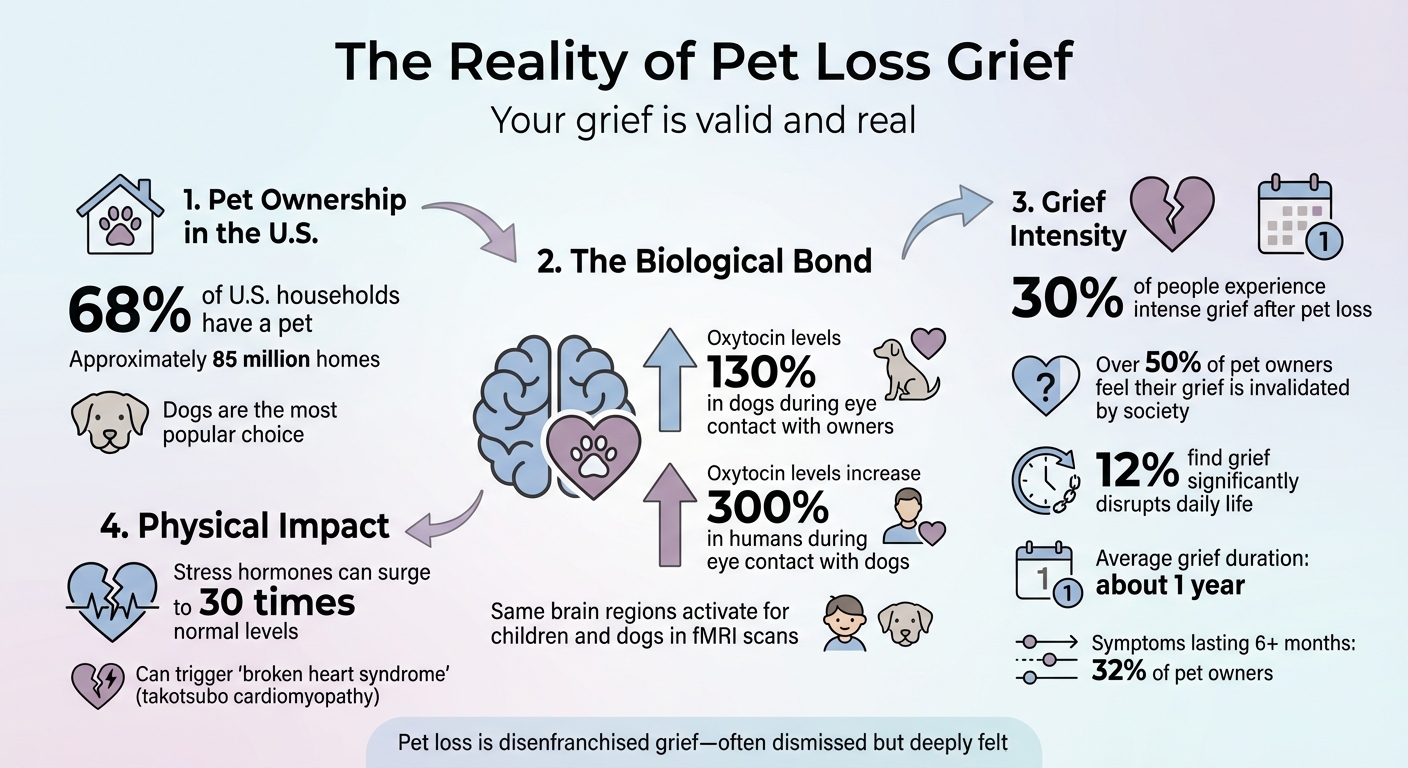
What makes this grief even harder is society’s lack of recognition for pet loss. Unlike human loss, there are no formal rituals or widespread acknowledgment, which can make you feel isolated. Studies show that 30% of people experience intense grief, with symptoms lasting six months or more, yet over half of pet owners feel their pain is invalidated.
Healing takes time and involves honoring your pet’s memory, seeking support, and allowing yourself to grieve. Whether it’s creating a memorial, joining a support group, or writing about your dog, these actions can help you process the loss and cherish the bond you shared.
The Bond Between Humans and Dogs
How the Human-Dog Relationship Works
The connection between humans and dogs is a mix of emotions and biology. When you and your dog share a gaze, both of your brains release oxytocin - the same hormone that strengthens the bond between a mother and her baby. In a study from April 2015, researchers Miho Nagasawa and Takefumi Kikusui observed 30 dog-owner pairs and found that prolonged eye contact boosted oxytocin levels by 130% in dogs and an incredible 300% in humans, deepening the relationship [8].
Your dog’s brain is also wired to prioritize you. Gregory Berns, a researcher at Emory University, used fMRI scans on 12 dogs and found that their reward centers lit up the most when they smelled their owner’s scent - more than when exposed to food, other dogs, or unfamiliar humans [8].
"If your dog stares at you for no reason, your furry friend is really hugging you with their eyes." - Dr. Brian Hare, Expert in Canine Cognition [11]
This unique bond shapes daily life, creating a relationship that feels as deep as family.
Dogs as Part of the Family
For many, dogs are more than pets - they’re family. In the U.S., over 68% of households, or about 85 million homes, have a pet, with dogs being the most popular choice [9]. Neuroscience backs up this sentiment. A study published in PLOS ONE led by Luke Stoeckel at Massachusetts General Hospital used fMRI scans on 14 mothers as they looked at photos of their children and their dogs. The results? The same areas in the brain tied to reward and affection lit up for both [9].
Dogs have spent the last 10,000 years evolving to be our companions, even developing the ability to interpret our facial expressions and emotions [6][7]. This bond is so strong that people often remember their dog’s name as easily as a family member’s [7][6]. Unlike human relationships, which can sometimes be tricky or filled with judgment, dogs offer something rare: unwavering love and support.
"Most people think of their pets as family members. … Sometimes, they consider their relationships with their dogs closer than their relationships with most of their family members." - Jennifer Golbeck, Professor and Researcher of Human-Animal Bonds, University of Maryland [10]
Pet loss grief; the pain explained | Sarah Hoggan DVM | TEDxTemecula
Why Losing a Dog Hurts So Much
Pet Loss Grief Statistics: Understanding the Impact of Losing a Dog
Losing a dog can feel as devastating as losing a human family member. A groundbreaking study highlights that many dogs are a primary source of emotional support for their owners [1]. The bond you share with your dog isn’t just emotional - it’s deeply biological and leaves a lasting imprint on your heart and mind. Your brain processes this loss in much the same way it would the loss of any loved one. However, society often overlooks the depth of this grief, making it even harder to navigate. Understanding the unique challenges of losing a pet begins with recognizing this profound connection.
When Grief Goes Unrecognized
Pet loss often falls into the category of "disenfranchised grief" - a type of grief that society tends to dismiss or ignore [14][15]. Unlike the loss of a human family member, losing a pet doesn’t come with bereavement leave, funerals, or other common rituals of support. Instead, you might hear dismissive remarks like, "It’s just a pet; you can get another one" [14][15].
"Pet loss grief is considered a 'disenfranchised grief,' which means it's a type of grief that's not widely acknowledged or validated or supported by our dominant culture." - Beth Bigler, Pet Grief Counselor [13]
This lack of recognition creates a painful contradiction. Studies reveal that about 30% of people experience intense grief after the death of a pet, yet over 50% of pet owners feel society doesn’t see their loss as a valid reason to grieve [9]. As a result, many choose to grieve privately, afraid of being judged [12][15]. Michelle Crossley, Vice President of the Association for Pet Loss and Bereavement, explains:
"People will grieve in isolation because they don't want to be invalidated in how distraught they are" [10]
This silence only amplifies the pain. The absence of support from others mirrors the emptiness left behind by a beloved pet. And beyond the societal dismissal, the way your brain processes this loss sheds light on why it feels so profound.
How the Brain Processes Pet Loss
Your brain doesn’t differentiate between "human" and "pet" relationships - it only recognizes the deep connection you had. The same neurochemicals - oxytocin, prolactin, and dopamine - that bonded you to your dog are also involved in parent-child attachment [9][10]. When that bond is broken, your brain reacts strongly to the loss.
This grief doesn’t just stay in your mind; it can affect your body too. The New England Journal of Medicine documented a case of "broken heart syndrome" (takotsubo cardiomyopathy) after a dog’s death, where the owner’s stress hormones surged to 30 times their normal levels, causing symptoms similar to a heart attack [12]. While acute grief often lasts one to two months, the sadness can linger for about a year on average [12]. The absence of your dog’s unconditional love creates a void that feels impossible to fill. Every quiet moment and empty space serves as a reminder of what’s missing, deepening the sense of loss [12]. Recognizing these emotional and physical responses is an important step toward finding a path to healing.
Understanding and Processing Your Grief
Grieving the loss of a dog is deeply personal and doesn’t follow a set timeline. The close bond you shared often amplifies the pain. One moment, you may feel overwhelming sadness, and the next, a sense of numbness. For many, grief can linger, with feelings like disbelief, constant thoughts of your pet, or emotional numbness lasting for at least six months [2]. Around 12% of people find their grief significantly disrupts their daily lives [2]. Recognizing these emotions as part of the process can help you begin to navigate this difficult path. Let’s look at how these emotional shifts align with the stages of grief.
The Stages of Grief
Grief often unfolds in waves, and the five stages - denial, anger, bargaining, depression, and acceptance - don’t follow a strict order [5][16]. In denial, you might find yourself expecting your dog to greet you at the door or instinctively calling their name. Anger can manifest as frustration, whether directed at the situation or yourself. Bargaining often brings "what if" thoughts, replaying decisions you made about their care. Depression, which can be the most prolonged stage, is marked by deep sadness and a loss of interest in things you once enjoyed. Eventually, acceptance - or as some call it, adaptation - emerges. This stage doesn’t mean forgetting but rather learning to live with the loss while cherishing the memories.
"Trying to ignore your pain or keep it from surfacing will only make it worse in the long run. For real healing, it is necessary to face your grief and actively deal with it." – Lawrence Robinson and Jeanne Segal, Ph.D. [16]
Feelings of guilt are also common, especially if financial limitations affected treatment choices or if euthanasia was involved. These emotions can deepen the bargaining stage, leading to cycles of second-guessing. Alongside these emotional shifts, grief often brings physical changes.
Physical Effects of Grief
Grief doesn’t just affect your emotions - it impacts your body too. Fatigue and disrupted sleep are common, leaving you feeling drained [16][17][18]. Changes in appetite may occur, with some people eating much less while others turn to food for comfort [16][17][18].
These physical symptoms can resemble those of clinical depression, so it’s important to pay attention to how long they last [17]. While grief often eases over time, certain triggers - like anniversaries or reminders - can bring it back. However, depression tends to be more persistent and pervasive [17]. If your grief continues to interfere with daily life, seeking help from a doctor or mental health professional can provide clarity and support [16].
Caring for your physical health is essential during this time. Eating nourishing meals, staying hydrated, maintaining a steady sleep routine, and staying active can help your body cope with the emotional strain [16][18]. Exercise, in particular, can release endorphins, which naturally improve mood and energy levels [16]. If you have other pets, sticking to their usual feeding and exercise schedules can also bring structure and comfort to both you and them during this challenging period.
How to Cope with Pet Loss
Navigating the loss of a beloved pet can feel overwhelming, but finding ways to process your emotions can provide some comfort. Honoring your dog's memory, seeking support from others, and expressing your feelings through writing are all meaningful ways to begin healing. These approaches allow you to carry your grief while cherishing the bond you shared with your pet. Below are some strategies that may help you through this difficult time.
Creating a Memorial for Your Dog
Creating a memorial can be a powerful way to honor your dog's life and give your grief a tangible focus. You might plant a tree, curate a photo album, or frame a paw print as a lasting tribute. Some people dedicate a garden space to their pet, planting perennial flowers that bloom year after year as a gentle reminder of their companion.
Another meaningful option is to make a difference in your pet's name. Consider donating to or volunteering at an animal shelter as a way to turn your grief into an act of kindness. These gestures not only honor your pet but also create a lasting connection to their memory. While memorializing your dog is one way to cope, finding support from others can also provide relief.
Finding Support Groups
Connecting with others who understand the pain of losing a pet can help ease feelings of loneliness. The Association for Pet Loss and Bereavement (APLB) offers free online chat rooms, which have supported more than 70,000 people since 1997 [19]. Colleen Rolland, President of APLB, shared:
"That chat room he started is still in existence and has helped over 70,000 people. Chat rooms have sort of gone out of style, but it's still a great tool for people suffering from pet loss. It really helps them feel safe and seen." [19]
Additionally, resources like the ASPCA Pet Loss Hotline (877-474-3310) and counseling services at veterinary schools such as Cornell (607-253-3932) and Tufts are available to help [3][16]. Local animal shelters may also host in-person support groups, offering a chance to connect with others in your community who understand what you're going through.
Writing About Your Memories
Writing can be a therapeutic way to process your emotions. Journaling about your dog's unique quirks, the routines you shared, or the moments that made you laugh can help keep their memory alive. You might also write a formal tribute to celebrate their life or pen a personal letter to your pet, sharing the thoughts and feelings you continue to carry.
This process allows you to externalize your grief and preserve the details that made your bond so special. Some people find it helpful to write about feelings of guilt or regret, using the act of writing to work through "what if" scenarios that often linger after a loss. Whether you're capturing joyful memories or confronting difficult emotions, putting your thoughts on paper can offer clarity and comfort during this challenging time.
Resources for Support and Healing
When you're navigating the difficult path of grief, having access to the right resources can make a world of difference. Some options provide free, immediate emotional support, while others offer in-depth guidance and research-based insights for a fee. Knowing what's out there can help you find the support that best suits your needs. Below, you'll discover how a memoir and other tools can assist you during this challenging time.
'To Lose A Dog' by Isaac H
This heartfelt memoir combines personal stories with practical advice for coping with grief. It delves into the unique neurological bond between humans and dogs, shedding light on why their loss can feel so profound. For example, the book explains the concept of interspecies brain wave synchronization, where mutual eye contact and petting create what Dr. Laurie Brush describes as a "neurological duet" between you and your dog[23].
Beyond the science, the memoir offers actionable tips to help you work through the stages of grief. It also connects readers to a supportive community of others who share similar experiences[20][21]. The hardcover edition is available for pre-order at $22, which saves you $6 off the regular price, and shipments are expected in the first quarter of 2026. Pre-ordering also grants access to a private grief support group.
Free vs. Paid Resources
Depending on your needs, both free and paid resources can play a role in your healing journey. Here's a quick comparison of some options:
Resource
Cost
Benefits
Access Method
ASPCA Pet Loss Hotline
Free
Immediate crisis support
Call 877-474-3310
Online Support Groups
Free
Peer connection and community support
Register on websites
'To Lose A Dog' Book
$22 (pre-order)
Memoir with practical advice and community access
Purchase hardcover
Free resources are perfect if you're looking for immediate help or a sense of community. These options can also address the feeling of "disenfranchised grief", which many pet owners experience when their loss isn’t fully acknowledged by society[2].
On the other hand, paid options like To Lose A Dog offer a more structured approach to healing, blending personal insights with a deeper understanding of the human-animal connection. While only a small percentage of pet owners - less than 5% - experience complicated grief requiring professional help, about 32% report grief symptoms that last six months or more[2]. If your grief feels overwhelming or disrupts your daily life, professional therapy services like BetterHelp (typically $65 to $90 per week) can provide additional support[22].
Moving Forward After Loss
Losing a dog cuts deep because the connection you shared wasn’t just emotional - it was built on shared experiences and a bond that felt almost instinctive. That kind of loss can leave a lasting ache.
Healing after such a loss doesn’t mean forgetting or finding "closure." Dr. Amy Sullivan, a Clinical Health Psychologist at Cleveland Clinic, puts it this way:
"I don't think you ever move on - you move forward, and the relationship you have with each pet is different. No one's going to replace that" [5]
Moving forward is about weaving the loss into your life while keeping your dog’s memory close to your heart.
Grief, though intense, often softens with time. But it’s not a straight path - it ebbs and flows. Some days might feel lighter, while others bring waves of sorrow. Still, healing is possible.
"The deeper way of honoring the pet is to apply the lessons of loving and living this creature made possible for you by sharing that with another animal when you have reached the appropriate point in your grieving process" [4]
Welcoming another dog into your life, when the time feels right, can be a way to honor the love your lost companion taught you.
The grief you feel is a reflection of the unconditional love and sense of security your dog gave you. By creating memorials, seeking support, and allowing yourself to fully experience the pain, you’re actively finding a way to adapt. The relationship doesn’t end - it transforms. You carry your dog’s memory with you, even as you rediscover joy in life.
FAQs
How can I handle the grief of losing my dog?
Losing a dog is a deeply emotional experience, and it’s okay to give yourself the time and space to grieve. Let yourself feel whatever emotions come up - whether it’s sadness, anger, or even a sense of numbness. Grief is a deeply personal process, and there’s no set timeline for healing.
Reach out to people who understand what you’re going through. Trusted friends, family members, or even pet-loss support groups can provide comfort and a listening ear. You might also find solace in creating a meaningful tribute to your dog, like a memorial or a keepsake, to honor the special bond you shared.
While you navigate this loss, don’t forget to care for yourself. Stick to healthy habits like eating balanced meals, staying physically active, and getting enough rest. If the weight of grief feels too heavy to carry alone, consider talking to a counselor or therapist who can help you through the healing process. The love and connection you had with your dog will always remain a cherished part of you.
Why is grief over losing a dog often dismissed by society?
Losing a dog can be an incredibly painful experience, but it’s often overlooked or dismissed. Society tends to undervalue the deep connection people share with their pets, viewing dogs as "just animals" rather than cherished family members. This perspective can lead to the assumption that grieving for a dog isn’t as meaningful or valid as mourning a human loved one.
Cultural norms also play a role, as they often place more importance on human relationships, leaving pet loss in the shadows. Without established rituals or widespread support systems for coping with the death of a pet, grieving dog owners may feel isolated and unsupported. Yet, the emotional weight of losing a dog is very real, and those feelings deserve recognition and validation.
How can I honor my dog's memory after their passing?
Honoring a dog's memory can be a heartfelt way to navigate the pain of their loss. You might start by creating a keepsake that holds special meaning - frame their collar, craft a paw-print mold, or even commission a custom portrait. Another idea is to gather your favorite photos and videos of your time together and turn them into a digital slideshow or a printed album, capturing the joy they brought into your life.
For a more lasting tribute, consider planting a tree or dedicating a small garden space in their memory. These living memorials can serve as a comforting reminder of their presence. Hosting a small ceremony, whether it’s lighting a candle or sharing cherished stories with family and friends, can also offer a sense of closure and connection.
If you’d like to honor their legacy in a way that helps others, donating to an animal shelter or rescue organization in their name is a beautiful gesture. For those grappling with grief, reaching out to a pet loss support group or speaking with a counselor can provide a safe space to share your feelings and find comfort among others who understand just how deep the loss of a furry companion can be.
Frequently Asked Questions
Is it normal to grieve as hard for a dog as for a person?
Yes, and the science supports it. Brain imaging research shows that the same neural regions tied to reward and affection activate when mothers look at photos of their children and their dogs. The neurochemicals that bonded you to your dog — oxytocin, dopamine, prolactin — are identical to those involved in parent-child attachment, so your brain registers the loss with the same depth.
How long does grief after losing a dog typically last?
Acute grief often peaks in the first one to two months, but sadness can linger for roughly a year on average, and about 32% of pet owners report grief symptoms lasting six months or more. A smaller group — around 12% — experience disruption severe enough to affect daily functioning, which is a signal to seek professional support.
What is disenfranchised grief and why does it make pet loss harder?
Disenfranchised grief is loss that society fails to formally recognize or support — no bereavement leave, no standard rituals, and often dismissive comments like 'it's just a dog.' Studies suggest more than half of pet owners feel their pain isn't treated as valid, which pushes many to grieve in isolation and can significantly intensify the pain they're already carrying.
What free resources exist specifically for people grieving a dog?
The ASPCA Pet Loss Hotline (877-474-3310) offers immediate crisis support at no cost, and the Association for Pet Loss and Bereavement runs free online chat rooms that have served more than 70,000 people since 1997. Veterinary school counseling services at Cornell and Tufts are also available and tend to be staffed by people who understand the specific weight of animal loss.
Should I feel guilty if euthanasia was involved in my dog's death?
Guilt after euthanasia is one of the most common and least-talked-about parts of pet loss grief, often showing up as relentless 'what if' thinking during the bargaining stage. Choosing euthanasia is nearly always an act of profound care — a decision made to spare a dog unnecessary suffering — and processing that guilt is easier with support from a pet loss counselor or a community that understands the weight of that choice.
When is the right time to get another dog after losing one?
There is no universal timeline, and rushing the decision out of loneliness can sometimes complicate grief rather than ease it. Grief researchers suggest the healthiest marker isn't a set number of weeks but a felt sense that you're honoring your lost dog's memory by opening your life to another animal — not replacing them, but carrying forward the capacity for that kind of love.
Reserve the paperback at the pre-order price, with clear shipping and cancellation terms.
Pre-order price: $24.99 (save $5 off retail price)
First copies out of the print run, estimated to ship December 2026, shipped directly to you
Email updates on the book's progress until it reaches you
$24.99$29.99
Save $5
Charged today · Cancel any time before it ships
US shipping is $4.90. Other countries are calculated at checkout.
Estimated to ship December 2026US shipping is $4.90. Other countries are calculated at checkout.
Not today?
If the timing is wrong, or you are buying for someone who is not ready yet, leave your email. I will write once, when copies start shipping, and that is the only time you will hear from me.