Euthanasia Guilt: How to Forgive Yourself for a Decision You Can Never Take Back
Guilt after euthanasia can feel unbearable. Learn why it is so common, how to ground yourself when it hits, and how to forgive yourself after your dog’s death.
Guides14 min read
You made an incredibly difficult choice to end your pet's suffering, and now you're left grappling with guilt and second-guessing yourself. Here's the truth: feeling guilty is normal, and it doesn’t mean you made the wrong decision. Forgiving yourself starts with understanding that your choice came from love, not failure.
Euthanasia as Compassion: You prioritized your pet’s peace over prolonged suffering.
Support Helps: Grief counselors, support groups, and understanding friends can guide you through the healing process.
Practical Steps: Journaling, memorializing your pet, and grounding techniques can help you process emotions.
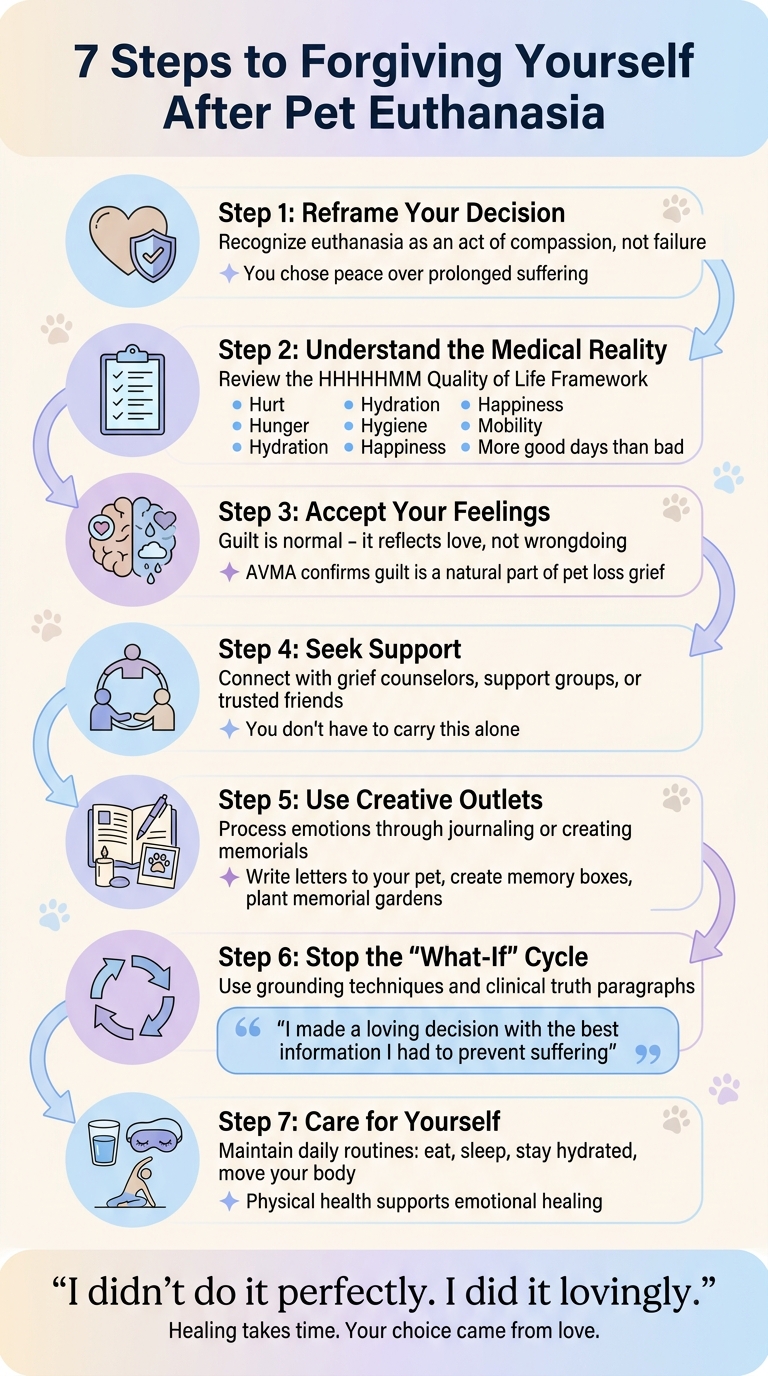
7-Step Guide to Forgiving Yourself After Pet Euthanasia
Letting Go Without Guilt: Understanding the Euthanasia Decision | Dr. Christina Guttuso DVM
Viewing Euthanasia as a Compassionate Choice
Easing feelings of guilt starts with reframing your decision as an act of compassion. You chose a peaceful end over the uncertainty and suffering nature might have imposed - things like air hunger, intense pain, panic, or seizures [4]. It’s natural to question if waiting longer was possible, but the calmness surrounding your decision speaks volumes. You avoided a middle-of-the-night emergency, ensuring your pet remained in a familiar, comforting environment [4].
This compassionate approach is also supported by medical evaluations.
Recognizing the Medical Reasons
Veterinarians often rely on the HHHHHMM framework to objectively assess a pet's quality of life: Hurt, Hunger, Hydration, Hygiene, Happiness, Mobility, and whether there are More good days than bad[7]. This tool helps confirm when consistent comfort is no longer achievable.
Consider the facts: Was your pet’s quality of life declining? Were you prioritizing their comfort above all else? Did your veterinarian agree with the decision? If the answers are yes, then your choice was both rational and loving [7]. It’s important to remind yourself that you didn’t cause their illness or aging - you responded to it with kindness.
While medical assessments offer clarity, the heart of this decision lies in the love that guided it.
Understanding It as a Final Gift of Love
Euthanasia is a deeply selfless act - accepting your own pain so your pet could avoid further suffering [4].
"I chose your comfort over my desire to keep you." – Funeral.com [7]
Separate your intentions from the outcome. Even though the loss is profoundly painful, your goal was always to protect and care for your pet. This is love in its most difficult form. Forgiving yourself starts with acknowledging that your decision came from a place of compassion and mercy.
Why Guilt is Normal When Grieving
Feeling guilty after making the decision for euthanasia is more common than you might think. According to the American Veterinary Medical Association (AVMA), grief after losing a pet often includes guilt. This highlights that such feelings are a natural part of the grieving process, not evidence of wrongdoing [4]. That guilt often stems from the deep connection you shared with your pet.
When euthanasia involves your active consent, it can lead to self-doubt and blame. You might find yourself searching for a "perfect" decision in a situation where no such thing exists. This emotional struggle often turns into a narrative of regret, further intensifying those feelings of guilt. Understanding how hindsight plays into this can help make sense of these emotions.
How Hindsight and 'What-If' Thoughts Create Guilt
"Guilt is a problem-solving emotion. It likes clear rules, clean cause-and-effect, and a version of the past you can edit." – Funeral.com [4]
Guilt has a way of reshaping your memories, condensing a long and difficult journey into a single moment of regret. That final decision may feel like the sole reason for your loss, overshadowing the days, weeks, or months of struggle that led up to it. You might find yourself questioning the timing - wondering if you acted too soon and took away precious time, or too late, allowing unnecessary suffering. These "what-if" thoughts are a normal part of grieving, even though they can feel overwhelming.
Recognizing these thought patterns can be the first step toward self-compassion. They are not a reflection of failure but rather a reflection of how deeply you cared.
Accepting Your Feelings as Normal
The mind’s tendency to focus on that final moment can make guilt feel all-consuming. Even finding relief - knowing your pet is no longer in pain - can spark feelings of betrayal, as though comfort somehow dishonors their memory [4].
It’s essential to acknowledge that your emotions, no matter how conflicting, are valid. They don’t mean you made the wrong choice. Guilt often serves as a way to anchor the intense pain of loss, making it feel more manageable [1]. Accepting these emotions as a normal part of grieving is a meaningful step toward healing.
Getting Support to Work Through Guilt
You don’t have to carry the weight of guilt alone. When guilt consumes your thoughts, keeps you awake at night, or triggers panic, it’s a sign your body’s alarm system is on high alert. Reaching out for support can help calm that response and equip you with tools to work through your emotions. This first step can also guide you toward seeking professional help.
Working with a Grief Counselor or Therapist
A grief counselor who focuses on pet loss can help you untangle grief from self-blame, offering a fresh perspective. They provide a safe, judgment-free space where you can express emotions like anger, shame, or even relief - feelings that might be hard to share with friends or family.
"Counseling can help you separate grief from self-blame and rebuild a truer story: a story in which love is still the central fact." – Funeral.com [4]
One effective technique is creating a factual account of your pet’s condition and the purpose of euthanasia with your counselor. This "clinical truth" serves as a grounding reminder during moments of guilt, helping you focus on the reality of your choices rather than the distorted narrative guilt might create. Professional guidance like this often complements the empathy and understanding found in group or personal conversations.
Connecting with Pet Loss Support Groups
Seeking support is a way to honor the loving decision you made. Support groups bring together people who have faced similar losses, offering a sense of community and understanding. These groups - available both online and in-person - are often led by certified pet loss coaches or trained volunteers who understand the complexities of euthanasia-related guilt.
If you’re hesitant to share your feelings with close friends or family, a support group can be a good starting point. It provides a space to "practice" sharing your story without fear of judgment. Telling your story multiple times is a natural way to process trauma, and group members understand the need to revisit it as part of healing.
Talking with Understanding Friends and Family
Trusted friends and family can also offer meaningful support. When loved ones ask, "How can I help?" be specific about what you need. Whether it’s someone to listen without judgment, a distraction from your thoughts, or help with daily tasks, clear communication can make a big difference.
"When friends and family ask, 'How can I help?' tell them what you need." – Barbara Axelson, Certified Pet Loss and Bereavement Counselor [6]
Choose your confidants wisely. Share your deeper feelings of guilt only with those who will validate your loss and provide comfort. If your guilt begins to shift from "I wish things had gone differently" to "I am a terrible person", it’s time to seek professional counseling for deeper support.
Using Creative Activities to Process Grief
In addition to counseling and support groups, creative outlets can provide a deeply personal way to navigate feelings of guilt. These activities allow you to channel your emotions into something reflective and meaningful. Whether it’s writing, crafting memorials, or creating rituals, these practices offer a way to honor your pet’s memory while working through self-blame. While they won’t erase the pain, they can soften its intensity and offer a sense of connection. Let’s explore two creative approaches - journaling and making memorials - that can help transform grief into lasting tributes.
Writing in a Journal or Letters to Your Pet
Journaling can be a powerful tool to process your emotions. Prompts like "The moment I keep replaying is..." or "If I could hold one memory in my hand, it would be..." help shift thoughts from your mind to paper, breaking the cycle of guilt and overthinking [8]. Writing honestly and without filters can bring clarity and provide a sense of relief.
Another approach is writing a letter directly to your pet. Share your feelings - your regrets, your love, and the words you wish you had said. Some find it healing to write a letter from their pet, imagining the forgiveness and unconditional love they would offer if they could speak [2]. For a more symbolic release, consider a "guilt-release ritual": write your apology, read it aloud in a quiet space, and then burn the letter, letting those emotions drift away with the smoke [9].
"Writing your thoughts and feelings on paper or in a journal will help with your healing process." – Barbara Axelson, Certified Pet Loss and Bereavement Counselor [6]
Over time, your writings may evolve. Early entries might feel raw and filled with sorrow, but as you continue, you may notice a shift toward gratitude and acceptance. This gradual change reflects how you’re beginning to integrate the loss into your life [4].
Making Memorial Items
Memorials provide a tangible way to celebrate your pet’s life and channel your grief into something meaningful. Whether it’s creating a scrapbook, planting a tree, or displaying a personalized memorial stone, these tributes allow you to focus on your pet’s life rather than just their passing. Tailor the tribute to your pet’s personality - a water burial for a dog who loved to swim, a suncatcher for a cat that adored sunny spots, or a small garden of catnip for a playful feline [8][5].
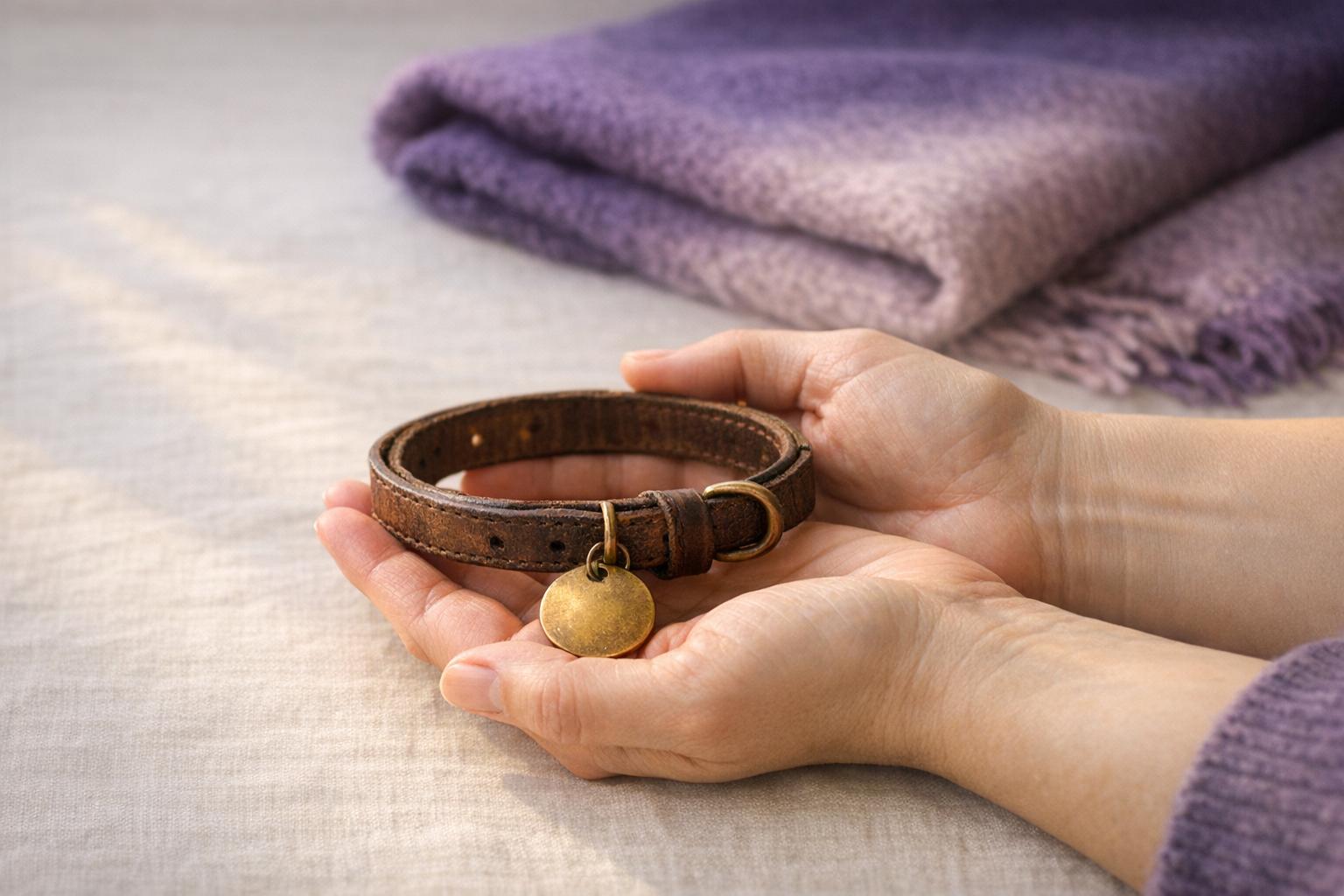
Memorial items can be as simple or intricate as you’d like. A "treasure box" might hold your pet’s collar, a favorite toy, or a lock of fur. Personalized keepsakes, such as engraved jewelry or wearable mementos, offer another way to keep their memory close [5][8].
"The greatest tribute you can offer is not to carry suffering in their name - but to carry love." – Paws and Memories [5]
For those drawn to nature-based tributes, consider planting a tree or placing a personalized stepping stone in your garden. These living memorials grow and change with the seasons, serving as a beautiful reminder of your pet [10]. Others find comfort in making charitable donations in their pet’s name, which can sometimes include a permanent plaque or paving stone at an animal shelter [10]. Creating something meaningful provides an outlet for the love that no longer has a clear place to go[8].
Learning to Forgive Yourself
Self-forgiveness starts with recognizing that your decision came from a place of love, not failure. Guilt often condenses years of care and affection into a single moment, overshadowing the countless loving experiences you shared with your pet. Feeling guilty doesn’t mean you’ve done something wrong - it reflects the depth of your attachment [4].
To begin forgiving yourself, try to separate your intentions from the outcome. You didn’t cause your pet’s illness or aging; you responded with compassion to a situation beyond your control. Choosing euthanasia was an act of kindness to shield your pet from unbearable suffering in their final stages, like air hunger, intense pain, seizures, or panic [4][1].
"I didn't do it perfectly. I did it lovingly." – Funeral.com [4]
Here are some practical steps to help you move forward.
Remembering the Good Life You Provided
When guilt takes over, it’s easy to forget the joy, care, and safety you gave your pet over the years. Instead of focusing on the end, reflect on the full life you shared. Think about how your love and home transformed their world. Without you, they may never have experienced that comfort or happiness.
One way to shift your perspective is by conducting a "Decision Audit." Ask yourself these questions:
Did I see that my pet was suffering?
Did I consult with veterinary professionals?
Was my decision aimed at easing their pain and providing comfort?
If your answers are yes, then your choice was both thoughtful and compassionate [4]. Another helpful tool is the Two-Way Letter Exercise. Write a letter to your pet expressing your feelings, then write a response from their perspective. This exercise can provide emotional clarity and healing [4][1].
"Death is not the opposite of life, but a part of it." – Anatole Broyard [1]
Once you’ve acknowledged the love and care you gave, it’s time to tackle the persistent "what-if" thoughts.
Stopping the 'What-If' Cycle
The "what-if" cycle is your mind’s way of trying to regain control over an irreversible event. It’s normal to feel torn between "I should have waited" and "I should have acted sooner", especially when making decisions about a pet’s quality of life during a time of escalating suffering [4].
To break this cycle, try creating a "Clinical Truth" Paragraph. Write down your pet’s symptoms, your veterinarian’s advice, and the fact that your goal was to provide comfort. When "what-if" thoughts creep in, revisit this paragraph to ground yourself in the reality of that moment [4]. You can also use a simple grounding phrase whenever guilt resurfaces:
"I made a loving decision with the best information I had to prevent suffering" [4]
Grounding techniques like this can remind you that your choice was rooted in compassion. Another helpful tool is the HHHHHMM Framework - Hurt, Hunger, Hydration, Hygiene, Happiness, Mobility, and More good days than bad. This framework allows you to objectively assess your pet’s quality of life. Reflecting on this can reassure you that your decision was made with their comfort and dignity in mind [4].
Taking Care of Yourself While Grieving
Caring for your physical health is an essential part of navigating grief. The emotional toll of loss often spills over into physical symptoms like nausea, shaking, racing thoughts, and trouble sleeping [7]. To handle these challenges, your body needs proper nourishment and rest. When you're physically drained, it becomes even tougher to quiet those relentless "what-if" thoughts [6][7].
"Grief affects you in many ways, emotionally, psychologically, physically and behaviorally. Eat, sleep and drink water to keep your body healthy." – Barbara Axelson, Certified Pet Loss and Bereavement Counselor [6]
Keeping Up with Daily Routines
Stick to the basics: eat regular meals, drink plenty of water, and aim for consistent sleep [6]. Adding even a short walk or some light exercise to your day can make a difference [6]. If insomnia or a lack of appetite persists for weeks, it might be time to reach out to a grief counselor or therapist [7].
When guilt feels overwhelming and your thoughts spiral, grounding techniques can help. Try this: place one hand on your chest and the other on your abdomen. Take a slow, deep breath, letting the exhale last longer than the inhale. Then, focus on five simple truths about your current environment, like "I’m in my home", "My feet are on the floor", or "I made the decision to prevent suffering." This exercise can help ease panic and bring you back to the present [7].
In addition to physical self-care, leaning on supportive relationships can provide the emotional strength you need during this time.
Staying Connected with Supportive People
Grief can feel isolating, but surrounding yourself with people who understand the depth of your loss can make all the difference [6]. Talk about your pet - say their name, share your favorite memories, and recount the story of your last day together. Repeating these stories isn’t a sign of being stuck; it’s a natural way to work through trauma [6].
If group settings feel overwhelming, consider seeking one-on-one support [3]. Inviting loved ones to help with memorial decisions, like choosing an urn or planning a small ceremony, can also create a sense of shared connection and lessen the feeling of facing grief alone [4].
If guilt or physical symptoms persist, don’t hesitate to seek professional help [4]. Building these connections and routines will not only help you heal but also honor the love and bond you shared with your pet. Taking these steps can guide you toward self-forgiveness and help you carry their memory forward.
Conclusion: Moving Forward and Honoring Your Pet
The journey toward self-forgiveness and compassionate decision-making is not about erasing guilt but understanding its roots. That guilt you feel? It’s not proof of a mistake - it’s a reflection of the deep love that drove you to make an incredibly difficult choice. The AVMA highlights that such feelings are common, stemming from love, not error [4][7]. Feeling this way doesn’t mean you’re flawed - it means you’re human.
Forgiving yourself takes time. It’s about reminding yourself of the truth every time guilt clouds your memories [4]. When your mind replays those painful moments, try to gently guide it back to the years of care, happiness, and security you gave your pet. Remember, you didn’t choose death - you chose to offer them a kinder ending than nature would have allowed [7].
"I didn't do it perfectly. I did it lovingly." – Funeral.com [4]
Moving forward doesn’t mean leaving your pet behind. It means cherishing their memory without holding onto self-blame. Create a space to honor them - maybe a favorite photo, a small keepsake, or even just speaking their name aloud. Reflect on the joyful moments and the bond you shared. These small acts can help shift your focus from one heartbreaking decision to a lifetime of love [1][7].
Healing isn’t about forgetting. It’s about acknowledging the love you shared, accepting that you made the most compassionate choice in an impossible moment, and understanding that this choice was a final act of love. Seek support when you need it and continue to honor your pet’s memory in ways that feel meaningful to you. Their legacy lives on in your heart.
FAQs
How do I know euthanasia was the right time?
Deciding if euthanasia was the right choice often involves considering whether your pet was in pain and if ending that pain was the kindest thing you could do. Many pet owners find comfort by reflecting on their pet's quality of life and the medical realities that led to the decision. Reminding yourself that your choice came from a place of love and care for their well-being can help ease any lingering guilt.
What if I still feel guilty months later?
It's completely normal to feel guilt months after euthanizing a pet. This often arises from unresolved emotions or second-guessing your decision. One way to cope is by reframing your choice as an act of compassion - something you did out of love to ease your pet's suffering.
You might also find comfort in seeking support from grief counselors, connecting with pet loss support groups, or expressing your feelings through journaling. Reading books or articles about pet loss can provide additional reassurance and understanding. Remember, healing is a process, and it’s important to be patient and gentle with yourself as you work through these emotions.
How can I explain the decision to my kids?
When talking to your kids about euthanasia, explain it as a decision made out of love and kindness. Let them know it was done to stop your pet from hurting and to make sure they were at peace in their last moments. Be honest and use simple words that match their age and understanding. Reassure them that feeling sad, confused, or even upset is completely normal as they process what happened.
Frequently Asked Questions
Is it normal to feel relieved after putting my dog to sleep, and does that mean I didn't love them enough?
Relief after euthanasia is a completely normal response, not a sign of insufficient love. When a dog has been suffering, relief that their pain has ended is a natural extension of the same care that drove the decision in the first place. Feeling relief and feeling grief are not opposites; most people experience both at once.
How do I stop replaying the moment of euthanasia over and over in my head?
The mind replays traumatic moments as a way of trying to solve what feels unsolvable. Writing a brief, factual account of your dog's condition and your veterinarian's guidance can give your brain something concrete to return to instead of the loop. Grounding techniques — slow breathing, naming five things in your immediate environment — can interrupt the cycle in the moment it starts.
What's the difference between normal euthanasia guilt and grief that needs professional help?
Guilt that gradually softens over weeks, even if painful, is a normal part of bereavement. When guilt hardens into a fixed belief that you are a bad person, disrupts sleep or eating for an extended period, or prevents you from functioning, those are signs that a grief counselor specializing in pet loss can offer more targeted support than time alone.
How do I find a grief counselor or support group specifically for pet loss?
Many veterinary schools and humane societies run free or low-cost pet loss support lines staffed by trained volunteers. The Association for Pet Loss and Bereavement maintains a directory of certified counselors, and organizations like Lap of Love offer online support communities specifically for owners who have navigated euthanasia decisions.
Should I be present in the room when my dog is euthanized, or is it okay to step outside?
There is no single right answer, and the choice does not determine the quality of your love or the compassion of your decision. Some owners find being present brings closure; others find it too overwhelming and step away. Veterinarians who perform in-home or clinic euthanasia understand both responses and will not judge your choice either way.
Reserve the paperback at the pre-order price, with clear shipping and cancellation terms.
Pre-order price: $24.99 (save $5 off retail price)
First copies out of the print run, estimated to ship December 2026, shipped directly to you
Email updates on the book's progress until it reaches you
$24.99$29.99
Save $5
Charged today · Cancel any time before it ships
US shipping is $4.90. Other countries are calculated at checkout.
Estimated to ship December 2026US shipping is $4.90. Other countries are calculated at checkout.
Not today?
If the timing is wrong, or you are buying for someone who is not ready yet, leave your email. I will write once, when copies start shipping, and that is the only time you will hear from me.