The Rainbow Bridge Poem: Where It Came From and Why It Still Makes Us Cry
Learn the Rainbow Bridge poem’s origin, how it spread, and why it comforts grieving dog owners. Find language for pet loss and support.
Guides10 min read
The Rainbow Bridge poem has comforted grieving pet owners for decades. Written in 1959 by Edna Clyne-Rekhy, a 19-year-old Scottish artist mourning her Labrador, Major, it describes a peaceful meadow where pets wait to reunite with their owners. Its themes of healing, reunion, and enduring love resonate deeply, offering solace to those mourning a beloved pet.
The poem became widely known after appearing in the "Dear Abby" column in 1994, reaching millions. For years, its authorship was debated, but in 2023, historian Paul Koudounaris confirmed Edna as the author after reviewing her original manuscript. Today, the phrase "crossed the Rainbow Bridge" is a widely understood way to express pet loss, helping validate grief and provide hope.
Whether shared in veterinary clinics, online communities, or memorials, the poem continues to support those coping with loss, emphasizing the timeless bond between pets and their owners.
Where the Rainbow Bridge Poem Came From
The Author: Edna Clyne-Rekhy
In 1959, a young Scottish artist named Edna Clyne-Rekhy, just 19 years old, penned a heartfelt note as she mourned the loss of her Labrador, Major. Living in Inverness, Scotland, she found herself overwhelmed with grief. She confided in her mother, saying, "It's Major. I can't put away this soreness." Her mother encouraged her to put her emotions into words, and that advice led Edna to write what would eventually bring solace to countless grieving pet owners.
The words seemed to flow effortlessly as she addressed Major, and she drafted the poem on a simple white sheet of paper. Later, she typed copies of the poem for a small circle of friends but left her name off them. Life took her to India and Spain, and during that time, she remained unaware of the poem’s growing reach and its profound impact on others.
Over the years, the poem’s origins became a mystery, sparking debates about who had truly written it.
Solving the Authorship Mystery
For decades, the authorship of the "Rainbow Bridge" poem was unclear. A column in "Dear Abby" ignited a wave of claims, and by 1995, the United States Copyright Office had received 15 separate filings for works under the title "Rainbow Bridge" [1].
The claimants included Paul C. Dahm, William N. Britton - who attributed the story to a Native American shaman - and Wallace Sife, who argued the poem was an adaptation of his own work, "All Pets Go to Heaven." To complicate matters further, numerous versions of the poem began circulating. Some were written in prose, others in rhyme, and each had slight differences, making it harder to trace the original.
Art historian Paul Koudounaris decided to tackle the mystery head-on. After examining the claims of 25 potential authors, a reference to "Edna Clyde" in an online chat led him to the truth. In January 2023, he met with Edna Clyne-Rekhy, now 82, and reviewed her original 1959 manuscript. His findings, published in National Geographic in February 2023 [1], finally confirmed her as the poem's true author.
When Koudounaris shared how widely the poem had touched people, Clyne-Rekhy was stunned, admitting, "I'm in shock." She stood out as the only woman, the only non-American, and the only candidate with physical evidence of authorship going back more than six decades.
The Original Rainbow Bridge Poem by Edna Clyne-Rekhy: A Heartfelt Tribute to Beloved Pets
How the Poem Spread Around the World
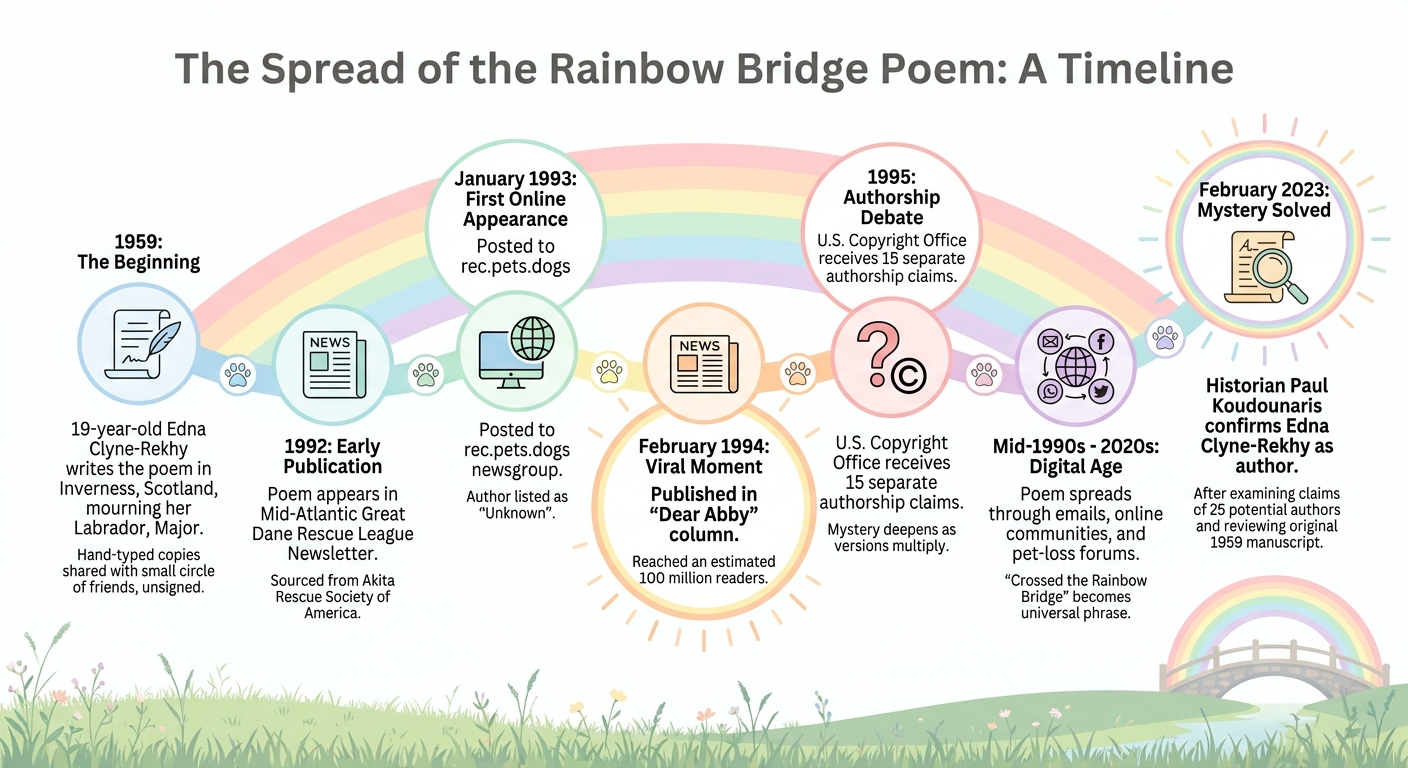
Rainbow Bridge Poem Timeline: From 1959 to Global Phenomenon
From Personal Loss to Shared Comfort
Edna's simple, hand-typed copies of the poem were initially shared with a small circle of friends, unsigned and personal. But as these copies were passed from one grieving pet owner to another, the poem began to travel far beyond its original audience. Over time, Edna’s name faded from the record, and by the early 1990s, the poem was appearing in pet-loss literature across the United States, often attributed to "Author Unknown."
The poem’s first documented online appearance came in January 1993, when a user posted it to the newsgroup rec.pets.dogs. This user referenced a 1992 issue of the Mid-Atlantic Great Dane Rescue League Newsletter, which had itself sourced the poem from the Akita Rescue Society of America[3].
A pivotal moment came in February 1994, when a reader submitted the poem to the widely-read "Dear Abby" advice column. This single publication brought the poem to an estimated 100 million readers [1]. What began as a private expression of grief had now become a global phenomenon, setting the stage for even broader dissemination through media and digital platforms.
The Role of Media and the Internet
The "Dear Abby" column ignited widespread interest, leading newspapers across the country to reprint the poem. By 1995, its popularity had grown so much that the United States Copyright Office received 15 separate claims from individuals asserting authorship of works titled "Rainbow Bridge" [1].
The arrival of the internet in the mid-1990s only amplified the poem's reach. Physical copies transitioned to digital formats, shared through emails and screenshots. Online pet-loss communities embraced the poem wholeheartedly, and the phrase "crossed the Rainbow Bridge" became a universal expression of pet bereavement. Its anonymous nature seemed to enhance its emotional impact, allowing it to resonate deeply with anyone mourning a beloved pet.
Journalist Ann Marie Gardner captured the poem’s cultural significance in The Washington Post:
It is, in free verse form, 'Chicken Soup for the Soul' for an exploding $69 billion pet care industry [3].
Why the Poem Helps People Grieve
Love, Loss, and Hope in the Poem
The Rainbow Bridge poem connects deeply with grieving pet owners by offering comfort in three key ways: it restores a sense of peace, reinforces the enduring bond between owner and pet, and promises a reunion in the future. The poem’s vivid imagery - pets being “restored to health and vigor” - helps soothe feelings of guilt and helplessness, especially for those who faced the painful decision to euthanize or witnessed their pet's prolonged illness.
Art historian Paul Koudounaris highlights the spiritual reassurance the poem provides:
Rainbow Bridge provides the missing piece for people who have had to live with this anxiety that their animal is not good enough to deserve an afterlife. It gives us a reason to hope. [1]
For many, the poem bridges a theological gap, especially in religious traditions that don't explicitly address the afterlife of animals. Its non-denominational imagery, like a serene meadow bathed in sunlight, offers solace regardless of individual beliefs. Whether interpreted as a literal paradise or a metaphor for enduring love, the poem speaks to universal emotions of loss and hope.
Beyond its emotional depth, the poem also plays a role in helping people navigate the grieving process.
How the Poem Helps People Heal
The poem does more than evoke hope - it actively aids emotional recovery. Pet loss is often dismissed or downplayed, leaving grieving owners feeling alone in their sorrow. However, a 2026 study in PLOS ONE revealed that grief from losing a pet can mirror the intensity of mourning a human loved one, sometimes even leading to prolonged grief disorder [5].
Animal behaviorist Karen London captures the poem’s healing essence:
The image of dogs anticipating their next hello with us, happy in a beautiful spot and waiting... is a source of comfort and even joy despite the depths of grief that accompany losing a dog. [7]
Rather than pressuring owners to "move on", the poem embraces the concept of continuing bonds. It reassures pet owners that their connection with their beloved animal lives on through memories and the hope of reunion. Phrases like “crossed the Rainbow Bridge” have even become a kind of shorthand in online communities, allowing people to express their feelings of loss, love, and hope succinctly. While the pain of loss remains, the poem provides a gentle framework for processing grief - offering a space where healing can gradually take root.
The Poem's Lasting Impact
A Continuing Source of Comfort
The Rainbow Bridge poem has become a staple in professional pet care, often included in sympathy materials provided by veterinary clinics, animal shelters, and rescue organizations after the loss of a pet [1]. Its words offer solace during one of the most difficult moments for pet owners.
The poem has also inspired meaningful rituals, such as Rainbow Bridge Remembrance Day on August 28th. This day encourages memorial practices that honor the poem's comforting message [4]. Pet memorials frequently incorporate the poem, whether it's read aloud during ceremonies, engraved on headstones, or displayed alongside urns crafted from various materials [2]. Even veterinary programs at universities have adopted the poem, weaving it into their formal grief support resources [5].
Kitty Block, CEO and President of the Humane Society, reflects on the poem's broader impact:
Its enduring popularity shows how relationships to pets matter to so many people across all walks of life. The intimacy of those connections can help us recognize our fundamental duty to care for animals. [1]
By becoming such a significant part of pet care services, the poem has contributed to a growing cultural recognition of pet loss as a profound and valid experience.
Changing How We Talk About Pet Loss
One of the poem's most profound contributions is how it has transformed the conversation around pet loss. For years, grieving a pet was often dismissed as "disenfranchised grief", leaving many feeling isolated or misunderstood [5]. The Rainbow Bridge poem has helped validate these emotions, emphasizing that the bond between humans and their pets is meaningful and worth honoring.
The phrase "crossed the Rainbow Bridge" has entered common language, becoming a universal way to express love, loss, and hope. As Funeral.com explains, "'He crossed the Rainbow Bridge' can mean: I loved him, I miss him, I hope he is safe somewhere, and I don't know what to do with this ache" [5]. This simple yet powerful expression has reshaped how we collectively approach pet bereavement, making it easier for people to share their grief and find support.
Through its presence in both professional settings and everyday conversations, the poem continues to symbolize the hope of reunion and the enduring love between people and their pets. Its legacy lies in the comfort it provides and the cultural shift it has sparked in acknowledging the depth of pet loss.
Conclusion: Why the Rainbow Bridge Poem Still Matters
Main Points to Remember
Back in 1959, 19-year-old Edna Clyne-Rekhy wrote the Rainbow Bridge poem as a tribute to her Labrador, Major. Since then, it has grown from a deeply personal expression of grief into a source of comfort for countless people worldwide. For years, the poem's origins were a mystery, but in 2023, historian Paul Koudounaris uncovered Edna's authorship by tracing her original 1959 manuscript. His investigation spanned 25 potential authors before confirming Edna’s role in creating this iconic work [1]. The poem's enduring appeal lies in its themes of healing, reunion, and the continuity of love [6].
What makes this poem so powerful is its validation of a grief that society often overlooks. Research from 2026 even found that the pain of losing a pet can be as intense as losing a human loved one [5]. By giving people permission to grieve fully, the Rainbow Bridge poem has reshaped how we talk about pet loss. The phrase "crossed the Rainbow Bridge" is now widely understood as shorthand for love, loss, and hope.
The poem also addresses a spiritual concern many have: the question of whether animals deserve an afterlife. Art historian Paul Koudounaris explains it beautifully:
Rainbow Bridge provides the missing piece for people who have had to live with this anxiety that their animal is not good enough to deserve an afterlife. It gives us a reason to hope [1].
These insights have inspired pet owners to find meaningful ways to honor their beloved companions.
Support for Grieving Pet Owners
Your grief matters and deserves acknowledgment. The Rainbow Bridge poem continues to offer solace, but many grieving pet owners also find comfort in personal rituals. Lighting a candle, writing a heartfelt letter, or keeping a memorial item can be deeply healing [6].
If you're seeking additional support, there are resources like the memoir To Lose A Dog, pet loss hotlines, and online communities that provide understanding and connection [5]. Remember, grief doesn’t follow a set timeline, and healing looks different for everyone. Whether the Rainbow Bridge imagery speaks to you or you find peace through other means, what’s most important is honoring the bond you shared in a way that feels right for you.
FAQs
Is the Rainbow Bridge meant to be religious?
The Rainbow Bridge isn't tied to any specific religion. Instead, it's a comforting and spiritual concept that imagines a serene place where pets patiently wait for their owners. Its roots stem from poetic and mythological traditions rather than being linked to any religious teachings. This idea appeals to people across different belief systems, symbolizing the unconditional love pets give and the hope of reuniting with them one day.
What’s the best way to share the poem after a pet dies?
The Rainbow Bridge poem is a touching way to bring comfort to those grieving the loss of a beloved pet. It’s perfect for inclusion in condolence cards, heartfelt social media posts, or as a printed or digital keepsake for pet owners. You might also consider incorporating it into memorial services or tribute events. Sharing it with care can offer solace, reminding others of hope, love, and the promise of reunion during such a difficult time.
What if the poem doesn’t comfort me?
Grief is a unique journey, and the Rainbow Bridge poem doesn’t provide comfort for everyone. If it doesn’t speak to you, there are plenty of other ways to cherish your pet’s memory. You might create a special memorial, share favorite stories about your time together, or develop personal rituals that hold meaning for you. Seeking support from a grief counselor or joining a pet loss group can also offer a sense of connection and understanding. Remember, healing is a process, and it’s important to find what feels right for you.
Frequently Asked Questions
Why does losing a pet hurt as much as losing a person?
The bond between a dog and their owner involves the same neurological attachment systems as human relationships, including daily routines, physical touch, and unconditional companionship. Research has found that pet loss can trigger grief as intense as losing a human loved one, and in some cases can lead to prolonged grief disorder. Acknowledging that intensity rather than minimizing it is the first honest step toward healing.
Is it okay if the Rainbow Bridge poem doesn't help me grieve?
Completely. The poem offers one framework for loss, but grief is personal, and imagery that comforts one person can feel hollow or even alienating to another. Some people find more grounding in concrete rituals, writing, or structured grief support rather than afterlife metaphors, and that's an equally valid path.
How do I support a friend who just lost their dog without saying something generic?
The most meaningful thing is to name the specific dog and acknowledge the real relationship, rather than offering vague reassurances like 'at least they had a good life.' Saying something like 'I know how much you loved her and how much she was part of your daily world' validates the loss in a way that broad platitudes never do.
What are some memorial rituals that actually help after a dog dies?
Practical rituals that create a moment of intentional acknowledgment tend to help more than passive sentiment: writing a letter to your dog, lighting a candle on meaningful dates, preserving a paw print, or returning to a place you loved together. The goal is to mark the loss in a way that reflects the specific relationship, not a generic idea of pet grief.
How do I talk to my child about a dog dying without relying on the Rainbow Bridge?
Honest, age-appropriate language tends to serve children better than metaphors that may later feel confusing or untrue to them. Saying the dog's body stopped working and that it's okay to feel sad and miss them gives children permission to grieve without requiring them to hold onto a specific afterlife image they may outgrow or question.
Reserve the paperback at the pre-order price, with clear shipping and cancellation terms.
Pre-order price: $24.99 (save $5 off retail price)
First copies out of the print run, estimated to ship December 2026, shipped directly to you
Email updates on the book's progress until it reaches you
$24.99$29.99
Save $5
Charged today · Cancel any time before it ships
US shipping is $4.90. Other countries are calculated at checkout.
Estimated to ship December 2026US shipping is $4.90. Other countries are calculated at checkout.
Not today?
If the timing is wrong, or you are buying for someone who is not ready yet, leave your email. I will write once, when copies start shipping, and that is the only time you will hear from me.