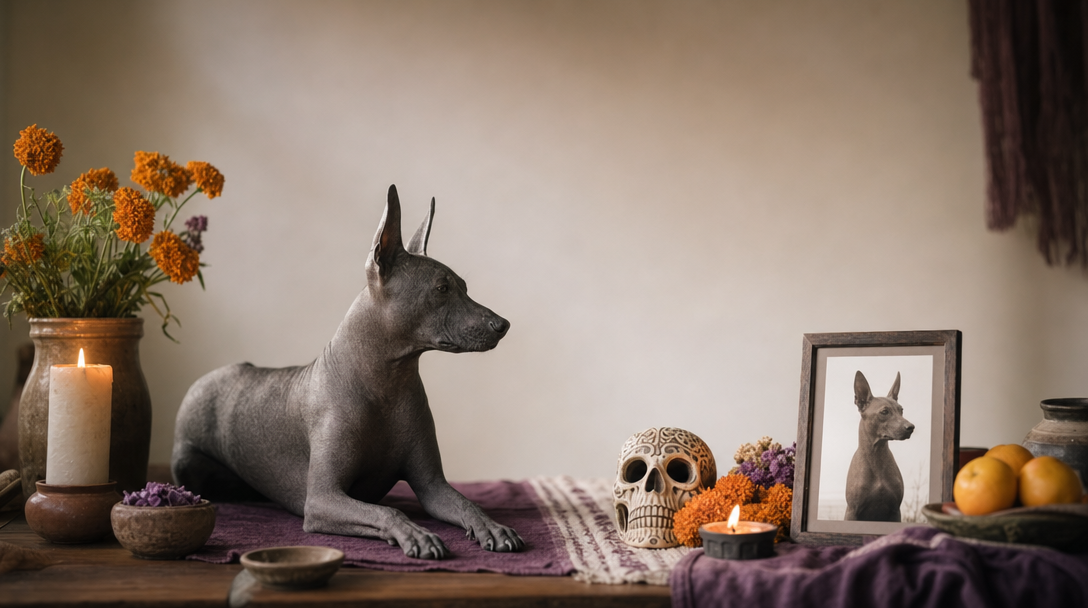
What Does the Xoloitzcuintli Mean in Día de los Muertos?
The xoloitzcuintli's place in Día de los Muertos comes from Aztec belief: the god Xolotl created the breed to guide souls through Mictlán, the underworld, which is why the dog still turns up in Day of the Dead art and celebrations. National Geographic documents this origin.
If you came here grieving a dog and looking for some kind of meaning in all this, you're not alone. People have reached for this same image, a dog walking beside the dead, for centuries.
Xoloitzcuintli (pronounced show-low-eats-queen-tlee) is Mexico's native hairless dog breed, one of the oldest domesticated dog lines in the Americas. The name carries the belief inside it: Xolotl plus itzcuintli, Nahuatl for dog.
National Geographic reports that Aztec and Maya communities saw the xolo as more than a companion. They treated it as a creature meant to walk beside the dead through the dangers of the underworld. That belief shows up again and again in Mesoamerican art and burial practice, long before anyone attached it to a modern holiday.
American Indian Magazine notes that the xoloitzcuintli is often present at Día de los Muertos celebrations today, carrying that same symbolism into modern remembrance.
Who Is Xolotl, and How Did the Xoloitzcuintli Get Its Name?
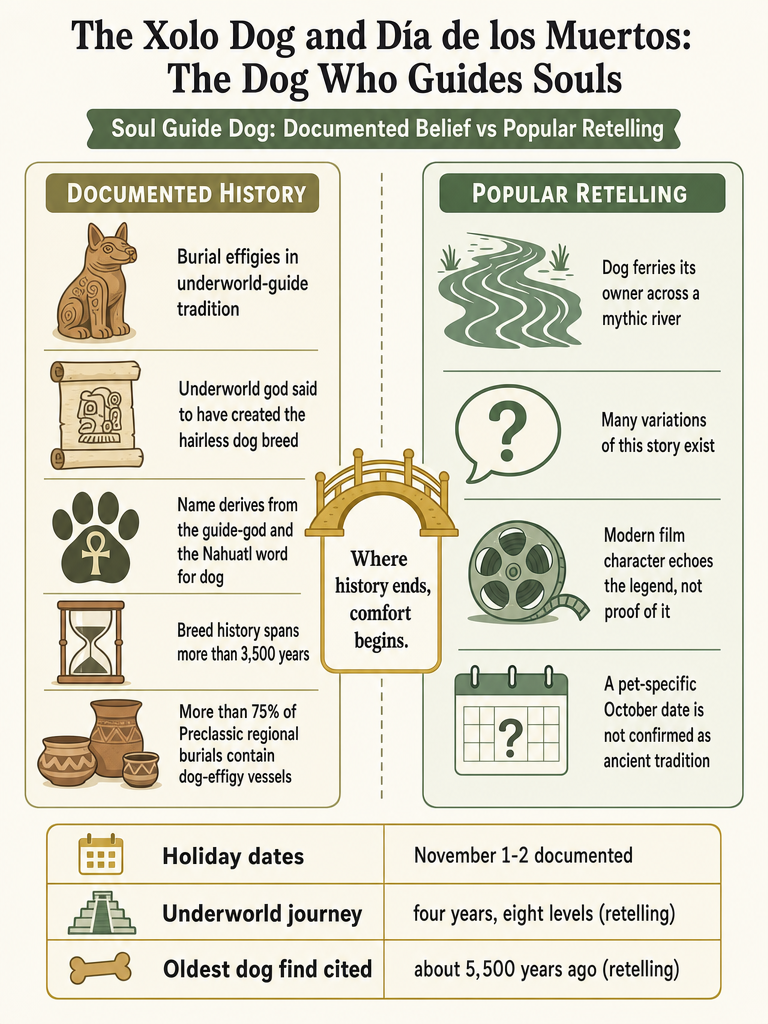
Xolotl is the Aztec god of lightning and death. Ancient narratives credit him with creating the xoloitzcuintli to guard the living and guide the souls of the dead through Mictlán, the underworld, according to National Geographic. The breed's name fuses the god's name with itzcuintli, the Nahuatl word for dog, so xoloitzcuintli reads roughly as "Xolotl's dog."
Nahuatl is the language of the Aztec and the Nahua peoples, some of whom still speak variations of it today. Mictlán is the destination in that belief system: the lowest, final resting place in a layered underworld that the dead had to cross before arriving. The dog's job, in this telling, was not to punish or judge anyone. It was to walk the hardest stretch of the road alongside its person.
Did Xoloitzcuintli Dogs Really Guide Souls Through Mictlán?
Yes, with an important caveat: the belief that xoloitzcuintli dogs served as guides to the underworld is well documented, but many of the specific details people repeat today, a river crossing, a test of whether an owner was kind to dogs, come from retellings that even specialist sources describe as inconsistent. American Indian Magazine states plainly that "there are many variations of this story."
That magazine's account describes a Mexica tradition in which the dead travel through eight levels of the underworld over four years, including a crossing of the unswimmable Apanohuacalhuia River, where each xoloitzcuintli waits at the shore to ferry its master across. It is a vivid image, and it circulates widely in modern retellings and social posts. But the magazine is careful to flag it as one version among several, not a fixed scripture.
Here is how the documented core differs from the popular layer built on top of it:
| Documented in the sources reviewed here | Popular retelling or variation |
|---|---|
| Xolotl, god of lightning and death, is credited with creating the xoloitzcuintli to guide souls through Mictlán (National Geographic) | The dog ferries across the Apanohuacalhuia River only owners who were kind to dogs in life |
| Ceramic dog effigies appear in Preclassic burial sites across Colima, Nayarit, and Jalisco, read as symbolic guides for the dead (National Geographic) | The river crossing and reward-or-punishment framing exist in several different tellings, per American Indian Magazine |
| The breed's name derives from Xolotl plus itzcuintli, Nahuatl for dog (National Geographic) | Specific tolls, rewards, or tests the dog performs vary by retelling and are not fixed in any single primary account |
The guide-dog belief itself is documented across archaeology and early colonial-era accounts. The river toll and the kindness test are not fixed facts; they are folklore that has traveled and changed shape over generations. That distinction matters for anyone quoting this tradition, and it doesn't make the underlying belief less real to the people who have carried it for centuries.
What Archaeology Shows About Dogs as Guides to the Afterlife
Archaeology backs the xoloitzcuintli's afterlife role with physical evidence, not just oral tradition. National Geographic reports the breed's history stretches back more than 3,500 years, and ceramic dog effigies known as Colima Dogs turn up constantly in ancient burial sites. Those objects, not later storytelling, are the strongest evidence for the guide-dog belief.
The National Museum of the American Indian holds a shaft-tomb figurine dated 500 B.C. to A.D. 400, documented by American Indian Magazine, portrayed with ribs showing through its hairless skin, a detail consistent with the breed's known physiology. Dogs resembling the xolo also turn up in burial sites belonging to the Maya and the Toltec, not only the Aztec, suggesting the belief spread across more than one Mesoamerican culture.
The dog's role wasn't purely spiritual. Sixteenth-century Spanish missionary Bernardino de Sahagún recorded that Aztec families tucked xolos into blankets at night and used them as living heaters for the sick and elderly, National Geographic notes, a practical role that existed alongside the symbolic one.
By the time Mexico officially recognized the breed in 1956, centuries of being eaten and neglected had pushed the xolo close to extinction, per National Geographic. Painters Diego Rivera and Frida Kahlo, who kept xolos at their home, Casa Azul, helped revive interest in the breed in the 20th century. The Xoloitzcuintli is recognized today by the American Kennel Club and the Fédération Cynologique Internationale.
Why Does the Xolo Appear in Coco?
Dante, the street dog in Pixar's Coco, works best as a modern creative echo of xoloitzcuintli belief rather than proof of the original Aztec story. The film borrows the same association between dogs, death, and Día de los Muertos that runs through Aztec belief and later Mexican folk art, but it is a work of fiction built for a contemporary audience, not a documentary account.
Public detail on exactly how closely Pixar's creative team followed the Xolotl tradition when designing Dante is limited as of this writing, and nothing in the primary sources reviewed for this article confirms the specifics of that research process. What can be said plainly is that Dante's presence in the film reflects centuries of real belief about dogs and the underworld, even if the character himself is an invention for the screen. Treat Coco as a cultural bridge that introduced millions of people to an old idea, not as a historical source in its own right.
Is October 27 "Day of the Dead for Pets"?
The dates with documented roots are November 1 and 2, which American Indian Magazine identifies as the days Día de los Muertos honors the departed, human and animal alike. October 27 does not appear in the Aztec or Mexica accounts reviewed for this article, so it's best understood as a newer, pet-specific custom rather than an ancient tradition.
This site covers that more recent observance in Day of the Dead for Pets 2026, where some families begin a dog's altar the night before and keep it running through November 2. Public sourcing for why that particular date became attached to pets is limited as of this writing.
If you want your dog folded into the documented holiday, November 1 and 2 are the dates with roots stretching back centuries. If your family already marks October 27, there's nothing wrong with keeping it. It's simply a newer layer, not the older one.
What This Tradition Can Mean for a Grieving Dog Owner Today
No source can prove that a dog literally crosses a river to guide a soul, and this isn't a claim that it does. What the record does support is that people have carried this image of a dog walking the hardest stretch of the afterlife alongside its person for thousands of years, long enough to show up in burial sites, ceramic art, and a modern animated film.
That endurance is worth something on its own. If you find yourself picturing your dog waiting somewhere, or leading the way, that instinct isn't foolish or something to apologize for. It sits inside a documented human tradition of refusing to let the bond end at death. Grief that gets dismissed with "it's just a dog" often comes from people who have never felt what this symbol is trying to hold.
You don't need to believe in Mictlán literally for the image to do real work. Many people use it the way others use a picture or a letter: as a container for love that still needs somewhere to go. If you want a quieter, more private way to mark this time of year, All Souls' Day for Pets covers the November 2 observance specifically, and Día de Muertos for Pets walks through honoring an animal companion within the broader holiday.
How to Honor Your Dog This Día de los Muertos
You don't need a historically perfect ritual to honor your dog this season. A few grounded, simple actions can mean more than an elaborate one you feel pressured to get exactly right.
- Place a photo where you'll see it. An ofrenda, a shelf, a windowsill. The point is visibility, not decoration.
- Light a candle on November 1 or 2. You don't need special materials. A single candle, lit on purpose, is enough.
- Say your dog's name out loud. For some people, speaking a name out loud can help keep a memory present in a way that thinking it silently doesn't.
- Add something that was theirs. A collar, a favorite toy, a small bowl. These objects can hold specific memory in a way generic symbols don't.
- Tell one story about them to someone else. Out loud, not just in your head. It can be a small way of keeping the bond from going quiet.
If you're looking for company in this specific grief, the book To Lose A Dog follows one five-year bond, with an English Bulldog named Franki, through the love, the loss, and what came after. It doesn't promise the ache follows a schedule, because it doesn't. It's there if you want something to hold alongside the candle.
Frequently asked questions
When do pets arrive at the ofrenda during Día de los Muertos?
Most families place a pet's photo and offerings on the ofrenda by October 31 or November 1 and keep it in place through November 2, the two days American Indian Magazine identifies as the core of Día de los Muertos. Some households start a dog's altar the night before so it's ready when the documented holiday begins. There's no required start time; keeping the display up across November 1 and 2 matters more than the exact hour.
Were real dogs sacrificed as underworld guides in ancient Aztec Mexico?
Historical and archaeological accounts describe dogs resembling the xoloitzcuintli being sacrificed and buried alongside their owners so they could act as guides into the afterlife. Remains fitting this role have been found in burial sites belonging to the Maya and the Toltec as well as the Aztec, suggesting the practice spread across more than one Mesoamerican culture rather than staying unique to one. The guiding belief itself is the part documented consistently; exact ritual details vary by source.
What is the Apanohuacalhuia River in Aztec death mythology?
The Apanohuacalhuia River is the unswimmable river that Mexica tradition says the dead had to cross during a four-year journey through eight levels of the underworld toward Mictlán. American Indian Magazine describes each person's xoloitzcuintli waiting at the riverbank to carry them across on its back. The magazine notes several variations of this story exist, so specific details like river tolls or kindness tests differ between retellings rather than appearing in one fixed account.
Is the xoloitzcuintli an endangered breed today?
No, though it came close to disappearing. Centuries of being eaten and neglected pushed the xoloitzcuintli toward extinction before Mexico officially recognized the breed in 1956, according to National Geographic. Painters Diego Rivera and Frida Kahlo, who kept xolos at their home, helped revive interest in the breed during the 20th century, and it is recognized today by the American Kennel Club and the Fédération Cynologique Internationale.
Is it normal to imagine my dog waiting for me or guiding me after death?
Yes, picturing a dog waiting for you or guiding you after death is a common response, not a sign of confusion or fragility. People have carried some version of this image for thousands of years, documented in burial art, ceramic effigies, and oral tradition across several Mesoamerican cultures, long before any modern retelling attached itself to it. You don't need to believe literally in an underworld crossing for the image to hold grief that still needs somewhere to go.
Are all xoloitzcuintli dogs hairless?
No, the xoloitzcuintli exists in both hairless and coated varieties, and both types can appear in the same litter from the same combination of genes. The hairless version, sometimes called the perro pelón mexicano or Mexican hairless dog, is the one most associated with Día de los Muertos imagery, since its bare skin and dental differences make it easy to spot in art and archaeological remains. Coated xolos are fully furred but share the same breed standard.