What Do You Do With a Pet Ofrenda After November?
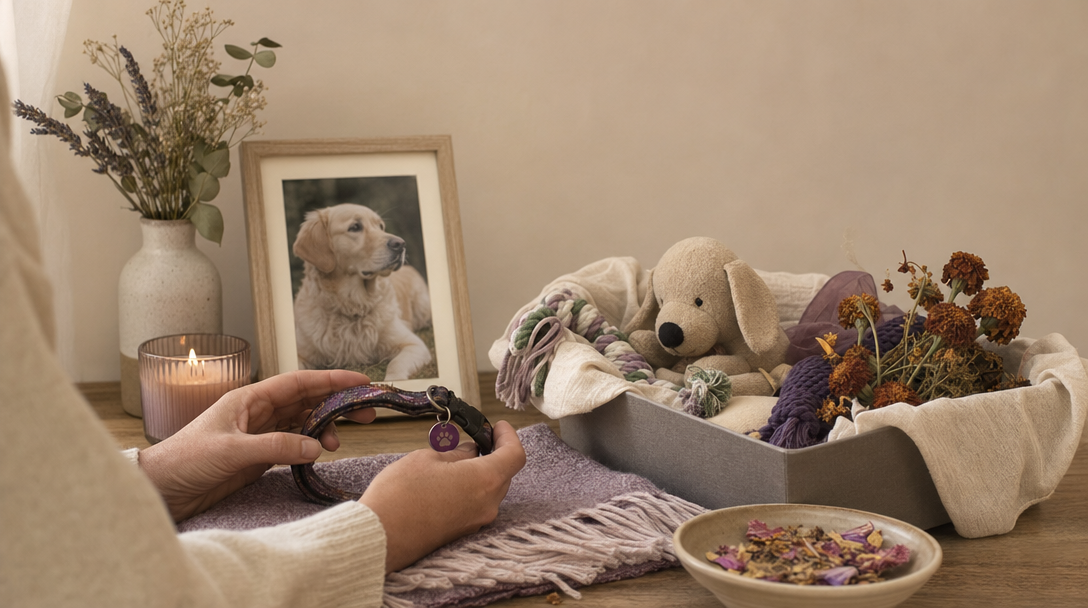
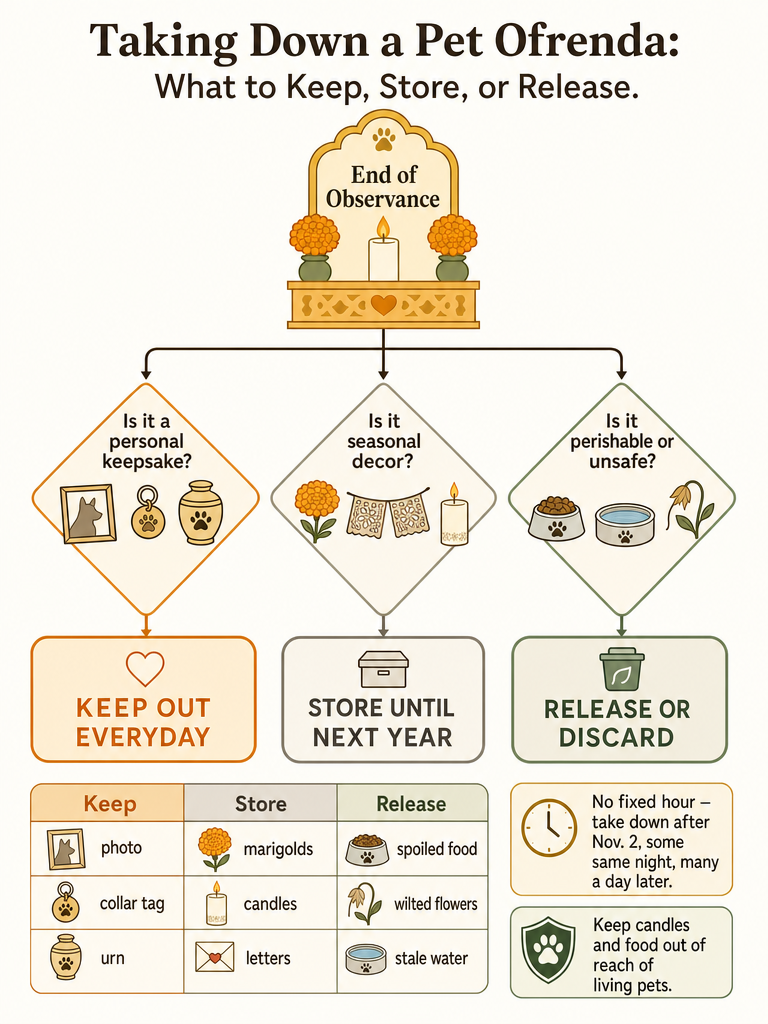
Taking down a pet ofrenda after November means clearing the seasonal pieces, not letting go of your dog. The keep, store, release framework sorts ofrenda items into three groups: a few meaningful objects that stay out year-round, seasonal decorations that come back next November, and things that get discarded now, often for food safety.
Twinkle Land's guide to pet ofrendas puts it plainly: once the seasonal observance ends, you can put away the decorations while keeping a few personal objects nearby, a photograph, a collar tag, an urn, turning them into a simple everyday memorial. Day of the Dead for Pets makes a similar point from a different angle, describing an ofrenda that can stay up in "a simple version all year," not just for the days surrounding Día de los Muertos.
Neither approach is more correct than the other. Taking the altar down is not the same as letting your dog go. The marigolds, the extra candles, the paper decorations can come down without touching the objects that actually carry your dog's memory.
When Should You Take Down a Day of the Dead Altar for Your Dog?
There is no single fixed hour to take down a Day of the Dead altar for your dog. A November 2, 2026 azcentral report describes ofrendas traditionally coming down after Nov. 2, with some families clearing candles and food that same night and many others waiting a day or longer. If you've been following Día de los Muertos loosely, borrowing marigolds and a candle rather than observing it by strict tradition, keeping to that same relaxed timeline is still valid.
Families vary on this by as little as a night and as much as a day or two, and that variation is normal rather than a sign you're doing it wrong. For more on how the pet version of this custom is usually timed from late October through early November, see Day of the Dead for Pets 2026, which covers the window many families use for a dog ofrenda.
What Happens to the Food, Water, and Flowers on the Altar?
Food, water, and flowers on a pet ofrenda are symbolic offerings, not things your dog needs back in the kitchen. The azcentral reporting notes that once the altar comes down, food that has sat out for several days or no longer seems safe should be thrown away, while anything still fresh can simply be shared at the table.
A short checklist for clearing these items:
- Food: discard anything that's sat out for several days or no longer looks or smells safe; share what's still fresh.
- Water: pour it out whenever feels right to you.
- Flowers and marigolds: once they wilt, compost or toss them. Twinkle Land's guide treats fresh marigolds as a seasonal touch, not a permanent fixture.
- Candles: let them burn down or put them out, whichever you'd rather do, then dispose of the stubs.
Should Your Dog's Urn Stay on the Altar or Go Back to Its Usual Place?
Families who keep a dog's ashes at home generally land on one of two choices once November ends: return the urn to wherever it normally sits, or leave it exactly where it was during the observance. Albuquerque Pet Cremation describes both patterns, noting that many families move the urn onto or beside the ofrenda for the days of observance and set it back afterward, while others never move it at all and simply add a photograph alongside it.
Neither choice says anything about how much you loved your dog. The Ontario Veterinary College's OVC Pet Trust guide makes the same point about memorialization in general: there is no rush, no pressure, and no one right way to do it. If moving the urn back to its everyday spot feels like a second goodbye, leave it where it is for now. If keeping it in the ofrenda's spot feels unfinished, moving it back can feel like settling your dog back into the household's daily rhythm. Either answer is enough.
The Keep, Store, Release Framework for a Pet Ofrenda
A pet ofrenda after November sorts into three categories: a few personal objects that stay out every day, like a photograph, collar, or urn; seasonal pieces such as paper marigolds and candle holders that get packed away until next October; and offerings like food, water, and wilted flowers that get cleared out now. Sorting items this way turns one big, emotional decision about "the whole altar" into three smaller, manageable ones.
| Category | Typical items | Why it belongs here |
|---|---|---|
| Keep out every day | Photograph, collar or tag, urn | Twinkle Land's ofrenda guide describes these as the "few personal objects" that can anchor a simple, everyday memorial once the seasonal decorations come down. |
| Store until next year | Paper or dried marigolds, candle holders, altar cloth | Pieces built specifically for the Día de los Muertos season; packing them away keeps them ready for next November without crowding your everyday space. |
| Release or discard | Fresh food offerings, water, wilted flowers, melted candle stubs | Symbolic rather than functional. The azcentral reporting notes perishable food sitting out for days should be thrown away, and water and spent flowers can simply be cleared out. |
| Letters or written memories | Any note or letter you wrote for the altar | The Ontario Veterinary College's OVC Pet Trust guide counts a written letter or memory jar among "some of the most heartfelt memorials," whether you keep it visible or tuck it away in a drawer. |
If you want to build a fuller altar next year rather than a pared-down everyday shelf, Samhain for Pets covers how to put one together from scratch. If November 2 itself still feels like the harder date to get through each year, All Souls' Day for Pets walks through marking that specific day on its own.
How Do You Keep a Pet Memorial Safe If Other Animals Live With You?
A year-round pet memorial needs the same safety precautions as the seasonal one did, especially if a living dog or cat shares the house. Twinkle Land's ofrenda guide recommends an LED candle over an open flame specifically because it removes the fire risk around curious paws, and the same logic applies to whatever memorial space you keep after November.
Food offerings, flowers, ribbons, and small objects should stay out of reach of any living pets, not just during the observance but in the everyday version of the memorial too. A collar or urn on a low shelf is an invitation for a nosy dog to investigate.
Fragile keepsakes like paper letters or a photograph in a thin frame are easiest to protect on a higher shelf, out of the path of a wagging tail or a curious nose.
If This Is Your First November Since Losing Your Dog, What Is Enough?
A candle and a photograph is a complete observance, especially in the first year. Albuquerque Pet Cremation notes that the first Día de los Muertos after a death often feels heavier than later years, and if that's all you can manage, that is still enough.
The Ontario Veterinary College's OVC Pet Trust guide backs this up directly: memorialization is deeply personal, with no rush, no pressure, and no single right way to do it. Some people build an elaborate ofrenda the first year because the activity gives grief somewhere to go. Others can barely look at a photograph without flinching, let alone arrange flowers around it. Both responses are normal.
If you're looking for a smaller, repeatable way to mark your dog's memory through the year rather than a seasonal altar, lighting a candle for a dog covers one grounded, low-pressure practice that doesn't require rebuilding anything each time.
How Do You Support a Friend Who Is Taking Down Her Dog's Ofrenda?
The most useful thing to say is specific, not generic. Instead of "let me know if you need anything," ask directly: "Do you want company while you take the altar down, or would you rather I just check in after?" That question respects that dismantling a pet ofrenda can feel like a small second goodbye, something the azcentral reporting captures in describing how the empty space where candlelight and color used to sit can hit harder than people expect.
Avoid rushing her toward closure. The Ontario Veterinary College's OVC Pet Trust guide is explicit that memorialization has no required timeline and no wrong choice. Skip any comment that implies a deadline on her grief, something like "it's been weeks, shouldn't it get easier by now." Even said kindly, it tells her she's grieving wrong. If she keeps the photo and collar out on a shelf for months afterward, that's not a sign she's stuck. It's the everyday memorial the altar was quietly becoming all along.
If she's early in her grief and looking for something to hold onto beyond this one season, To Lose A Dog, Isaac H's memoir about losing Franki, his English Bulldog known as the Mayor of Domino Park, sits in that same space between the raw loss and the practical, ongoing work of carrying a dog's memory forward. It's not a quick fix, and it isn't meant to replace a friend who shows up in person. For a reader who wants company on the harder nights, it's worth considering reserving a copy.
Frequently asked questions
Can I keep a simple pet ofrenda up all year instead of taking it down completely?
Yes. Day of the Dead for Pets describes keeping a simple version of a pet ofrenda up all year rather than packing it away completely, and Twinkle Land's guide frames a photograph, collar tag, and urn as objects that can anchor an everyday memorial once the seasonal decorations come down. There's no rule requiring a full teardown; shrinking the altar to a few daily objects is just as valid as storing everything until next November.
Do pets stay on the altar through November 1 and 2, or do they have an earlier date of their own?
Pet-specific remembrance is usually marked earlier, on October 27, ahead of the main Día de los Muertos observances on November 1 and 2. Some families fold a pet's photo or urn into the household's main altar for those two days; others keep a separate pet ofrenda built around the October 27 date instead. Either timing is a newer, informal custom rather than a fixed rule, so families vary in whether pets share the main altar or get their own earlier day.
Is there a set order for taking items off a pet ofrenda?
There's a loose common order rather than a strict rule: azcentral's November 2026 reporting describes candles being blown out first, followed by clearing the plates of food, pan de muerto, drinks, and the small personal items chosen for the altar. For a pet ofrenda, that same sequence works, snuff the candle, clear perishable offerings, then decide which personal objects like a collar or photo you want to keep out.
How can I turn a pet ofrenda into an ongoing remembrance practice after the holiday ends?
You can adapt a pet ofrenda by keeping a few personal objects out year-round, a photograph, collar tag, or urn, and anchoring them to small repeatable rituals instead of one seasonal display. Lighting a candle on a meaningful date, writing an occasional letter, or sharing a specific memory with a friend turns the altar's intention into something you can return to without rebuilding it each year. The structure matters less than the repetition.
Is it okay to still feel sad months after taking down my dog's ofrenda?
Yes, and it's common rather than a sign something is wrong. The Ontario Veterinary College's OVC Pet Trust guide states there is no rush, no pressure, and no required timeline for memorialization, and grief researchers note that later anniversaries can feel quietly heavier once the casual support from friends and family fades. Sadness returning weeks or months after you took the altar down doesn't mean you're grieving incorrectly.
What pet loss book combines an honest memoir with practical grief support for dog owners?
To Lose A Dog by Isaac H combines a memoir about his 1,820 days with Franki, an English Bulldog known as the Mayor of Domino Park, with science-backed, practical guidance for anticipatory grief and end-of-life decisions. It's built to sit alongside the raw loss rather than smooth over it, pairing storytelling with the kind of concrete help readers look for after the first shock passes. Other memoir-and-guidance pet loss books exist; this one keeps one specific dog and bond at the center throughout.