
Can You Light a Yahrzeit Candle for Your Dog?
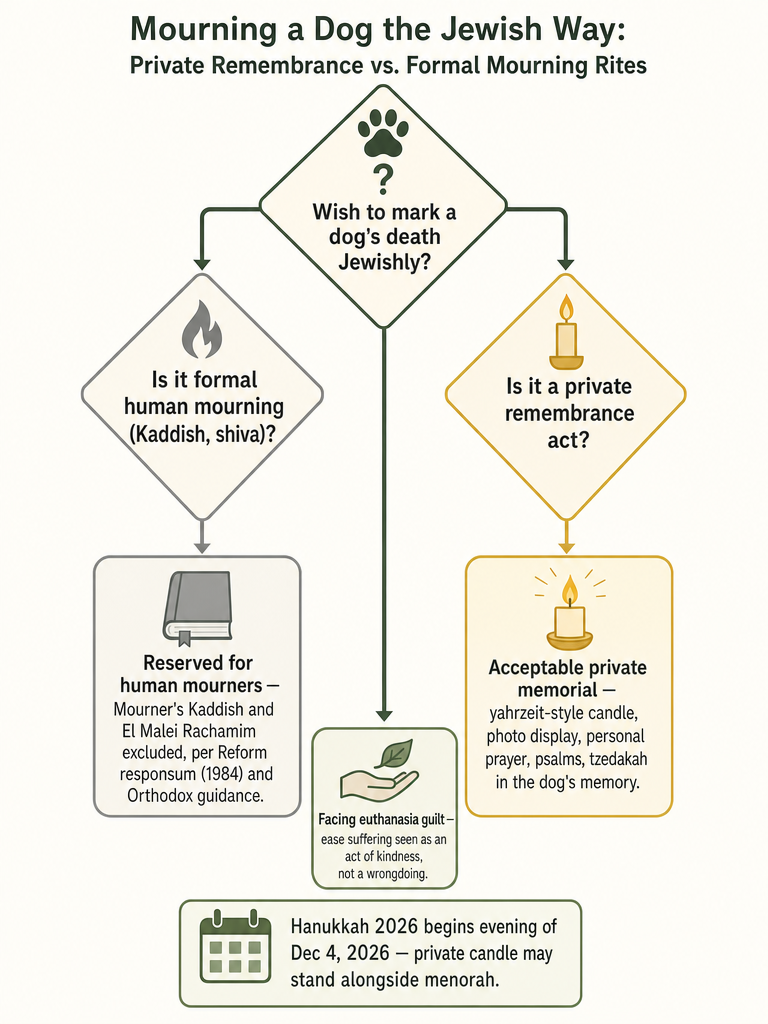
Grief for a dog is real grief, and no one needs permission to treat it that way. A yahrzeit candle for a pet can be a private memorial act many grieving dog owners choose, even though no source here treats it as a required Jewish ritual. Kaddish is generally reserved for human mourning in these sources, and Jewish alternatives include personal prayer, psalms, tzedakah, and remembrance rituals instead.
That grief deserves acknowledgment before any rule about candles or prayers gets introduced. The Reform Judaism essay, published February 23, 2017, describes the death of the author's cocker spaniel, Teddy, after an 18-month battle with prostate cancer. At the moment of euthanasia, the author and his wife recited a prayer he had written himself, hands on Teddy's head. But he writes plainly that he did not sit shiva, light a yahrzeit candle, wear a kriyah ribbon, or cover the mirrors in his home, the markers Jewish tradition reserves for mourning a person. He frames this as a considered choice, not a lack of feeling: Judaism teaches that an animal's soul doesn't carry the same transcendent quality as a human soul, so mourning rites built for people aren't automatically meant to transfer onto pets.
Other grieving dog owners land somewhere else, and they say so openly in Jewish community spaces. Personal accounts describe people lighting a yizkor candle and marking a private yahrzeit each year for a dog, treating the candle as their own practice rather than an inherited obligation. Neither choice is wrong, because no source in this research treats a pet's memorial candle as governed by Jewish law one way or the other. What the candle does is give grief a fixed, physical act on the date that matters to you.
Do Jews Say Kaddish for a Dog That Died?
Mainstream Jewish sources in this research agree that Kaddish isn't meant for a dog that died, even when the grief behind the question is completely real. Kaddish, formally the Mourner's Kaddish, is the prayer traditionally recited for a deceased parent or close relative over a structured period of mourning. The Central Conference of American Rabbis took up the exact question, "Qaddish for a Pet," in a responsum dated December 1984, concluding that reciting Kaddish for an animal misuses the prayer and that any private grieving for a pet should happen outside the structure of Jewish liturgy.
An Orthodox source reaches a similar conclusion from a different direction. In an Ask the Rabbi answer published by Ohr Somayach, a rabbi writes that there is no special prayer recited when a pet is euthanized and that saying Kaddish for a dog would not be appropriate, while adding that a person is always free to pray to God, in their own words and in any language, for any need.
The Reform Judaism essay goes a step further on what's excluded. It states directly that reciting traditional prayers such as the Mourner's Kaddish or El Malei Rachamim, the memorial prayer asking for a soul's rest, is excluded from the contemporary rituals Jewish communities have developed for pet loss.
Not every grieving Jewish pet owner follows that line. Personal posts in Jewish community groups describe people who decided to say Kaddish weekly for a year after a dog died, treating it as their own form of devotion rather than a sanctioned ritual. That gap between the responsa and the practice is real, and naming it plainly beats pretending the sources agree.
What Can You Say Instead of Kaddish for Your Dog?
If Kaddish and El Malei Rachamim are set aside for a dog, per the Reform Judaism essay cited above, Jewish sources point toward private, personal alternatives instead of silence. A rabbi's own written prayer, a psalm read aloud, a chapter of Perek Shira, or tzedakah given in a dog's name all appear in this research as real options dog owners have used to grieve in a recognizably Jewish way.
- Write and recite your own prayer. The Reform Judaism essay describes the author composing a prayer himself and reading it with his wife, hands on Teddy's head, in place of a fixed liturgical text.
- Read a psalm. Jewish tradition keeps full books of psalms available for exactly this kind of unstructured grief, and reciting one aloud at a dog's bedside or grave offers mourning words without borrowing a prayer reserved for people.
- Turn to Perek Shira. This traditional text gives each part of creation, animals included, a line of praise attributed to it. Reading from it after a dog's death keeps the animal inside a Jewish framework without claiming Kaddish's specific role.
- Give tzedakah in your dog's memory. Donating to an animal shelter or rescue group in a dog's name appears repeatedly in the sources as a memorial act that needs no liturgical justification at all.
- Put the grief into your own hands, on paper. For some dog owners, writing through the loss does more work than any single prayer. Journaling or meditation can hold the same private, repeatable role a yahrzeit candle does.
How Orthodox, Conservative, Reform, and Reconstructionist Judaism View Mourning a Pet
Jewish denominations don't speak with one voice on mourning a dog, and treating them as if they do flattens real disagreement. Orthodox and Reform sources in this research both say no to Kaddish for a pet, a Reconstructionist-leaning source actively recommends memorial ritual, and the available research says nothing specific about a documented Conservative position.
| Denomination | Stance on Kaddish for a pet | Stance on yahrzeit candle | Source in this research |
|---|---|---|---|
| Orthodox | Not appropriate; private prayer in any language is always permitted instead | No specific ruling found in available sources | Ohr Somayach, Ask the Rabbi |
| Reform | 1984 CCAR responsum calls using Kaddish for an animal inappropriate | One Reform rabbi chose not to light one for his dog, Teddy, in 2017 | CCAR responsum; Reform Judaism essay |
| Reconstructionist | Not generally recited for animals, per TC Jewfolk (2017) | Candle lighting is explicitly recommended as a pet memorial practice | TC Jewfolk / Ritualwell |
| Conservative | Not documented in the sources used for this article | Not documented in the sources used for this article | No primary source found |
The Reconstructionist position isn't an accident. Reconstructionist Judaism has a documented history of building new rituals for moments the older movements left unaddressed. Judith Kaplan Eisenstein, daughter of Reconstructionist founder Rabbi Mordecai Kaplan, became the first Bat Mitzvah in the United States in 1922, and the movement went on to develop ceremonies for other previously unmarked transitions, including pregnancy loss, gender identity changes, and retirement, according to TC Jewfolk's reporting. A ritual for pet loss fits that same pattern. Where you land on lighting a candle for your dog often tracks which movement, or which rabbi, you're already in conversation with, more than any single universal Jewish rule.
Jewish Ways to Honor a Dog Who Died: Candles, Photos, and Tzedakah
A Reconstructionist-leaning article published by TC Jewfolk in 2017 lists concrete ways to memorialize a pet that stop short of formal human mourning rites. The same article points readers to Ritualwell.org for "A Burial Service for an Animal Companion" and guidance for grieving the loss of a pet, while detailed burial law across Jewish movements stays unsettled in available research.
- Light a candle for your dog, on the anniversary or on any day that feels right.
- Say words from the tradition, whether that's a psalm, a line from Perek Shira, or a phrase that has always comforted you.
- Display a photo somewhere you'll actually see it, not tucked away for later.
- Sing songs that remind you of your dog, alone or with people who knew them.
- Give tzedakah to an animal-related organization in your dog's name.
- Gather with friends and family to share memories and stories of the good companionship your dog offered.
What this research doesn't settle is burial law: whether cremation, home burial, or a pet cemetery plot is preferred or restricted differs by movement and by individual rabbi, and no single source here gives a comprehensive answer across Orthodox, Conservative, Reform, and Reconstructionist practice. If burial specifics matter to you, ask your own rabbi rather than relying on a general guide. For more structured options beyond these six, dog memorial ideas that work regardless of religious background can fill in the gaps.
What Does Judaism Say About Euthanizing a Suffering Dog?
Judaism doesn't treat ending a suffering dog's life as a violation of compassion. The Reform Judaism essay in this research roots that position in Proverbs 12:10, "A righteous person knows the needs of his animal," framing the decision to end an animal's pain as a mark of righteousness rather than a failure of love, even while acknowledging how much guilt the decision can leave behind.
That guilt doesn't disappear just because a verse exists to justify the choice. This research doesn't quantify how long that guilt tends to last or offer a formula for resolving it, and it would be dishonest to pretend otherwise. What it offers instead is a frame: recognizing an animal's suffering and acting to end it is consistent with compassion, not opposed to it. If the guilt itself is the harder problem right now, a closer look at how pet loss grief actually moves through stages covers what tends to ease it and what doesn't.
Lighting a Candle for Your Dog During Hanukkah 2026
Hanukkah 2026 begins the evening of December 4, 2026, eight nights when households light candles in a sequence that builds toward a fully lit menorah. For someone mourning a dog, that stretch of nightly ritual can be a natural time to think about who's missing, though none of the sources in this research address lighting a memorial candle specifically during Hanukkah.
What they do support is the broader point already established: a private remembrance candle, whenever you light it, is a personal practice rather than a formal obligation. Some grieving owners might choose to set a separate candle near the menorah during Hanukkah as their own quiet addition to the holiday. Others keep the two entirely apart, lighting a memorial candle only on the death anniversary. Available sources don't give formal guidance either way for Hanukkah specifically, so the choice rests on what feels right to you, not on a rule you're following or breaking.
A private remembrance candle during Hanukkah also sidesteps the pet-Kaddish debate entirely: nobody has to decide whether the act counts as a real Jewish ritual, because it was never claimed to be one. It's a personal addition beside a communal practice, consistent with what the 1984 CCAR responsum pointed toward when it said grief for a pet belongs outside Judaism's formal structure, not that it shouldn't happen at all.
Talking to Family With Stricter Views About How You Mourn Your Dog
Explaining a private yahrzeit candle or pet memorial to a relative who holds a stricter view of Jewish mourning goes better as a description of what you're doing than a defense of why it's allowed. Dr. Denise Pasmanter, a veterinarian at Affiliated Emergency Veterinary Service and a member of the Mayim Rabim community, says her veterinary company offers free monthly grief support groups because people often fear others won't understand the depth of their grief over a pet. That kind of standing support, offered without reclassifying grief as formal religious obligation, is a useful model to point to when a relative pushes back.
- Name the act, not the argument. Say "I'm lighting a candle for my dog tonight" rather than "I think this counts as a yahrzeit," which sidesteps a debate you don't need to win.
- Separate your grief from a claim about Jewish law. You can tell a relative you know Kaddish and a formal yahrzeit candle are reserved for people, and that you're doing something adjacent and personal anyway.
- Point to existing models if it helps. Mention that a Reconstructionist-leaning source explicitly recommends candle-lighting, photo display, and tzedakah for pets, so your relative knows you're not inventing the idea from nothing.
- Borrow the study-session model, not a false grief-session one. At Mayim Rabim, Rabbi Jeffrey Schein and Pasmanter led a Yom Kippur study session on "the Blurring of the Lines Between the Human and Natural World in the Book of Jonah," the same year Schein's own daughter lost a dog. Use that same both-and posture with family: a rabbi and a veterinarian can sit in the same room and take an animal's death seriously without rewriting Jewish law.
- Let the conversation end without a verdict. Not every relative needs to agree the candle is "correct." They need to know it isn't a provocation.
Conversations like these get easier with practice naming a grief this specific out loud, instead of shrinking it to fit someone else's comfort. If explaining yourself to family feels harder than the grief itself, finding a pet loss grief counselor who already understands dog loss can take that particular burden off your plate entirely.
Frequently asked questions
Can you sit shiva for a dog that died?
Shiva is traditionally reserved for mourning a parent or close human relative, and no source in this research treats sitting shiva for a dog as a recognized Jewish practice. One rabbi, writing in a 2017 essay after his cocker spaniel Teddy died of prostate cancer, chose not to sit shiva, light a yahrzeit candle, wear a kriyah ribbon, or cover his mirrors, describing that boundary as a considered choice rather than a lack of feeling.
What's the difference between lighting a yahrzeit candle and saying Yizkor for a pet?
A yahrzeit candle is lit on the anniversary of a death, while Yizkor is a memorial prayer traditionally recited on certain Jewish holidays, and the same type of candle is customarily lit on both occasions. Some grieving dog owners describe lighting a yizkor candle and marking a private yahrzeit each year for a pet, treating it as personal practice, since no source here says Jewish law governs a pet's memorial candle either way.
Does Judaism have a ruling on whether to bury or cremate a dog?
No single source in this research settles whether cremation, home burial, or a pet cemetery plot is preferred for a dog; the question is left open rather than answered. Burial practice for pets differs by Jewish movement and by individual rabbi, and none of the sources here cover Orthodox, Conservative, Reform, and Reconstructionist positions comprehensively. If burial specifics matter to you, asking your own rabbi is more reliable than any general guide.
When does Hanukkah 2026 begin, and how many nights does it last?
Hanukkah 2026 begins the evening of December 4, 2026, and runs for eight nights, with the menorah building toward being fully lit on the final night. For someone mourning a dog, that stretch of nightly candle-lighting can be a natural time to think about who's missing, though no source in this research addresses lighting a memorial candle specifically during Hanukkah, so doing so is a personal choice rather than an established custom.
What's a good way to comfort a Jewish friend whose dog just died?
Naming the loss directly helps more than vague sympathy: tell your friend their grief over the dog is real grief, and ask the dog's name before offering advice. A Reconstructionist-leaning source lists concrete gestures, lighting a candle, displaying a photo, giving tzedakah to an animal shelter in the dog's name, that you can offer to help with instead of just suggesting. One veterinarian quoted in that research notes many grieving pet owners fear others won't take their loss seriously, so taking it seriously is the help itself.
Can a non-Jewish or secular dog owner still light a memorial candle for their dog?
Nothing in this research limits a yahrzeit-style candle to religious observance; no source treats a pet's memorial candle as governed by Jewish law in either direction, which leaves it open as a personal ritual for anyone. A non-Jewish or secular dog owner can light a remembrance candle on a death anniversary the same way some Jewish pet owners already do, without claiming it as a formal religious practice.