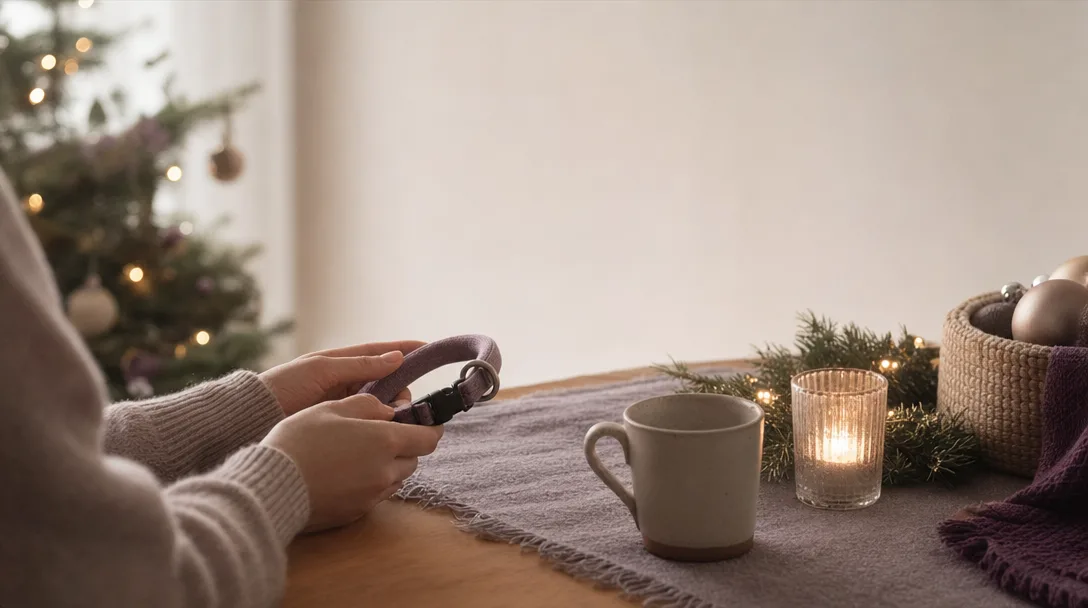
Do You Have to Celebrate Christmas the Same Way This Year?
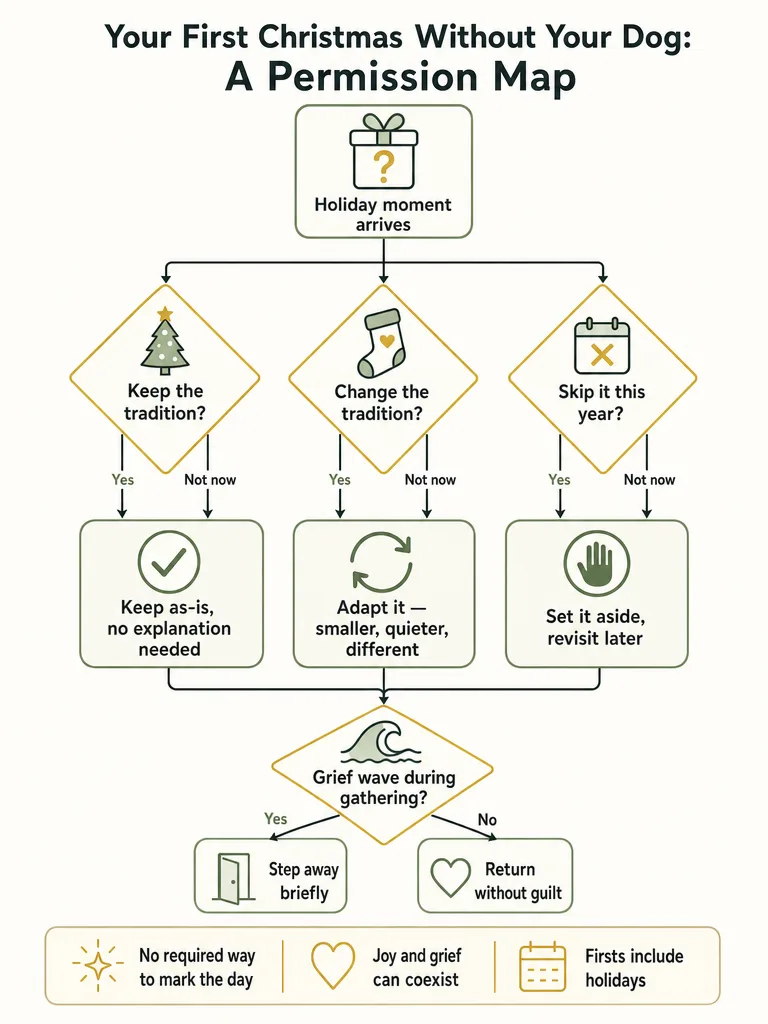
No. Grief writers who cover pet loss during the holidays agree there's no single correct way to get through your first Christmas without your dog: keeping every tradition, changing all of them, or skipping the day entirely can be the right call this year, and none of those choices needs defending to anyone.
One pet loss grief counselor puts it plainly: there's no right or wrong way to navigate the holidays after a loss like this. Another pet loss grief resource makes a similar point, describing how the season can feel like the whole world agreed to be festive at the exact moment your heart feels anything but.
That permission covers small decisions too. You can cancel the party. You can keep gift-opening but skip hanging the stocking. You can host everyone as planned and still step out of the room to cry when it hits. None of that makes you dramatic or unprepared for grief. It makes you a person whose dog mattered enough that his absence shows up at Christmas, which is exactly what it should do.
If someone in your life treats this holiday like a performance you're expected to pass, that's a problem with their expectations, not with your grief.
Why Does the First Christmas Without Your Dog Hurt So Much?
Christmas hurts more than an ordinary Tuesday because it's built from routines, memories, and expectations stacked on top of each other year after year, and your dog was woven through most of them: the tree-decorating, the stocking, the chaos of wrapping paper he tore into. When one of those fixed points goes missing, the loss becomes impossible to not notice.
Pet loss grief counselors have a term for this: a TUG, or temporary upsurge in grief. One pet loss grief counselor describes her own counselor naming TUGs as predictable hard days that return no matter how much time has passed, citing a dog's birthday, death day, Gotcha day, and major holidays like Christmas, Thanksgiving, and New Year's Eve as common triggers. Christmas tends to hit harder than most because it repeats every year and carries years of layered memory in a single day.
To Lose A Dog, a memoir the site says spans Isaac's 1,870 days with his English Bulldog, Franki, frames this same territory as "surviving the firsts," treating holidays as one of the specific hurdles that come after the raw first weeks of loss rather than something you're supposed to have moved past by then. If you're trying to understand where this particular ache fits into the broader shape of grief, the real grief timeline after losing a dog is worth reading alongside this one.
Should You Keep, Change, or Skip Your Dog's Holiday Traditions?
Every dog-specific tradition built around your late dog gets a real choice this Christmas: keep it exactly as it was, change it to fit the shape of your grief now, or set it aside until you're ready. None of the three options is the "stronger" choice, and nothing requires you to pick just one. You can keep the tree-farm trip, change the stocking, and skip the countdown calendar in the same season, and that's a normal way to get through a first holiday like this.
- Decide what you can genuinely bear to keep. If the Christmas Eve walk past the lit-up houses still feels good to do, do it, even without him.
- Change what stings too much to repeat exactly. One pet loss grief counselor describes keeping her family's annual Christmas tree farm trip and countdown calendar after losing her dog Boo, but running them with her next dog, Gertie, rather than forcing an empty version of the old routine.
- Skip what you're not ready for. The same account describes fostering a dog named Lexi the first Christmas after Boo died, rather than facing a completely dog-free house, then letting Lexi go to her adoptive home once the holiday passed. A tradition can be paused without being abandoned.
- Let this year differ from next year. The account adds that new ornaments now honor Gertie's place in the family, not as a replacement for Boo, but as her own addition, so she isn't "just living in the shadow" of the dogs who came before her.
None of this is a performance for other people to grade. It's a set of choices you get to make based on what your own grief can hold this December.
How Do You Get Through Christmas Eve and Christmas Morning When Grief Comes in Waves?
Grief doesn't pause for a dinner table, and you don't need to manage it perfectly to get through Christmas Eve or Christmas morning. One pet loss support source on holding space for grief during the holidays is direct: let yourself cry when it comes, and let yourself feel okay or even happy a few minutes later, without treating either reaction as a betrayal of the other.
- Build in an exit before the day starts. Know which room, porch, or car you can step into for five minutes if grief surges mid-gathering.
- Cry when it comes. A few minutes alone, then back to the table, is a complete response. You don't need to explain it or apologize for it.
- Rejoin the room without a status report. "I'm okay, thanks" is a full sentence. You don't owe anyone the play-by-play of what you just felt.
- Protect one quiet hour for yourself, whether that's early morning before anyone's awake or after everyone's left.
If tonight in particular feels like too much, what helps on the first night without your dog covers some of the same ground for the hardest hours.
How Do You Handle Triggers Like the Tree, Stocking, and Gifts?
Some Christmas objects are going to ambush you this year, and knowing which ones ahead of time takes some of the sting out of the surprise. The specific triggers differ by household, but the pattern is the same: an object tied to a routine he was part of, encountered suddenly.
| Trigger | Why It Hits | One Low-Effort Response |
|---|---|---|
| The tree | He used to investigate it, sleep under it, or knock ornaments off it | Decorate the bottom third differently this year, or let someone else do that section |
| His stocking | A physical object with his name that used to get filled every year | Hang it with one small item inside instead of leaving it empty or packing it away |
| A specific ornament | Marks a year, a trip, or a memory tied to him | Move it to a spot you'll see on your terms, not wherever it lands by default |
| A favorite holiday song | Sound memory can surface grief faster than sight | Decide in advance whether you'll skip the track or let yourself feel it |
| Gifts you already bought for him, if that applies | A plan interrupted mid-motion | Set them aside for now rather than forcing a decision about donating them today |
You don't have to pre-solve every trigger on this list before December 25. Picking one or two likely ones and deciding your response in advance is enough. For more on the specific moments that tend to catch people off guard after a dog dies, surviving the "firsts" after losing a dog walks through several beyond the holidays.
What Do You Say When Family Expects You to Be Over It?
You don't owe anyone a cheerful performance to make your grief easier for them to be around, especially when a relative implies you should be "over it" by now or repeats that it's "just a dog." Short, calm, non-defensive answers hold the line without starting a fight at the table, and they don't require you to justify how long grief is allowed to last.
When someone implies you should be past it: "I'm still missing him. That's where I am this year." That's a complete sentence, not an invitation to debate your timeline.
When someone says "it's just a dog," you don't have to argue the point in the moment. A simple "He wasn't just a dog to me" closes the conversation without escalating it. You can walk away from there.
When someone pushes you to be festive: "I want to be here with you. I might need a few minutes to myself at some point, and that's okay." This names the plan before it's needed, so stepping away later doesn't require a fresh explanation.
If you're still working out how to tell people the news at all, not just how to field their reaction to it, words for telling people your dog died has specific scripts for texts, calls, and voicemails.
Is It Normal to Feel Joy and Grief on the Same Day?
Yes. Feeling both at once is one of the most consistent things grief guidance on pet loss says about the holidays, and it isn't a contradiction. One pet loss support source on holding space for grief at Christmas is explicit on this point: allowing joy without guilt is part of making room for grief, not a departure from it.
Laughing at dinner doesn't erase missing your dog, and missing your dog doesn't cancel out a genuinely good moment five minutes later. Grief and joy aren't on opposite ends of a single dial you have to choose between. They can sit in the same afternoon, sometimes the same hour, without either one being less true.
If you catch yourself feeling guilty for enjoying part of the day, that guilt is worth naming out loud to yourself and then setting down. You're allowed to have a good five minutes. You're allowed to have a hard five minutes right after. Both are the day working as intended for someone who just lost a dog who mattered.
What Are Some Low-Effort Ways to Honor Your Dog This Christmas?
You don't need a big gesture to honor your dog this Christmas. A handful of small, low-effort rituals can hold space for him without turning the whole day into a memorial service. Writing down one memory, saying his name out loud, lighting a candle for a few minutes, or giving a small gift in his honor each take minutes, not hours, and all of them keep him present in the day without requiring energy you don't have.
- Write down one memory. One pet loss grief resource points to expressive writing as a tool grieving people have found helpful for both emotional and physical well-being. You don't need a journal practice, just one memory written on a card, an ornament, or a scrap of paper you tuck somewhere.
- Speak his name once, on purpose. Saying it out loud at some point in the day, to yourself or to someone who knew him, keeps him part of the conversation instead of something everyone tiptoes around.
- Light a candle for a few minutes. No ceremony required. Lighting it while you make coffee or wrap the last gift is enough.
- Make a small donation or gesture in his name. A gift to a shelter, rescue, or vet fund he'd have benefited from turns grief into something that moves outward, even in a small way.
None of these require energy you don't have today. Pick one, or skip all four and just get through the day; that's a legitimate choice too.
Frequently asked questions
Will I still feel sad on Christmas years from now, or does it fade after the first one?
Grief can resurface every Christmas regardless of how much time has passed. Pet loss counselors call this a temporary upsurge in grief, or TUG: a predictable hard day tied to specific dates like a dog's birthday, death day, or major holidays such as Christmas, Thanksgiving, and New Year's Eve. One counselor describes her own counselor naming these TUGs years into her own pet loss journey. Expect the day to carry weight again, not because you've failed to heal, but because the date itself is tied to memory.
Is it too soon to bring home a new dog or foster one before my first Christmas without my dog?
There's no fixed timeline; fostering or adopting before your first Christmas without your dog is a personal call, not a readiness test. One pet loss grief counselor fostered a dog named Lexi the Christmas after losing her dog Boo rather than face an empty house, then let Lexi go to her adoptive family once the holiday passed. A new dog doesn't replace the one you lost, and you're allowed to try it, return it, or skip it entirely.
How can I support a friend who's facing their first Christmas without their dog?
Skip advice and skip "it's just a dog"; offer presence instead. Short, specific gestures work better than generic sympathy: text that you're thinking of them on the day itself, ask if they want company or space, and let them decide whether to talk about their dog or avoid the subject entirely. Naming the dog by name, rather than saying "your pet," tells a grieving friend their loss is being taken seriously, not minimized.
What should I do with Christmas gifts I already bought for my dog before he died?
Set them aside rather than deciding today whether to keep, donate, or discard them. These gifts represent a plan that got interrupted mid-motion, and rushing a decision about them during the holidays adds pressure you don't need this week. Donating unopened toys or treats to a shelter or rescue is a common choice once you're ready, but there's no deadline attached to making that call.
Does writing about my dog actually help with grief, or is it just something people suggest?
Yes, expressive writing has measurable benefits for grieving people's emotional and physical well-being, according to research cited in pet loss grief resources. Writing about a loss can help process feelings, surface stressors, and create a lasting record of memories that would otherwise blur over time. You don't need a journaling habit; one memory written on a card or ornament counts as the same practice.
Why does losing a dog feel like losing a family member, especially around the holidays?
The bond between dogs and their owners runs on the same biology as other close attachments. Researchers have measured oxytocin, the hormone that bonds a mother to a newborn, rising in both dog and owner after sustained eye contact, which is the science the memoir To Lose A Dog covers in its chapter on the bond between Isaac and his English Bulldog, Franki. That shared biology is part of why a missing dog at Christmas registers as a missing family member, not a missing object.