How to return to work after losing a dog in the first week?
Returning to work after a dog dies means doing less, disclosing little, and expecting the day to wobble. The morning after the loss, facing a workday can feel impossible — that empty food bowl and the quiet house you're leaving behind hit hard (Source: Honor Pet). You have every right to take care of yourself, and the AHELP Project notes that returning to work rarely comes with a built-in pause or shared language for why your concentration is suddenly fractured.
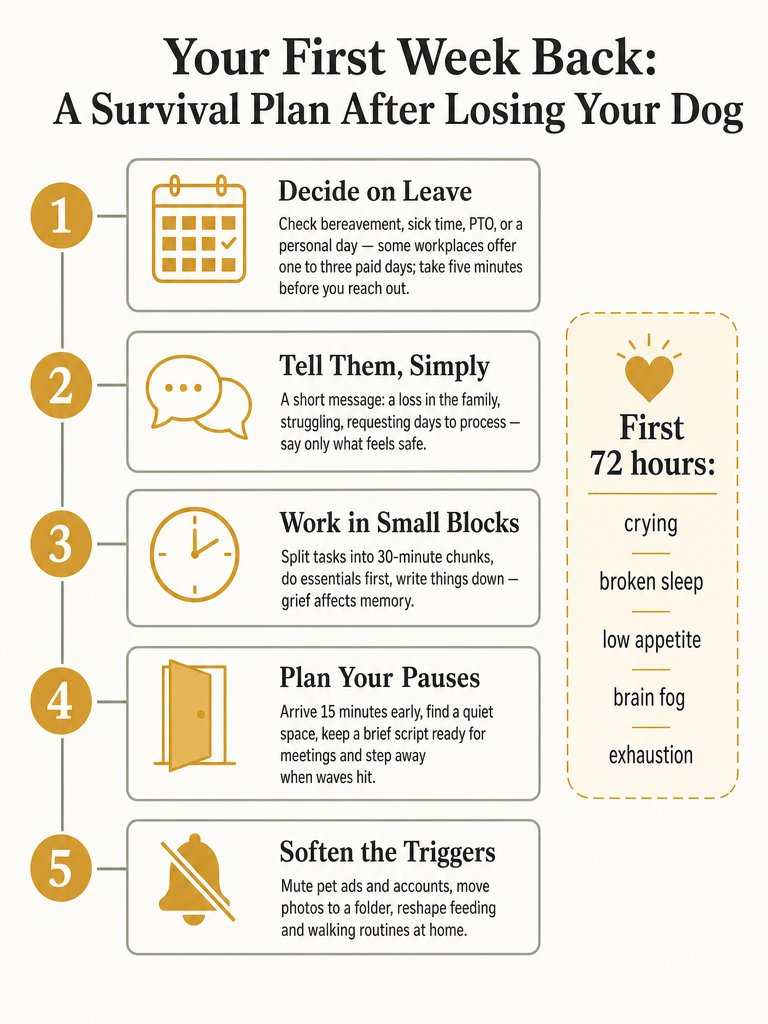
If you can take time off, take it. If you can't, build the smallest survivable week. Start with the least disclosure that feels safe, cut your work down to essentials, and let yourself work at a different pace. Honor Pet recommends splitting larger projects into 30-minute chunks and documenting your work more carefully than usual, because grief can affect memory.
Expect the days to be uneven. Grief after pet loss is not linear — one workday may feel almost normal, the next unexpectedly difficult (Source: Honor Pet). That isn't failure. It's how this works.
This guide moves in order — leave and disclosure first, then protecting your focus, then the triggers waiting at home and in your inbox.
Can I take bereavement leave for a pet?
Some employers do offer paid pet bereavement leave, but most do not, so check your own policy before assuming either way. My Resting Pet states that some companies — including Mars, Kimpton Hotels, and Trupanion — include pet loss in their bereavement policies, with some offering one to three paid days for a pet's death. The AHELP Project is blunt about the broader reality: workplaces struggle to recognize pet loss as legitimate grief, and policies rarely include pet bereavement leave.
Before you contact anyone, take five minutes to understand your options. My Resting Pet advises checking four things first:
| What to check | Why it matters |
|---|---|
| Company bereavement policy | A few employers cover pet loss directly |
| PTO balance | Vacation days need no reason given |
| Sick time | Grief affects your health and ability to work |
| Disclosure requirements | How much you legally have to explain |
If your workplace has no pet bereavement policy, that doesn't mean you have no options. Personal days, sick time, and PTO are all yours to use. Honor Pet is clear: it's completely okay to ask for time off to process this loss.
How do I tell my boss I need time off for a pet death?
Tell your boss exactly as much as you need to and no more — a direct, professional message works without a long explanation. Honor Pet suggests a straightforward script: "I wanted to let you know that my pet passed away, and I'm finding it particularly challenging. I'd like to use [X] days of my personal or sick time to process this loss."
For dog owners who dread hearing "it was just a dog," My Resting Pet offers a disclosure ladder — pick the rung that fits your manager and your nerve:
- Direct and honest: name the loss and the days you need, as above.
- Minimal: request a personal or sick day without specifying the reason.
- Family-matter framing: describe it as a personal or family matter you need to attend to.
- Written instead of spoken: send an email or text if saying it out loud feels too raw.
Remote workers can add context Honor Pet recommends naming directly: "As someone who works from home, my pet was a constant presence during my workday. Their absence is significantly impacting my ability to focus in my usual workspace."
You do not owe anyone the full story of your grief to justify needing rest. Choose the smallest true thing you can say, and let that be enough. If speaking live feels impossible, writing it down is not a lesser choice — it's a practical one.
Why is pet bereavement very real and why should it be respected in the workplace?
Dog grief is real bereavement that shows up in the body, not a lapse in professionalism. Boston Dog Lawyers describes the first 72 hours after sudden pet loss as a period when you may experience restlessness or anxiety, uncontrollable crying sometimes with headaches, fractured sleep, loss of appetite, brain fog, exhaustion, and moments where it feels hard to catch your breath. That list is physiological. Your nervous system is responding before your mind can catch up.
At work, this same grief surfaces in ways colleagues may misread. The AHELP Project notes that unacknowledged grief can appear as reduced focus, emotional fatigue, irritability, and unexpected waves of sadness — or relief. None of that is you slacking. It's the cost of a real attachment ending.
The hard part is that the world often doesn't treat it that way. Returning to work after pet loss usually happens with no structured acknowledgment and no shared language for why concentration feels fractured (Source: AHELP Project). Knowing the symptoms are normal won't make them stop, but it can stop you from adding shame on top of grief. For more on why the bond hurts so deeply, see the science behind why losing a dog hurts.
If I have to work during the first week, what tasks should I do first and what can reasonably wait?
Do the essentials first, defer everything optional, and assume your memory is not reliable this week. Honor Pet's workload strategy is built for exactly this: focus on essential tasks first, communicate adjusted timelines, and document your work more carefully than usual because grief can affect memory.
A simple triage for the first week:
- List only what truly can't wait — deadlines with real consequences, commitments other people depend on today.
- Break each one into 30-minute chunks. Honor Pet recommends this so a large project stops feeling like a wall and becomes a series of short, finishable pieces.
- Use a written task list to track small accomplishments, since brain fog makes it easy to lose your place.
- Push non-urgent work to later in the week and tell teammates the new timeline plainly.
- Write down decisions and conversations as you go — what you agreed to, what comes next — so you don't have to trust your memory to hold it.
| Do first | Can wait |
|---|---|
| Hard deadlines today | Long-term planning |
| Work others are blocked on | Optional meetings |
| Quick, finishable tasks | New projects |
| Documenting what you do | Non-urgent email replies |
Give yourself permission to work at a different pace (Source: Honor Pet). A slower, careful week is not a failed week.
How can I get through meetings, calls, and client communication when grief waves hit?
Grief waves arrive without warning, so plan for them before the meeting starts rather than hoping they hold off. The AHELP Project describes the ordinary scene: you log into your first meeting, someone asks about your weekend, and you mute yourself so no one hears your voice catch. That's the moment to prepare for.
A few practical defenses:
- Keep brief scripts ready. Honor Pet offers reduced-capacity language you can reuse. For colleagues: "I'm currently dealing with a personal loss. I appreciate your understanding if I'm less responsive than usual." For clients: name that you're briefly operating at reduced capacity due to a personal loss while staying committed to the work.
- Arrive early. Honor Pet suggests office workers arrive 15 minutes early to compose themselves; the same buffer works before a call.
- Know your quiet space. Identify somewhere — a stairwell, a parked car, an unused room — you can step into if emotion rises.
- Give yourself permission to step away. A muted camera, a "give me one moment," or leaving a call briefly is allowed.
Office vs. remote work: where will dog grief hit hardest?
Office and remote work each carry their own triggers, so the fix depends on where you'll actually be. Honor Pet gives different adjustments for each, because the absence shows up differently in each place.
| Office workers | Remote workers | |
|---|---|---|
| Main trigger | Commuting, being watched, public emotion | Constant presence of the dog's absence at home |
| What helps | Arrive 15 minutes early to compose yourself | Rearrange your workspace if needed |
| Identify quiet spaces for brief emotional moments | Create new break patterns | |
| Keep a small comfort item at your desk | Work from a different room temporarily |
For office workers, the hardest moments tend to be sudden and exposed — a colleague's question, a meeting, the drive home to an empty house. For remote workers, the difficulty is steadier. Your dog may have been a constant presence during the workday (Source: Honor Pet), which means every familiar corner of your home office can ache.
The AHELP Project adds one grounding option that works in either setting: a small point of connection, like a photo tucked into a drawer or a tag kept nearby, can steady you during the day. If you work from home and a room is unbearable, moving to a different one temporarily isn't avoidance — it's giving your nervous system a break from the cues that hurt most.
What should I change in my routine and digital space when my dog's absence is everywhere?
The deepest disruption after a dog dies is rhythmic — the feeding, walking, and medication times that structured your day are suddenly empty. The AHELP Project names this directly: the disruption to your daily routine can be one of the hardest parts. For a work-from-home owner especially, those gaps land in the middle of the workday, where a dog was a constant companion.
Two fronts to manage:
Your physical routine. Old habits will surface at their old times — the lunchtime walk, the afternoon feeding. Expect them. The AHELP Project suggests creating new break patterns so those moments have somewhere to go instead of becoming ambushes.
Your digital space. Screens are full of triggers, and Honor Pet recommends adjusting your digital environment deliberately:
- Mute pet-related advertising in your social media settings.
- Move pet photos into a separate folder so they don't pop up unexpectedly.
- Temporarily mute pet-focused social accounts.
Add the work-specific ones the sources point toward: soften calendar reminders set for medication or feeding times, and turn off any pet-camera app notifications. These were lifelines a week ago; now they're hits you don't see coming. For more on rebuilding the small structures of a day, see how to handle daily tasks after losing a dog.
How do I handle returning to work when I was already exhausted from anticipatory grief?
If you were caregiving for a dying dog before the death, you're returning to work already depleted, and that depletion is real. The AHELP Project is clear that returning to work after pet loss often doesn't follow a sudden loss alone — it follows weeks or months of anticipatory grief, the long stretch of watching a beloved companion decline.
That grief appears, the AHELP Project notes, in medication schedules, mobility changes, appetite concerns, and late-night worry. By the time you log back in, you may have been running on empty for a long time. Returning after prolonged emotional vigilance can feel disorienting.
This is where conserving energy becomes a skill, not a weakness. The AHELP Project emphasizes that opting out of optional social activities, taking breaks alone, or protecting your emotional energy can be self-awareness rather than disengagement. You are not being antisocial by skipping the optional team lunch this week.
If you're still inside the decline rather than past it, coping with anticipatory grief as a pet owner covers that stretch in more depth.
What should I do if a surviving dog at home is also grieving while I am trying to work?
A surviving dog can grieve too, and that means you may be managing your own grief and another animal's at the same time while trying to work. Old Dog Haven explains that because dogs process everything emotionally, their sense of loss can be profoundly difficult for them.
Watch for these signs, which Old Dog Haven lists — though each dog grieves differently:
- Loss of appetite
- Lethargy and depression
- Wakefulness, or sleeping more than usual
- Accidents in the house
- Behavior issues
- Separation anxiety
- Vocalizing — howling, whimpering, whining
- Personality changes
Old Dog Haven recommends seeing a vet first to rule out a physical problem behind the symptoms. If it's grief, the help is steadying: stick to a secure routine, add a bit more exercise and stimulation, and bond through extra time together.
Two cautions. Old Dog Haven advises against hovering, and against expecting a new dog to fix things right away. The sources differ here — some owners find another animal genuinely helpful, while Old Dog Haven warns not to rush it. If you're weighing that, balancing grief and bonding with a new pet walks through readiness honestly.
How do I manage the loss of my beloved dog who died 1 week ago if I still can't function?
If a week has passed and you still can't function, that is not a failure — it's a sign you need more support than the workday alone can hold. Honor Pet points to several options that exist outside your job: a company Employee Assistance Program, pet loss support groups that meet virtually after work hours, and grief counseling that fits your schedule.
Start with what's nearest. Many employers offer an Employee Assistance Program with free, confidential counseling sessions — worth checking even if you've never used it. Beyond that, virtual pet loss support groups let you find people who won't say "it was just a dog," and a counselor who understands pet bereavement can help with the guilt and the looping what-ifs.
For deeper, dog-specific help, these guides go further than a single workday allows:
- I lost my dog and I can't function — here's what actually helped
- How to survive the first week after your dog dies
- How to find a pet loss grief counselor
If you want something to hold in the in-between hours — companionship and practical guidance from someone who has walked through this — To Lose A Dog was written for exactly this stretch of grief. You don't have to get through this week, or this loss, on willpower alone.
Frequently asked questions
Can I take bereavement leave for a pet's death?
A few employers do offer paid pet bereavement leave — companies like Mars, Kimpton Hotels, and Trupanion provide one to three paid days — but most workplaces still don't include it in formal policy. Before you assume you have no options, check your PTO balance, sick time, and personal days. None of those require you to explain the reason, so you're not without a path even if your employer's bereavement policy comes up short.
How do I tell my boss I need time off because my dog died?
A direct, short message works best: "My pet passed away and I'd like to use [X] days of personal or sick time to process this loss." You don't owe a full explanation. If naming the loss out loud feels too raw, send it in writing — that's practical, not avoidant. For managers likely to minimize pet grief, describing it as a personal or family matter is a completely legitimate way to frame the request.
What tasks should I prioritize at work the week my dog died?
Focus only on deadlines with real consequences and work other people are blocked on — let everything else slide. Breaking each essential task into 30-minute chunks makes the workload feel finishable instead of overwhelming. Write down every decision and conversation as you go, because grief genuinely affects memory. A slower, careful week spent on only the essentials is not a failed week.
Why does dog grief make it so hard to concentrate at work?
In the first 72 hours after a dog's death, the body responds physiologically — restlessness, brain fog, fractured sleep, loss of appetite, and exhaustion are all documented symptoms of acute pet loss grief. At work, the same nervous-system response shows up as reduced focus, emotional fatigue, and unexpected waves of sadness. That's not a lapse in professionalism; it's the cost of a real attachment ending.
How do I get through work meetings when grief hits without warning?
Prepare a short script before the meeting starts rather than hoping the wave holds off. For colleagues: "I'm dealing with a personal loss — I appreciate your patience if I'm less responsive than usual." Arriving 15 minutes early gives you time to compose yourself. Identify one quiet space — a stairwell, a parked car — where you can step away briefly if emotion rises. Avoid scheduling back-to-back calls this week; there's no buffer if one grief wave spills into the next.
Is it harder to work from home after a dog dies than to go into an office?
Remote workers face a steadier, more constant difficulty: the dog was a daily presence in that space, so every familiar corner of the home office carries the absence. Office workers tend to hit sharper, more exposed moments — a colleague's question, the commute home. For remote workers, rearranging the workspace or temporarily moving to a different room isn't avoidance; it gives the nervous system a break from the cues that hurt most.
Sources
- How to Help a Grieving Dog - Old Dog Havenwww.honor.pet
- How to return to work after losing a pet? - Facebookwww.bostondoglawyers.com
- Sudden Pet Loss: How to Get Through the First 72 Hourswww.ahelpproject.org