
How long does grief last after a dog dies?
Grief after a dog dies has no fixed deadline. It can stay intense for weeks or months, then return in waves for a year or longer, especially around routines and anniversaries. The sources are consistent on this: recovery varies from person to person. One pet-loss writer puts it plainly — for some people it takes weeks or months, for others it could be years (Source: nikitisza.com). A funeral-industry account of research and real stories describes owners feeling deeply affected for several months, with noticeable waves of sadness for a year or longer.
Here is what the honest answer requires you to know. There is no research-backed human timeline for dog-loss grief with neat stages or median durations. The corpus does not contain one, and anyone who hands you a tidy week-by-week schedule is guessing.
What the sources do support is this: grief lasting weeks or months is not a malfunction. It is the ordinary shape of losing someone you loved. A grieving owner on r/Petloss wrote, five, four, and two months out from losing dogs and a cat, that they still cried almost daily and didn't expect the pain to lessen soon.
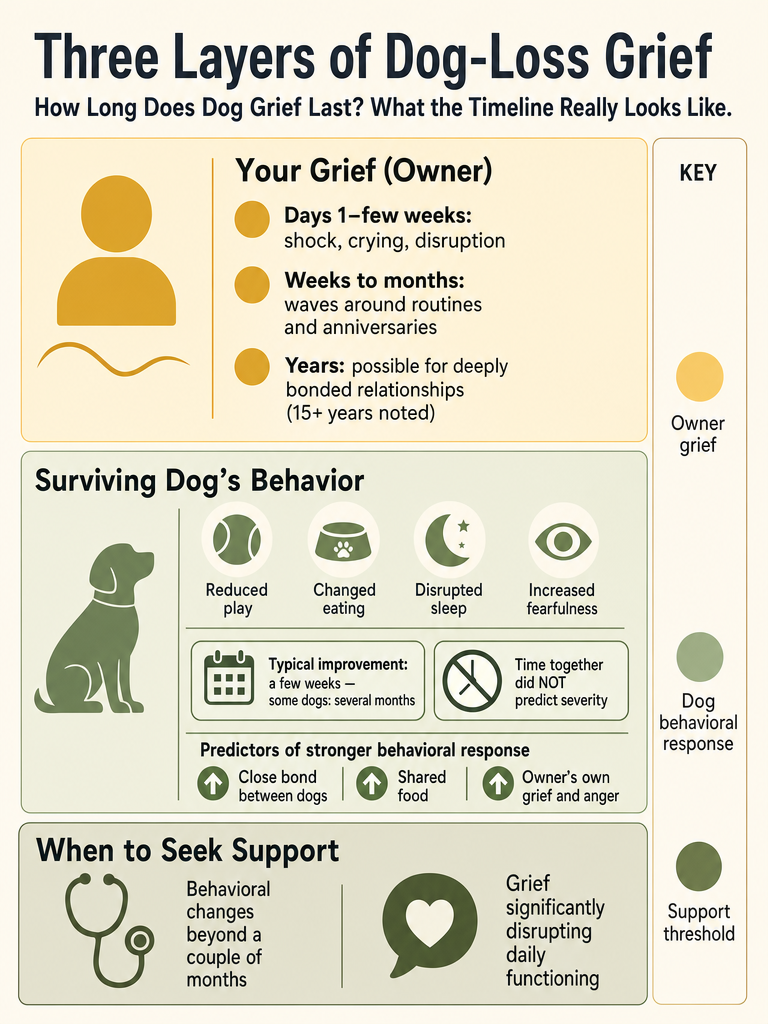
What does dog-loss grief look like in the first days, first weeks, and later months?
The realistic shape of dog grief is shock first, raw disruption next, and waves later — not a straight line down. No source gives validated benchmarks for each phase, so treat the following as a map of common experience, not a clock you're behind on. What the corpus supports is that the intensity can hold for weeks or months and resurface around routines and anniversaries for a year or longer (Source: funeral.com).
| Period | What people often describe | What the sources support |
|---|---|---|
| First days | Shock, disbelief, the body running on autopilot | Grief "may not just take a few days" (Facebook pet-loss group) |
| First weeks | Daily crying, broken sleep, empty routines | Owners report crying almost daily months out (r/Petloss) |
| Later months | Waves around walks, feeding times, anniversaries | Deep effect for several months, waves for a year or longer (funeral.com) |
The waves matter more than the calendar. The empty water bowl at 6 a.m., the leash by the door, the first holiday — these are the moments grief returns, even when you thought you were steadier. If you're in the earliest stretch, our guide to getting through the first week after a dog dies breaks the days into smaller, survivable pieces.
Grief doesn't move in a straight line, and a hard month six does not mean you're doing it wrong.
Is it normal if I am still grieving my dog weeks or months later?
Yes — grieving your dog weeks or months later is normal, not a sign you're stuck. The sources directly back this up. A grieving owner on r/Petloss described still crying almost daily at two, four, and five months out and not expecting the pain to lift soon. Pet-loss writers note recovery may take weeks, months, or years depending on the person (Source: nikitisza.com).
The pressure to "be over it" usually comes from outside, not from your own healing. When people say "it's just a dog," they're measuring your loss against a yardstick that was never built for love this real. Their discomfort is not your timeline.
If the crying feels constant and frightening in its size, that doesn't mean something is wrong with you. We unpack why in why constant crying after losing a dog is completely normal.
How does pet grief compare to human grief?
Pet grief can match human grief in intensity. A narrative review in the QEIOS journal reports that among the studies it examined, only one directly compared the severity of grief over a human death versus a pet's death — and that study found no significant differences in pain severity levels. That single finding does real work: it explains why losing your dog can feel as shattering as losing a person.
This isn't sentimentality. It's a measurable observation that the pain registers at a comparable level. The bond was woven into your daily life — the morning walk, the weight against your leg at night — so its absence hits the body as well as the heart.
The hard part is that human grief comes with bereavement leave, casseroles, and a funeral. Pet grief often comes with silence or a dismissive shrug. For a deeper look at the science behind the bond, see why pet loss hurts so much.
What are some common emotions experienced during pet grief?
Pet grief carries a wide emotional range, and none of it means you're handling things badly. The corpus and the lived accounts in it point to sadness and frequent crying, shock in the first days, and the particular sting of feeling dismissed when others treat the loss as minor. Guilt and anger commonly ride alongside, especially after an end-of-life decision.
What people often feel:
- Sadness and crying — sometimes daily, for months, as the r/Petloss accounts describe
- Shock and disbelief — the early numbness when grief "may not just take a few days"
- Anger — at the situation, the timing, sometimes at yourself
- Guilt — over a decision, a missed sign, or simply surviving them
- Feeling minimized — the loneliness of "it's just a dog"
If guilt is the loudest of these — particularly after euthanasia — you're not alone in that, and forgiving yourself after a euthanasia decision addresses it directly.
Do the stages of grief for pet loss predict your timeline?
The stages of grief don't predict how long your grief will last. Some pet-loss writing frames loss after 15+ years through "unique stages" of grief (Source: paigerechtman.com), but the corpus offers no fixed stage-by-stage duration for dog grief — no validated schedule for how many days denial lasts or when acceptance is supposed to arrive.
Stage models can help you name what you're feeling. They become harmful the moment they turn into deadlines. There is no rule that says anger should be done by week three or that lingering in sadness means you skipped a step.
Read stages as a vocabulary, not a calendar. If you want the framework without the pressure, the five stages of pet loss grief explained treats them as overlapping experiences rather than a checklist.
Does the length of the bond decide how long grief lasts?
The length of time you had your dog does not reliably decide how long or how hard you'll grieve. One source frames losing a pet after 15+ years as one of the hardest experiences a person can go through (Source: paigerechtman.com), and a long bond can absolutely deepen the loss. But the corpus does not support a simple rule that more years always equals longer grief.
Interestingly, the animal research points the other way for dogs. The Scientific Reports survey of surviving dogs found that the time two dogs had spent together had no effect on the surviving dog's behavior changes after one died.
For people, grief seems to track the depth of the bond and how the loss happened more than the raw number of years. A four-year-old dog lost suddenly can wound as deeply as a fifteen-year companion. Don't let the math become another reason to doubt your own pain.
How does a surviving dog's grief differ from your grief?
A surviving dog's grief looks like behavior change, not the human experience of mourning — and confusing the two leads people to misread both. Your grief is reflective, anticipatory, tangled with guilt and memory. A dog's response shows up in what they do.
A study published in Scientific Reports surveyed 426 Italian adults who had owned at least two dogs, one of whom died while the other lived. After a companion dog's death, surviving dogs changed in activities like playing, sleeping, and eating, and in emotions such as fearfulness. The study's authors note there was no documented scientific evidence of grief in pet dogs before this work; they measured responses using the Mourning Dog Questionnaire.
What predicted the strongest changes is the part most owners miss. A friendly or parental relationship between the two dogs, shared food, and — notably — the owner's own grief and anger were principal predictors of negative behavioral changes in the surviving dog. The dogs' time together did not predict the changes.
| Your grief | A surviving dog's response | |
|---|---|---|
| How it shows | Crying, guilt, waves of sadness | Less play, appetite changes, more sleep, fearfulness |
| Key influence | Depth of bond, how the loss happened | Relationship between dogs, your own grief and anger |
| Source | QEIOS review; pet-loss accounts | Scientific Reports (426 adults) |
There's an unsettling honesty in that last finding: your dog may be reading your distress as much as missing the other dog. VCA Animal Hospitals and Ever Loved both confirm dogs show mourning-like signs — which raises a practical question about when those signs need professional attention.
When should a grieving surviving dog see a veterinarian or behaviorist?
Call a veterinarian or behaviorist when a surviving dog's grieving behavior lasts more than a couple of months or clearly harms their well-being. VCA Animal Hospitals says signs of mourning in dogs may include depression and listlessness, decreased appetite, declining to play, and sleeping more than usual. Ever Loved adds that dogs typically begin showing improvement within a few weeks, though some carry lingering effects for months.
The timeline gives you a practical decision point. Watch for these VCA-named signs:
- Depression and listlessness
- Decreased appetite
- Declining to play
- Sleeping more than usual
A few quieter weeks are expected. Months of withdrawal, or any sharp drop in eating, deserve a professional's eyes — partly to rule out a physical illness wearing a grief costume.
What are some practical steps to cope with pet grief?
The most useful thing you can do while grieving is lower the bar and protect the basics — eating, hydrating, resting — rather than forcing yourself back to normal. The sources are united that grief takes weeks or months and that crying is not something to be afraid of (Source: Facebook pet-loss group). Functioning, not "healing on schedule," is the goal of the early stretch.
Grounded steps that hold up:
- Shrink the day. Handle one task, not the whole list. Our guide to handling daily tasks after losing a dog helps when routines feel hollow.
- Protect sleep. Nights are often worst; what actually helps when you can't sleep offers small, doable steps.
- Manage work narrowly. Do less and disclose little in the first week — see dog grief at work.
- Find words for others. When you can barely speak it, how to tell people your dog died gives short scripts.
- Reach a real voice when needed. Pet loss hotlines connect you to live support.
You don't have to be productive to be healing. Surviving the day counts.
Are there any support groups for people grieving the loss of a pet?
Pet-loss support exists in several forms — hotlines, counselors, and groups designed specifically for animal grief — and it's worth seeking when the loss feels too heavy to carry alone. The current research corpus here is thin on naming specific vetted groups, so rather than point you toward generic directories, the most honest move is to send you to resources built for this exact grief.
Two kinds of help matter most early on:
- Real-time support for the hardest nights — covered in pet loss hotlines.
- Ongoing professional help if grief becomes hard to function around — see how to find a pet loss grief counselor.
A good rule of thumb: if grief is interrupting your ability to eat, sleep, or work for an extended stretch, that's reason enough to reach for outside help. You don't have to wait until you're in crisis to deserve support.
How can I honor my dog after they pass away?
Honoring your dog can be as small as keeping one daily ritual or as deliberate as a memorial you build over time — there's no required form. The research corpus here doesn't carry authoritative sourcing on specific rituals, so treat the following as grounded options rather than prescriptions, and choose what fits your grief.
A memorial often helps because it gives the love somewhere to go. Some people need it in the first week; others can't face it for months. Both are fine.
Where to start:
- Keepsakes and tributes — practical, budget-flexible ideas in 25 ways to honor your dog's life and 10 dog memorial ideas.
- Creative outlets — when words fail, painting through grief gives feeling a place to land.
- Living tributes — healing through animal volunteering honors your dog by helping others.
There's no deadline on remembrance. The ritual that matters is the one you'll actually return to.
Frequently asked questions
How long does grief last after a dog dies?
There's no fixed deadline — grief after a dog dies commonly stays intense for weeks or months, then returns in waves for a year or longer, especially around daily routines and anniversaries. Recovery varies widely: for some people it takes weeks or months; for others, years. A grieving owner on r/Petloss described still crying almost daily at two, four, and five months out. Grief lasting months is not a malfunction — it's the ordinary shape of losing someone you loved.
Is it normal to still be grieving my dog weeks or months later?
Yes — grieving your dog months later is normal, not a sign you're stuck. Owners on r/Petloss report crying almost daily five months after a loss and not expecting the pain to lift soon. Pet-loss writers confirm recovery can take weeks, months, or years depending on the person. The pressure to "be over it" almost always comes from outside, not from any legitimate grief timeline. Your pain has its own pace.
How does pet grief compare to human grief?
Pet grief can match human grief in intensity. A narrative review in the QEIOS journal found that the one study directly comparing the two reported no significant differences in pain severity between grief over a human death and grief over a pet's death. What makes pet loss harder is the social silence around it — no bereavement leave, no casseroles, and frequent dismissal from people who say "it's just a dog." The pain is real; the recognition often isn't.
What are some common emotions experienced during pet grief?
Sadness and frequent crying are most common, often lasting months — r/Petloss accounts describe almost daily crying well past the two-month mark. Shock and disbelief hit hardest in the first days. Guilt is especially loud after an end-of-life decision. Anger at the situation or at yourself is also widely reported, as is a specific loneliness that comes from feeling dismissed when others treat the loss as minor. All of these responses are normal.
Do the stages of grief predict how long dog grief will last?
Stage models don't predict how long grief lasts — they give you vocabulary, not a schedule. Some pet-loss frameworks describe "unique stages" for losing a pet after 15-plus years, but no validated timeline specifies how many days each stage runs. Treating stages as deadlines — telling yourself anger should be done by week three — is where they cause harm. Read them as overlapping experiences that help you name what you feel, not as a checklist to complete.
What are practical steps to cope with grief after losing a dog?
Lower the bar first: protect eating, hydrating, and sleep rather than forcing a return to normal. Sources consistently note that grief takes weeks or months and that crying is not something to fight. Practically: shrink each day to one task, guard your nights (they're typically the hardest), and limit what you disclose at work in the first week. When you need a real voice, pet-loss hotlines offer live support. Surviving the day — not healing on schedule — is the goal of the early stretch.
Sources
- The Unique Stages of Grief: Losing a Pet After 15+ Yearspaigerechtman.com
- how long does grief last after pet loss? - Facebookwww.facebook.com
- How Long Does It Take To Recover From Your Dog's Deathwww.nikitisza.com
- Do Dogs Mourn? | VCA Animal Hospitalsvcahospitals.com
- Do Dogs Grieve? | Ever Lovedeverloved.com