
Am I already grieving before my dog is gone, and what helps right now?
Yes. Grief that starts before your dog dies is real bereavement, and it has a name: anticipatory grief. The Association for Pet Loss and Bereavement, in an article by Dr. Erica Dickie of PetComfortVet.com, defines it as a natural reaction that occurs before the loss of a pet and an unconscious form of coping that helps prepare you emotionally for the goodbye to come.
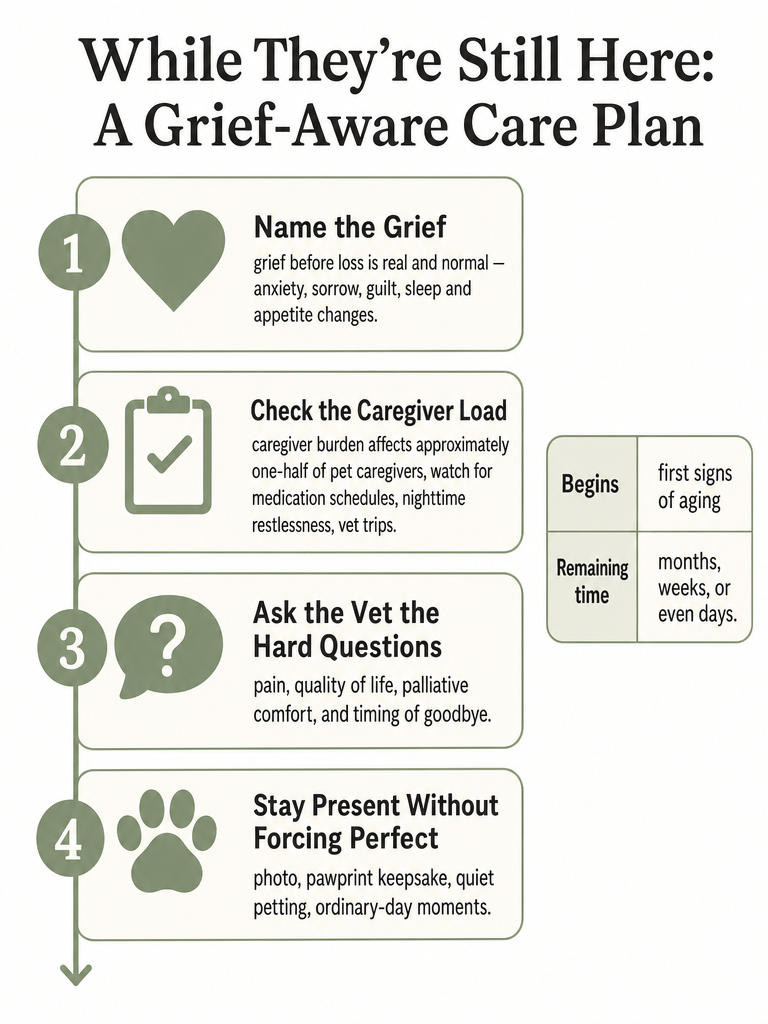
Anticipatory grief in dog owners is the mourning that begins after a serious illness, a terminal diagnosis, or significant decline — and sometimes as early as the first signs of aging. Any grief reaction you might expect after a dog dies can also surface during this "in-between" time. It is felt most deeply by people highly bonded with their dogs, which is most of the people reading this.
You don't have to manage it alone, and you don't have to make every choice today. Three steps help right now:
- Allow yourself to feel. Lap of Love notes that grieving while your dog is still beside you can feel strange, but you have every right to feel anger, fear, and sadness.
- Ask for help. Caregiving for a sick or elderly dog drains people, and others can carry part of it.
- Begin planning with your veterinarian so decisions come from steadiness rather than panic.
What does anticipatory grief look like in daily life?
Anticipatory grief usually arrives in waves, with anxiety as the predominant feeling. The Association for Pet Loss and Bereavement lists sorrow, depression, anger, dread, worry, fear, guilt, confusion, indecision, isolation, and forgetfulness among the common reactions dog owners report while their dog is still alive.
It shows up in the body too. Caring for an ill dog while constantly evaluating quality of life can create a hypervigilant state that is mentally and physically exhausting — and that may disrupt your appetite, weight, and sleep. You may catch yourself checking your dog's breathing at 3 a.m. or losing track of ordinary tasks.
Christine Henry, writing for Therapy for Pet People, describes a pattern many dog owners recognize: shock first, then a delayed crash. She kept busy researching and problem-solving after her dog's diagnosis, and only days later did it come crashing down — wave after wave of tears, the inability to imagine life without him.
The aging itself becomes a series of small griefs. Kristi Lehman, MSW, LISW, explains that as a dog's arthritis worsens, she may one day no longer manage the daily walk, the stairs, or chasing a ball. Each lost activity is an ending.
How do I know when caregiver burden means I need more support?
Caregiver burden is present in approximately one-half of pet caregivers in the context of serious illness, according to the Association for Pet Loss and Bereavement. If the work of caring for your dog feels like too much to carry alone, that is common — not a failure of love or competence.
The research backs this up. A 2019 study by Spitznagel and Carlson, cited by the Association for Pet Loss and Bereavement, linked greater caregiving burden with poorer psychosocial functioning — more stress, more anxiety and depression symptoms, and lower quality of life. The heavier the daily load, the more it costs you.
Watch for the signal in the tasks themselves. Lap of Love describes the realities that wear caregivers down: a strict medication schedule, cleaning up accidents in the house, a dog who becomes restless and vocal at night, and frequent veterinary visits. When those start to consume your sleep, your work, and your ability to think clearly, that is the moment to widen the circle of support.
Practical asks that genuinely lighten the load:
- A friend who handles a medication dose so you can sleep through one night.
- Someone to help clean up house accidents without making you feel ashamed.
- A person to sit with you, or drive, during a hard vet appointment.
- Someone who simply takes a regular task off your plate for a week.
Asking for help is part of caregiving, not a retreat from it. If the burden stays heavy, a pet loss grief specialist can support you while your dog is still alive — Doug Koktavy wished he had sought that help during his Labrador's illness rather than after.
Is my dog in pain, and what should I ask the veterinarian?
"Is my pet in pain?" is the first question Lap of Love lists among the worries that haunt owners in anticipatory grief, and it belongs at the top of your next vet conversation. Your veterinarian is the person who can assess pain, comfort, and quality of life directly — and turning your fear into specific questions gives you ground to stand on.
Bring a written list, because hypervigilance and forgetfulness make it hard to hold questions in your head. A focused conversation can cover:
- Pain: What signs of pain or discomfort should I watch for, and how do we treat them?
- Quality of life: How do we assess my dog's quality of life together, in concrete terms?
- Palliative and comfort care: What options exist to keep my dog comfortable as the illness progresses?
- Euthanasia timing: Lap of Love states a veterinarian can help assess when euthanasia is the kindest option — ask how you'll know that point is near.
- When to call: What specific changes should prompt a phone call or an urgent visit?
Lap of Love describes how unpredictable this stretch is — remaining time may be months, weeks, or even days, with no fixed timeline. That uncertainty is exactly why a clear set of "if this, then call" instructions from your vet matters so much.
When is the appropriate time to say goodbye?
Euthanasia timing is a veterinarian-supported decision aimed at preventing unnecessary suffering — not a test of whether you loved your dog enough. Lap of Love states that euthanasia is often the most compassionate and merciful choice to spare a dog unnecessary pain, and that a veterinarian can help you assess when it becomes the kindest option.
"When is the appropriate time to say goodbye?" is one of the questions Lap of Love says owners ask most. It sits alongside others that circle the same wound: How much time do we have? Am I making the best choices? What if I hold on too long? What if I let go too soon?
There is no clean formula here, and the sources do not offer a magic number or score. What they offer is a frame: the goal is your dog's comfort, judged with professional help, not your own endurance. Lean on your veterinarian's read of pain and quality of life rather than trying to carry the entire decision on intuition and guilt.
The goal of the timing is your dog's comfort, assessed with veterinary support — not proof of how much you cared.
If you want a deeper walk-through of weighing this choice, see our guide on when to put your dog down, written to be read on exactly these hard days.
What if I hold on for too long or let go too soon?
Both fears are normal, and Lap of Love names them as questions nearly every grieving owner asks: "What if I hold on for too long?" and "What if I let go too soon?" Naming them does not make them disappear, but it stops you from carrying them as private evidence that something is wrong with you.
Doug Koktavy offers a way to locate these feelings instead of drowning in them. In his Grey Muzzle excerpt, he frames fear as living in the future — what lies ahead when the illness worsens — and guilt as living in the past — the missed signs, the choices second-guessed. Presence is the work of living in the moment with your dog.
That framing is practical. When you catch yourself rehearsing a future goodbye, you are in fear. When you replay what you should have noticed sooner, you are in guilt. Neither is where your dog is. Your dog is here, now, in the room with you.
How do you prepare for the death of a beloved canine companion?
Preparing for a dog's death means building a plan while they're still here, so decisions come from steadiness instead of crisis. The Association for Pet Loss and Bereavement frames it directly: planning from a position of power, rather than anxiety-driven decision-making, helps owners cope better after the loss. Here is a dog-centered sequence.
Before the next day:
- Track daily observations — what your dog ate, how they moved, comfort levels, and your own emotional check-in. K9 Hearts describes exactly this kind of Pet Daily Care & Observation Journal for a serious or terminal diagnosis.
- Keep medication notes so doses don't slip through the cracks of an exhausting week.
Before the next vet visit:
- Bring your written observations and your list of pain, quality-of-life, and timing questions.
- Ask about palliative options that keep your dog comfortable at home.
Before aftercare decisions:
- Talk with your veterinarian about end-of-life choices, including whether in-home euthanasia is right for your dog. Lap of Love specifically raises in-home euthanasia as an option worth discussing.
- Decide on burial or cremation preferences in advance, so you are not choosing in the rawest hours.
For ideas centered on the goodbye itself, our guide to planning your dog's last day walks through favorite activities, treats, and keepsakes.
What memories or rituals can I create without making every day perfect?
The goal is connection, not perfection. Augusta O'Reilly, a veterinary social worker at the Virginia-Maryland College of Veterinary Medicine, names the trap directly: anticipatory grief can include "feeling pressure to make this holiday the perfect one." You do not owe your dog a flawless final season. You owe them your presence.
O'Reilly, through Virginia Tech, suggests low-pressure rituals that fit into ordinary days:
- Make a meaningful memory: take a photo, create a pawprint ornament, or wrap up a new toy or treat for your dog to open.
- Find quiet moments: notice paw prints on a walk, or synchronize your breathing with your dog's when things feel stressful.
- Pet mindfully: slow down and notice your dog's muscles and the texture of their fur.
None of these require a special occasion. A single quiet moment counts. Mindful petting on a regular Tuesday counts. The point is to be where your dog is, instead of mourning a day that hasn't happened yet.
What can I say when others minimize this grief while my dog is still alive?
When someone implies it's too early to grieve, or that "it's just a dog," you don't owe them a debate. Your grief is real bereavement. The Association for Pet Loss and Bereavement lists isolation among the common feelings of anticipatory grief precisely because so many people don't understand mourning a dog who is still breathing.
A few calm responses that hold your ground without escalating:
- "I'm grieving now because I love him now. I'd rather feel this than miss any of it."
- "This is real grief for me. I just need you to know that."
- "I'm not looking for it to make sense to you — I'm just telling you where I am."
You can also simply step toward people who get it. Talking with others who understand anticipatory grief, rather than those who minimize it, eases the isolation. If your circle keeps falling short, that is a reason to find better support, not a reason to doubt your own heart.
Where should I go next for euthanasia planning, last-day ideas, or the first week after loss?
Your next step depends on where you are in this. Below are grounded guides for the specific decisions ahead — and for the days after, when you may not have the energy to search.
| If you are facing... | Start here |
|---|---|
| Wondering if the end is near | 7 signs your dog is nearing end of life |
| The euthanasia decision | When should you euthanize your dog? |
| Planning the goodbye | How to plan your dog's last day |
| Needing professional support | How to find a pet loss grief counselor |
| The hours right after | What to do when your dog dies: the first 24 hours |
| The first week | How to survive the first week after your dog dies |
If you want company through the whole arc — anticipatory grief, the decisions, and the days after — our deeper guide on coping with anticipatory grief as a pet owner sits alongside this one.
For something to hold onto in your hands, To Lose A Dog blends one owner's story with practical guidance for exactly this stretch — written for people grieving a dog they still get to hold.
Frequently asked questions
Is it normal to grieve your dog before they've actually died?
Yes — grieving before a dog dies is called anticipatory grief, and it's real bereavement. The Association for Pet Loss and Bereavement defines it as a natural reaction that occurs before the loss of a pet and an unconscious form of coping. Any grief reaction you'd expect after a dog dies — sorrow, anger, fear, guilt — can surface during this in-between time. Feeling it doesn't mean you've given up; it means you're deeply bonded.
What does anticipatory grief feel like day to day when your dog is still alive?
Anxiety is the dominant feeling, arriving in waves alongside sorrow, dread, guilt, confusion, and forgetfulness. Many owners also experience a whiplash pattern: settling into "maybe he's okay" when the dog chases a ball, then being pulled back by a tired look in his eyes or his refusal to climb the stairs. Constant quality-of-life monitoring creates a hypervigilant state that disrupts sleep, appetite, and the ability to manage ordinary tasks.
How do I know if caregiver burden from a sick dog is getting to be too much?
About half of pet caregivers in serious-illness situations experience caregiver burden, according to the Association for Pet Loss and Bereavement. A 2019 study by Spitznagel and Carlson linked heavier caregiving loads to more stress, anxiety, depression symptoms, and lower quality of life. When a strict medication schedule, nighttime restlessness, house accidents, and frequent vet visits start consuming your sleep and your ability to think clearly, that's the signal to widen your support circle — not push through alone.
What questions should I ask my vet about my dog's pain and end-of-life care?
Bring a written list, because hypervigilance makes it hard to hold questions in your head during an appointment. Cover these five areas: what specific signs of pain to watch for and how they're treated; how to assess quality of life together in concrete terms; what palliative or comfort-care options exist at home; how to know when euthanasia is becoming the kindest choice; and which changes should trigger an urgent call versus a routine visit. Knowing the line between emergency and non-emergency in advance spares you from judging it alone at 3 a.m.
How do you know when it's the right time to euthanize your dog?
Euthanasia timing is a veterinarian-supported decision aimed at preventing unnecessary suffering — not a test of how much you loved your dog. Lap of Love states it's often the most compassionate and merciful choice, and that a veterinarian can help you assess when it becomes the kindest option. There's no clean formula, but the frame that holds is this: the goal is your dog's comfort, assessed with professional help, not your own endurance or guilt.
How do I stop the fear of losing my dog from stealing the time I have left with them?
Doug Koktavy, author of The Legacy of Beezer and Boomer and an APLB-certified counselor, offers a practical frame: fear lives in the future, guilt lives in the past — and your dog lives in neither. When you catch yourself rehearsing the goodbye, you're in fear. When you replay what you should have noticed sooner, you're in guilt. Neither is where your dog is. Naming which one has pulled you out of the present is often enough to find your way back to the room you're both actually in.
Sources
- How to navigate 'anticipatory grief' for aging pets this holidaytherapyforpetpeople.com
- My Heart Is Breaking While You're Still Here - Therapy For Pet Peoplewww.greymuzzle.org
- Coping with Pet Illness and Loss by Doug Koktavywww.k9hearts.com