
If you need to talk to someone right now after pet loss, who can you call?
If your dog just died and you need a voice on the other end, three pet-loss resources can help. The Cornell Pet Loss Support Hotline answers at 607-218-7457 during staffed hours. Lap of Love runs a Support Center at (855) 933-5683, available 24/7 for questions. The Association for Pet Loss and Bereavement (APLB) hosts a chat room for grieving pet parents.
These are pet-loss support resources, not emergency lines. The Cornell University College of Veterinary Medicine hotline keeps set hours: Monday-Friday 6-9 p.m. EST, and Saturday and Sunday 12-9 p.m. EST. Lap of Love says its Support Center is open every day of the year, including weekends and holidays, so a person can answer when the hour is wrong everywhere else.
If you are in crisis, thinking about hurting yourself, or in danger, please contact emergency services or a crisis line in your area. The pet-loss resources here hold grief; they are not built for medical or psychiatric emergencies.
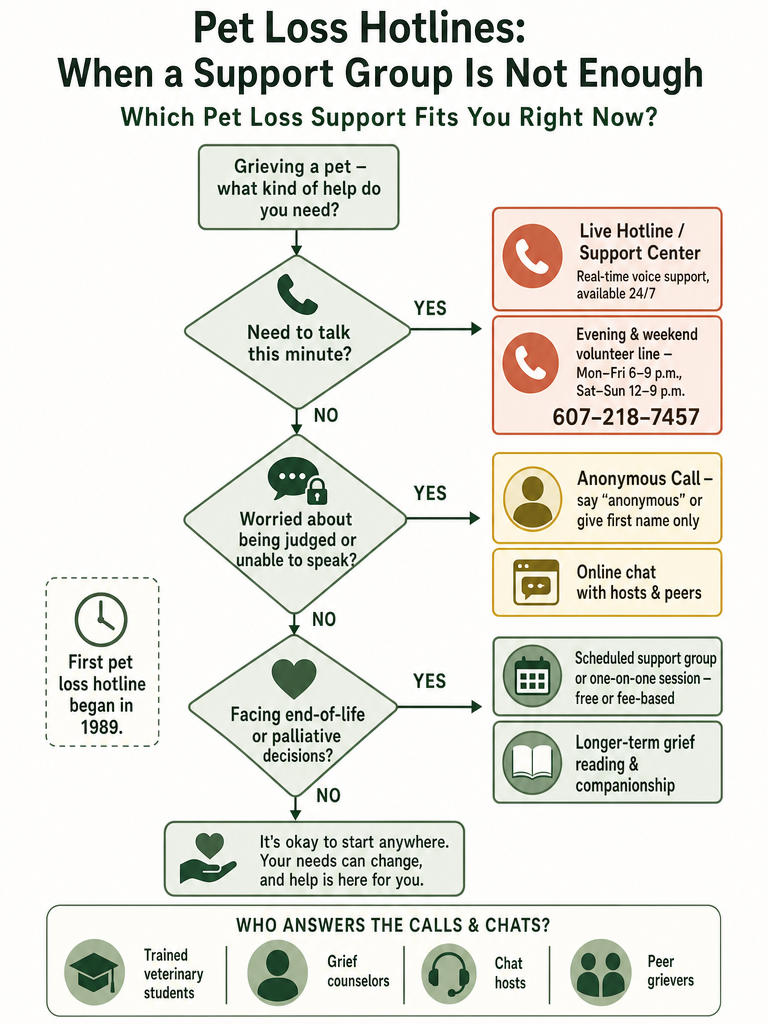
How do you choose between a pet loss hotline, support group, private session, and longer-term support?
The right kind of help depends on how urgent your pain is, how private you need to be, and whether your grief is tied to an end-of-life decision. A live hotline fits a hard hour you have to get through now. A support group fits ongoing loneliness. Private coaching fits grief you'd rather not say out loud in a room. None is better; they answer different needs.
Match your situation to the kind of support before you dial. Cornell says grief involves physical, intellectual, emotional, social, and spiritual levels, and that there's no prescribed timeline, so your needs will shift week to week.
| Type of help | Best when | Example resource | Cost category |
|---|---|---|---|
| Live phone hotline | You need a voice in a bad hour | Cornell Pet Loss Support Hotline | Free, limited hours |
| 24/7 phone support center | You have questions any time of day | Lap of Love, (855) 933-5683 | Free to call |
| Hosted chat room | You can type but not speak | APLB Bronze membership chat | Free |
| Virtual support group | You want shared, scheduled connection | Lap of Love small groups | Free and fee-based |
| Private one-on-one | You want focused, private support | Lap of Love certified coaches | Fee-based |
| End-of-life counseling | Decisions and grief overlap | Argus Institute, Two Hearts Pet Loss Center | Varies |
A book like To Lose A Dog fits later, as companionship for the quiet weeks. It's not a substitute for a live person when you need one tonight.
What is a pet loss support helpline?
A pet loss support helpline is real-time grief support for someone facing a pet's death before, during, or after it happens. Cornell University College of Veterinary Medicine describes pet grief as a complicated process with no prescribed timeline, touching physical, intellectual, emotional, social, and spiritual levels of life. A helpline gives you a trained, compassionate listener for that experience rather than a checklist.
These lines exist because the bond is real and the loss is profound. Cornell notes the very first pet loss support hotline was set up in 1989 at the University of California at Davis, and Cornell used those guidelines when building its own. The model has held for decades: someone who understands picks up, and you don't have to defend why a dog's death hurts this much.
What pet loss hotlines are available, and what hours are actually stated?
Two pet-loss phone resources have clearly stated, verifiable details: the Cornell Pet Loss Support Hotline and the Lap of Love Support Center. Cornell lists 607-218-7457, staffed Monday-Friday 6-9 p.m. EST and Saturday and Sunday 12-9 p.m. EST. Lap of Love lists (855) 933-5683 and says its Support Center runs 24/7, every day of the year.
The Cornell hotline is staffed by volunteer veterinary students trained by professional grief counselors. That matters: you're speaking with people who understand both the medical and emotional sides of losing a dog.
| Resource | Phone | Stated hours |
|---|---|---|
| Cornell Pet Loss Support Hotline | 607-218-7457 | Mon-Fri 6-9 p.m. EST; Sat-Sun 12-9 p.m. EST |
| Lap of Love Support Center | (855) 933-5683 | 24/7, every day of the year |
Other resources appear in directories without full, current details I can verify here. Tufts University Cummings School of Veterinary Medicine runs a Pet Loss Support Helpline, listed at 508-839-7966 in directory snippets. Humane Colorado's resource page references additional hotlines. Many commonly listed lines — including ones tied to the ASPCA, Chicago Veterinary Medical Association, Penn Vet, the University of Illinois College of Veterinary Medicine, Virginia Tech, the University of Maryland, Washington State University, and UC Davis — appear in roundups, but I can't confirm their current numbers or hours from the sources at hand.
Are pet loss hotlines free support when you need it most?
Some of the most respected pet-loss support is free, though "free" varies by format. The Cornell hotline costs nothing to call. APLB offers a free Bronze Membership for Pet Parents that opens its hosted chat room. APLB is a 501(c)(3) nonprofit founded in 1999, which is part of why core access stays free.
Lap of Love describes its virtual pet loss support as both free and fee-based: free weekly virtual support groups alongside paid individual sessions, group journaling, and extended courses. The free groups are a reasonable first step; the paid options exist for people who want focused, private guidance.
Exact pricing for Lap of Love's fee-based sessions and courses, and for APLB's paid Silver and Platinum membership tiers, isn't something I can state from the available sources. APLB's Silver membership does include one pet memorial, and its higher tiers add more. The first call or chat that matters most is almost always free — start there before you weigh anything paid.
Can I call anonymously if I feel ashamed, overwhelmed, or unable to speak clearly?
Yes — you can stay anonymous on the Cornell Pet Loss Support Hotline. Cornell says callers can remain anonymous by saying "anonymous" or entering only a first name when Google Voice prompts them. You don't owe anyone your full name to deserve support, and shame about how hard you're taking this is its own kind of grief Cornell names directly.
Cornell lists guilt, numbness, embarrassment, and feeling isolated in grief as normal parts of the process. So if you can barely form sentences, that's expected, not a problem. You can open with something plain:
- "My dog died and I don't really know what to say."
- "I think I made the wrong call about euthanasia and I can't stop thinking about it."
- "I feel numb and I don't understand why I can't cry."
- "Everyone keeps saying it's just a dog and I can't talk to them."
The person on the line will take it from there. You're allowed to cry, pause, or say you need a minute.
Where can I find real-time help for pet loss: hotlines, chats, and online communities?
Real-time and near-real-time pet loss help comes in three shapes: live chat rooms, scheduled virtual groups, and on-demand resources. The APLB chat room, opened through free Bronze membership, lets you share your story with professional chat hosts and other grieving pet parents. Lap of Love runs virtual small groups and private support led by certified coaches.
Best Friends lists several more in its pet loss resource page. These differ in how live they actually are:
| Resource | Format | How immediate |
|---|---|---|
| APLB chat room | Hosted text chat | Scheduled dates/times |
| Lap of Love small groups | Virtual group | Scheduled |
| Michigan State University Veterinary Medical Center group | Phone or computer meetings | Scheduled |
| Jasper | Videos, articles, guided practices | On-demand |
| PawsPathway | Virtual groups and one-on-one | Scheduled/booked |
| Grief Healing | Lists helplines and message boards | Directory |
| The Pet Loss Support Page | Lists hotlines and resources | Directory |
Best Friends also offers on-demand video, including a 10-minute guided meditation led by co-founder Cyrus Mejia and a TEDx talk by Dr. Sarah Hoggan. Those comfort and explain, but they aren't a live person — keep them on a different shelf from the chat rooms and groups.
Pet loss hotline vs online pet loss group: what are the pros and cons?
A hotline and an online group solve different problems. A hotline gives you private, one-to-one attention in a single hard moment — useful when the pain is urgent and you can't wait for a scheduled meeting. A group, like those through APLB, Lap of Love, or Michigan State University, gives you shared mourning and the recognition of people who get it.
The sources don't compare which works better, so choose by fit, not by ranking.
| Factor | Hotline | Online group |
|---|---|---|
| Privacy | High; can be anonymous (Cornell) | Lower; you're with others |
| Timing | Single call, urgent moments | Scheduled, recurring |
| Connection | One listener | Peer recognition, shared stories |
| Best for | Acute distress, a bad night | Ongoing loneliness, the long middle |
Many people use both — a hotline to survive the first night, a group for the weeks after. There's no rule that you pick one and stay there.
When is private pet loss coaching or counseling a better fit than a group?
Private support fits when a group feels too public, too scheduled, or simply not enough for what you're carrying. If you flinch at speaking in front of strangers, or your grief is tangled with a specific decision you can't say aloud in a room, one-on-one support gives you room to go deeper at your own pace.
Several options offer this. Lap of Love's professionally certified pet loss coaches lead private one-on-one support and extended courses alongside their groups. PawsPathway offers one-on-one support. The Argus Institute at Colorado State University's College of Veterinary Medicine links to individual counseling and information on end-of-life decisions. Two Hearts Pet Loss Center offers grief counseling resources for families.
The sources don't set clinical thresholds for when private support becomes necessary, so trust your own read. If a group leaves you feeling more alone, that's a reason to try something more focused. If you're searching for ongoing professional help, our guide on finding a pet loss grief counselor walks through what to look for.
If euthanasia or palliative care is part of the grief, which resources can help?
When grief is wrapped around an end-of-life decision, look for resources built specifically for that overlap. Lap of Love addresses it directly through veterinary hospice, in-home euthanasia, telehospice, aftercare, quality-of-life assessments, and pet loss support — all under one network. Best Friends notes that the Argus Institute provides information on making end-of-life decisions for a pet.
This matters because anticipatory grief and euthanasia guilt aren't ordinary mourning. Cornell describes guilt and bargaining as normal parts of the grieving process, including the spiritual weight of questioning a decision you can't take back. You don't have to carry that alone or in silence.
If you're still in the deciding phase, the Lap of Love quality of life scale for dogs and our guide on when to put your dog down can help you think it through. If the decision is behind you and the guilt is loud, euthanasia guilt and self-forgiveness speaks to exactly that. For the days before, see coping with anticipatory grief and how to say goodbye to your dying dog.
What should you do after the call in the first night or first week?
After you hang up, make the next few hours small. Cornell describes grief as physical, intellectual, emotional, social, and spiritual — which means your body, not just your heart, is in shock. Don't expect yourself to plan, decide, or function normally tonight. Pick one thing: water, a blanket, a text to one person.
A loose plan for the first stretch:
- Tonight: lower the bar to survival. If you can't sleep, that's normal grief, not failure.
- Tomorrow: handle only the body-care or aftercare decisions that can't wait.
- This week: tell the few people who need to know, in your own words and on your timeline.
- When you're ready: think about returning to work and whether you want ongoing support.
We have grounded guides for each piece: what to do in the first 24 hours, when you can't sleep, when you can't function, how to tell people your dog died, and getting through the first week back at work.
How can a family involve children honestly and gently after a dog's death?
Children grieve a dog's death too, and they need honesty rather than euphemisms. Cornell advises that children comprehend death differently than adults, and that families should be honest, allow questions, listen, and include children in memorializing through creative processes like drawing, writing, or sharing memories. "Put to sleep" and "went away" can confuse a young child more than the plain truth.
Let kids ask the same question many times; repetition is how they process. Give them something to do with the grief — a drawing for the dog, a favorite memory said out loud, a small role in a goodbye ritual. Memorializing isn't only for adults.
For age-appropriate scripts and rituals, see how to help your child understand the death of a pet and how to help kids deal with pet death.
Frequently asked questions
What pet loss hotlines can I call right now, and what are their actual hours?
Two lines have clearly verified details. The Cornell Pet Loss Support Hotline (607-218-7457) is staffed Monday–Friday 6–9 p.m. EST and Saturday–Sunday 12–9 p.m. EST by volunteer veterinary students trained by professional grief counselors. The Lap of Love Support Center (855-933-5683) is available 24/7, every day of the year, including holidays. Confirm any other hotline's current hours directly on the organization's own page before relying on it.
Are pet loss hotlines free to call?
The Cornell Pet Loss Support Hotline costs nothing to call. The Lap of Love Support Center is also free to reach by phone. The Association for Pet Loss and Bereavement (APLB), a 501(c)(3) nonprofit founded in 1999, offers free Bronze membership that opens its hosted chat room. Lap of Love also runs free weekly virtual support groups alongside paid individual sessions — the free options are a solid first step before weighing anything that costs money.
Can I call a pet loss hotline anonymously if I feel ashamed or can't speak clearly?
Yes — Cornell's hotline allows callers to stay anonymous by saying "anonymous" or entering only a first name when prompted. Cornell explicitly names guilt, numbness, embarrassment, and isolation as normal parts of grief, so struggling to form sentences isn't a problem. You can open with something plain like "My dog died and I don't know what to say" and the person on the line takes it from there.
What is a pet loss support helpline, and why do they exist?
A pet loss helpline connects you with a trained, compassionate listener before, during, or after a pet's death — no need to justify why it hurts. Cornell University College of Veterinary Medicine describes pet grief as touching physical, intellectual, emotional, social, and spiritual levels of life, with no prescribed timeline. The first dedicated pet loss hotline launched in 1989 at UC Davis; Cornell modeled its own line on those original guidelines.
What's the difference between a pet loss hotline and an online pet loss support group?
A hotline gives you private, one-to-one attention in a single urgent moment — useful when you can't wait for a scheduled meeting. An online group, like those run by APLB, Lap of Love, or Michigan State University's Veterinary Medical Center, provides shared mourning and the recognition of people who understand what you're carrying. Many people use both: a hotline to survive the first night, a group for the weeks that follow.
When does grief around euthanasia or palliative care need its own kind of support?
When grief is tangled with an end-of-life decision, look for resources built for that overlap. Lap of Love addresses it directly through veterinary hospice, in-home euthanasia, telehospice, quality-of-life assessments, and pet loss support under one network. The Argus Institute at Colorado State University's College of Veterinary Medicine also offers individual counseling and guidance on end-of-life decisions. Cornell names guilt and bargaining — including questioning a choice you can't undo — as recognized parts of the grieving process.
Sources
- Grieving the Loss of a Pet: Resources for Copingbestfriends.org
- Association for Pet Loss and Bereavement – Free pet loss & grief ...www.lapoflove.com
- Pet Loss Support | Lap of Lovewww.vet.cornell.edu
- Pet loss and grief support - Humane Coloradofuneral.com