What does my dog’s Lap of Love quality-of-life score mean?
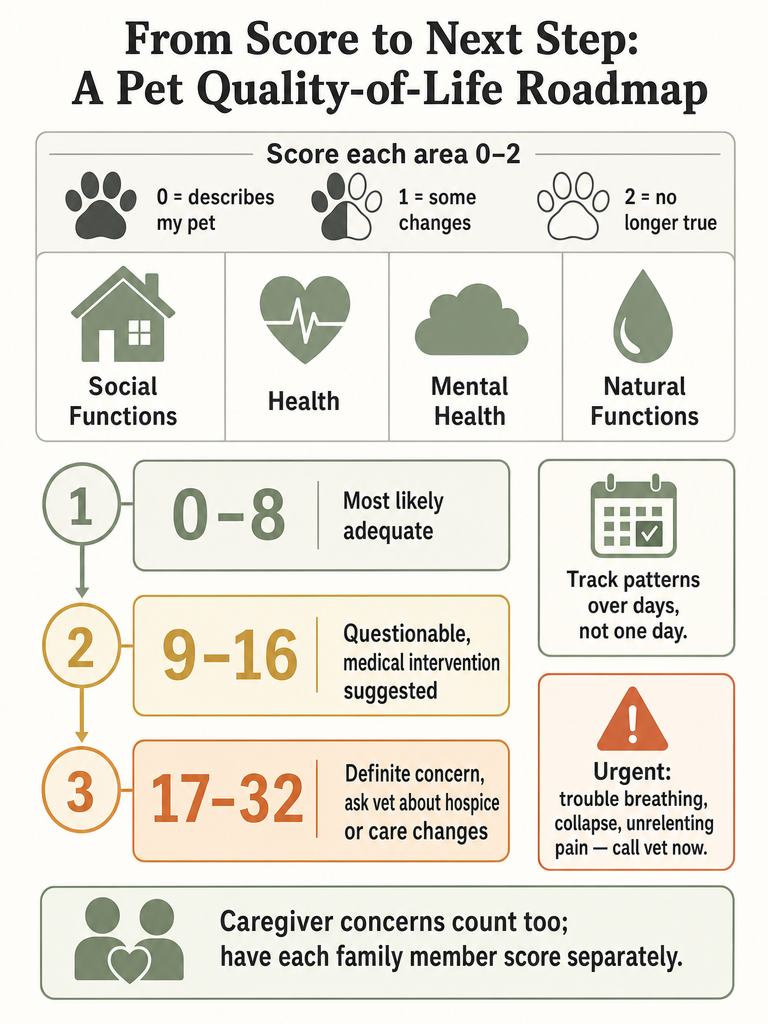
Your total score points you toward a conversation, not a conclusion. On the Lap of Love Pet Quality-of-Life Scale, 0–8 means quality of life is most likely adequate, 9–16 means it's questionable and medical intervention is suggested, and 17–32 means it's a definite concern (Source: LSU College of Veterinary Medicine, hosting the Lap of Love scale). Those bands describe what's likely happening — they don't decide anything for you.
Here's the distinction that matters most. A high score doesn't read "schedule euthanasia." For the 17–32 range, the Lap of Love scale says veterinary guidance will help you understand the end stages of your dog's disease process so you can make a more informed decision about whether to continue hospice care or elect peaceful euthanasia (Source: Lap of Love Pet Quality-of-Life Scale). A 9–16 score points to treatment changes and veterinary oversight, not goodbye.
| Total score | What it means | Likely next step |
|---|---|---|
| 0–8 | Quality of life most likely adequate | No medical intervention required yet; ask your vet what to watch for |
| 9–16 | Questionable; medical intervention suggested | Veterinary oversight to evaluate the disease process |
| 17–32 | Definite concern | Veterinary guidance on hospice care vs. peaceful euthanasia |
How do I use Lap of Love’s Quality-of-Life Scale for a dog?
You score each subsection 0 to 2, where 0 means the statement describes your dog, 1 means some changes are seen, and 2 means it does not describe your dog (Source: LSU/Lap of Love scale). Work through all four sections — social functions, health, mental health, and natural functions — add the totals, and bring the completed scale to your veterinarian.
The Lap of Love Pet Quality-of-Life Scale, created by Dr. McVety of Lap of Love Veterinary Hospice, is built so the math reflects decline: a calm, unchanged dog scores low, and a dog with mounting changes scores higher. Lap of Love instructs families to discuss the questions and the entire scale with their veterinarian rather than scoring in isolation (Source: Lap of Love).
There are different versions of the same tool, and they serve different moments:
- Printable Lap of Love Quality-of-Life Scale — the paper PDF you score by hand and bring to an appointment.
- Quality-of-Life Assessment — an online form that asks a few questions about your dog (age, weight, diagnosis) to provide more information (Source: Lap of Love).
- Interactive Quality of Life Assessment and Daily Diary — the digital version Lap of Love links from the printable scale for ongoing tracking.
Is there a way to objectively measure my dog’s quality of life?
No single tool delivers pure objectivity, but the Lap of Love Quality-of-Life Scale gets you closer than memory alone. Lap of Love says the scale helps families observe and score daily comfort, behaviors, and joy "with as much objectivity as possible," while organizing your thoughts rather than making decisions for you (Source: Lap of Love).
That phrasing is honest about its limits. The scale does not diagnose disease, erase the uncertainty you feel, or hand you the end-of-life answer. What it does is turn vague dread into specific, repeatable observations — how your dog rests, eats, moves, breathes, and connects with you.
A lower score doesn't mean you failed your dog, and a higher score doesn't mean things will stay that way forever.
Lap of Love is clear that the pattern matters most: whether comfortable days are becoming fewer, and whether distress is harder to relieve (Source: Lap of Love). The number is a starting point for a conversation, not the conversation itself.
What does each category mean for a dog approaching the end of its life?
Each of the four sections asks you to notice concrete, everyday behavior — not abstractions. The Lap of Love Pet Quality-of-Life Scale evaluates social functions, health, mental health, and natural functions, and the statements translate cleanly into what you watch for in a declining dog (Source: Lap of Love scale).
| Section | What to observe in your dog (per the scale) |
|---|---|
| Social functions | Whether the desire to be with family has changed; whether your dog interacts normally with people or other pets, without new aggression or withdrawal |
| Mental health | Whether your dog still enjoys normal play; signs of stress or anxiety; pacing around the house; whether it still reacts to old triggers (the scale's own example: still hates the mailman = 0, doesn't bark anymore = 2) |
| Health | Changes in breathing or panting; outward signs of pain (the scale notes excessive panting, pacing, and whining are most common); confusion or apathy; nighttime activity changes; whether overall condition has changed recently |
| Natural functions | Whether appetite, drinking, urination, and bowel movements have stayed the same; whether the ability to walk around (ambulate) has changed |
Notice how many items overlap. Panting and pacing show up under both pain and anxiety, which is why one worrying sign rarely tells the whole story. A dog who's withdrawn, off her food, and pacing at night is giving you several data points at once.
For a wider plain-language read on the body changes that tend to cluster near the end, see the signs a dog is nearing the end of life.
Should I use one score or track patterns over days and weeks?
Track the pattern. Lap of Love says many families find it helpful to complete the scale every few days or once a week, compare the results, and have each family member fill it out (Source: Lap of Love). Lap of Love's own guidance also recommends grading each category daily and looking for weekly patterns rather than relying on a single day (Source: Lap of Love blog).
One reason this matters: dogs have good days and bad days, and a single great afternoon can quietly talk you out of a real decline — or one rough night can panic you into a decision the week doesn't support.
What you're watching for is the slope, not the point. Are comfortable days becoming fewer? Is distress getting harder to relieve even with medication or care (Source: Lap of Love)? When the answer to both turns toward "yes," that trend carries more weight than any one number.
When are my dog’s symptoms urgent enough to contact a veterinarian immediately?
Some signs override the scale entirely. Lap of Love names sudden difficulty breathing, collapse, repeated crying, unrelenting pain, or distress that cannot be soothed as urgent signs your dog needs immediate veterinary help (Source: Lap of Love). When you see these, you stop scoring and you call.
The scale is a monitoring tool for changes that unfold over days and weeks. Urgent symptoms are a different category — they're emergencies, and waiting to "see if tomorrow's score is better" can mean leaving your dog in suffering you could relieve now.
If your dog can't breathe, collapses, cries repeatedly, or is in pain nothing settles, that's a call to make immediately — not a number to log.
Keep your regular veterinarian's after-hours number and the nearest emergency hospital somewhere you can find them without searching. If you use a hospice or in-home service, note their hours too; the Lap of Love Support Center, for example, lists hours of 7:00 am to 11:00 pm ET every day, including weekends and holidays (Source: Lap of Love).
How do Pet Family Concerns belong in a quality-of-life decision?
Your wellbeing is part of the assessment, by design. The Lap of Love scale states plainly that quality of life "applies not only to the pet, it also applies to you" (Source: Lap of Love). Its Pet Family Concerns section asks you to score your own concerns 0 to 2, then total them into three bands (Source: Lap of Love).
The items it asks you to weigh are concrete: pet suffering, your dog dying alone, not knowing the right time to euthanize, your desire and ability to perform nursing care, coping with loss, concern for other household animals, and concern for other family members such as children (Source: Lap of Love).
| Concerns score | What it means (per Lap of Love) |
|---|---|
| 0–4 | Concerns are minimal at this time |
| 5–9 | Concerns are mounting |
| 10–16 | Concerns are valid; now is the time to build a support system |
For the 10–16 range, Lap of Love says veterinary guidance can help with the medical changes while counselors and other health professionals can help with anticipatory grief (Source: Lap of Love). That's a direct acknowledgment that the exhaustion, the dread, and the fear of getting the timing wrong are real and worth tending to. If you're carrying that weight now, coping with anticipatory grief as a pet owner covers it in depth.
What if family members score the same dog differently?
Different scores aren't a problem to win — they're information to bring. Lap of Love specifically suggests having multiple family members complete the scale, and many families find it useful to compare those results (Source: Lap of Love). One person sees the morning stiffness; another notices the dog skipping dinner. Both observations are real.
The honest part: public guidance on a step-by-step method for resolving disagreement is limited as of this writing. The scale gives you structure for surfacing differences, not a formula for settling them.
So treat the gap as something to take to your veterinarian. Bring both completed scales, name where you see things differently, and let the clinical picture — not the louder voice in the room — anchor the conversation. Grief, guilt, and fear shape how each of you reads the same dog, and that's worth saying out loud rather than scoring away.
Lap of Love vs HHHHHMM Scale: how are the scores different?
These are two separate tools with different math, and they're frequently confused. The Lap of Love scale uses 0–2 scoring across four sections for a 0–32 total, where higher means more concern (Source: Lap of Love scale). The HHHHHMM Scale, developed by Dr. Alice Villalobos, uses seven categories scored 1 to 10, where higher means better (Source: VCA Canada).
The directions are inverted, which is exactly why mixing them up is dangerous — a "high" score means opposite things.
| Feature | Lap of Love Quality-of-Life Scale | HHHHHMM Scale |
|---|---|---|
| Created by | Dr. McVety, Lap of Love Veterinary Hospice | Dr. Alice Villalobos |
| Structure | 4 sections (social functions, health, mental health, natural functions) | 7 categories: Hurt, Hunger, Hydration, Hygiene, Happiness, Mobility, More good days than bad |
| Scoring per item | 0–2 (0 = describes pet, 2 = does not) | 1–10 (10 = best) |
| Total range | 0–32 | up to 70 |
| What a "high" score means | More concern | Better quality of life |
| Threshold guidance | 0–8 adequate; 9–16 questionable; 17–32 definite concern | Above 5 in each category, or greater than 35 overall, suggests acceptable quality of life |
VCA Canada notes the HHHHHMM scale is meant to help judge whether ongoing hospice care remains in a dog's best interest (Source: VCA Canada). VCA Canada's coverage is reviewed by veterinarians including Tammy Hunter and Robin Downing. Both tools end in the same place: discuss your results with your veterinarian.
Which other quality-of-life and pain tools can I discuss with my veterinarian?
The Lap of Love scale isn't the only option, and the right tool can depend on your dog's specific condition. The IAAHPC (International Association for Animal Hospice and Palliative Care) maintains a curated list of quality-of-life and pain resources to discuss with a veterinarian (Source: IAAHPC).
From that list and related resources, tools worth raising with your vet include:
- QOL Pyramid — a visual covering the emotional, social, and physical facets of quality of life (Source: IAAHPC)
- Ohio State: How Will I Know? — Ohio State University's guide to late-life decisions (Source: IAAHPC)
- VetMetrica HRQL — an online questionnaire across four domains: energy, happiness, comfort, and calmness (Source: IAAHPC)
- JOURNEYS Scale — a tool for weighing factors in a pet's wellbeing (Source: IAAHPC)
- Canine BEAP and the Canine Brief Pain Inventory — pain-focused tools listed by IAAHPC
- The DISHAA Assessment Tool, Purina Institute resources, and the AAHA/AAFP Pain Management Guidelines for Dogs and Cats — additional resources for pain and cognitive assessment
Which one fits your dog best isn't something the available sources settle — that's a conversation for your veterinarian, who knows the diagnosis. The point of naming them is to give you options, not a ranking.
How to choose the next step: vet visit, hospice care, or euthanasia planning
Combine four things — your score band, your trend over time, any urgent symptoms, and your Pet Family Concerns score — to decide what to do next. No single one of them should carry the whole decision alone.
Use this as a starting checklist before you call:
- Check for urgent signs first. Sudden difficulty breathing, collapse, repeated crying, unrelenting pain, or distress you can't soothe means contact a veterinarian immediately (Source: Lap of Love) — skip the rest of this list.
- Read your score band. 0–8 suggests monitoring; 9–16 suggests calling your regular veterinarian about medical intervention; 17–32 is a definite concern warranting a deeper conversation (Source: Lap of Love).
- Look at the trend. Fewer comfortable days and harder-to-relieve distress weigh more than any single day's number (Source: Lap of Love).
- Factor in your own capacity. A Pet Family Concerns score of 10–16 signals it's time to build support, including help with anticipatory grief (Source: Lap of Love).
- Ask about palliative or hospice care. Resources such as Lap of Love Veterinary Hospice and your regular veterinarian can explain what comfort-focused care looks like before euthanasia is the only option.
If the trend and the score point toward goodbye, walking through it gently helps: see when to put your dog down, a vet-backed guide and how to plan your dog's last day. And if you're already living in the gap between knowing and acting, you don't have to do the waiting alone.
Frequently asked questions
What do the Lap of Love quality-of-life score ranges actually mean for my dog?
Three bands guide next steps: 0–8 means quality of life is most likely adequate; 9–16 means it's questionable and medical intervention is suggested; 17–32 is a definite concern. A score of 17–32 doesn't mean euthanasia is required — it means veterinary guidance can help you understand your dog's disease progression and decide between continuing hospice care or electing peaceful euthanasia. No band makes the choice for you.
How do I score each item on the Lap of Love quality-of-life scale?
Each statement is scored 0, 1, or 2: 0 means the statement describes your dog, 1 means some changes are seen, and 2 means it does not describe your dog. The math reflects decline — a calm, unchanged dog scores low; mounting changes score higher. After completing all four sections (social functions, health, mental health, and natural functions), add the totals and bring the completed scale to your veterinarian.
How often should I complete the quality-of-life scale for a dog with a serious illness?
Lap of Love recommends completing the scale every few days or once a week, and having each family member fill it out separately. Comparing results over time reveals the pattern that matters most: whether comfortable days are becoming fewer and whether distress is harder to relieve even with medication. A single score from one afternoon — good or bad — doesn't carry the same weight as a clear trend.
What symptoms mean I should contact a veterinarian immediately instead of scoring the scale?
Sudden difficulty breathing, collapse, repeated crying, unrelenting pain, or distress that can't be soothed are emergencies — stop scoring and call a vet right away. The Lap of Love scale is a monitoring tool for changes that unfold over days and weeks; acute suffering is a different category entirely. Keep your vet's after-hours number and the nearest emergency hospital somewhere easy to find. The Lap of Love Support Center is available 7:00 am to 11:00 pm ET every day, including weekends and holidays.
What is the Pet Family Concerns section of the Lap of Love scale and why does it matter?
The Pet Family Concerns section scores your own wellbeing — not just your dog's — on the same 0–2 scale, for a total up to 16. Items include fear of your dog dying alone, not knowing the right time to euthanize, ability to perform nursing care, and concern for other family members. A score of 10–16 signals it's time to build a support system: veterinary guidance for medical questions and counselors or other health professionals for anticipatory grief.
How is the Lap of Love quality-of-life scale different from the HHHHHMM scale?
The scoring directions are inverted, which is exactly where confusion causes harm. The Lap of Love scale uses 0–2 per item across 4 sections for a total of 0–32, where a higher score means more concern. The HHHHHMM Scale, developed by Dr. Alice Villalobos, uses 1–10 per item across 7 categories for a total up to 70, where a higher score means better quality of life. Both tools conclude with the same advice: discuss your results with your veterinarian.
Sources
- [PDF] Pet Quality-of-Life Scale - Lap of Lovewww.lapoflove.com
- Quality-of-Life Assessment | Lap of Lovewww.lapoflove.com
- How do I use Lap of Love's Quality-of-Life Scale?info.lapoflove.com
- [PDF] Quality-of-Life Scale - LSUwww.lsu.edu
- Quality of Life Assessment: A Critical Tool for Your Senior Petwww.lapoflove.com
- Lap Of Love Quality Of Life Scale - [Vet Explains Pets]vetexplainspets.com
- Quality of Life at the End of Life for Your Dogvcacanada.com