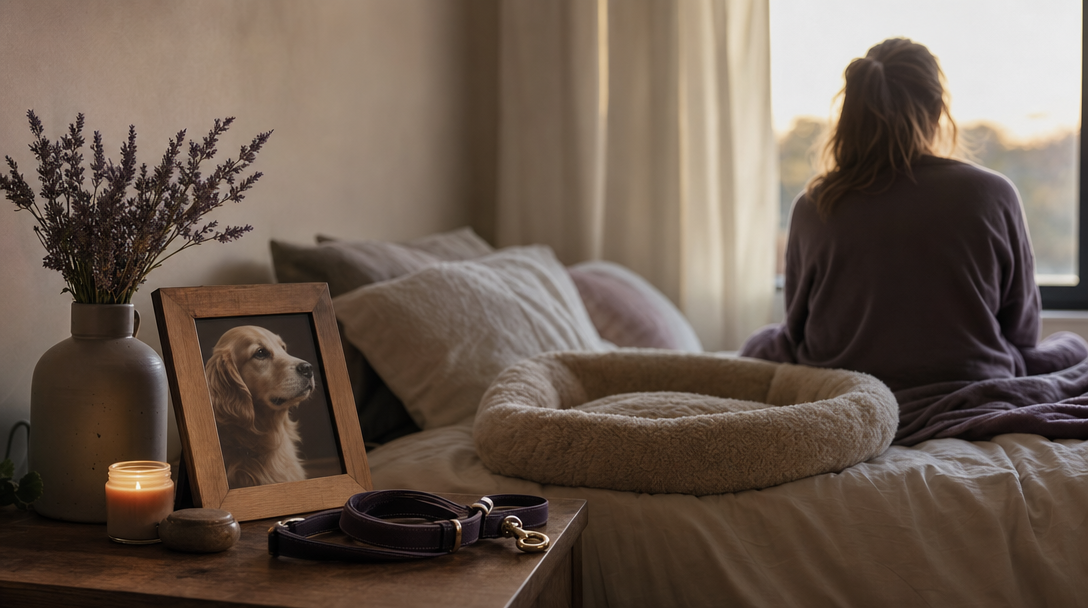
I'm not able to sleep since losing my dog, any advice for tonight?
You don't have to sleep perfectly tonight. You don't even have to sleep well. The goal for the next few hours is just to rest your body, not to win at sleeping. If you're lying awake replaying the day your dog died, that's grief doing what grief does, not a sign you're broken.
Psychology Today says most grieving pet owners find sleep extremely elusive after a pet dies, because trying to fall asleep can pull your attention straight back to the loss. So lower the bar on purpose tonight.
Pick one calming step and only one. Spirit Pieces, a pet-loss resource, suggests a relaxation ritual before bed: a warm bath, slow breathing, white noise, or ocean-wave sounds playing low. Hold something soft. Let yourself lie down even if sleep doesn't come.
Resting your body is a win even on a night your mind refuses to settle.
If you've just lost your dog, you may also need calm, practical steps for the first 24 hours.
Why can't I sleep because my dog died?
Bedtime is when the distractions stop. During the day, errands, work, and people fill the space. At night, the house goes quiet, the bed is still, and your attention has nowhere to go except your dog's death and the empty spot where they used to be.
According to Psychology Today, trying to fall asleep after pet loss can focus your mind on distressing thoughts about your pet's absence, and anxiety often rises right as you're trying to rest. That's why sleep can feel impossible exactly when you need it most.
The pattern shows up two ways. Psychology Today describes bereaved pet owners who avoid sleep entirely, and others whose sleep is broken, waking in panic, anxiety, or longing for their companion animal. Both are normal grief responses, not personal failings.
There's a physical reason this hurts the way it does. Research summarized by Doctor Connor, a piece on grieving the loss of a pet published July 28, 2020, notes that grief after losing an animal companion can feel the same as grief after losing a human, and some people report it more intensely. If you want the science of why losing a dog hurts so deeply, the bond is real and your brain knows it.
What should I do when I wake up panicking or missing my dog at 3 a.m.?
Keep the stimulation low. When you wake at 3 a.m. in panic or longing, don't grab your phone, don't turn on bright lights, and don't start solving anything. Bright screens and racing problem-solving will pull you further awake.
Psychology Today notes that some grieving pet owners wake suddenly in panic, anxiety, or longing for their companion animal, so this kind of waking is expected, not a setback. Treat it as a wave to ride, not an emergency.
Try a short grounding sequence:
- Slow your breathing first. Long, quiet exhales tell your body the danger is over.
- Turn on white noise or ocean-wave sounds, low, as Spirit Pieces suggests for pet-loss insomnia.
- Reach for a comforting object. Funeral.com, a pet-loss resource, recommends holding a soft object to support emotional and physical safety at bedtime.
- Let a short meditation carry you. Psychology Today notes meditation practices can help encourage relaxation before sleep, even when calming the mind feels hard during grief.
How do I cope with nightmares, guilt, and regret after losing a dog?
Guilt and regret at night are part of grief, not evidence you did something wrong. Doctor Connor lists guilt, anger, anxiety, and loneliness among common grief responses after pet loss, alongside mental symptoms like confusion, trouble focusing, constant dwelling on your pet, and thinking you see or hear your pet. The 3 a.m. replay of what-ifs is your mind dwelling, which is exactly what grief does.
You don't have to win the argument with those thoughts. When the replay starts, naming it can help more than debating it: "This is dwelling. My brain is doing the thing brains do after loss." Then return to your breathing or your soft object instead of building a courtroom case against yourself.
Sensing your dog still there is also normal. Doctor Connor notes some people think they see or hear their pet. That isn't a sign you're losing your grip.
If the guilt centers on a euthanasia decision, you're carrying one of the heaviest forms of this, and there's grounded help for forgiving yourself.
Should I keep my old bedtime routine or create a new one now that my dog is gone?
Keep the schedule, soften the ritual. Psychology Today recommends sticking to a sleep schedule and says routines matter during grief, because predictable structure steadies a body that's already overwhelmed. So protect the timing, going to bed and waking around the same hours, even when sleep is poor.
The harder part is the ritual itself, because so much of a dog's bedtime is woven into yours. The walk, the last trip outside, the weight of them settling on the bed. Those cues now point at an absence, and following them unchanged can ache.
You can keep the stabilizing frame and build a gentler version inside it:
| Keep | Gently change |
|---|---|
| Same bedtime and wake time | The route or rooms that hurt most |
| A wind-down hour before bed | The dog-shaped parts of the ritual |
| Lights low, devices off | Add a soft object or quiet sound where the dog used to be |
Hold the schedule steady and let the ritual evolve, rather than abandoning routine entirely.
You're not erasing your dog by adjusting the routine. You're making the nights survivable while the grief is loud.
Which sleep-hygiene steps are worth trying first after dog loss?
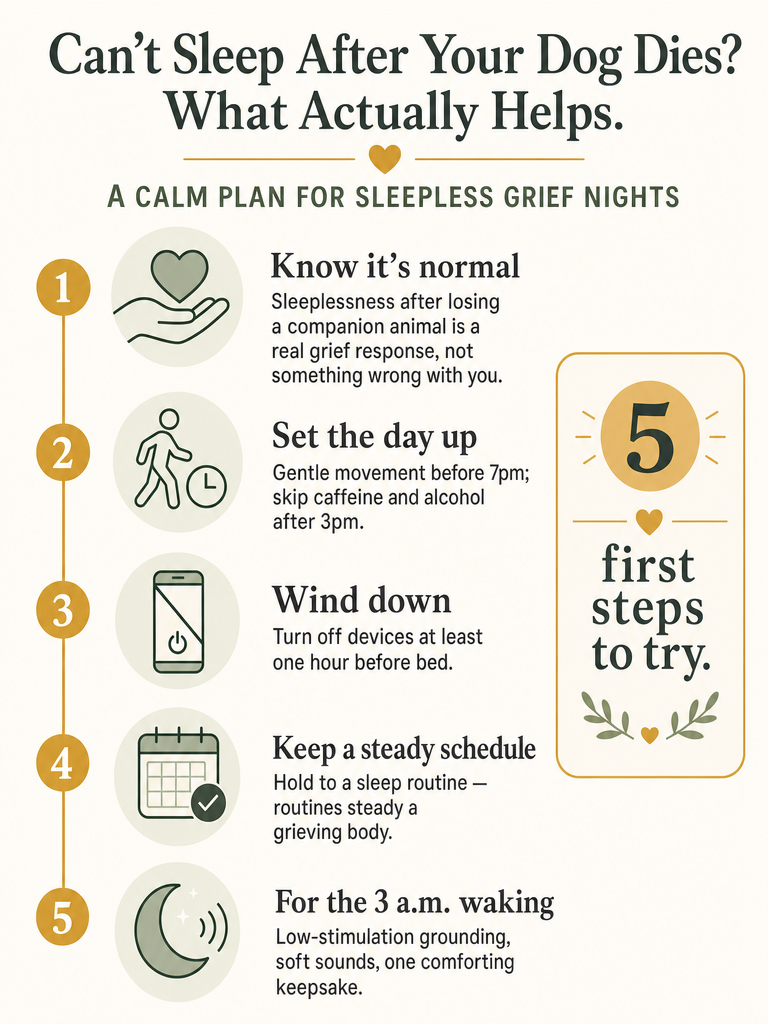
Start with daytime movement, then protect the hours before bed. Spirit Pieces offers five suggestions for getting your sleep pattern back on track after losing a pet, and they stack in a sensible order, beginning with what you do during the day and ending with how you wind down.
Here's the priority order, drawn from Spirit Pieces' guidance:
- Move gently during the day, before 7pm. Low-intensity activity like yoga or a walk around the block gets your blood flowing and prepares your body for rest. Don't overdo it; if you haven't been sleeping, you're already tired.
- Cut caffeine and alcohol after 3pm. Caffeine works against sleep, and alcohol disrupts it once your body metabolizes it, so an afternoon cutoff protects the night.
- Turn off electronic devices at least one hour before bed. Blue light can trigger alertness right when you need to come down.
- Use a relaxation ritual. Yoga, meditation, a warm bath, white noise, or ocean-wave sounds all signal your body that the day is closing.
| Step | When | Why it helps |
|---|---|---|
| Gentle activity | Before 7pm | Tires the body without overdoing it |
| No caffeine or alcohol | After 3pm | Both sabotage sleep |
| Devices off | 1+ hour before bed | Blue light delays rest |
| Relaxation ritual | At bedtime | Cues the body to wind down |
Pick one or two to start. A grieving body doesn't need a perfect protocol; it needs a few repeatable steps.
Can a memorial ritual or keepsake help me sleep, or will it make the empty space worse?
A bedtime keepsake can soothe or sting, depending on what it stirs in you. Spirit Pieces notes that actively memorializing a pet, with a picture, a portrait, or ashes jewelry, may ease the pain connected to the missing companionship. Funeral.com adds that holding a soft object at bedtime can support emotional and physical safety. For many grieving owners, something to hold in the dark genuinely helps.
But the same object can cut the other way. If a photo on the nightstand makes you replay the loss every time you glance at it, that reminder may intensify distress rather than calm it. Watch your own reaction honestly.
A simple test: does the keepsake make you feel held, or does it make you feel hollowed out? Choose accordingly tonight, and feel free to change your mind. A soft toy you can tuck against your chest tends to comfort more than a framed image you keep staring at.
If you want gentle, grounded options, here are ways to honor your dog's life that can become part of an evening ritual when you're ready.
Physical symptoms of grief after pet loss: what your body is telling you after your dog dies
Insomnia rarely arrives alone. Doctor Connor lists fatigue, insomnia, a hollow feeling in the stomach, tightness in the chest, dry mouth, and aches and pains among the physical symptoms grief from pet loss can cause. If you're not sleeping and your body also feels wrung out and sore, those things are connected.
Grief is physical because it works the brain and body, not just the heart. Doctor Connor notes that grief involves physical changes in the brain that affect thoughts and emotions, which is part of why you may also feel anxiety, irritability, confusion, or trouble focusing during the day after a sleepless night.
The exhaustion, the hollow stomach, the tight chest: your body is grieving, not malfunctioning.
Knowing this matters because it lowers the second layer of fear. You're not getting sick on top of being sad. You're carrying loss in your nervous system, and the symptoms tend to ease as the rawest days pass. If the body-level pain frightens you, why pet loss hits the body so hard explains more.
What can I do tomorrow morning after my dog dies and I still can't function?
Aim low and protect the basics. After a sleepless night, the morning's job isn't productivity, it's keeping your body fed, hydrated, and gently moving. Doctor Connor counts fatigue and insomnia among grief's physical symptoms, so expect to feel hollowed out and plan around it rather than pushing through.
A doable morning looks small:
- Drink water before coffee. Dry mouth is one of grief's physical symptoms, per Doctor Connor.
- Eat something, even a few bites, even if you have no appetite.
- Get outside for a short, low-intensity walk, the kind Spirit Pieces recommends before 7pm. Daylight and movement help reset a wrecked night.
- Lower your expectations for the day out loud, so you stop measuring yourself against a normal one.
You may not be able to do your usual tasks, and that's not failure. If everything feels impossible, what actually helped when functioning fell apart and how to handle daily tasks after losing a dog offer steps sized for a hard week.
How to help a dog cope with the grief of losing another pet at night
Watch your surviving dog's sleep, appetite, and behavior, and keep their routine steady. According to ImpriMedicine, a grieving dog may show appetite loss, lethargy or depression, an inability to sleep or sleeping more than normal, separation anxiety, vocalizing like howling, whimpering, or whining, behavioral issues, and accidents in the house. Nighttime is often when separation anxiety and vocalizing show up most.
ImpriMedicine recommends keeping a sense of normalcy, because a predictable routine helps a dog feel secure and less lost when something big and upsetting has happened. Knowing what comes next as the day unfolds steadies them, much as it steadies you.
There's an important caveat. ImpriMedicine notes that these same symptoms, the appetite loss, lethargy, and accidents, can signal physical illness rather than grief, so a vet check is worth it to be sure you're not missing something medical.
Care for their physical needs, too. ImpriMedicine notes a dog manages grief better when their body is supported, the same way a grieving person does.
Frequently asked questions
Why can't I sleep after my dog died?
Bedtime strips away every daytime distraction — work, errands, other people — and leaves your mind with nowhere to go except the loss. Psychology Today notes that trying to fall asleep after pet loss can focus attention on distressing thoughts about your dog's absence, causing anxiety to spike at exactly the moment you need calm. Both avoiding sleep entirely and waking in panic or longing are recognized grief responses, not personal failings.
What actually helps when you can't sleep the first night after your dog dies?
Lower the bar on purpose: the goal tonight is resting your body, not winning at sleep. Pick one calming step — a warm bath, slow breathing, white noise, or ocean-wave sounds playing low. Holding something soft can support emotional and physical safety at bedtime, according to Funeral.com's pet-loss guidance. If your mind won't quiet, let resting count as enough rather than fighting thoughts that grief will keep sending anyway.
What should I do when I wake up at 3 a.m. panicking or missing my dog?
Keep stimulation low. Skip the phone, skip bright lights, skip problem-solving — all of them pull you wider awake. Try this sequence: slow your exhales first (long out-breaths signal safety to your nervous system), turn white noise on low, then reach for a soft object to hold. Psychology Today notes that meditation can encourage relaxation even when calming the mind feels hard during grief. If you're still wide awake after a few minutes, sit somewhere dim until the wave passes, then return to bed.
Is waking up thinking I hear or see my dog a sign something is wrong with me?
No — it's a documented grief response. Doctor Connor's clinical writing on pet loss lists thinking you see or hear your pet among the mental symptoms of grief, alongside confusion, trouble focusing, and constant dwelling. Your brain formed thousands of sensory associations with your dog over years; those pathways don't switch off immediately. The experience is disorienting, but it's grief, not a sign you're losing your grip.
What sleep hygiene steps are worth trying first after losing a dog?
Start with two anchors before adding anything else. Spirit Pieces' pet-loss guidance recommends gentle daytime movement — a walk or yoga — before 7 p.m. to tire the body without overdoing it, and cutting caffeine and alcohol after 3 p.m. since both sabotage night sleep. Add a one-hour device-free wind-down after that. A grieving body doesn't need a perfect protocol; two repeatable steps done consistently do more than a long list done once.
Why does my body feel physically sick after my dog died — tight chest, hollow stomach, exhaustion?
Grief is physical, not just emotional. Doctor Connor lists fatigue, insomnia, a hollow feeling in the stomach, chest tightness, dry mouth, and aches among the documented physical symptoms of pet-loss grief. That's because grief involves physical changes in the brain that affect both thoughts and the body's stress response. The exhaustion and physical pain aren't separate from the sadness — they're the same thing moving through your nervous system.
Sources
- Exhausted Grief: Can't Sleep After the Death of a Petwww.psychologytoday.com
- I'm not able to sleep since losing my dog, any advice? : r/Petlosswww.spiritpieces.com
- Dealing with Insomnia after the Loss of a Pet - Spirit Piecesdoctorconnor.com
- Grieving the Loss of a Pet - Brynna Connor MDwww.imprimedicine.com