
How to tell people your dog died when you can barely say it
You don't need beautiful words. You need true ones, and they can be short. Honor.pet's guidance on announcing a pet's death is clear: simple and honest wording is enough, and there's no single right way to do it. The right approach is the one that feels honest and kind to you.
When you can barely get the sentence out, a four-part message carries everything that matters:
- Name the dog. "I'm heartbroken to tell you that Bella died."
- Share the basic fact, nothing more. "It happened this morning."
- Say how you feel in three words or fewer. "I'm not okay."
- Set one boundary. "I can't talk right now, but messages help."
That last line is permission, not rudeness. Honor.pet notes you can set boundaries clearly and kindly, like saying you're not up for calls but appreciate texts.
You're not announcing. You're surviving a sentence. Keep it small.
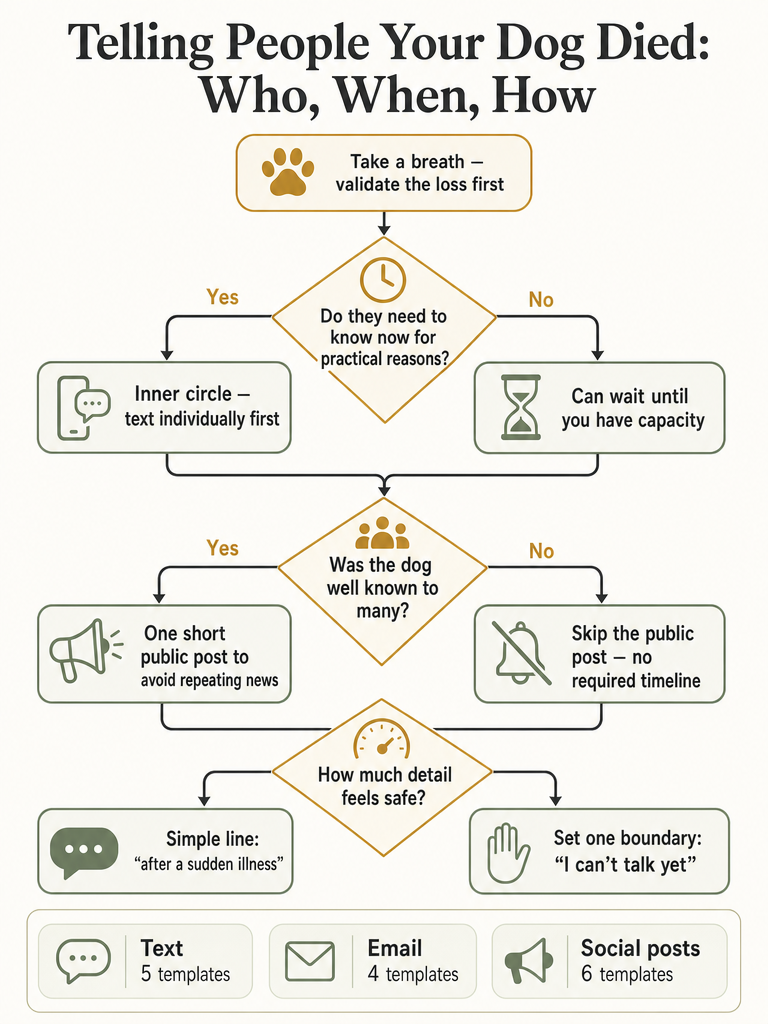
Who needs to know now, who can wait, and who does not need to know?
Triage your contacts before you write anything. Honor.pet suggests three questions to sort who you tell and when: who needs to know for practical reasons, who you want to know because they loved your dog too, and where you actually feel comfortable sharing the news. Those three filters turn an overwhelming list into a short one.
Most people fall into three groups:
| Group | Examples | When |
|---|---|---|
| Now, for practical reasons | Your vet, the boarding facility, the dog walker, your boss if you'll miss work | Within hours |
| When you have capacity | Close friends and family who loved your dog, people already asking how the dog is doing | A day or a few days later |
| Doesn't need to be told | Distant acquaintances, people who'd make it about themselves, anyone who'd drain you | On your timeline, or never directly |
Honor.pet's point about practical reasons matters here. Canceling a grooming appointment is different from telling your sister. One protects your week; the other can wait until you can breathe.
You are not obligated to tell everyone, and silence toward someone is not a lie. Tell the people who earn your remaining energy. The rest can find out later, or not at all.
Text vs call vs post: should I tell close people individually first?
Text your inner circle first, then decide about a wider post. Tuckerly's announcement guidance explains that texts are more personal for close contacts, while social media reaches many people at once but opens you up to public comments. Many grieving owners use a combination: private texts to the people closest to the dog, then a single broader post later, if at all.
Channel choice is really about how much input you can absorb right now.
| Channel | Best for | Trade-off |
|---|---|---|
| Text | Close family and friends | Personal, low exposure, easy to send in batches |
| Phone call | The one or two people you want to hear voices from | Hardest in the moment; can't control the conversation |
| Facebook / Instagram | The dog's broader community at once | Reaches many, but invites comments you'll have to read |
| Extended family, coworkers, formal contacts | Calm, professional, no public thread | |
| WhatsApp / group chats | A friend group or family thread | Tells several people in one message |
There's no rule that says public first. Start private, stay private if that's what you can handle.
What words should I use in a text saying my dog died?
Use plain, specific words and let one small detail carry the love. Honor.pet says announcements don't need poetic language, and that a single quirk, ritual, or favorite spot can say more than a long biography. Good Housekeeping and Quora respondents echo the same instinct: short, sincere wording lands better than anything elaborate.
Here are scripts you can adapt by audience.
Close family: "I have to tell you something hard. Max died this morning. I'm wrecked. I don't really want to talk yet, but I wanted you to know."
A close friend: "Lola's gone. It happened today. I keep expecting to see her by the door. I'll call when I can."
A neighbor who knew the dog: "I wanted you to hear it from me — Buddy passed away this week. Thank you for always saying hi to him on your walks."
The dog's community (group chat, dog park friends): "It's with a broken heart that I'm sharing that Daisy died. She loved her morning crew more than anything. Thank you for being part of her world."
A Quora respondent put the truth plainly: losing a pet you've had a long time is the same as losing your best friend. Your wording can be as direct as that feeling.
Don't agonize over "died" versus "passed." For adult contacts, either is fine. Use whichever leaves your mouth easier.
What can I say on a phone call or voicemail?
Open with a soft warning, then say it. A call can start with "I have some sad news" so the other person braces before you speak. Public scripts for live calls are limited as of this writing, so the wording below builds on Honor.pet's boundary guidance rather than a dedicated call-script source.
If you're calling live: 1. Soft opener: "I have some hard news about Cooper." 2. The fact: "He died yesterday." 3. Your limit: "I can't say much more right now." 4. The exit: "I just needed you to know. I'm going to go — I'll text you later."
That last step matters. You're allowed to end a call mid-grief. "I have to go now" is a complete sentence.
For a voicemail, keep it shorter so the person isn't blindsided by a callback into raw grief: "Hi, it's me. I wanted to let you know that Cooper died this week. I'm okay enough — I just can't really talk yet. No need to call back right now. A text is perfect."
Do I need to post anything at all after my dog died?
No. There is no required announcement, no deadline, and no platform you owe anything to. Tuckerly's guidance lists three timing options — immediately or within hours, within a few days, or after a week or more — precisely because people process at different speeds. Some share right away; others stay private for weeks before telling anyone beyond their household.
A post serves one practical purpose: it stops you from repeating painful news. Tuckerly notes that a quick announcement can prevent telling the story over and over when a dog was well known or people are already asking. If that's not your situation, skip it.
A public post is a tool, not an obligation — use it only if it saves you pain, not because you think grief requires an audience.
Honor.pet's framing settles the question: the right approach is the one that feels honest and kind to you. If silence feels honest and kind right now, that's your answer.
How much detail is too much when people ask how your dog died?
You decide the line, and you can keep it vague. Honor.pet offers two phrases that share enough without opening the medical file: "after a sudden illness" or "after a long struggle." Either acknowledges what happened while protecting the parts you're not ready to relive.
You owe no one the timeline, the diagnosis, or the moment of euthanasia. A few calibrated answers:
- Minimal: "She got sick suddenly. We're heartbroken."
- Some context: "He'd been declining for a while, and it became the kindest thing to let him go."
- Boundary, no detail: "I'd rather not get into how. Thank you for asking, though."
If you chose euthanasia and dread the question, "we made the decision to let him go peacefully" tells the truth without inviting interrogation. You don't have to justify a hard choice to people who weren't in the room.
The detail is yours to keep. Sharing it should help you, not perform for someone else's curiosity.
How do I explain this to my child's teacher or my coworkers?
Give the practical fact and the practical need — nothing about your dog's medical history. Honor.pet notes that work and professional contacts often only need enough information to understand an absence, a schedule change, or slower responses, and that boundaries can be set kindly. Tuckerly's guide reflects the same logic with email templates aimed at extended family and professional contacts.
For a boss or coworkers: "I've had a loss in the family — my dog died — and I'm not at my best this week. I may be slower to respond. I'll keep [project] on track and flag anything urgent."
Calling it "a loss in the family" is accurate and stops the "it's just a dog" reflex before it starts. You don't have to win the argument that your grief is valid; you just have to state your need.
For a child's teacher (wording here is structurally useful but not drawn from a dedicated source): "Our family dog died over the weekend, and [child] is grieving. They may be quieter or more upset than usual. I wanted you to know so you can be gentle with them."
That's it. The teacher needs context to support your child, not a full account.
What to do when your dog dies after the necessary messages are sent
Once the messages are out, the next job is getting through the hours. The first day has its own shape — there's a step-by-step guide to what to do in the first 24 hours, and then surviving the first week when the quiet sets in.
If the nights are the worst part, what actually helps when you can't sleep is worth reading. For going back to work, there's practical help on getting through that first week on the job. When you're ready to remember rather than just survive, start with ways to honor your dog's life, and if the grief is bigger than you can carry alone, here's how to find a pet loss grief counselor.
To Lose A Dog grew out of Isaac H's 1,820 days with Franki, an English Bulldog known as the Mayor of Domino Park. If you want company that doesn't flinch from this kind of grief, the book is here for the long nights — not to fix anything, just to sit with you in it.
Frequently asked questions
What do I actually say in a text when my dog dies?
Plain, specific words work better than anything elaborate. Name the dog, share one basic fact, say how you feel in three words or fewer, and set one boundary — something like "I can't talk right now, but messages help." One small concrete detail, like the spot on the couch or the bark at the mail truck, does more emotional work than a long tribute. Short and honest lands harder than polished.
Do I have to post on social media when my dog dies?
No — there's no required announcement and no platform you owe anything to. A public post serves one practical purpose: it stops you from repeating painful news. If your dog wasn't widely known and people aren't already asking, skip it entirely. Silence toward acquaintances isn't a lie. Tell the people who earn your remaining energy; let everyone else find out later, or not at all.
Should I call or text close friends when my dog dies?
Text your inner circle first, then decide about anything wider. Texts are personal, low-exposure, and easy to send in batches without losing control of the conversation. Reserve phone calls for the one or two people whose voices you actually want to hear — but know you're allowed to end a call mid-grief with "I have to go now." That's a complete sentence.
How much detail do I have to share about how my dog died?
You decide the line, and vague is fine. Two phrases cover most situations without opening the medical file: "after a sudden illness" or "after a long struggle." If you chose euthanasia, "we made the decision to let him go peacefully" tells the truth without inviting interrogation. Decide your one-line answer in advance — having it ready means you don't have to compose it through tears every time someone asks.
What do I say to my boss or coworkers when my dog dies?
Give the practical fact and the practical need — nothing more. "I've had a loss in the family — my dog died — and I may be slower to respond this week" is complete. Framing it as "a loss in the family" is accurate and stops the "it's just a dog" reflex before it starts. You don't have to win the argument that your grief is valid; you just have to state what you need.
What do I say when someone minimizes my dog's death?
Have a flat, kind exit line ready before it happens. Veterinary grief counselor Michele Pich notes that not everyone acknowledges the severity of pet loss, which can leave grieving owners feeling their animal's importance went unrecognized. You don't have to educate anyone in the moment. "He was family to me — I'd rather not talk about it with someone who sees it differently" ends the exchange without escalating it.
Sources
- What to Say When Someone's Pet Dies: 60 Comforting Messageswww.headspace.com
- What to say (and not say) when a friend loses their pet - Headspacewww.goodhousekeeping.com
- What are some good kind words to say when someone you know ...www.tuckerly.com