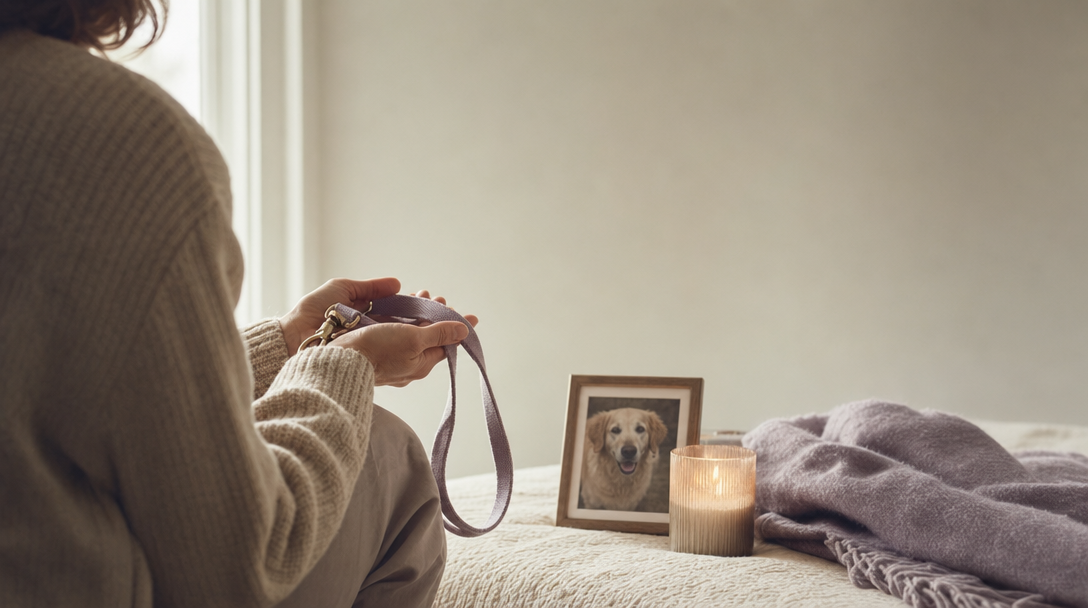
What are the best ways to cope after losing a dog’s firsts?
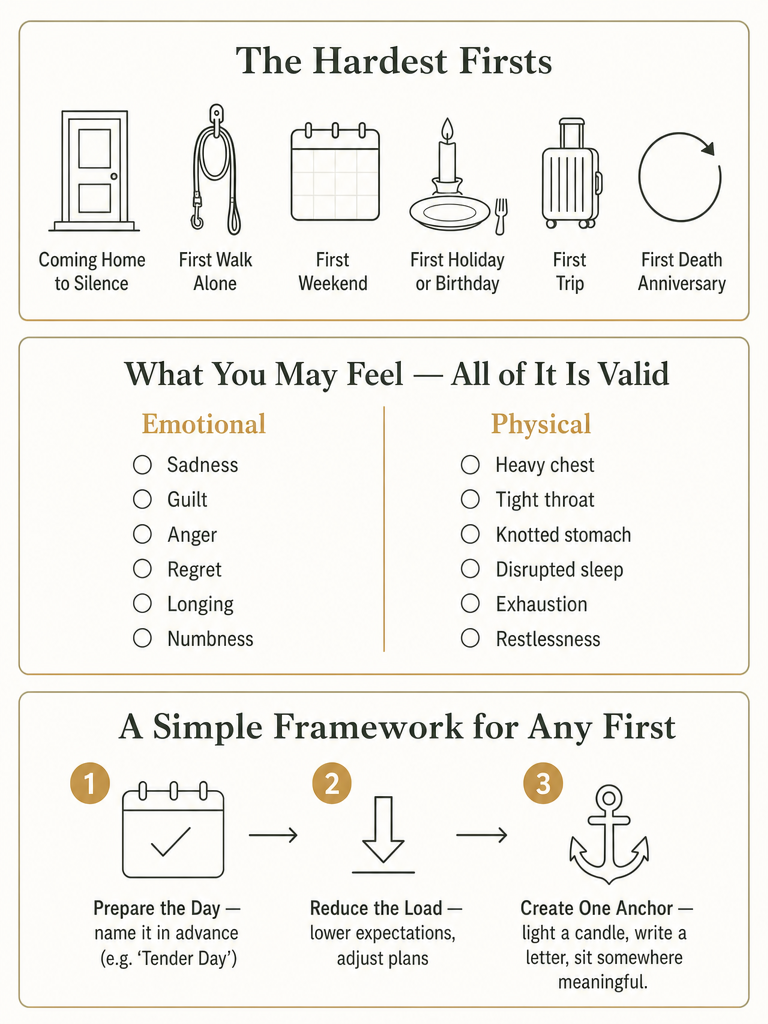
Coping with the firsts after losing a dog comes down to three moves: prepare the day before it arrives, reduce your load so you have less to carry, and create one small anchor for the moment you dread. Forever In My Heart Pet Loss Counselling frames its guidance as 10 specific tips for coping with pet loss anniversaries and the firsts, and gentleness runs through all of them.
The firsts are the ordinary moments that suddenly feel unfamiliar. The first morning without a greeting. The first walk alone. The first weekend, holiday, birthday, gotcha day, or death anniversary. According to Forever In My Heart, when these dates arrive, "grief can hit in a way that feels brand new, even if you've been experiencing more balance within your loss."
Here's the framework, in order:
- Prepare the day. Look at the calendar and name what's coming, so it doesn't ambush you.
- Reduce the load. Lower expectations, cancel what you can, and clear space to feel whatever surfaces.
- Create one anchor. Pick a single manageable act — lighting a candle, a short walk, sitting somewhere that meant something — rather than a full production.
Surviving the firsts is part of healing, not proof you're stuck. You are not doing grief wrong when a Tuesday morning knocks you flat. You're feeling the shape of a life that used to be there, and that ache is the measure of the bond.
Why does losing a dog hurt so much during ordinary routines?
Ordinary routines hurt after a dog dies because your whole day was built around one. The caretaking loop — you meeting the dog's needs, the dog returning unconditional love — gets established fast and strengthens over time, so its sudden absence disrupts dozens of small, automatic moments a day. Colleen Rolland, President of the Association for Pet Loss and Bereavement, calls the animal-human bond the starting point for understanding why the grief runs so deep.
"I usually start sessions by talking about the animal-human bond and why it is so strong," Rolland told Just Labs Magazine. "I talk about the caretaking loop… You look after all of the needs and wants of the dog — the social, the physical, the emotional… In return, the dog looks after you by providing unconditional love."
That loop is why the empty leash hook stings and the untouched food bowl feels like a small assault.
Rolland also notes how often people are ashamed of their own grief. "They're mystified as to why they are feeling such strong, tumultuous emotions."
The pain lives in the routines because the routines were the relationship. The morning walk, the meal countdown, the greeting at the door — each was a thread of the bond, and now each one is a place where the dog used to be.
Which firsts tend to hit hardest after a dog dies?
The firsts that hit hardest are the ones tied to daily contact and marked dates: coming home to silence, the first solo walk, the first weekend, and the first holiday, birthday, or gotcha day. Forever In My Heart lists these alongside "the day they died" as dates that "carry meaning, memory and so much love" and can feel overwhelming when they arrive.
Here's a map of the firsts readers most often dread, drawn from Forever In My Heart's descriptions:
| The first | Why it lands hard |
|---|---|
| Coming home | "The first time you come home and they're not there to greet you." |
| The walk alone | "The first time you go for a walk without them by your side." |
| The holiday morning | "The first Christmas morning without the sound of their paws." |
| The birthday / gotcha day | "No treat, no photo, no celebration to plan." |
| The first trip | The absence is "front and center" when you no longer worry who will care for them. |
| The death anniversary | Grief "can hit in a way that feels brand new." |
Two more firsts show up in reader accounts. One person in a pet loss group wrote of their first Christmas after their pet passed in August: "The first year I won't have to re-wrap gifts because you opened them." And seeing a dog that resembles yours can catch you off guard on an otherwise ordinary day.
If it helps to know what's coming, the first 30 days after losing a dog walks through the earliest stretch in detail.
How can you prepare for a birthday, holiday, or death anniversary without making it worse?
Preparing for a known hard date works best when you mark it gently in advance, lower your expectations for the day, adjust social plans early, and choose one manageable act instead of a full ceremony. Forever In My Heart suggests naming the date ahead of time — with a soft label like "Tender Day" or "Day of Love" — so it doesn't blindside you when it arrives.
The point of preparing is not to control grief. It's to keep the day from being an ambush.
- Name it early. Put the date on your radar days ahead. A gentle label reframes it from a dreaded deadline into a day you're choosing to hold with care.
- Lower the bar. Decide in advance that surviving the day is enough. You do not owe anyone a good mood or a productive afternoon.
- Adjust the social calendar. If a holiday gathering will be too much, tell people now. Forever In My Heart notes there's "no one right way to move through these days" — some plan ahead, some choose quiet.
- Pick one act. Choose a single small thing you can actually do, not a checklist.
Renee Magri's guidance at Forever In My Heart treats these dates as worthy of intention without demanding performance. Adjusting your work life helps too — getting through the first week back at work covers how to protect your energy around anniversaries.
Private ritual vs social remembrance: what are some healthy ways to memorialize a dog?
Healthy remembrance can take four shapes: a private ritual you do alone, a shared remembrance with others, postponing the day entirely, or doing nothing at all. The right choice depends on your capacity that day, not on what anyone expects. Forever In My Heart is explicit that "there's no one right way to move through these days" — some people plan ahead and create rituals, others lower expectations and choose quiet.
Simple rituals become anchors. Forever In My Heart points to lighting a candle, writing a letter, cooking a food you shared, or sitting in a place that meant something. Small acts, not grand gestures.
Use this to match the ritual to your capacity:
| Your capacity | What tends to fit |
|---|---|
| Very low — barely functioning | Doing nothing, or postponing the date to when you can breathe |
| Low but present | A private anchor: candle, letter, favorite spot alone |
| Steady, wanting connection | Shared remembrance — cooking a meal you both loved, gathering people who knew your dog |
| Uncertain | Keep it flexible; decide the morning of |
There's no obligation to perform grief for an audience. A candle lit alone counts. So does skipping the day entirely and trying again next year.
Choosing to do nothing on a hard date is a legitimate way to honor your dog. If you want more concrete options when you're ready, ways to honor your dog's life covers keepsakes and living tributes across different budgets.
Why can losing a dog trigger guilt, numbness, anger, or physical symptoms around milestones?
Milestones can trigger guilt, anger, regret, longing, or blank numbness because grief doesn't stay tidy around meaningful dates — and feeling that range does not mean you're grieving wrong. Forever In My Heart is direct about this: "This doesn't mean you're grieving the wrong way. It means you're human and your grief is doing whatever it feels like doing in these moments in time."
The body carries these dates too. According to Forever In My Heart, grief around firsts and anniversaries can show up as a heavy chest, a tight throat, a knotted stomach, disrupted sleep, headaches, or waves of exhaustion and restlessness "that don't make sense on the surface."
That source frames these physical responses plainly:
It's not a step backwards. It's your nervous system doing its best to process something enormous.
Numbness confuses people most. You expect to sob on the anniversary and instead feel nothing, and then feel guilty about the nothing. That flatness belongs to the same process, and it's no sign you've stopped caring.
One practical note from Forever In My Heart: if any physical symptom worries you, check in with your doctor. Grief and genuine medical concerns can overlap, and ruling things out is its own kind of self-care. For why the body reacts this hard, the neuroscience of pet loss explains what's happening in the brain.
How long does grief after losing a dog usually last when the firsts keep coming?
Grief after losing a dog has no fixed deadline, but the sources describe a rough shape: the first 72 hours are often shock, the first 30 days are the most disorienting, and a full year of firsts can keep grief resurfacing. Tuckerly labels Days 1-3 as "the immediate shock period," marked by disbelief, numbness, fogginess, and exhaustion while practical decisions still have to be made.
The firsts are precisely why grief doesn't resolve on a neat timeline. Just Labs Magazine frames the first year as a run of firsts — the first birthday, the first holiday, the first season without the dog around — each capable of reopening the loss.
Here's the general arc the sources describe:
- First 72 hours: shock, disbelief, fogginess, and the burden of practical matters (Tuckerly).
- First 30 days: the most disorienting stretch, as routine, attachment, and caregiving patterns all reorganize at once (Tuckerly).
- First year: each new first — season, holiday, anniversary — can bring grief back with fresh force (Just Labs Magazine).
Anyone promising you'll be "over it" by a certain date is guessing. The waves get further apart, but a birthday or a lookalike dog can still land hard a year on. What the dog-grief timeline really looks like goes deeper on why there's no universal clock.
When should I seek therapy for pet loss, and are there support groups for grieving pet owners?
Reach for extra support when grief stops moving through you and starts shutting you down — when you can't function for a sustained stretch, when guilt becomes fixed and relentless, or when physical symptoms worry you. Forever In My Heart advises checking with your doctor about any physical grief symptom you're concerned about. Normal grief comes in waves; a wave that never recedes is a signal to bring in a person.
Pet loss is real bereavement, and there is specialized help for it. Colleen Rolland is a certified Pet Loss Grief Recovery Specialist and President of the Association for Pet Loss and Bereavement — meaning support exists specifically for the loss others keep minimizing, not just general grief counseling.
A few markers that it's time to widen your circle of support:
- You're unable to manage basic daily tasks for more than a short stretch.
- Guilt or self-blame has hardened into something you can't loosen.
- You're isolating completely and hearing "it's just a dog" from everyone around you.
- Physical symptoms — sleep loss, exhaustion — are stacking up.
You don't need to hit a crisis to deserve support. Wanting a room where the loss is taken seriously is reason enough. If you're weighing formats, which pet loss support group helps most compares the options, and how to choose a counselor who gets dog loss helps you vet someone who won't minimize it.
How can anticipatory grief help you prepare for the firsts before your dog dies?
Anticipatory grief — the mourning that begins while your dog is still alive — can soften the firsts by letting you imagine them, line up support, and accept that the timing of letting go is a window, not a single perfect moment. Just Labs Magazine describes this grief as including wondering what life will be like afterward and whether you'll recognize when it's time.
According to Coleen Ellis, cited in Just Labs Magazine, there's a window when it's the "right" time to let a dog go, and that window differs for each case rather than being one fixed moment. That reframing takes some pressure off the search for a flawless goodbye.
Practically, anticipatory grief lets you do a little quiet preparation while your dog is still here:
- Picture the firsts you'll face — the empty morning, the first walk — so they're less of an ambush.
- Decide now who you'll lean on when the day comes.
- Give yourself permission to grieve already; it doesn't shorten the time you have.
If you're in this stretch, what helps with anticipatory grief right now and how to plan your dog's last day offer grounded, concrete steps. Whatever's coming, know this: the firsts are survivable, and you don't have to face them without a guide.
Frequently asked questions
why does losing a dog hurt so much
Losing a dog dismantles your entire daily architecture. Colleen Rolland, President of the Association for Pet Loss and Bereavement, explains that a caretaking loop forms fast — you meet every physical, social, and emotional need your dog has, and in return receive unconditional love. That loop only strengthens over time. When it breaks, dozens of automatic daily moments collapse at once. The pain isn't an overreaction; it's the exact measure of how deep the bond ran.
what are the best ways to cope after losing a dog
Three moves help most: prepare a hard day before it arrives, lower your load so you're not carrying extra weight on top of grief, and choose one small anchor — a candle, a short walk, a familiar spot — rather than a full ritual you may not have the energy for. Forever In My Heart Pet Loss Counselling frames gentleness as the thread running through all 10 of its coping tips for the firsts and anniversaries. Surviving the day is enough. You don't owe anyone more than that.
which firsts after losing a dog tend to hit the hardest
The hardest firsts are tied to daily contact and marked dates: coming home to silence, the first walk alone, the first holiday morning, a birthday or gotcha day without a treat to give, and the death anniversary. Forever In My Heart notes that grief on these dates "can hit in a way that feels brand new, even if you've been experiencing more balance within your loss." Seeing a dog that resembles yours can land just as hard on an otherwise ordinary Tuesday.
how long does grief after losing a dog usually last
There's no fixed deadline. The sources describe a rough shape: the first 72 hours are typically shock and disbelief, the first 30 days are the most disorienting as routine and caregiving patterns reorganize, and a full year of firsts — each birthday, holiday, and season — can reopen the loss with fresh force. Just Labs Magazine puts it plainly: "There's a year of firsts following a death." The waves get further apart, but a lookalike dog or a gotcha day can still land hard well past year one.
why can losing a dog trigger guilt, numbness, or physical symptoms around milestones
Grief doesn't stay tidy around meaningful dates — it can surface as guilt, anger, longing, or blank numbness, and none of those responses mean you're grieving wrong. Forever In My Heart is direct: "It means you're human and your grief is doing whatever it feels like doing." The body carries these dates too: heavy chest, tight throat, disrupted sleep, and waves of exhaustion are your nervous system processing something enormous, not a sign you've moved backward. If any physical symptom worries you, checking with a doctor is its own form of self-care.
when should I seek therapy or a support group for pet loss grief
Reach for extra support when grief stops moving through you — when you can't manage basic daily tasks for a sustained stretch, when guilt has hardened into something fixed and relentless, or when everyone around you keeps saying "it's just a dog." Pet loss is real bereavement, and specialized help exists: Colleen Rolland is a certified Pet Loss Grief Recovery Specialist and President of the Association for Pet Loss and Bereavement, which means you don't have to settle for general counseling that minimizes the loss. You don't need to hit a crisis to deserve a room where your grief is taken seriously.
Sources
- How do you handle the firsts after losing a pet?justlabsmagazine.com
- How would you explain the grief of losing a beloved pet ...www.foreverinmyheartpetlosscounselling.com.au
- Facing the holidays after pet losswww.tuckerly.com
- Losswww.facebook.com
- What's Inside To Lose A Dog | 15 Chapters, 4 Partswww.instagram.com