
Do you need a licensed therapist, a pet loss specialist, or a support group?
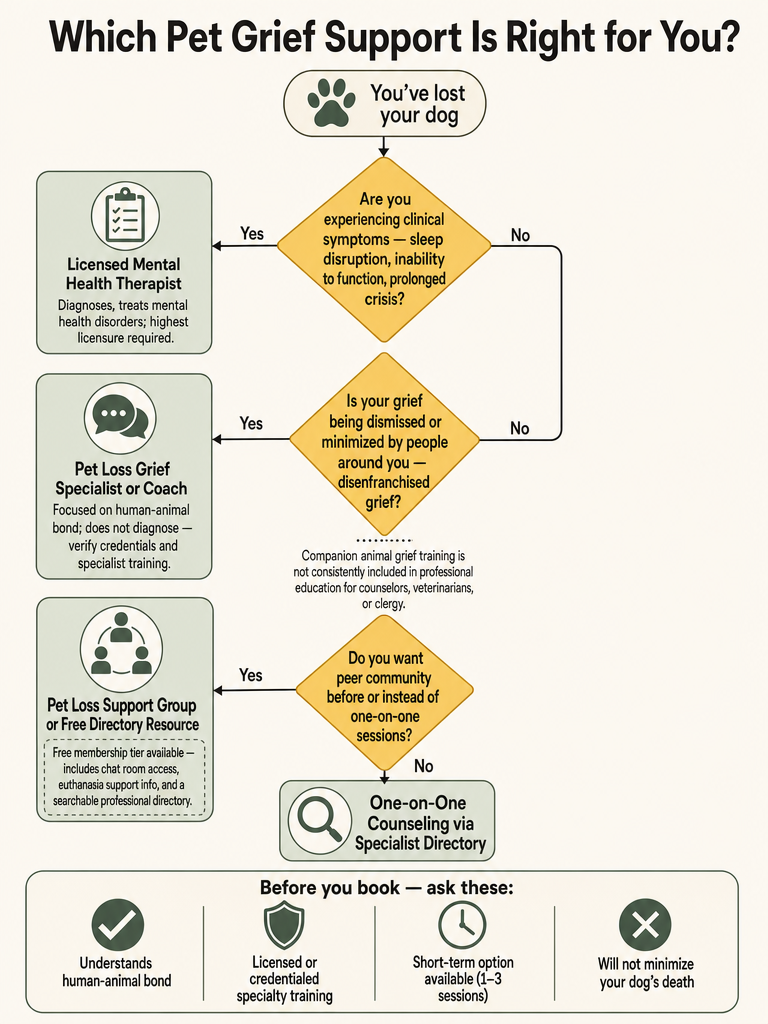
Match the level of help to what your grief is doing to your daily life. If losing your dog has made it hard to function, sleep, or get through work, a licensed therapist who understands pet loss is the right first call. If you mainly need someone to witness the pain and give you language for it, a support group or short-term specialist can be enough. Marina Resa Therapy says a pet grief specialist may be a good fit when someone only needs 1-3 sessions to process the loss.
None of these options minimizes what happened. Losing a dog is losing a major relationship, and the grief deserves real support — Drew DiFonzo Marks, writing for Kindman & Co., found no major difference between grieving an animal and grieving a human loved one.
Start with a quick self-check:
- Support group or directory resource — you want to feel less alone and hear from others who get it.
- Pet loss specialist or coach — you need a few focused sessions to move through guilt or shock.
- Licensed therapist — grief is affecting your ability to function, or you're carrying depression, panic, or trauma alongside the loss.
The Association for Pet Loss and Bereavement (APLB) offers a free entry point through its Bronze membership, so you can try low-cost support before committing to paid one-on-one care.
What is the difference between a pet grief coach, therapist, specialist, or counselor?
The titles vary most in training and legal scope. A therapist is a licensed mental health professional trained to diagnose and treat emotional and psychological issues using evidence-based methods, according to Marina Resa Therapy. A pet grief coach, by contrast, does not diagnose or treat mental health disorders such as depression — and the same guide notes no formal training is required to become one.
That gap matters when you're deciding who to trust with a loss this deep.
| Title | Licensed clinician? | Can diagnose/treat mental health? | Training required |
|---|---|---|---|
| Therapist | Yes | Yes, using evidence-based methods | Licensure |
| Pet grief coach | No | No | None formally required |
| Pet loss specialist | Varies | Varies | None required; APLB offers a certificate course |
| Counselor | Varies | Varies | May be used without education or training |
Source: Marina Resa Therapy
Marina Resa Therapy warns that many people call themselves a "counselor" without education or training, and advises asking directly whether the person is a licensed clinician if formal mental health training matters to you.
The title "pet loss specialist" also does not require formal training, though organizations such as APLB offer a certificate course. So a warm, experienced specialist can be exactly right for grief support — just don't assume the title guarantees clinical care. For a fuller look at the clinical side, see how therapists help with pet loss grief.
What credentials should I look for in a pet loss counselor?
Look for two things at once: a real license, and specific experience with companion-animal grief. A license tells you the person is trained to diagnose and treat, per Marina Resa Therapy. Pet-loss experience tells you they won't treat your dog's death as a minor life event. The University of Vermont makes clear why you can't assume the second follows the first: its Pet Loss Support Group Specialist Certificate says training in grief following companion animal loss is not consistently included in professional education for veterinarians, counselors, clergy, and human services professionals.
That means a fully licensed therapist may still have zero training in pet loss. Ask about it directly.
A working checklist:
- Licensure — if clinical treatment matters to you, confirm they're a licensed clinician (Marina Resa Therapy).
- Pet-loss-specific training — ask what they've done to learn about companion-animal grief, since it's often left out of standard education (University of Vermont).
- Recognized programs — APLB runs a Pet Loss Grief Specialist Training Program for professional members, though additional registration fees apply.
- Directory listing — providers listed in APLB's Directory of Services have chosen to work in pet loss specifically.
The credential you most want is honest fluency in the human-animal bond, whether it comes with letters after a name or not.
Is there a pet grief counselor to help with losing my dog?
Yes — pet grief counselors exist, and there are established directories to find them. The most direct route is APLB's Directory of Services, which any visitor to the site can use to find pet loss support. You don't need a paid membership to search it; APLB includes access to the directory in its free Bronze membership.
If you'd rather ask a person you already trust, the Pet Loss support site (pet-loss.net) advises that when family or friends do not understand, you can ask a veterinarian or humane association to recommend a pet loss counselor or support group. Your vet's office has often walked other clients through the same loss and may keep a short referral list.
The need is common and real. One grieving owner posting to the r/therapists community on Reddit simply asked whether pet grief counselors exist at all. The answer is that the field is real, even if it's smaller and less standardized than human grief care.
Three places to start:
- APLB Directory of Services — searchable, no paid tier required.
- Your veterinarian or local humane association — direct referrals to counselors or groups.
- A pet loss support group — for when the people around you don't understand.
For more on where to look, see how to find a pet loss grief counselor.
How can you tell a counselor will not minimize your dog's death?
The clearest sign is that they name pet grief as real bereavement without you having to argue for it. Grief after losing a dog is a form of disenfranchised grief — loss that society tends to dismiss. The University of Vermont describes companion-animal grief as often misunderstood, minimized, or dismissed. A counselor worth your time already knows this and treats it as the starting point, not something you have to prove.
Guest blogger Drew DiFonzo Marks, writing for Kindman & Co., specialized in pet loss grief after becoming a grief counselor and reached a blunt conclusion:
"The major difference I learned was this: There is no major difference."
That's the frame to listen for. Losing a dog is losing a major relationship, and a good counselor mourns it with you rather than measuring it against a human loss.
Validation checkpoints for a first conversation:
- They treat intense grief as normal and natural, echoing Moira Anderson Allen's Ten Tips on Coping with Pet Loss.
- They don't rush you toward "getting a new dog" or "moving on."
- They understand guilt — especially around euthanasia — without judgment.
- They recognize that others in your life may have dismissed the loss as "just a dog."
If a provider needs convincing that your dog's death is worth grieving, that's your signal to look elsewhere. You can read more about why pet grief differs from human grief to know what you're entitled to expect.
What questions should you ask in a consultation before booking?
Ask direct questions about pet-loss experience before you commit money or hope. A consultation is your chance to test whether this person understands dog loss and the specific weight of euthanasia guilt — not just grief in general. Marina Resa Therapy's core advice applies here: if formal mental health training matters to you, ask whether the person is a licensed clinician.
Questions worth asking out loud:
- Have you worked with people grieving a pet, specifically a dog? You're checking for real experience, since the University of Vermont notes this training is often missing from standard education.
- Are you a licensed clinician, or a coach or specialist? This clarifies scope of practice per Marina Resa Therapy.
- How do you approach euthanasia guilt? Many dog owners carry this, and the answer reveals whether they'll judge or support you.
- Do you understand the human-animal bond as a real relationship? Listen for whether they treat it as significant or minor.
- What methods do you use? A therapist should be able to name evidence-based approaches.
- How many sessions do people usually need? Marina Resa Therapy says a specialist may be enough if you only need 1-3 sessions, so this helps you gauge fit and cost.
Public detail on pricing, insurance, and reimbursement for pet loss counseling is limited, so ask about fees directly in the same call.
Should you start with APLB, a support group, or one-on-one counseling?
Begin with the lowest-cost option that fits your need, then step up if it isn't enough. The Association for Pet Loss and Bereavement makes this easy because its Bronze Membership is free and includes access to its chat room, support and information regarding euthanasia and self-care tips, and its extensive bibliography and Directory of Services. That's a real first step at no cost — useful when you're not sure yet whether you need paid care.
| Path | Cost | What you get |
|---|---|---|
| APLB Bronze Membership | Free | Chat room, euthanasia and self-care info, bibliography, Directory of Services |
| APLB Silver Membership | Paid | 1 pet memorial, free video support group admission, webinars |
| APLB support groups / webinars | Included with membership tiers | Live group support (e.g., a members-only webinar was listed for Thursday, October 30th, 2025, 7:00-8:00 PM ET featuring Dillon Dodson) |
| One-on-one counseling | Paid, varies | Individual sessions with a specialist or licensed therapist |
Source: APLB
A reasonable sequence: try the free chat room and directory first, join a support group if you need live human contact, and move to one-on-one counseling if grief is affecting how you function. APLB also advertises a 20% off discount on Silver or Platinum membership tied to its Rainbow Bridge Memorial Day promotion. For a breakdown of group formats, see which online pet loss support group helps most.
Should I choose online or in-person grief counseling after losing a pet?
Online support wins when local providers don't understand dog grief; in-person wins when you need the grounding of being physically present with someone. The advantage of virtual care is reach: it lets you find a pet-loss-fluent counselor even if no one nearby specializes in it. This matters because, as the University of Vermont notes, pet loss training is not consistently part of professional education — so the right person may not be in your zip code.
APLB's support runs largely online, including its chat room and video support groups, which shows how well group-format pet grief care translates to a screen. That makes virtual a strong option in the acute early days, when leaving the house feels impossible and your loss feels socially dismissed.
Public evidence comparing online versus in-person one-on-one pet loss counseling is thin, so weigh it on practical grounds: access, comfort, and whether you'd open up more from home or in a room. If you need real-time voice support tonight, pet loss hotlines can bridge the gap while you arrange ongoing care.
How do you use counseling alongside euthanasia, aftercare, and the first 30 days?
Counseling works best woven into the concrete decisions grief forces on you, not treated as a separate track. The first days after a dog dies are crowded with choices — the body, aftercare, telling people, getting through work — and a counselor can help you carry those alongside the emotional weight. Moira Anderson Allen's Ten Tips notes that when a pet dies you must choose how to handle its remains, often in the middle of grief; that's exactly the kind of decision support can steady.
Line counseling up with the practical steps that come first:
- Euthanasia decisions and guilt — pair support with when to put your dog down so the choice feels less isolating.
- Being present — sort through the question of being in the room during euthanasia.
- Aftercare — decisions like cremation versus burial are easier with a calm outside perspective.
- The first month — use the first 30 days survival guide as a map, and bring what's hardest into sessions.
- Right now — if you can't function, that's a reason to reach for help sooner, not later.
Counseling gives you a place to process what these steps stir up.
Can a dog grief book help while you wait for counseling?
A book can hold you between the loss and your first session, but it isn't clinical care. APLB includes an extensive bibliography in its free Bronze membership precisely because reading offers companionship and practical support while you find the right help. Books validate the grief, give you language for it, and let you set your own pace — but they don't diagnose or treat, and they don't replace a licensed clinician if grief is affecting how you function.
Used honestly, a book fills two gaps at once: the wait for an appointment, and the moments at 3 a.m. when no counselor is available. It offers steady company through the hours no professional can cover.
To Lose A Dog was written to sit in that space — a memoir of Isaac H's 1,820-day bond with Franki, an English Bulldog, paired with practical guidance for anticipatory grief and end-of-life decisions. It treats pet grief as real bereavement and offers a usable structure for the hardest days, without pretending to stand in for professional care. If you want a fuller picture, see who this book helps most or a broader list of books that helped one owner survive losing a dog.
Pair the reading with real support, and let each do what it's good at.
Frequently asked questions
Is there a pet grief counselor to help with losing my dog?
Pet grief counselors exist, and the Association for Pet Loss and Bereavement (APLB) maintains a searchable Directory of Services any visitor can use for free. You can also ask your veterinarian or local humane association for a direct referral — vet offices often keep a short list of counselors who've helped other clients through the same loss. The field is real, even if it's smaller and less standardized than human grief care.
What is the difference between a pet grief coach, therapist, specialist, or counselor?
A licensed therapist can diagnose and treat mental health conditions using evidence-based methods. A pet grief coach cannot diagnose or treat, and no formal training is required to become one. The title 'counselor' can be used without any education or training at all. 'Pet loss specialist' also requires no formal credential, though APLB offers a certificate course. Always ask directly whether someone is a licensed clinician before committing to care.
What credentials should I look for in a pet loss counselor?
Look for two things together: a valid clinical license and specific experience with companion-animal grief. The University of Vermont's Pet Loss Support Group Specialist Certificate notes that grief following companion animal loss is not consistently included in professional education for counselors, clergy, or veterinarians — so a fully licensed therapist may still have zero pet-loss training. Ask both questions directly. APLB's Professional Membership includes a Pet Loss Grief Specialist Training Program, though additional registration fees apply.
How can you tell a counselor won't minimize your dog's death?
The clearest sign is that they name pet grief as real bereavement before you have to argue for it. Companion-animal grief is frequently misunderstood, minimized, or dismissed — what grief researchers call disenfranchised grief. Drew DiFonzo Marks, a grief counselor who specialized in pet loss, studied the difference between grieving an animal and grieving a human and reached a direct conclusion: there is no major difference. A good counselor starts there, not after you've made the case.
What questions should you ask a pet loss counselor in a first consultation?
Ask six things: Have you worked specifically with people grieving a dog? Are you a licensed clinician or a coach? How do you approach euthanasia guilt? Do you treat the human-animal bond as a real relationship? What evidence-based methods do you use? And how many sessions do people typically need — a pet loss specialist may be sufficient for just 1–3 sessions, per Marina Resa Therapy. If someone can't clearly state their license status or training, that ambiguity is itself an answer.
Should you start with APLB, a support group, or one-on-one counseling?
Begin with the lowest-cost option that fits your need. APLB's Bronze Membership is free and includes access to its chat room, euthanasia and self-care information, an extensive bibliography, and the full Directory of Services — a real first step at no cost. From there, a support group adds live human contact, and one-on-one counseling makes sense if grief is affecting your ability to function. APLB Silver Membership adds one pet memorial and free video support group admission.
Sources
- Supporting clients with pet loss : r/therapistswww.facebook.com
- Managing Pet Loss: How to Understand and Cope with Griefwww.pet-loss.net
- Ten Tips on Coping with Pet Losspmc.ncbi.nlm.nih.gov
- Coping with Animal Companion Loss: A Thematic Analysis of ...www.griefsupportcenter.com