Should I be there when my dog is euthanized?
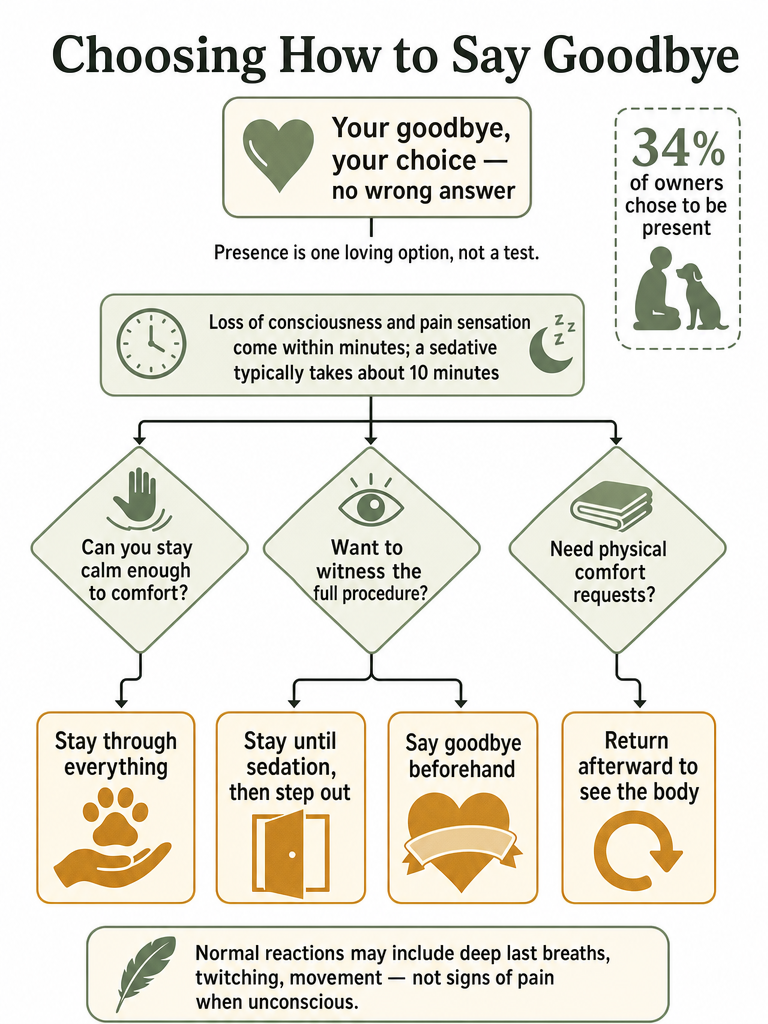
Being present during your dog's euthanasia is a personal decision, not a moral test you can pass or fail. The Cornell University College of Veterinary Medicine describes this choice as deeply personal: some owners stay because they feel they can comfort their pet, while others worry their own emotional upset would upset the animal. Paws Into Grace reports that 34% of owners in one cited study chose to accompany their pets during the final moments.
If you decide to stay, there is real reason to believe it can help your dog. Paws Into Grace explains that staying with your pet during the process can ease their stress and discomfort, letting them feel your presence as they drift into a peaceful sleep. Your voice, your scent, your hand on their fur — these are the things your dog has trusted their whole life.
And if you can't stay, that does not make you a bad owner. The pull to be there comes from love. So does the instinct to protect yourself from a memory you may not be able to carry. Both can be true at once.
What follows is a calm, no-guilt way to think through your options — including several middle paths most people don't realize exist. If you're still weighing the decision itself, how to say goodbye to your dying dog covers the steps before this one.
Staying through everything vs stepping out after sedation: which goodbye fits you?
You have more than two options. Most owners assume the choice is "be there" or "don't," but the euthanasia process has natural points where you can step in or step away. The University of Illinois College of Veterinary Medicine notes that you usually choose to be present for the procedure or to leave your pet with the veterinary staff after saying goodbye — and within that, there's room to design the goodbye that fits you.
Cornell adds that owners who choose not to stay may still view their pet's body afterward. That single fact opens up gentler middle paths.
| Your choice | What it gives you | What to weigh |
|---|---|---|
| Stay through everything | You're holding your dog as the heart stops; full presence and closure | The physical realities can linger in memory longer than expected (Source: Paws Into Grace) |
| Stay until sedation, then step out | Your dog is calm and asleep when you leave; you skip the final injection | You won't be touching them at the very end |
| Say goodbye beforehand | You hold and speak to your dog while they're alert and aware of you | The actual passing happens without you |
| Return afterward to see the body | A physical goodbye and confirmation of peace, without witnessing the procedure | Cornell confirms this is offered when you ask |
The middle paths exist precisely so you don't have to choose between abandoning your dog and traumatizing yourself. Tell the veterinary team which version you want. They arrange this every week.
What is euthanasia for dogs, and will my dog feel pain?
Dog euthanasia is the act of ending a life in a painless and humane manner by injecting a medication that stops the heart from beating. That definition comes from Krystal Newberry, a licensed social worker and former certified veterinary technician at the University of Illinois College of Veterinary Medicine, who notes the Greek word euthanasia translates to "good death." It's most often chosen when a dog's quality of life has declined from age or disease and cannot be restored.
Your dog will not feel pain from the procedure. Newberry states plainly: "Your pet will not feel any pain or discomfort from the euthanasia procedure." The reason is pharmacological. Cornell University College of Veterinary Medicine explains that the euthanasia solution is usually a barbiturate — the same class of drug used for general anesthesia. At the dose used, the dog loses consciousness and loses pain sensation before the cardiovascular and respiratory systems stop.
The medication that stops the heart was originally used as anesthesia in pets, according to Newberry. So the experience begins as a deep, painless sleep.
If pain is your specific fear, say so before the appointment. Newberry encourages owners to raise their concerns about pain with the veterinary team in advance.
How does the dog euthanasia procedure work?
The dog euthanasia procedure follows a predictable, gentle sequence, though details vary slightly by clinic. The University of Illinois College of Veterinary Medicine and Cornell describe the same general arc: private time first, then a catheter, optional sedation, and a final injection that works within minutes.
Here's the typical order:
- Private time first. In most hospitals, you can spend quality time alone with your dog in a room before anything begins (Source: University of Illinois). Some clinics and mobile services offer this in your home.
- IV catheter placement. If you stay, the first step is placing an intravenous catheter in your dog's vein. This allows easy administration of sedation and the euthanasia solution. The team may step out to place it or do it in the room with you, per Newberry.
- Optional sedation. Some clinics sedate before the euthanasia solution; others don't. Sirius Veterinary Care describes a mild sedative as typically taking about 10 minutes to take effect. You can ask for this conversation.
- The final injection. When you're ready, the veterinarian administers the solution. You control the timing.
- The heart and lungs stop. Cornell states that after the injection, your dog loses consciousness and the heart and lungs stop functioning within minutes.
You set the pace of every step — the team waits for your "when you are ready," not the other way around. If you want your dog on a familiar blanket or in your lap for this, ask.
What should you expect during dog euthanasia?
Some physical reactions during euthanasia look alarming but are not signs of pain. This is the part veterinary sources prepare you for that many articles skip — and knowing it in advance keeps you from being blindsided in the room. The University of Illinois lists several bodily activities that can occur once the solution is given.
According to Newberry, your dog may:
- Urinate or defecate as the muscles relax
- Take a few deep, last breaths
- Twitch or experience body movement
- Vocalize or make a sound
These happen when your dog is already unconscious. They are not signs of pain or distress. The University of Illinois is explicit that these reflexes occur because the body is shutting down, not because your dog is suffering.
Eyes may also stay open. That's normal too — animals don't reliably close their eyes at the end.
If any of this happens, your veterinarian will recognize it immediately and can tell you what you're seeing. You won't be left to interpret it alone. Understanding these reflexes ahead of time is one of the kindest things you can do for the version of yourself who will be in that room.
What if I am sobbing, panicking, or afraid I might collapse?
If you fear you'll fall apart, you are allowed to step out — and that can be the loving choice. Cornell University College of Veterinary Medicine acknowledges that some owners worry their own emotional upset would upset their pet. Dogs read us closely. A calm presence soothes; a panicking one can register as something is very wrong.
So ask yourself honestly: in the room, will you be steadying or overwhelming? Neither answer is shameful.
Not everyone can stay, and that's a real limit, not a weakness. As one compassionate guide puts it, some people carry trauma histories, panic disorders, or fainting responses that make being present genuinely unsafe for them. Protecting your own nervous system is not abandonment.
There's a workable compromise: stay until your dog is sedated and calm, then step out before the final injection. Your dog feels your hand while they drift off, and you leave before the part you can't hold. If grief is already swallowing your days, I lost my dog and I can't function offers grounded first steps.
Your dog's last memory should be safety — sometimes that means your steady voice, and sometimes it means a calm room you trusted them to.
Can you ask for sedation, a quiet room, a blanket, or in-home euthanasia?
Yes — these requests are standard, and a good veterinary team expects them. The most peaceful goodbyes are usually the ones owners shape in advance by asking. Cornell University College of Veterinary Medicine notes that hospital euthanasia is often performed in a quiet room where the pet may feel more at ease, and that some veterinarians perform euthanasia in the pet's home.
Here's what you can reasonably request:
- Sedation before the final injection — discuss this option with your veterinarian so your dog is fully relaxed first (Source: University of Illinois).
- A quiet, private room, away from waiting-room noise (Source: Cornell).
- Comforting belongings — Sirius Veterinary Care suggests bringing your dog's favorite blanket or toy to create familiarity in their final moments.
- Private time before the procedure begins (Source: University of Illinois).
- In-home euthanasia, so your dog passes in their own bed or favorite spot (Source: Cornell).
- Family support — decide who you want present (Source: Sirius Veterinary Care).
Sirius also recommends sharing your questions and worries with the team beforehand, because informed owners make calmer decisions on a hard day. Planning your dog's last day ahead of time means you spend the appointment present with your dog instead of making decisions in shock.
Should other pets be present during the euthanasia?
Whether other household pets should be present depends on each animal's temperament, not a single rule. Midtown Mobile Veterinary Hospice Services (MMVHS) lays out both sides: presence can offer companionship and help surviving pets acknowledge the loss, but it can also cause stress, anxiety, or disruptive behavior in animals who don't cope well with charged situations.
The case for including them: pets who've spent years together form deep bonds, and a familiar face can ease confusion. MMVHS notes that animals are sentient beings capable of grief, and allowing them to witness the passing — or at least enter the room afterward to sniff and observe — can help prevent prolonged searching behavior.
The case against: for some pets, witnessing it is traumatic and may heighten stress or trigger disruptive behavior during an already fragile moment.
If your other dog can't be present, MMVHS suggests alternatives:
- Create a dedicated grieving space for the surviving pet
- Let them access scents or belongings of the dog who died
- Give them extra attention and affection in the days after
Read your own household. A calm, gentle dog may benefit from saying goodbye; an anxious one may do better with the body afterward.
What body-care and memorial decisions should you make before the appointment?
Deciding on body care and keepsakes before the appointment spares you from choosing while in shock. Sirius Veterinary Care recommends settling memorial plans ahead of time precisely because making these choices on the day adds stress to an already overwhelming hour. A few minutes of planning now protects you later.
Many clinics offer keepsakes. The University of Illinois notes that veterinary clinics often provide paw prints in clay or ink and locks of hair — small, physical things you may be grateful to have.
For your dog's remains, the University of Illinois lists the common options:
| Option | What it means |
|---|---|
| Home burial | Taking the body home to bury |
| Communal / group cremation | Cremated with other pets; ashes typically not returned |
| Private cremation | Cremated alone; ashes returned to you |
| Necropsy | Examination to understand cause of death, if you want answers |
| Teaching donation | Donating the body for veterinary education |
Decide which fits before you arrive, and tell the clinic. If you want to think through ways to mark your dog's life afterward, dog memorial ideas and a calm walkthrough of what to do in the first 24 hours can give the next days a little structure when everything feels unsteady.
Frequently asked questions
Should you stay in the room when your dog is euthanized?
Staying is a personal choice, not a moral obligation. Paws Into Grace notes that your presence can ease your dog's stress — your voice, scent, and touch are what they've trusted their whole life. But Cornell University College of Veterinary Medicine acknowledges that owners who fear their own distress might upset their pet are also thinking about their dog's comfort. Both instincts come from love. There's no version of this choice that makes you a bad owner.
Will my dog feel pain during euthanasia?
No. The University of Illinois's Krystal Newberry, a licensed social worker and former certified veterinary technician, states plainly: "Your pet will not feel any pain or discomfort from the euthanasia procedure." The solution is a barbiturate — the same drug class used for general anesthesia — administered at a dose that causes your dog to lose consciousness and pain sensation before the heart stops. The American Veterinary Medical Association's guidelines, followed by all clinics, prioritize the animal's comfort throughout.
What actually happens during dog euthanasia — what's the step-by-step process?
The University of Illinois and Cornell describe the same general sequence. First, private time alone with your dog. Then an IV catheter placed in a vein. An optional sedative — Sirius Veterinary Care notes it typically takes about 10 minutes to take effect — can be given first. When you say you're ready, the veterinarian administers the euthanasia solution. Cornell confirms the dog loses consciousness and the heart and lungs stop within minutes. You control the pace; the team waits for your signal.
What are the physical reactions during dog euthanasia that might look alarming?
Some reflexes happen after your dog is already unconscious and aren't signs of pain. According to the University of Illinois, a dog may urinate or defecate as muscles relax, take a few deep final breaths, twitch, vocalize, or keep their eyes open. These are the body shutting down, not suffering. Cornell confirms consciousness and pain sensation are gone before the cardiovascular system stops. Knowing this in advance is one of the most practical things you can do before walking into that room.
Can I leave after sedation instead of staying for the final injection?
Yes — this middle path is standard and veterinary teams arrange it regularly. You stay while your dog receives sedation and drifts into a calm, pain-free sleep, then step out before the final injection. Your dog's last conscious awareness is your hand and your voice; you leave before the part you can't hold. Cornell also confirms owners who don't stay for the procedure can return afterward to view the body — another option that offers physical closure without witnessing the moment of death.
What should I request ahead of the euthanasia appointment to make it more peaceful?
A good veterinary team expects these requests. Cornell notes that euthanasia is typically performed in a quiet room, and that some veterinarians offer in-home appointments so a dog passes in their own bed. The University of Illinois confirms most hospitals provide private time before the procedure. Sirius Veterinary Care recommends bringing a favorite blanket or toy for familiarity, and discussing sedation options in advance. Settling memorial plans — private cremation, communal cremation, or home burial — before the appointment also means you won't be making those decisions in shock.
Sources
- Should You Stay With Your Pet During Euthanasia? Making the ...vetmed.illinois.edu
- Euthanasia: Why, When, and How to Say Goodbye to a Petsiriusvets.com
- Should Other Pets Be Present During the Euthanasia?www.psychologytoday.com
- Should You Be Present for the Euthanasia of Your Pet?www.vet.cornell.edu