Should I bury or cremate my dog?
There is no wrong answer here, only the one you can live with. Burial gives you a fixed place to visit and tend. Cremation gives you portability and more choices later, which is one reason Embrace Pet Insurance reports that about 90% of pet owners now choose it.
If you are reading this in the raw hours after your dog died, know that this decision does not have to be made in the next ten minutes. Most states allow 24 to 48 hours before burial or cremation is required (Source: Embrace Pet Insurance), which is more room than grief makes it feel like.
Cremation or burial for a dog is a personal decision shaped by where you live, what you can spend, and how you need to remember. Burial suits people who want a grave to sit beside and a physical marker in the ground. Cremation suits people who move, who live in apartments, or who cannot bear the thought of leaving their dog behind somewhere.
The rest of this guide turns that fork in the road into something you can actually work through: cost, legality, the different kinds of cremation, and the quieter question underneath all of it. Decide what matters most first — a place to visit, or the ability to keep your dog with you — and the practical choice usually follows from there. Do you need somewhere to return to, or do you need to keep your dog close enough to carry?
How do I decide between cremation and burial for my dog?
The clearest way to decide is to answer a short list of practical questions before an emotional one settles the matter for you. Your living situation, budget, and likelihood of moving usually narrow the choice faster than any pros-and-cons list. Embrace Pet Insurance frames the decision around exactly these factors: living situation, budget, and beliefs.
Work through these, honestly, in whatever order feels bearable:
- Where do you live? A house with yard space makes burial possible. An apartment or rental usually does not. Goodbye Good Boy notes that backyard burial is often not viable without space.
- Might you move? If relocation is likely, burial means leaving your dog behind. Cremation lets the ashes come with you.
- What can you spend? Cremation ranges from $50 to $500, while a pet cemetery plot and headstone can run $1,500 or more (Source: Embrace Pet Insurance).
- Do you need a place to visit? Some people grieve better with a grave to tend. Others find comfort in an urn at home.
- Do you want the ashes back? If yes, that points to private or individual cremation, not communal.
- Do your beliefs shape this? Some cultures and faiths favor one method. Sweet Goodbye for Pets names religious and cultural considerations as a real factor.
If you answer honestly, one option usually emerges as the more livable choice long before you have to sign anything.
There is no scorecard that produces a "correct" result. This is about which version of remembering you can carry.
Cremation vs. burial for a dog: cost, permanence, and emotional tradeoffs
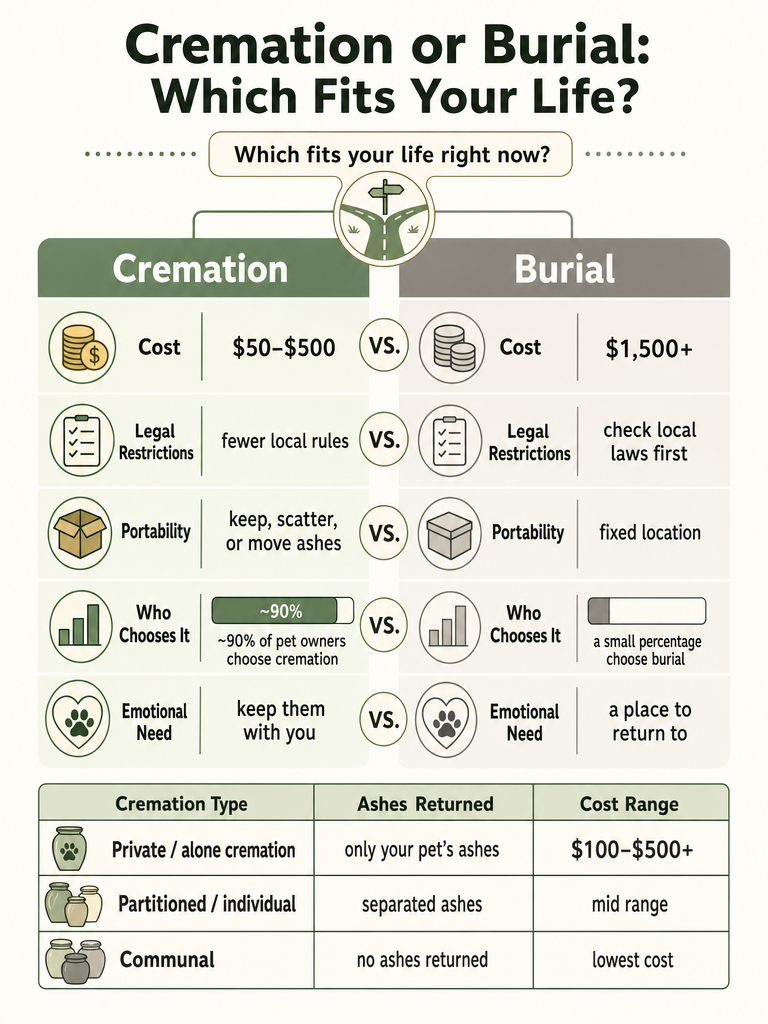
Cremation and burial differ most on three axes: what they cost, how permanent and portable the result is, and which grief need each one serves. Burial anchors your dog to one spot; cremation reduces them to something you can hold, move, or scatter. Embrace Pet Insurance says burial provides a permanent physical place to visit, while cremation lets a dog's remains move with the family.
| Factor | Cremation | Burial |
|---|---|---|
| Typical cost | $50–$500 (Embrace Pet Insurance) | $1,500+ for a cemetery plot and headstone (Embrace Pet Insurance) |
| Permanence | Ashes kept, scattered, or buried later | Fixed grave in one location |
| Portability | Moves with you | Stays behind if you relocate |
| Place to visit | An urn or keepsake at home | A physical gravesite |
| Later memorial options | Urn, scattering, jewelry, later burial | Limited to the grave itself |
The emotional tradeoff is the part competitor pages tend to skip. Valley Funeral Service names it plainly: a drawback of cremation is that some families feel they have no permanent place to visit, while a drawback of burial is that a move usually means leaving the remains behind.
Neither option is more loving. One gives you ground to return to. The other gives you something to keep.
How much does dog cremation cost?
Dog cremation typically costs between $50 and $500, according to Embrace Pet Insurance, and the price tracks directly with the type of service you choose and how much of your dog's ashes are returned. The more privacy and certainty you want around the ashes, the higher the cost.
Here is how the tiers break down, per Embrace Pet Insurance:
| Cremation type | Typical cost | Ashes returned |
|---|---|---|
| Private | $100–$500+ | Only your dog's ashes |
| Individual or partitioned | $50–$250 | Your dog's ashes, with some risk of mixing |
| Communal | $30–$200 | Usually none returned |
A few practical details help set expectations. Pet cremation uses high heat of 1,400 to 1,800°F, and the process itself takes roughly 30 minutes for small pets to 2 or 3 hours for larger dogs (Source: Embrace Pet Insurance). Most families receive the ashes within 1 to 7 days.
The volume is smaller than many people expect. Cremains typically weigh about 3% to 5% of a dog's original body weight (Source: Embrace Pet Insurance) — enough to fill an urn, not a room. If you are bracing yourself to open that box, that scale can help you prepare.
What is the difference between private, individual, and communal pet cremation?
The three cremation types differ mainly in whether your dog is cremated alone and whether you get their ashes back. Private is the most certain and the most expensive; communal is the least. Getting this terminology right matters, because it directly controls whether you receive only your dog's ashes.
- Private cremation means your dog is cremated alone, and the ashes returned are exclusively theirs (Source: Embrace Pet Insurance). This is the option to choose if certainty about the ashes matters to you. It typically costs $100–$500 or more.
- Individual or partitioned cremation places more than one pet in the chamber at once, separated by dividers. You generally receive your dog's ashes, but the separation is not absolute. Embrace Pet Insurance lists this at $50–$250.
- Communal cremation cremates several pets together, and the ashes are not separated. Usually nothing is returned to you. This is the lowest-cost option at $30–$200 (Source: Embrace Pet Insurance).
If receiving only your dog's ashes matters to you, private cremation is the only option that guarantees it.
The words vary between providers, which is where confusion and later regret creep in. Some crematories use "individual" to mean what another calls "private." When you call, do not rely on the label alone. Ask the direct question: Will I receive only my dog's ashes, and is my dog cremated alone? The answer, not the term, is what you are buying.
Can I bury my dog in my backyard?
Backyard burial is not automatically legal everywhere, because rules can vary by city and county — so check your local ordinances before you dig. Burying your dog at home can feel deeply personal, giving you a grave to visit and a spot to mark with a plaque or stone (Source: Goodbye Good Boy). But feeling right and being permitted are two different things.
Public detail on state-by-state burial law is limited, and this guide cannot tell you what your specific municipality allows. The rules exist at the local level, and checking them first spares a painful reversal later.
Beyond legality, backyard burial runs into practical limits. Goodbye Good Boy notes it is often not viable for people in apartments or without yard space. There is also the question competitor pages rarely raise directly: if you might move, a home grave means leaving your dog behind.
If home burial is not workable but you still want a grave, a pet cemetery is the alternative. It offers a dignified, permanent place to visit, though Embrace Pet Insurance notes a plot and headstone can cost $1,500 or more.
Is burial or cremation better if I might move house?
If relocation is even a possibility, cremation is usually the more forgiving choice, because a buried dog generally has to stay behind. Valley Funeral Service names this bluntly: a drawback of burial is that a family that moves typically cannot take the pet's remains with them.
For renters and apartment dwellers, this is often the deciding factor. Goodbye Good Boy points out that moving later can make burial feel harder, because the pet stays in a place you no longer visit. Ashes, by contrast, move with you — Embrace Pet Insurance describes this portability as one of cremation's central advantages.
There is a real emotional weight to sit with here. Some people find that a grave they can never return to becomes a source of ongoing grief rather than comfort. Others accept that the resting place matters more than proximity, and that leaving a beloved spot behind is bearable.
If the thought of driving away from your dog's grave for the last time is unbearable, that answer is already telling you something.
Ask yourself plainly: a year from now, in a new home, would I rather have an urn on the shelf or a grave three states away?
What do I do with my dog's ashes after cremation?
Once you have your dog's ashes, you have three broad paths: keep them, scatter them, or bury them later — and you can combine them. Cremation's appeal is precisely this flexibility to memorialize on your own timeline. Goodbye Good Boy lists keeping ashes in an urn or keepsake box, scattering them somewhere meaningful, or burying them as the common choices.
The main options, drawn from Goodbye Good Boy and Sweet Goodbye for Pets:
- Keep them at home in an urn or keepsake box you can see and touch.
- Scatter them in a place that mattered — a favorite trail, a yard, a beach.
- Bury the ashes later, including alongside yourself when the time comes.
- Wear a portion in cremation jewelry, which Sweet Goodbye for Pets notes lets you carry a physical reminder.
You do not have to choose all at once, and you do not have to choose only one. Many people keep most of the ashes and set aside a small amount for a piece of jewelry or a scattering spot. Ashes also let you wait — you can decide on a memorial when your head is clearer, not in the first shattered week. If you are weighing an urn against something you can wear, how to choose between dog ashes jewelry or an urn walks through keeping most at home while carrying a small part.
When burial may be the more comforting choice
Burial tends to comfort people who need a physical place to return to. If the idea of a grave you can sit beside, tend, and mark feels steadying, that instinct is worth trusting. Goodbye Good Boy notes that burial lets you personalize the spot with a plaque or marker and keeps your dog close and easy to visit.
Burial may be the more comforting choice when:
- You want a fixed place to visit. Some grief needs somewhere to go. A grave gives your body a destination.
- The act itself feels meaningful. Goodbye Good Boy notes that some people find the physical act of digging and burying cathartic — part of the goodbye rather than a task to outsource.
- You are staying put. If you own your home and plan to remain, the drawback of leaving a grave behind does not apply to you.
- Permanence matters more than portability. You would rather have one true resting place than something you carry.
If a grave is what your grief is reaching for, that is a valid and grounded reason to bury. For more on marking and tending a resting place, see dog memorial ideas to honor your pet.
When cremation may be the more manageable choice
Cremation is often the more manageable choice when space, distress, or an uncertain future make burial hard. It asks less of you physically in the first days and leaves your options open. Embrace Pet Insurance notes that cremation's flexibility and fewer legal restrictions make it workable across most living situations, which is part of why about 90% of pet owners choose it.
Cremation may fit better when:
- You lack space. Goodbye Good Boy notes cremation suits owners of large dogs or those in apartments with little or no yard.
- Handling the body is too painful. Some owners find the thought of burying their dog's body distressing; cremation removes that step. Goodbye Good Boy names this directly.
- You may move. Ashes travel with you; a grave does not.
- You want to decide on a memorial later. Sweet Goodbye for Pets highlights the flexibility to hold a service or ritual when the timing suits your grief, not the day of.
If you are barely functioning right now, choosing the option that asks less of you is a fair and kind response to where you actually are.
What needs to happen in the first 24 to 48 hours?
In the first 24 to 48 hours after a dog dies, you generally have a short window to decide on aftercare, but less pressure than shock makes it feel like. Embrace Pet Insurance says most states allow 24 to 48 hours before burial or cremation is required. That is time enough to breathe, not time to waste.
Here is a calm order of operations for the first day or two:
- Contact your veterinarian or a pet crematory to ask about timing and whether they hold the body while you decide.
- Ask how the body should be kept in the meantime if you are not moving immediately.
- Decide on cremation type or burial using the questions earlier in this guide — housing, budget, moving, and whether ashes matter.
- Do not force a memorial decision now. Ashes let you choose an urn, scattering spot, or jewelry weeks later.
You are allowed to grieve before you organize. If the practical steps feel impossible right now, what to do when your dog dies in the first 24 hours breaks the day into smaller pieces.
If you want a steady companion through these decisions — one that treats this grief as real and gives you language for it — To Lose A Dog was written for exactly these hours.
Frequently asked questions
How much does dog cremation cost compared to burial?
Dog cremation typically runs $50–$500, while a pet cemetery plot and headstone can cost $1,500 or more, according to Embrace Pet Insurance. Private cremation — where only your dog is cremated and the ashes returned — sits at the higher end ($100–$500+). Communal cremation, where ashes aren't returned, starts around $30. Burial costs less upfront only if you have yard space and local ordinances permit it.
What is the difference between private, individual, and communal pet cremation?
Private cremation means your dog is cremated alone — the only option that guarantees you receive exclusively their ashes. Individual (or partitioned) cremation places multiple pets in one chamber with dividers; you usually get ashes back, but separation isn't absolute. Communal cremation combines several pets with no separation, and nothing is typically returned. When you call a crematory, ask directly: 'Is my dog cremated alone?' — the answer matters more than the label they use.
Can I bury my dog in my backyard?
Backyard burial is legal in many places but not everywhere — rules vary by city and county, so check local ordinances before you dig. Beyond legality, it's not practical for apartment dwellers or anyone without yard space. The deeper question: if you might move, a home grave means leaving your dog behind. A pet cemetery is the alternative if you want a permanent, dignified grave without that risk.
Is cremation or burial better if I might move house?
Cremation is the more forgiving choice when relocation is possible. A buried dog generally has to stay behind — Valley Funeral Service names this directly as burial's central drawback for families who move. Ashes travel with you, which Embrace Pet Insurance describes as one of cremation's key advantages. If the thought of driving away from your dog's grave for the last time feels unbearable, that instinct is already pointing you toward cremation.
What can I do with my dog's ashes after cremation?
Three broad paths exist: keep them, scatter them, or bury them later — and you can combine options. Common choices include an urn or keepsake box at home, scattering ashes somewhere meaningful (a favorite trail or beach), burying them later, or incorporating a small portion into cremation jewelry you can wear. Crucially, you don't have to decide immediately — ashes let you wait until your head is clearer before committing to a memorial.
How long do I have to decide between cremation and burial after my dog dies?
Most states allow 24 to 48 hours before burial or cremation is required, according to Embrace Pet Insurance. That's more breathing room than shock makes it feel like. Contact your veterinarian or a pet crematory first to ask about timing and whether they'll hold the body while you decide. You don't need to choose a memorial format — urn, scattering spot, jewelry — in those first hours. That decision can wait weeks.
Sources
- Burial vs. Cremation : r/dogs - Redditwww.facebook.com
- Burial or cremation? Why? I'm struggling to decide. - Facebookwww.goodbyegoodboy.com.au
- Dog cremation vs burial - Which is better for your pet?www.memorials.com
- Cremate or Bury a Pet: How to Decide | Memorials.com Info Centerwww.valleyfs.com
- Is It Better To Cremate or Bury a Pet? - Heishman Funeral Homesweetgoodbyeforpets.com
- Burying vs Cremating a Dog: Legal Issues, Costs, and Emotional Conside | Funeral.com, Inc.www.embracepetinsurance.com