Should you choose dog ashes jewelry or an urn?
Choose an urn for a secure home base, jewelry to keep a small part of your dog close during the day, or both when the ashes need to do more than one job. According to Funeral.com, a primary pet urn is meant to hold all or most of a dog's cremated remains, while cremation jewelry usually carries only a very small symbolic amount, and many families end up using more than one option rather than treating them as rivals.
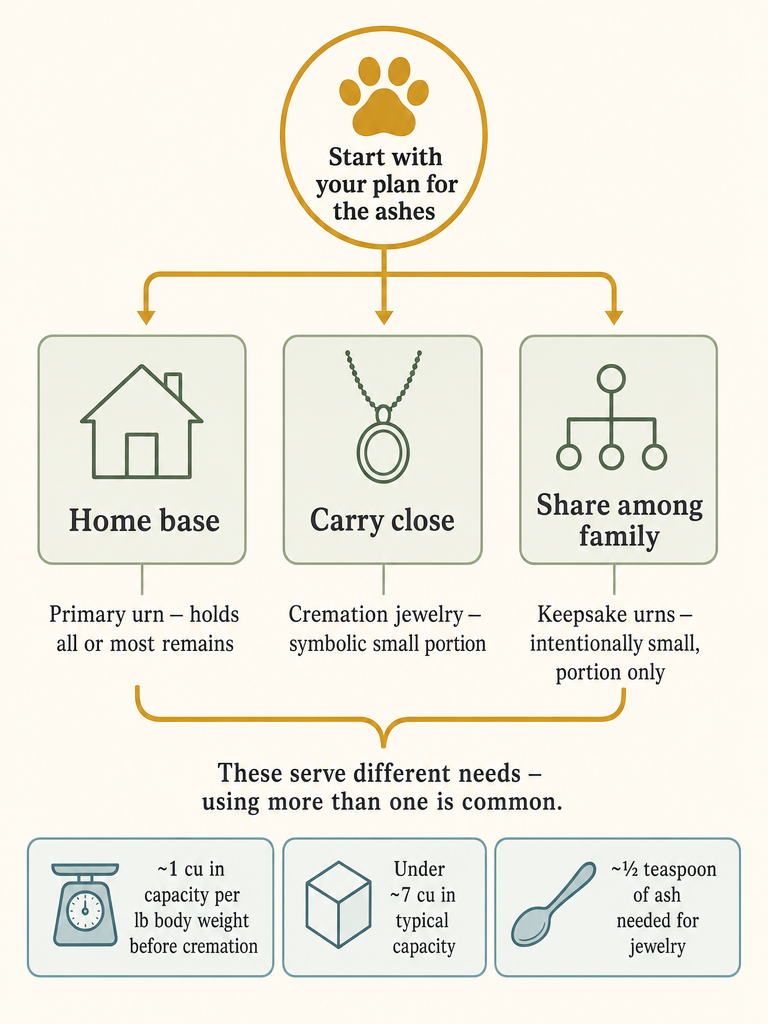
Start with a quieter question than "which product": what do you want to do with the ashes? Keep them together at home. Share a portion with family. Carry a little with you. Display, bury, or one day scatter the rest. The plan comes first; the object follows.
If you're reading this in the rawest stretch of grief, you don't have to decide today. The ashes are not going anywhere, and a steadier choice made next month is worth more than a rushed one made tonight.
Should I wear my pet's ashes or keep them at home?
Wearing your dog's ashes keeps a small part of them portable and close; keeping them home keeps the memorial steady, private, and out of public view. Funeral.com frames this as a portability-versus-home-memorial distinction, and the honest answer depends less on the product than on what you can tolerate right now. A necklace travels with you to work, on walks, into ordinary days. An urn stays put, asking nothing of you on the hard mornings.
Three things worth testing against yourself before you decide:
- Emotional readiness. In acute grief, a constant reminder against your skin can feel like comfort or like an open wound. Both are normal. If you're not sure, an urn at home lets you choose when to be near the ashes instead of carrying them every hour.
- Privacy. A necklace invites questions. Some people want the chance to say their dog's name out loud; others don't want to explain their grief to a coworker. An urn keeps the memorial as private as your home.
- Daily comfort. Will you actually wear it, or will it sit in a drawer? A memorial that lives in a box helps no one.
The best choice is the one you'll still be glad you made on a bad day, not just a good one.
What is the difference between a pet urn, keepsake urn, and cremation jewelry?
These three forms differ mainly by how much of your dog they hold. A primary pet urn is meant to hold all or most of the cremated remains and often becomes a stable home memorial. A keepsake urn is intentionally small, designed for a portion rather than the whole amount. Cremation jewelry carries only a very small, symbolic amount and is usually meant to complement a traditional urn, not replace it. Funeral.com lists keepsake urns at typically under about 7 cubic inches, which reinforces that they're for a share, not the full ashes.
| Memorial form | Holds | Typical role |
|---|---|---|
| Primary pet urn | All or most ashes | Secure home base, display, burial, or later scattering |
| Keepsake urn | A portion (under ~7 cubic inches) | Sharing among family; multiple personal tributes |
| Cremation jewelry | A very small, symbolic amount | Carried daily; closeness on the go |
GetUrns describes pet cremation jewelry as pieces with a secure compartment that hold a small portion of ashes or another keepsake, such as fur, creating a discreet memorial you can wear. Pulvis Art Urns notes that keepsake urns let multiple family members share ashes and create personal tributes. The point isn't which is "best." It's which job each one is built to do.
Can you put only some of a dog's ashes in jewelry and keep the rest in an urn?
Yes, and most families do exactly this. You don't have to choose only one memorial. Jewelry uses such a small amount of ashes that the rest can stay in a primary urn, be divided among keepsake urns for family, or be set aside for scattering later. Funeral.com is clear that families do not have to surrender the entire urn to create a jewelry piece, and that many people use more than one form because the options serve different needs.
A combined plan often makes more sense than a single choice when:
- Several people are grieving and each wants a tangible share. Keepsake urns, typically under about 7 cubic inches each, let you divide the ashes without losing the main memorial.
- You want both a steady home base and something to carry. Most ashes stay in the urn; a symbolic portion goes into a pendant.
- You're not ready to commit to scattering but want to keep that door open.
How much ash does pet cremation jewelry hold?
Pet ashes jewelry uses only a tiny, symbolic amount, so you almost never surrender all of your dog's ashes to make a piece. Thicket Memorials says its resin process needs around half a teaspoon of ashes to create pet ashes jewelry. That detail matters before you buy, because the fear of "using up" your dog is one of the quiet anxieties that stops people from choosing jewelry at all.
There are two main ways the ashes are used, per Funeral.com:
- Fillable jewelry (the "urn necklace" approach): a pendant, charm, or ring with a tiny compartment that holds a symbolic amount. You decide how much to place inside, and you can keep the rest in a main urn.
- Resin or glass pieces: a small portion of ashes is incorporated into the material itself, so the ashes become part of the design rather than sitting in a chamber.
Either way, the amount is small. Choosing jewelry does not mean giving up the urn. For most dog owners, the practical reality is the opposite: a teaspoon's worth goes into the piece you wear, and the rest of your dog stays wherever you've decided home should be.
How do you choose the right urn for a pet's ashes?
Start with purpose, not the product photo. Pulvis Art Urns recommends defining what the urn is for first: home display, burial, a memorial niche, or a biodegradable ceremony. That decision narrows everything that follows. Funeral.com's sizing rule is the next anchor: allow about 1 cubic inch of urn capacity per pound of pre-cremation body weight, plus a little extra if you want room for keepsakes.
A simple order of decisions:
- Purpose. Decide whether the urn stays home, gets buried, or holds ashes until you scatter them. Burial and biodegradable ceremonies point toward different materials than a display piece.
- Size. Use the cubic-inch-per-pound rule against your dog's weight before cremation. A 60-pound dog points toward roughly 60 cubic inches of capacity.
- Material. Pulvis Art Urns lists ceramic, wood, metal, stone or marble, and biodegradable options chosen for appearance and durability.
- Style. Pulvis Art Urns suggests matching the design to your dog's personality or your bond. A favorite color, a paw motif, an engraving of the name.
The right urn does two jobs at once: it holds the ashes securely and gives your grief somewhere to land.
How do you choose the right dog cremation jewelry?
Pick the format first, then check whether you'll actually wear it. GetUrns advises confirming the piece has the right space for ashes or keepsakes and that it fits comfortably enough to live with daily. Pet Cremation Place gives a working price range of $30–$250 for ash-infused pendants depending on metal and complexity, which sets realistic expectations before you shop.
A buyer's checklist grounded in the sources:
- Fillable or ash-incorporated? Funeral.com describes both: a tiny compartment you fill, or resin/glass where ashes become part of the design. Fillable lets you control the amount; resin and glass make the ashes visible.
- Capacity and comfort. Check the piece holds what you intend and sits well. Hand on Heart Jewellery, for example, lists a 16–18" sterling silver chain and a pendant of approximately W17mm x H6mm for its cremation ashes pet tag necklace.
- Will it be worn? This is the real test. A pendant that lives in a drawer doesn't comfort anyone. If you rarely wear jewelry, an at-home memorial may serve you better.
- Care limits. Funeral.com notes well-made pieces have a threaded opening, are often sealed with a small drop of clear adhesive, and should be removed before swimming or heavy activity.
- Turnaround. Plan for production time. Hand on Heart Jewellery finishes its pet tag necklace within 21 days of receiving your ashes or hair.
| What to check | Why it matters |
|---|---|
| Format (fillable vs. resin/glass) | Determines whether ashes are hidden or visible |
| Capacity | Confirms it holds what you intend |
| Comfort and wearability | A piece you won't wear can't help |
| Sealing and water rules | Protects the ashes from loss or damage |
| Turnaround time | You ship ashes, then wait for the finished piece |
What are the pros and cons of pet ashes jewelry compared with an urn?
Jewelry wins on portability and closeness; an urn wins on security and stability. Funeral.com frames the core trade-off plainly: a common advantage of jewelry is portability, while a common advantage of an urn is having one secure, contained place at home. The rest of the comparison comes down to how you actually live.
| Factor | Pet ashes jewelry | Pet urn |
|---|---|---|
| Daily closeness | High; carried on your body | Stays in one place at home |
| Visibility / privacy | Visible; may prompt questions | Private; as seen as you choose |
| Portability | Travels with you | Best left in place |
| Household security | Small, can be misplaced or lost | One contained, stable spot |
| Water exposure | Remove before swimming/heavy activity | Not a daily concern |
| Amount of ashes held | A very small, symbolic portion | All or most remains |
The emotional side deserves the same honesty. Wearing ashes can feel like comfort or, during acute grief, like too much, too close. An urn lets you choose when to be near the ashes instead of carrying them every hour. Funeral.com's note that well-made jewelry is sealed and meant to be removed before swimming points to a small but real ongoing care load that an urn at home simply doesn't ask of you.
Neither option is more "correct"; they fail and comfort in different directions, which is exactly why so many families keep both. If you're still circling the decision, the deeper work is grief itself. The first 30 days after losing a dog can make any purchase feel impossible, and that's allowed.
Is ashes jewelry or an urn a good sympathy gift for someone who lost a dog?
Ashes-based memorials are rarely the right gift to buy for someone else, because they require access to the dog's remains and a deeply personal choice about how to use them. Buying jewelry or an urn that touches the ashes is almost always too intimate a decision to make on a grieving friend's behalf without asking first. The kindest move is to offer the idea, not the object: tell them you'd be glad to help find or fund a memorial when they're ready, then let them lead.
Better gifts in the early weeks tend to be the ones that don't presume what their grief should look like:
- A memorial that doesn't involve ashes, drawn from grounded dog memorial ideas they can adopt or ignore.
- Practical support, plus knowing what to say when someone loses a dog so your words land as sincere rather than generic.
- A book that offers both companionship and a usable map. To Lose A Dog pairs Isaac H's memoir of his 1,820-day bond with Franki, an English Bulldog, with practical guidance for the hardest days. It sits naturally beside any ashes decision without forcing one.
If you want vetted starting points for the giver, American Humane and the American Kennel Club both publish pet-loss bereavement guidance worth pointing a grieving friend toward.
If you're preparing for loss or sitting with it now, To Lose A Dog was written to keep you company through exactly these decisions. When the moment feels right, you're welcome to reserve your copy today.
Frequently asked questions
Dog ashes jewelry or urn — which should I choose?
Choose an urn if you want one secure home memorial; choose jewelry if you want to carry a small part of your dog daily; choose both if the ashes need to serve more than one purpose. Most families end up using more than one option. The real starting question is simpler: where do you want most of the ashes to live? That single answer narrows everything else.
Can I put some of my dog's ashes in jewelry and keep the rest in an urn?
Yes — and most families do exactly this. Cremation jewelry uses only a symbolic amount, roughly half a teaspoon in resin-based pieces, so nearly all of your dog's ashes remain available for a primary urn, keepsake urns for family, or future scattering. You don't have to surrender the urn to wear a pendant. The two memorials complement each other rather than compete.
What is the difference between a pet urn, a keepsake urn, and cremation jewelry?
A primary pet urn holds all or most of the cremated remains and serves as a stable home memorial. A keepsake urn holds only a portion — typically under 7 cubic inches — so multiple family members can each have a share. Cremation jewelry carries a very small, symbolic amount, usually in a sealed pendant compartment or incorporated into resin or glass. Each serves a different job, not a different level of devotion.
How do I choose the right size urn for my dog's ashes?
Allow roughly 1 cubic inch of urn capacity per pound of your dog's pre-cremation body weight, plus a little extra if you want room for a keepsake. A 60-pound dog points toward about 60 cubic inches of capacity. Confirm this measurement against the specific urn's listed capacity before ordering — a piece that looks right in a photo can hold far less than expected, and discovering that after cremation is a painful surprise.
What is the best non-cheesy gift for someone whose dog died?
Skip ashes-based memorials as a surprise gift — those require access to remains and a deeply personal choice the grieving person should make themselves. Thoughtful alternatives include practical support, knowing what to say so your words feel sincere rather than generic, or a book that offers both companionship and usable guidance for the hardest days. American Humane and the American Kennel Club both publish vetted pet-loss bereavement resources worth sharing.
What are the best books for grieving the loss of a dog?
The most useful dog grief books for adults combine emotional honesty with practical guidance — not just sentiment. To Lose A Dog pairs Isaac H's memoir of his 1,820-day bond with Franki, an English Bulldog, with science-backed support for anticipatory grief, euthanasia decisions, and the first days after loss. It's designed to keep grieving dog owners company through exactly the kind of decisions — including memorial choices — that feel impossible in early grief.
Sources
- How to Choose the Right Pet Urn: Sizes, Materials & Styleswww.memorials.com
- Choosing the Perfect Dog Cremation Jewelry - GetUrnswww.facebook.com
- What's a perfect urn for a beloved pet? - Facebookwww.pulvisurns.com