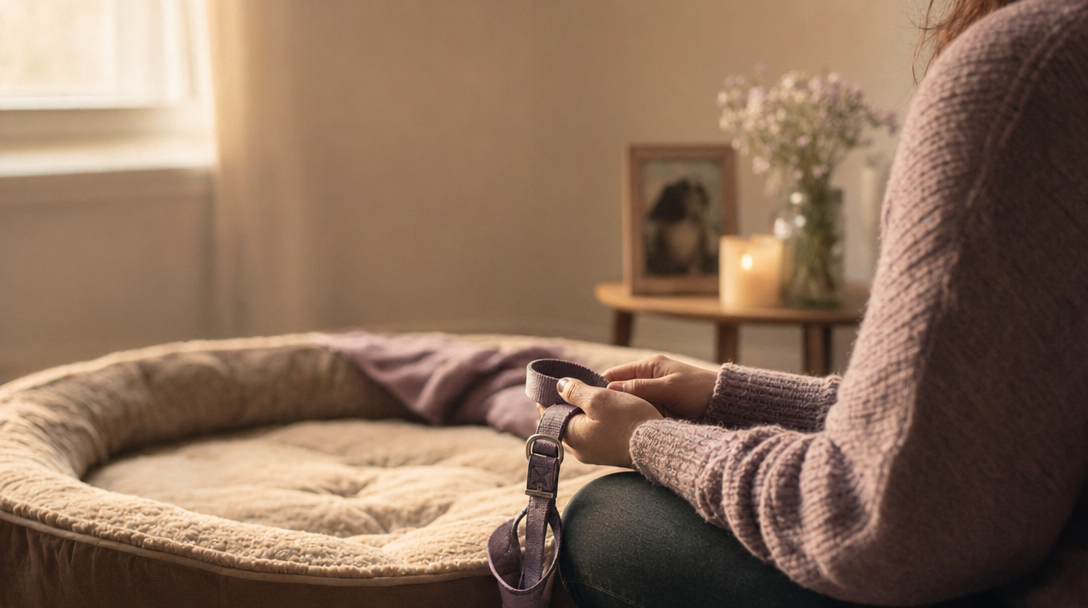
What Should You Say When Someone Loses a Dog?
Say the dog's name, name the loss as real, and keep it short. Something like: "I'm so sorry about Franki. He was such a good dog, and I know how much you loved each other." That single sentence does more than a paragraph of carefully chosen condolences, because it tells the grieving person three things they desperately need to hear — their dog mattered, you remember who their dog was, and their pain is not an overreaction.
The instinct to "say something profound" is what makes most condolences fall flat. You don't need profound. You need specific. Use the dog's name (not "your pup" or "your fur baby"), acknowledge the bond, and resist the urge to wrap the loss in a bow.
A few openers that work in almost any context:
- "I'm so sorry about [dog's name]. There's no replacing a dog like that."
- "I just heard about [dog's name]. I'm thinking of you. You don't have to respond."
- "I know how much [dog's name] meant to you. This is a real loss, and I'm so sorry."
The most comforting thing you can say is the dog's name, said like the dog mattered.
Notice what's missing: no "at least," no "she's in a better place," no "you gave him such a good life" as the opening line. Those things may be true, and there's a place for them later — but the first message is not the place to reframe their grief. It's the place to sit beside it. As Headspace notes in its guidance on supporting friends through pet loss, the grieving person is usually fixated on the final days and on guilt; your job in that first moment is to make space for that, not solve it.
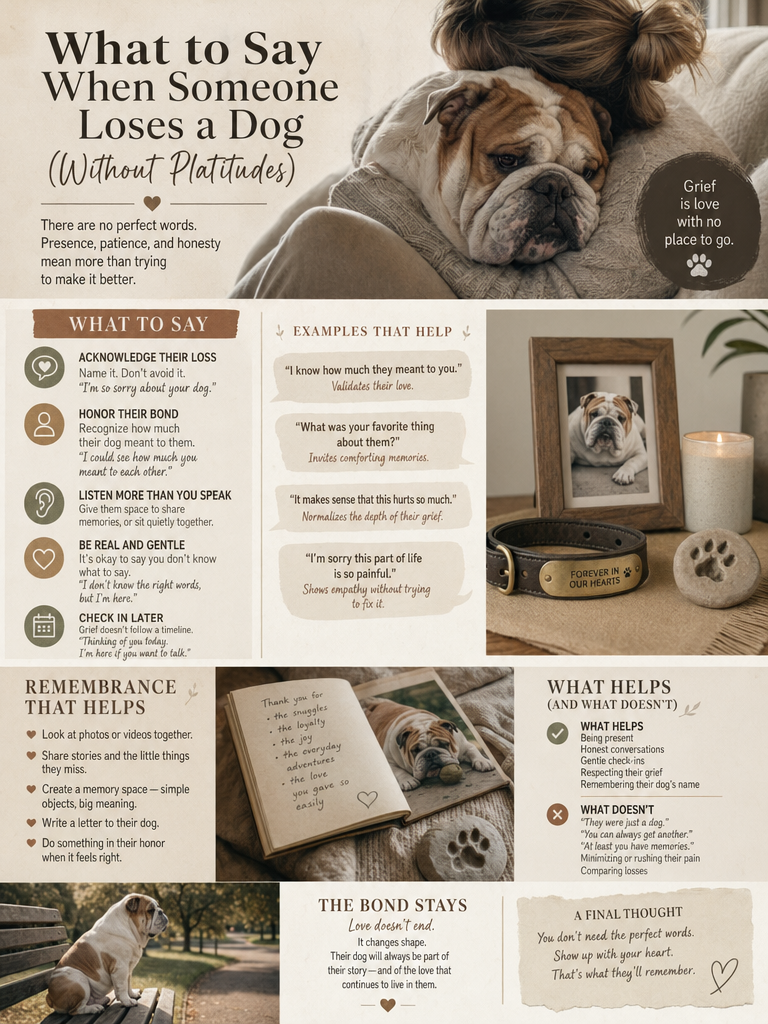
What Should You Not Say After a Dog Dies?
Avoid any phrase that ranks the loss, rushes the timeline, or suggests the dog is replaceable. "It was just a dog," "at least it wasn't a person," "you can always get another one," and "everything happens for a reason" are the four most common — and the four most damaging. They tell the grieving person that you don't understand what they lost, which often hurts more than the silence of people who say nothing at all.
The science backs this up. Pet grief is what researchers call disenfranchised grief — bereavement that society doesn't fully recognize, which makes it harder to process. When friends and family minimize the loss, they're not just being clumsy; they're actively interfering with healing.
Here's a quick translation guide for the phrases that come out reflexively, and what to say instead:
| Don't say | Why it hurts | Say instead |
|---|---|---|
| "It was just a dog." | Denies the bond was real bereavement. | "Losing [name] is a real loss. I'm so sorry." |
| "At least he lived a long life." | Turns grief into a math problem. | "However long you had with him, it wasn't enough." |
| "You can always get another one." | Implies the dog was replaceable. | "There will never be another [name]." |
| "She's in a better place." | Assumes a belief system; minimizes pain now. | "I know how much you loved her." |
| "At least she's not suffering anymore." | Often lands as a defense of the death. | "This was the kindest, hardest thing you could do." |
| "Everything happens for a reason." | Demands meaning before they're ready. | "This is so unfair. I'm so sorry." |
| "I know exactly how you feel." | Centers your experience. | "I can't imagine. Tell me about him." |
Watch out: Silver linings almost always sound like minimization, even when you mean them as comfort. Save reassurance about "a good life" or "no more pain" for week two or three, after the person has had room to feel the rawness of week one.
If you've already said one of these, don't spiral. A simple follow-up — "I said 'at least' earlier and I regretted it. I'm just so sorry about [name]" — repairs more than it costs.
What Do You Write in a Text or Sympathy Card for Dog Loss?
Keep it short, name the dog, say one true thing, and don't ask the griever to do anything in return. The best messages can be read in ten seconds and require zero reply. Long, ornate cards often pressure the recipient to respond gratefully when they have nothing left to give.
Below are tested templates you can adapt. Replace `[name]` with the dog's actual name every time — generic "your pet" wording is the single biggest reason these messages feel hollow.
For a quick text (best within 24–48 hours): - "I just heard about [name]. I'm so sorry. Please don't feel any pressure to write back — I just wanted you to know I'm thinking of you." - "Sending so much love. [name] was such a good dog, and you were such a good human to him." - "There are no words for losing [name]. I'm here whenever you want to talk, cry, or sit in silence."
For a sympathy card: - "[name] will always be part of your story. I'm so sorry. May you feel surrounded by support as you mourn this sweet companion." (adapted from funeral.com's compilation of comforting pet-loss messages) - "I know how loved [name] was. The home you gave him was the best a dog could ask for. I'm holding you in my thoughts." - "I'm so sorry for your loss. I hope [name] lives on in your heart and in every story you tell about him." (a version of this phrasing appears widely in pet-loss communities, including discussions on r/dogs)
For a coworker or someone you don't know well: - "I'm so sorry to hear about [name]. Please take whatever time you need. I've got [specific work task] covered." - "I know [name] meant a lot to you. Sending my sympathy."
For a close friend or family member, if you knew the dog: - "I keep thinking about the way [name] used to [specific memory — greet you at the door, steal socks, sigh dramatically]. I'm going to miss him too." - "[name] was one of the great dogs. I'm so sorry, and I love you."
For social media replies: A single line works better than a paragraph. "So sorry. [name] was the best." Done.
Tip: If you knew the dog personally, share one specific memory — a quirk, a sound, a way they greeted you. As legendURN's grief guidance notes, sharing a fond memory honors the dog and reminds the grieving person that their dog left a mark on someone else's life, too. That validation is often the most healing thing a card can do.
How Do You Comfort Someone After Their Dog Dies?
Reach out fast, name the loss, listen more than you talk, and follow up after the world moves on. Comfort is a process, not a single message — and the most meaningful support usually shows up in week two, when other people have stopped checking in.
Here's a practical workflow:
- Reach out within 24–48 hours. A short text the day you find out is better than a perfect card a week later. Use the dog's name. Don't wait until you have the right words.
- Don't try to fix the feelings. Resist explaining, reframing, or finding the bright side. Your job is to witness, not solve. Phrases like "that makes sense," "of course you feel that way," and "tell me about him" do more than any pep talk.
- Share a specific memory if you knew the dog. "I'll never forget how he used to [X]" is one of the most healing things a grieving owner can hear, because it confirms their dog existed in someone else's life too.
- Offer something concrete, not vague. "Let me know if you need anything" puts the work on them. Instead: "I'm dropping off dinner Thursday — leave the porch light on if that's okay," or "I can walk your other dog this weekend if that helps."
- Check back at days 5, 14, and 30. The first week is loud with sympathy. Weeks two through four are when the silence sets in. A simple "Thinking of you and [name] today" on day 14 lands harder than the first card did.
- Sit with silence. If they cry, don't rush to fill the air. If they don't want to talk, don't push. Presence — even on the phone, even in a quiet room — is its own kind of message.
Steady, low-pressure presence beats perfect words every single time. For a deeper breakdown of practical comfort techniques, our guide on [how to comfort someone who lost a dog](/how-to-comfort-someone-who-lost-dog-what-never-to-say) walks through more scenarios in detail.
What If They Feel Guilty About Their Dog's Final Days?
Don't argue with the guilt — redirect it gently toward the love. Guilt after a dog's death is almost universal, especially after euthanasia, an accident, an illness that was caught late, or any decision made under pressure. Trying to debate the facts ("you couldn't have known," "the vet said it was time") usually backfires, because guilt isn't a logic problem. It's grief looking for somewhere to land.
What helps more is reflecting back the truth they're losing sight of: that the dog had a loving home, that the hard decisions were made out of love, and that being present at the end is one of the last gifts a person can give a dog. As Headspace's pet-loss guidance puts it, the friend is fixated on the final days; your role is to help them remember the loving home they provided across all the days before.
A few responses that work without minimizing:
- "You loved him every single day he was with you. That's what he knew."
- "Choosing to end her suffering was one of the hardest, most loving things you'll ever do."
- "There's no version of this where you did it perfectly. There's only the version where you loved him, and you did."
- "Guilt is part of grief. It doesn't mean you did anything wrong."
Avoid: "You shouldn't feel guilty." Telling someone what they shouldn't feel rarely lands; it usually makes them feel ashamed of their grief on top of everything else.
If their guilt is centered on the euthanasia decision specifically — and that conversation is going to keep coming up — our piece on [euthanasia guilt and how to forgive yourself](/euthanasia-guilt-how-to-forgive-yourself) is a resource you can quietly send along when the moment is right. For someone in the rawness of week one, our guide on [surviving the first week after a dog dies](/survive-first-week-after-dog-dies) offers grounded, practical structure.
Tip: Don't send a resource link in the same message as your condolences. Wait a week or two, then share it as: "I came across this and thought of you — no pressure to read it." That makes it a gift, not an assignment.
What If You Didn't Know the Dog Well?
Be brief, sincere, and honest about your distance. You don't need a personal memory to offer real comfort — you just need to avoid pretending closeness you didn't have. A short, genuine message from an acquaintance often lands better than a flowery card from someone trying to perform grief they didn't share.
What works for coworkers, neighbors, distant relatives, and friends-of-friends:
- "I didn't know [name] well, but I know how much he meant to you. I'm so sorry."
- "I'm thinking of you. Losing a dog is its own kind of grief, and I hope you're being gentle with yourself."
- "I just wanted to send my condolences. No need to reply."
What to skip: claiming a bond you didn't have ("I feel like I knew him from your stories!" rings false unless it's actually true), and any version of "I know exactly how you feel" if you've never lost a dog. Sincere distance is more comforting than performed closeness.
Words vs. Actions: What Helps More After a Dog Loss?
Both — but actions carry the words. The most meaningful response usually pairs a short, honest message with one concrete act of help, because grief is exhausting in ways that paralyze ordinary life. Cooking, errands, and basic household tasks become unmanageable in the first week, and a friend who quietly handles one of them is often remembered longer than any card.
Here's how the two stack up in practice:
| What you offer | When it helps most | Example |
|---|---|---|
| A short text or card | First 48 hours | "I'm so sorry about [name]. Thinking of you." |
| A meal dropped off | Days 1–7 | Leave it on the porch; no need to come in. |
| Practical task help | First two weeks | Walking another pet, mowing the lawn, picking up groceries. |
| Specific check-ins | Weeks 2–8 | "Thinking of [name] today" on hard dates. |
| A memorial gesture | Anytime after week 2 | Donation to a shelter in the dog's name, a printed photo, a tree. |
| A book or resource | When asked, or weeks later | Offered as companionship, not a fix. |
Memorial gestures deserve particular care. A donation to a local shelter or rescue in the dog's name, a framed photo you already had on your phone, or a small tree or plant — these honor the dog without turning grief into a shopping event. Skip the mass-produced sympathy gifts that feel like inventory; they almost always read as generic.
If you're looking for ways to help someone honor their dog's life on their own terms, our guide to [25 beautiful ways to honor a dog's life](/beautiful-ways-honor-dogs-life) is full of grounded ideas they can return to when they're ready.
The best support after a dog dies is usually a short message and a warm meal — not a long speech.
How Can You Keep Supporting Them After the First Message?
Show up after everyone else has stopped. The hardest part of pet loss isn't the first week — it's the second month, when the casseroles are gone, the social media posts have ended, and the grieving person is alone with an empty leash by the door. Sustained, low-key presence is the single most underrated form of support.
A few ways to do that without being intrusive:
- Mark the firsts. First holiday, first walk past the dog park, the dog's birthday, the anniversary of the death. A simple text — "Thinking of [name] today" — on these dates reminds them they're not grieving alone.
- Invite memories, don't avoid them. Many people stop saying the dog's name because they're afraid of "reminding" the owner. The owner has not forgotten. Saying the name is a gift, not a wound.
- Respect silence too. If they don't want to talk about it on a given day, that's not regression. Grief moves in waves. Your job is to stay reachable, not to manage the timeline.
- Suggest support gently if grief becomes unmanageable. If they're not eating, sleeping, or functioning weeks in, it may be time to mention a pet-loss counselor. Our guide on [finding a pet loss grief counselor](/find-pet-loss-grief-counselor) is a useful starting point. Frame it as an option, not a prescription.
- Offer companionship in book form, when the moment fits. Sometimes a grieving person needs a voice that has been through it — not advice, just company. To Lose A Dog, a memoir and grief-support book about Isaac H's 1,820 days with his English Bulldog Franki, was written for exactly this season: the long quiet after the first wave of sympathy passes. If a friend is searching for words for their own grief, it can sit on the nightstand as company.
The friends who help most are the ones who keep saying the dog's name long after everyone else has moved on.
Grief doesn't end on a schedule, and neither should support. A text on a random Tuesday in month three — "Saw a bulldog today and thought of [name]" — can mean more than every condolence card combined.
If you or someone you love is navigating this season and looking for a steady, honest companion through it, reserve your copy of To Lose A Dog — a memoir and practical grief guide written for the people who knew their dog was family.
Frequently asked questions
Is it okay to reach out if I didn't know the dog personally?
Yes, and brevity is your friend. A short, honest message like "I didn't know [name] well, but I know how much he meant to you — I'm so sorry" is more comforting than a long card that overstates your closeness. Sincerity matters more than shared history.
What if I already said the wrong thing — how do I fix it?
A simple, direct follow-up repairs more than most people expect. Try: "I said 'at least' earlier and I regretted it — I'm just really sorry about [name]." Acknowledging the misstep without over-explaining it shows the grieving person you were paying attention.
How long should I keep checking in after someone loses their dog?
The most meaningful support often arrives in weeks two through eight, after most people have stopped reaching out. Texting "thinking of [name] today" on the dog's birthday, the first holiday, or even a random Tuesday can mean more than the original condolence card did.
What kind of memorial gift actually helps — and what should I avoid?
A donation to a local shelter in the dog's name, a framed photo you already had on your phone, or a small plant tend to land better than mass-produced sympathy products, which often feel generic. The gesture matters most when it's tied to something specific about that dog.
How do I help a friend who feels guilty about the euthanasia decision?
Don't try to debate the facts or argue them out of the guilt — it usually backfires because guilt isn't a logic problem. Instead, reflect back the truth they're losing sight of: that the decision was made out of love, and that being present at the end is one of the last gifts a person can give a dog.
Sources
- What to say (and not say) when a friend loses their pet - Headspacewww.headspace.com
- Comforting Sayings for the Loss of a Dogwww.legendurn.com
- What to Say When Someone's Pet Dies: 60 Comforting Messagesideas.hallmark.com
- What to say when someone loses a pet — Calm Blogwww.goodhousekeeping.com