Should you see your dog's body after euthanasia?
Seeing your dog's body after euthanasia is a personal choice, and both looking and choosing not to look can be the right decision. Veterinary Wisdom says grief experts agree that seeing a body helps people accept the reality of death and say a heartfelt goodbye. The same source notes many clients feel afraid or unsure beforehand, especially if they have never seen a dead body. Neither response is wrong.
For many owners, the moment of seeing the body is what makes the loss real. Denial is one of grief's first defenses, and the mind can keep expecting a dog to trot around the corner. Being present with the body interrupts that loop. It tells your body, not just your thoughts, that the goodbye has happened.
There is also a quieter reason people choose to look: regret runs the other direction more often than people expect. PetMD says many pet parents later say they regretted not being there when their pet was euthanized. That doesn't mean everyone should force themselves. It means the fear of the image is often larger in advance than the memory turns out to be.
If you are torn, know that fear beforehand is normal, and so is choosing to protect yourself from an image you can't unsee. There is no test to pass here. You knew your dog. You know your own limits. Both paths are acts of love.
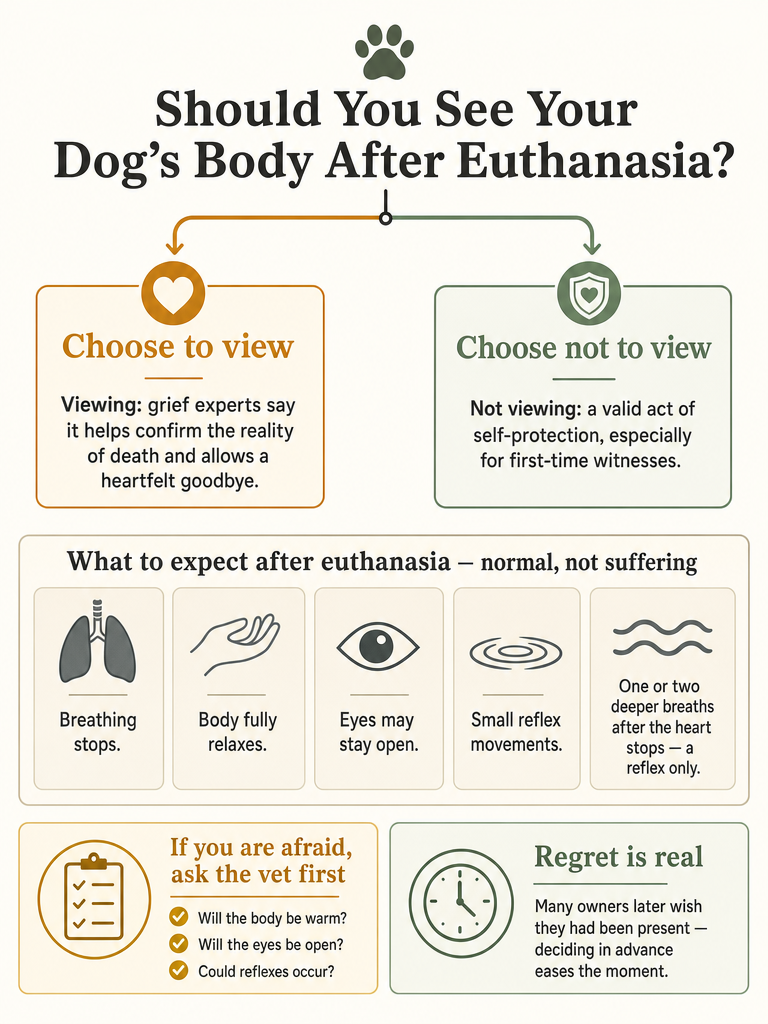
Seeing your dog's body vs not looking: which choice fits your grief?
Whether to view your dog's body comes down to how your grief tends to work. Some people need concrete evidence to accept a loss; others already carry the reality and don't need the image to confirm it. Veterinary Wisdom describes both realities at once: seeing the body helps people accept death, and many clients are genuinely afraid or uncomfortable with the idea beforehand.
Neither instinct is a character flaw. Here is a plain way to weigh the two paths against what you know about yourself.
| Choosing to view may help if… | Choosing not to look may fit if… |
|---|---|
| You struggle to believe a loss is real until you see it | You already feel certain of the death and don't need proof |
| You want a final, unhurried goodbye | You have a trauma history around dead bodies |
| You suspect you'd later regret not being there | You know a hard image would replace your living memories |
| You want to touch or hold your dog one more time | Seeing the body would overwhelm rather than comfort you |
The fear you feel in advance is not a reliable predictor of what you'll feel in the room. But it is real, and it deserves respect. If you decide not to look, you are protecting yourself, and your dog will not know the difference. You are the one who has to live with the memory, and you get to choose which one you keep.
What should I expect right after my pet dies?
Right after your dog dies, you may see the breathing stop, the body relax completely, the eyes stay open, and small reflex movements. Sweet Dreams In-Home Pet Euthanasia says these changes are normal and do not mean your dog is suffering. When euthanasia is done properly, your dog is already deeply unconscious before the final medication, so what you see afterward can be startling but is not pain.
Knowing this in advance is the single best way to protect yourself from panic. Here is what Sweet Dreams In-Home Pet Euthanasia lists as normal:
- Breathing stops. This is usually the first sign families recognize. Your vet confirms death by listening for heartbeat and breath sounds.
- The body relaxes. Muscles release, the jaw may loosen, and your dog's posture may shift.
- The eyes may stay open. In many cases, pets' eyes do not close after passing. This surprises people, and it is normal.
- A final breath or sigh. Some pets take one or two deeper breaths after the heart has stopped. It can look like a sigh or a gasp. This is a reflex, not distress.
- Small twitching or muscle movement. A shiver-like motion or a small limb movement is a reflex, not awareness.
- Release of urine or stool. After the muscles relax, the bladder or bowels may release. Your vet is prepared for this and will be discreet.
- The body cools. Circulation stops, and the body begins to cool, sometimes faster than people expect, especially in smaller dogs.
None of these signs mean your dog felt pain. They are the body letting go.
What happens immediately after a pet's passing at home or at the vet?
Immediately after euthanasia, the workflow is intentionally slow and quiet, whether at home or at the clinic. Sweet Dreams In-Home Pet Euthanasia describes the standard sequence in-home vets follow: they confirm passing, give you quiet time, answer questions, discuss next steps, and handle transportation if you've chosen cremation.
The confirmation comes first. Your veterinarian listens for a heartbeat and breath sounds to confirm your dog has passed. This part is usually gentle and brief, and a good vet will tell you what they're doing as they do it.
Then the pace changes. The rush is over, and most vets will not hurry you. You can sit quietly, cry, or say nothing at all. Some owners keep talking to their dog through the process and afterward; whether or not a dog can hear at that point isn't something the sources settle, but talking often helps the person more than anyone.
If you're at a clinic, the staff will guide you on when and how to leave, and how your dog will be cared for next. If you're at home, the vet may take your dog for cremation or leave you time before transport.
Can you touch, hold, or spend time with your dog after death?
You can touch, hold, and stay with your dog after death, and there is no single right amount of time. Sweet Dreams In-Home Pet Euthanasia says one benefit of in-home euthanasia is that families can often take their time to sit with their pet, hold them, and let children say goodbye gently. Some cremation providers offer this too: Paws Into Grace says it offers up to one hour of private viewing time in its office.
At a clinic, the window may be shorter than at home, but you can still ask for time. Most staff will make space if you tell them what you need.
Hold your dog if you want to. Brush the fur one more time. Say the things you didn't get to say. Some people stay ten minutes; some stay much longer. The point isn't the clock. It's leaving the room without the feeling that you were rushed out of your own goodbye.
If sitting with the body feels like too much, that is also fine. Wanting to leave quickly does not mean you loved your dog less.
If you are afraid to look, what can you ask the vet to tell you first?
If you're afraid to see your dog's body, ask your vet to describe what you'll see before you look. Veterinary Wisdom says staff can prepare clients by telling them the body may still be warm, the eyes may be open, and there may be slight soiling from release of the bowel and bladder. Being told in advance removes most of the shock, which is usually the part people fear.
Here is a simple script you can use, in your own words:
- "Will his body still be warm when I see him?"
- "Will her eyes be open? Can they be closed?"
- "Might there be any twitching, a last breath, or any soiling I should expect?"
- "Can you stay with me, and can I stop and step out if I need to?"
You are allowed to ask all of it. Vets who do this work regularly have answered these questions many times, and a good one will not make you feel foolish for asking.
Preparation is the difference between a startling image and a peaceful one. The body usually looks calmer than the fear in your head.
You can also ask them to position your dog gently, cover part of the body, or tuck them in a favorite blanket before you come in. Small requests are welcome. This is your goodbye to shape.
Should I let my dog see my other dog after he gets put down?
If you want your surviving dog to see or smell the body, wait until after death has occurred rather than during the procedure. That's the practical guidance owners share from experience. On the Reddit DogAdvice community, one response put it plainly: only let your pet see their friend after death has occurred, because letting them say goodbye can help, but watching the death happen can be distressing.
Be honest about what this is and isn't. There's no reliable way to know exactly what your surviving dog understands, and the sources here don't claim certainty about animal grief. Some owners feel it gives their other dog a chance to register that their companion is gone rather than simply vanished. Others notice no clear response at all. Both happen.
If you try it, keep it calm and brief, let your dog approach on their own terms, and don't force it. There's no evidence that skipping this step harms a surviving dog, so do it only if it feels right to you.
What do vets do with a dog's body after putting it to sleep?
After euthanasia, your veterinarian handles your dog's body according to the aftercare choice you make: burial or cremation. PetMD says you may choose to leave your pet with the veterinarian for burial or cremation, or you may be able to bury your pet at home depending on local ordinances. The clinic or in-home vet will usually help arrange whichever option you pick and coordinate transport for cremation.
The main choices break down like this:
| Option | What it means | Notes from sources |
|---|---|---|
| Private cremation | Your dog is cremated individually and the ashes are returned to you | Sweet Dreams describes ashes returned in an urn or container |
| Communal cremation | Your dog is cremated with other pets; ashes are typically not returned | Lower cost option; ashes not individualized |
| Home burial | You bury your dog on your property | PetMD says this depends on local ordinances |
| Vet-arranged burial | You leave your dog with the vet for burial | PetMD lists this as an option |
A short checklist to settle before the appointment:
- Choose burial or cremation. If burial, confirm your local ordinances allow home burial. If cremation, decide private versus communal.
- Decide about ashes. Private cremation returns them; communal usually does not. This affects cost and what you can keep.
- Arrange transport. With in-home euthanasia, ask whether the vet takes your dog for cremation. Owners in a Dogspotting Society thread describe struggling emotionally with transporting the body themselves, so let the vet handle it if that's easier.
- Settle payment beforehand. Ask what's owed and pay in advance if you can, so no one hands you a bill in the parking lot.
PetMD recommends finalizing aftercare details and payment arrangements ahead of time instead of making decisions in the emotional moments after your pet has passed. If you want ashes, decide now whether you'll keep them in an urn, wear a portion, or both. Our guide on choosing between a dog urn and cremation jewelry walks through that quietly. And if you're facing the first day and unsure what to handle now versus later, our step-by-step guide to what to do in the first 24 hours after a dog dies lays out the order without pressure.
How much do euthanasia and cremation usually cost?
Euthanasia generally runs $50 to $500, with the highest figures for at-home services. PetMD says cost varies by practice and appointment type, and that at-home euthanasia costs more than a clinic visit. Some practices offer end-of-life appointments for existing clients at no cost. Cremation is a separate expense.
According to PetMD, cremation services may cost another $50 to $300, depending on whether you have the ashes returned. Communal cremation without returned ashes sits at the lower end; private cremation with an urn sits higher.
Ask for the full total upfront so nothing surprises you later. Money is the last thing you want to negotiate through tears, which is exactly why settling it before the appointment is worth the awkward phone call now.
How to know when it is time to euthanize your dog
You know it may be time to euthanize your dog when the bad days start to outnumber the good ones. PetMD says a pet's quality of life is the most important factor: your dog should have more good days than bad, and when that reverses, it's time to start thinking about a peaceful passing. The same source stresses there is no one-size-fits-all approach, and these decisions should always be made through careful discussion with your veterinarian.
That's the honest core of it, and it connects directly to everything above. The calmer you are about the after-death questions in this article, the more present you can be for the decision itself.
Beyond that plain guidance, public tools exist to help you track patterns. Quality-of-life scales, like the one from Lap of Love, give families a structured way to notice decline over time rather than trusting a single bad afternoon. Our walkthrough of the Lap of Love quality of life scale and our vet-backed guide on when to put your dog down go deeper than we can here.
More good days than bad is the plainest test PetMD offers, and when that balance flips, it's a conversation to have with your vet.
If you're weighing whether to stay for the procedure itself, whether to be in the room during euthanasia is worth reading before the appointment.
Where to turn next if the image, guilt, or first night feels too heavy
If the image, the guilt, or the first night feels like too much to carry alone, that reaction is normal grief, not weakness. Sweet Dreams In-Home Pet Euthanasia lists shock, panic, guilt, numbness, and intense sadness as common feelings in the minutes after a pet dies, and notes it can hit fast. What you do next matters less than knowing you don't have to do it alone.
A few places to go from here, depending on what's heaviest:
- If tonight is the problem: what actually helps when you can't sleep after your dog dies.
- If guilt about the decision is loud: how to forgive yourself for euthanasia.
- If the whole month ahead feels impossible: the first 30 days after losing a dog.
- If you need other people who get it: which online pet loss support groups help most.
- If you're deciding what to do with the ashes: choosing a dog urn or cremation jewelry.
Whatever you saw, or chose not to see, in that room, you made a loving choice under impossible pressure. Be as gentle with yourself now as you were with your dog at the end.
Frequently asked questions
Should you see your dog's body after euthanasia?
Seeing the body is a personal choice — both looking and not looking are valid. Grief experts note that viewing helps many people accept the reality of death and say a genuine goodbye. But many owners feel afraid beforehand, and that fear is normal too. PetMD data shows pet parents more often regret not being present than regret going in. You can ask to see your dog and stop at any point — you don't have to commit before you walk in.
What should I expect right after my dog dies from euthanasia?
Breathing stops first, followed by full muscle relaxation, eyes staying open, and possibly a final reflex breath or small twitching — none of which signal pain. Sweet Dreams In-Home Pet Euthanasia confirms these are normal physical reflexes, not distress. Your dog is already deeply unconscious before the final medication. The bladder or bowels may also release as muscles let go. Knowing this in advance is the single best protection against panic in the room.
How do I know when it is time to euthanize my dog?
The plainest test: bad days outnumber good ones. PetMD states that a pet's quality of life is the most important factor, and when the balance of good days to bad reverses, it's time to discuss a peaceful passing with your veterinarian. There's no one-size-fits-all answer, and that conversation should always involve your vet. Structured tools like the Lap of Love quality-of-life scale give families a way to track decline over time rather than relying on a single difficult afternoon.
How do I stop feeling guilty about my dog's euthanasia?
Guilt after euthanasia is one of the most common grief responses — not a sign you made the wrong call. Sweet Dreams In-Home Pet Euthanasia lists guilt alongside shock and numbness as normal feelings in the minutes after a pet dies. The decision to end suffering is an act of love made under impossible pressure. Naming the guilt as a grief symptom, not a verdict, is the first step. Dedicated pet loss support groups and counselors who specialize in pet bereavement can help when guilt becomes persistent.
Can I hold or spend time with my dog's body after euthanasia?
Yes — and there's no required time limit. Sweet Dreams In-Home Pet Euthanasia notes that in-home euthanasia gives families space to sit with their pet, hold them, and let children say a gentle goodbye. Some providers offer private viewing time at their facility as well; Paws Into Grace, for example, offers up to one hour of private viewing. At a clinic, the window may be shorter, but you can ask for the time you need. Leaving before you're ready is the only thing worth avoiding.
Should I let my surviving dog see my other dog's body after euthanasia?
If you want your surviving dog to acknowledge the loss, let them sniff or see the body only after death — not during the procedure. A response on the Reddit DogAdvice community puts it plainly: letting a pet say goodbye can help, but watching the death happen can be distressing. Some owners find their surviving dog registers the absence more clearly this way; others notice no visible response. Keep it calm, let your dog approach on their own terms, and don't force it either way.
Sources
- [Sad] Should I let my dog see my other dog after he gets put down?www.compassionunderstood.com
- What happens immediately after a pet's passing?sweetdreamsgeorgia.com
- What Should I Expect Right After My Pet Dies?www.memorials.com
- Pet Euthanasia: Everything You Need to Know - PetMDwww.veterinarywisdom.com