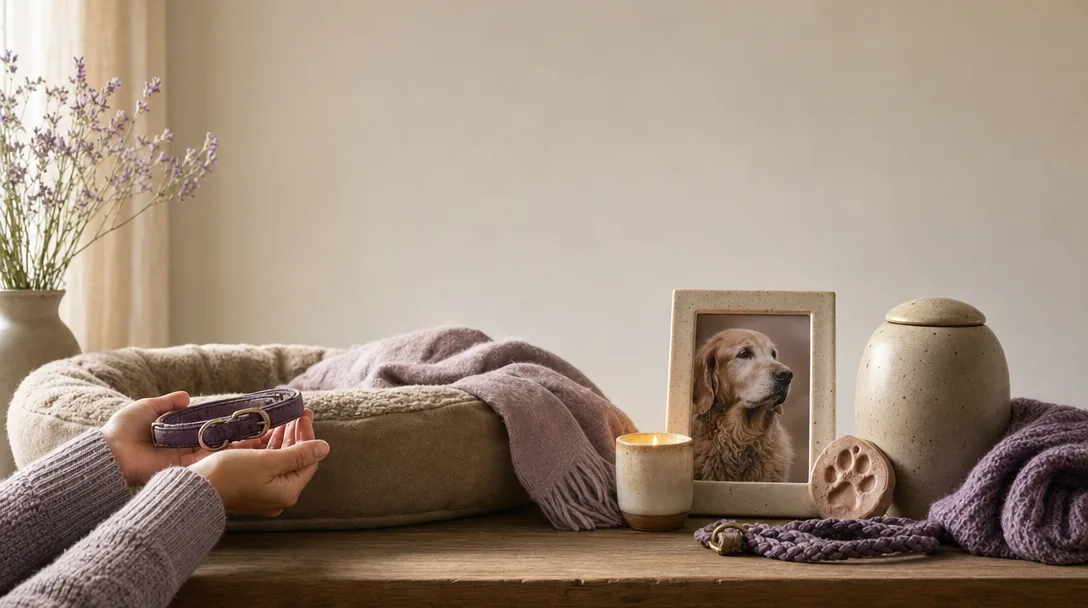
What are some good bereavement rituals for a dog?
A bereavement ritual for a dog is an intentional act that marks the loss, expresses your love, and gives you a sense of goodbye. The most useful way to choose one is by timing: pick a single act before death, another during the goodbye, one in the first 24 hours, and one for later remembrance. You don't need all four, and you don't need anything elaborate.
Grief for a dog is real bereavement. Humane World for Animals is direct about this: people often feel the same grief after losing a beloved pet as they do after losing a person, yet that grief may go unacknowledged by others. Rituals help because they give shape to something the world around you keeps minimizing.
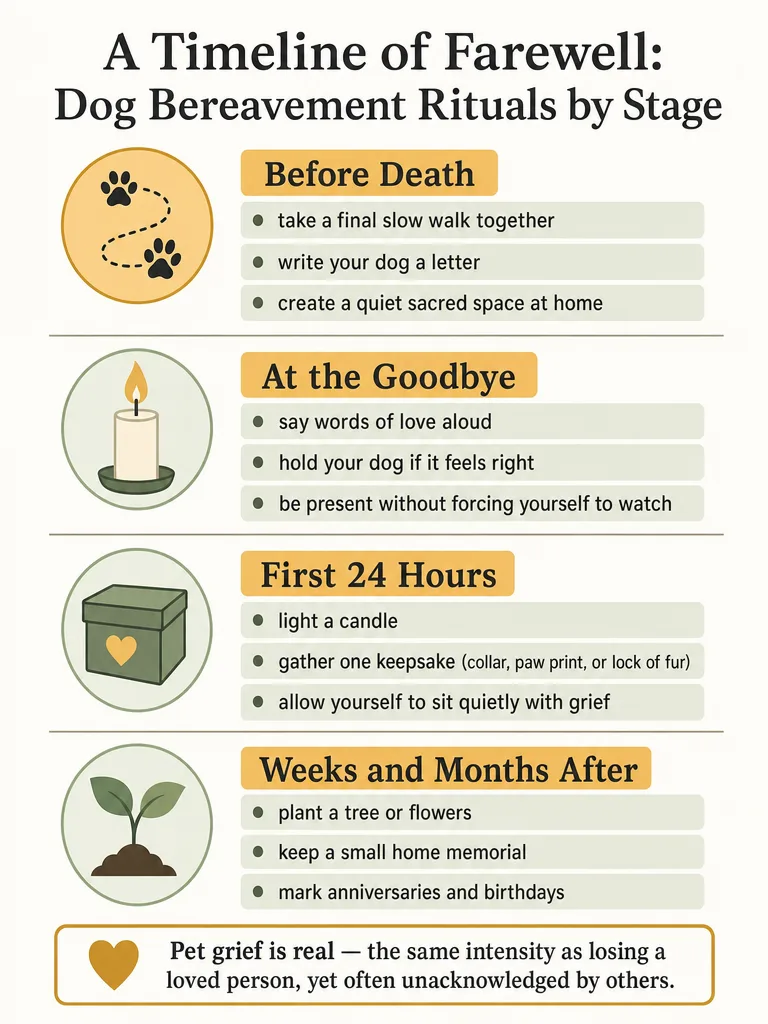
Here's a simple timeline to work from:
- Before death: slow your walks, tell stories, write a letter, plan the goodbye.
- During the goodbye: stay present, hold your dog, light a candle, say what you love.
- First 24 hours: spend time with the body if you want, mark the moment quietly.
- Later: plant something, keep a memory space, mark the firsts.
The sections below walk through each, with sourced options and no pressure to perform grief a certain way.
How do I choose a ritual that feels meaningful, not forced?
The right ritual matches your values, your dog's routines, and the support you actually want, not what looks meaningful to anyone else. Ready Pet Education suggests starting with reflection: would a gathering of family and friends feel comforting, or would you prefer something small and private? Do you and your dog have a tradition you'd want to fold in? Do your religious, spiritual, or cultural beliefs play a part?
That last question about support matters as much as the ritual itself. Ready Pet Education also names a hard truth: pet loss is often disenfranchised grief, meaning you may not get the same support others would after a human death. Choosing a private ritual because you fear being judged is different from choosing it because quiet is what you need. Both are valid. Only you can tell them apart.
There's no single correct form. A candle at bedtime counts. So does a backyard gathering.
How can I say goodbye to my dog before euthanasia?
If you have time before a scheduled euthanasia, anticipatory rituals let you say goodbye while your dog is still with you. Be Ceremonial frames this as honoring the bond rather than waiting passively for the end. Co-founder Megan Sheldon, preparing for the death of her dog Kona, described slowing down their walks and not rushing Kona as she sniffed and explored, plus building photo albums to give her daughters on the day Kona died.
A workable sequence, drawn from Be Ceremonial and Ready Pet Education:
- Create a quiet space at home, decorated with photos, toys, or meaningful objects, where you can spend calm time together.
- Take slower walks and let your dog set the pace.
- Tell stories about your dog's life, out loud or with family, including the day you first met.
- Write letters expressing your love and gratitude; read them aloud or keep them.
- Plan the farewell and confirm the practical decisions.
Those practical decisions carry real weight. Ready Pet Education recommends deciding in advance whether you want euthanasia at a clinic, at home, or somewhere like your dog's favorite park, and what you want for the remains and any keepsakes. Sheldon reached out to Dr. Jenn of Sage Paws, who walked her through what the day might look like. If you're mapping the day itself, what to do the day you put your dog down covers the logistics so the day can stay about your dog.
What can I do in the first hours after my dog dies?
In the first hours after your dog dies, the most useful thing is to be present in whatever way feels right, without forcing yourself into a performance. Be Ceremonial suggests being with your dog during their final moments if possible, and marking the time with a simple act: light a candle, say a prayer, or just hold your dog and express your love. Ritualwell echoes the candle, describing one lit and burned down in memory of the pet.
Hold the body if that feels right to you. Spend time. There's no rule about how long.
There is one thing worth protecting yourself from. Humane World for Animals warns against replaying your last moments, especially if they were traumatic. The pull to ruminate on the final hours is strong and it deepens the wound.
If sleep won't come afterward, what actually helps when you can't sleep after your dog dies has grounded steps for the first night.
Should I have a memorial service for my dog, or keep the ritual private?
Neither a gathering nor a private ritual is more correct; the choice depends on whether shared stories comfort you or drain you. Ritualwell describes a fitting communal ritual as friends and family gathering to talk about the dog's life and say goodbye, an image that came from a five-year-old imagining everyone making a circle and saying what they loved. A private version can be as simple as a candle and a framed photo at home.
The aftercare decisions run alongside either choice. Ready Pet Education lays out the practical menu:
| Decision | Options the sources describe |
|---|---|
| The body | Burial, cremation, aquamation, composting |
| Ashes | Returned to you or not; choice of urn |
| Prints | Clay or ink paw print, or nose print |
| Physical keepsakes | Fur or whisker trimmings |
Ready Pet Education also notes you should research local services and any laws about burying or spreading pet remains in your area. Deciding these in advance, it says, makes the days around the loss easier because you can focus on your needs instead of paperwork. If you're weighing the two main paths, how to choose between cremation and burial for a dog compares cost, permanence, and portability.
What should I keep after my dog dies?
Keep what carries your dog, and don't rush the decision. Ritualwell suggests keeping something that belonged to your dog: a leash, a bowl, a toy, and framing a photo to display prominently. Ready Pet Education adds paw or nose prints and fur or whisker trimmings to the list, alongside ashes and a chosen urn. You can also keep a letter, a poem, or a photo book.
The rushing is the risk, not the keeping. In the first days, everything feels urgent, but a collar or a favorite toy isn't going anywhere.
A few common keepsakes and where the choice can get thoughtful:
- Collar and leash: the most tactile reminder; what to do with your dog's collar after they die covers reversible options.
- Ashes: an urn at home, a small amount carried, or both; how to choose between a dog urn and ashes jewelry helps you decide.
- Words: a memorial quote for a stone, urn, or card; dog memorial quotes that don't sound generic gives lines that feel like your dog.
How do I help a child grieve the loss of a dog, step by step?
Children grieve a dog best with truthful, age-appropriate language and a real chance to say goodbye. Humane World for Animals notes that honest explanation and a goodbye can help children move through pet loss more healthily. Ritualwell adds that, painful as it is, an early pet loss can prepare a child for later human losses by teaching that things end and that grief and healing can coexist.
A gentle sequence pulled from the sources:
- Tell the truth in plain words. Avoid euphemisms that confuse; Ritualwell's example of a hamster simply "put in the garbage" shows how badly a hidden or blunt handling can land.
- Invite their memories. Be Ceremonial describes inviting children to share the stories and moments that stand out to them.
- Make something together. A photo album or a simple goodbye circle, where each person says what they loved, gives kids a role.
- Let the child help choose a keepsake, a toy or a framed photo that stays theirs.
- Don't rush in a new pet as a replacement. Ritualwell's experts advise holding off; a new dog is not an eraser for grief.
For the language itself, how to help your child understand the death of a pet offers age-specific scripts.
Which rituals help after the first week and the first anniversaries?
Ritual isn't a one-day event; the most sustaining rituals create an ongoing place for memory long after the first week. Humane World for Animals suggests memorial acts that live on: planting a tree or flowers, keeping a memory book or scrapbook, and maintaining a memorial space at home. Ready Pet Education mentions setting up a memorial or shrine where you can place meaningful objects. Ritualwell suggests writing your own poem or essay about what your dog meant to you and sharing it.
The firsts will come whether you plan for them or not: the first empty morning, the first walk route, your dog's birthday. Marking them on purpose tends to hurt less than being ambushed. Surviving the firsts after losing a dog and how to handle your dog's birthday after they die both walk through these.
Memorializing has become a widely shared practice, not a private oddity. Etsy lists more than 5,000 items in its Pet Loss Gifts category, a marketplace signal that keeping something is common. That's context, not instruction. A hand-planted flower with no receipt counts every bit as much.
Is it normal to feel intense grief after my dog died, even after a ritual?
Yes, and a ritual doesn't switch grief off. Humane World for Animals describes the grief process as non-linear: you may move in and out of denial, anger, guilt, and sadness rather than passing through them in order, and just when you feel better a wave can wash over you again. Guilt and shame about being "so upset" are named as normal parts of it. Ready Pet Education adds that pet loss is often disenfranchised, so you may carry it with less support than a human loss would bring, even though many say it hurts more.
The ritual honors your dog; it does not close the grief, and needing more help afterward is expected, not a failure.
You don't have to carry it alone. Humane World for Animals points to several dedicated resources:
- The Pet Compassion Careline, 24/7 grief support with trained pet grief counselors.
- Lap of Love, grief courses and 50-minute one-on-one sessions with a grief counselor.
- Love, Baxter, grief articles and ways to memorialize your pet.
- Everlife Support Groups, organized by state.
- Association for Pet Loss and Bereavement support groups at set times.
If the weeks ahead feel unmanageable, the first 30 days after losing a dog maps what's normal, how to choose a pet loss grief counselor who gets dog loss helps you find real support, and some people find company in a dog-specific memoir. To Lose A Dog by Isaac H, built around his 1,820 days with Franki, is one such book for readers who want a story alongside the guidance.
Frequently asked questions
What are bereavement rituals for a dog, and do they actually help?
A bereavement ritual is any intentional act that marks the loss, expresses your love, and gives shape to a goodbye — lighting a candle, writing a letter, or gathering family to say what they loved about your dog. They help because pet grief is real bereavement, yet it often goes unacknowledged by others. Humane World for Animals confirms people frequently feel the same depth of grief after losing a pet as after losing a person. Rituals give that grief a container the world around you may not offer.
How can I say goodbye to my dog before euthanasia?
Slow everything down before the day arrives. Be Ceremonial's co-founder Megan Sheldon, preparing for her dog Kona's death, stopped rushing their walks, told her daughters stories about the day they first got Kona, and built photo albums to give the children on the day she died. She also consulted a vet in advance who walked her through what the day would look like — which she described as empowering rather than frightening. Writing letters to your dog and creating a quiet space with photos and meaningful objects are also grounded ways to say goodbye while your dog is still present.
What should I do in the first 24 hours after my dog dies?
Be present in whatever way feels right without forcing yourself into a performance. Be Ceremonial suggests marking the moment with a simple act — holding your dog, lighting a candle, saying what you love. Spend time with the body if that feels right; there's no rule about how long. One specific thing worth protecting yourself from: Humane World for Animals warns against replaying the final moments, especially if they were traumatic. That pull to ruminate keeps you stuck in the hardest hour instead of the years of life you shared.
Should I have a memorial service for my dog, or keep the goodbye private?
Neither is more correct — the choice depends on whether shared stories comfort you or drain you. Ritualwell describes a communal ritual where friends and family make a circle and say what they loved about the dog, an idea that came from a five-year-old's instinct about what a goodbye should look like. A private ritual can be as simple as a candle and a framed photo. Ready Pet Education advises deciding in advance about practical aftercare — burial, cremation, aquamation, paw prints, ashes — so the days around the loss stay focused on your needs rather than logistics.
Is it normal to cry every day after my dog died, even weeks later?
Yes, and it doesn't mean something is wrong with your grieving. Humane World for Animals is explicit that the grief process is non-linear — you may feel better, then have a wave wash over you again, cycling through denial, anger, guilt, and sadness in no predictable order. Feeling ashamed of how upset you are is itself named as a common part of the process. Ready Pet Education adds that pet loss is frequently disenfranchised grief, meaning you may carry it with less social support than a human loss would bring, even though many people describe it as more painful.
What rituals help in the weeks and months after a dog dies — not just the first day?
The most sustaining rituals create an ongoing place for memory. Humane World for Animals suggests planting a tree or flowers, keeping a memory book or scrapbook, and maintaining a memorial space at home. Ritualwell recommends writing your own poem or essay about what your dog meant to you. Ready Pet Education adds setting up a small shrine where meaningful objects can live. The firsts — empty mornings, familiar walk routes, your dog's birthday — will arrive whether you plan for them or not; marking them on purpose tends to hurt less than being caught off guard.
Sources
- Rituals Surrounding The Death Of A Petwww.beceremonial.com
- Mourning or grief rituals? : r/Petlosswww.readypeteducation.com
- End Of Life Rituals for Petsritualwell.org
- Grieving the Loss of a Pet - Ritualswww.humaneworld.org
- How to Cope With the Death of Your Petwww.quora.com
- What are the funeral rites and rituals for a dead beloved dog?www.wilsonshealth.com
- How to Create a Meaningful Goodbye or Farewell Ceremonyiheartdogs.com