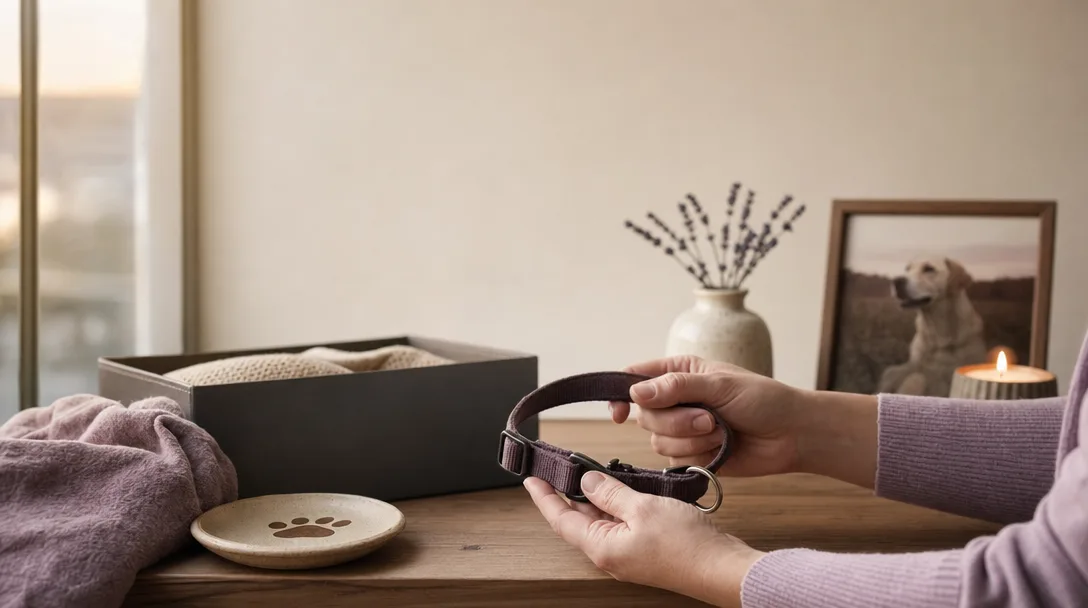
What to do with your dog's collar after they die in the first 72 hours?
You do not have to decide anything right now. In the first 72 hours after a dog dies, the safest move is to protect the collar, not to alter it. PetDecorArt puts it plainly in its guide to what to do with a pet collar after death: you can place the collar somewhere safe for a few days, make a temporary choice now, and a permanent one later.
That distinction matters more than any craft idea. Washing, cutting, donating, or framing a collar are all decisions you cannot easily undo, and the first days after loss are the worst possible time to make an irreversible choice about a one-of-a-kind object.
PetDecorArt's simplest recommendation is what it calls the 72-hour box: put the collar, the tag, and any loose hardware together in one labeled box for at least three days. The box is not a memorial. It is a pause that protects you from doing something during shock that you would grieve later.
If the collar still holds your dog's scent, still carries fur, still curves to the shape of their neck, none of that has a deadline. There is no correct amount of memorabilia to keep and no schedule you're behind on.
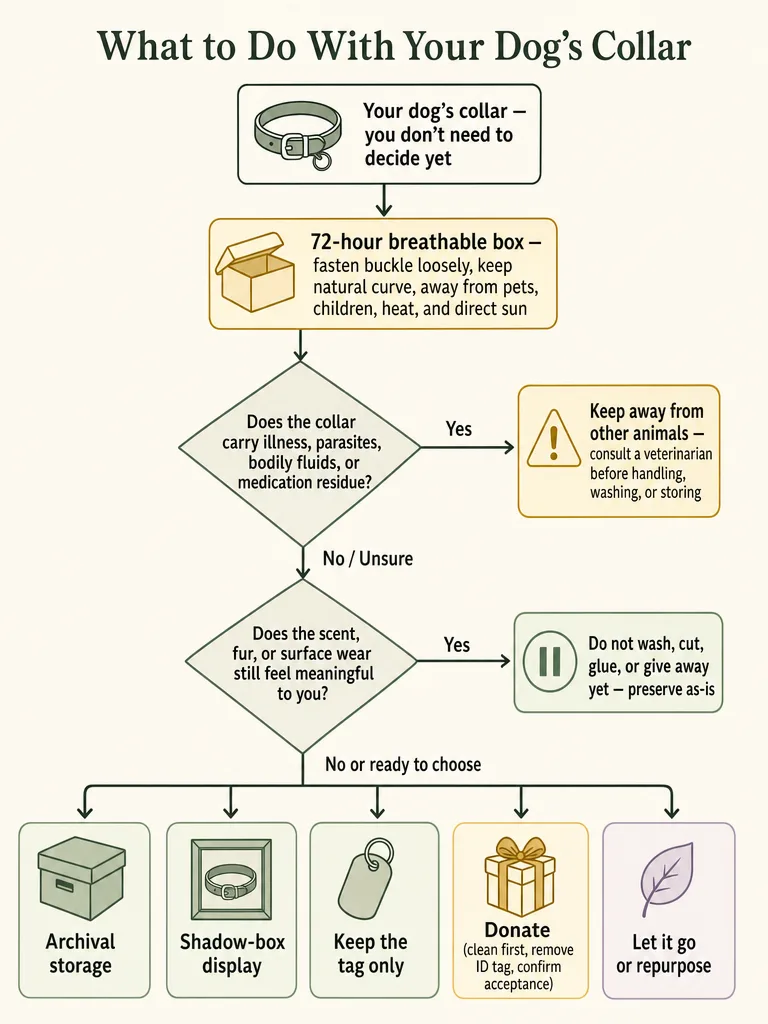
What should you do with the collar first if you are still in shock?
Handle it once, gently, and put it somewhere protected. PetDecorArt's first-step guidance is built around making a reversible decision while your judgment is still clouded by loss. The goal is to keep every option open, not to commit to any of them.
Here is the workflow that source lays out:
- Fasten the buckle loosely. This keeps the collar's natural curve, the shape it held on your dog's neck, instead of letting it flatten or kink.
- Place it on a clean tray or inside a plain, breathable box. Avoid sealed plastic bags for long-term storage, especially if the collar isn't fully dry.
- Move it away from pets, children, spills, heat, and direct sun. A closed closet shelf is enough. Sunlight fades fabric and cracks leather; curious animals and kids can carry it off.
- Do not wash it, cut it, glue it, or give it away while you're still unsure.
If the collar came home from a veterinary hospital or aftercare provider in a bag, PetDecorArt cautions against assuming that bag is fine for long-term storage. Check first that the collar is dry and clean enough to handle safely before you settle it anywhere.
Should you keep your dog's collar exactly as it is?
Keeping the collar unchanged preserves the things that fade fastest: scent, fur, soil, the exact curve of the buckle, and the sound the tag makes. For many grieving owners, those sensory details carry the most weight, and they're also the most fragile. Once they're gone, no craft can bring them back.
This is why PetDecorArt frames the very first choice as emotional timing, not decoration. Its guide describes a collar as "an ordinary object until it suddenly is not." The tag may still make the sound that used to mean a walk, dinner, or someone waiting at the door. That's exactly why advice to "just put it in a shadow box" can feel too fast.
If you're afraid of altering something irreplaceable, that fear is doing its job. It's telling you not to rush.
Storing it out of sight is also valid. Some people can't bear to see the collar every day in the early weeks, and tucking it into a labeled box on a shelf is not avoidance. It's pacing. You can bring it back out when, or if, you're ready.
Should you clean a pet's collar after death?
Decide what you want to keep before you decide whether to clean. Washing a collar can remove odor, fur, soil, medication residue, and the recognizable surface wear that makes it your dog's collar and not a generic strap. PetDecorArt frames cleaning around one question: does that familiar scent and wear matter to you?
For a lot of owners, the smell is the hardest thing to lose. It's often the most immediate, involuntary trigger of memory, and it disappears the instant a collar goes through soap and water. If you suspect the scent matters, that alone is reason to wait before cleaning.
There are also cases where cleaning is the right call, or a safety requirement rather than a preference. If the collar is soiled with something you can't live alongside, or if there's a contamination concern (covered in the next section), gentle cleaning or professional guidance may be necessary.
A middle path exists. You can keep the collar unchanged in your 72-hour box for now, sit with the decision, and clean it later only if you choose to. What you can't do is un-wash it.
| If you value most | Then | Reversible? |
|---|---|---|
| The scent and fur | Do not wash yet; store as-is | Yes |
| The exact worn appearance | Keep unchanged or display without cleaning | Yes |
| A clean collar to display or donate | Clean gently after deciding | No |
| Safety from contamination | Follow veterinary guidance first | Depends |
Cleaning is the one collar decision that erases the very details grief clings to, so make it last, not first.
Is the collar safe to keep if illness, parasites, or residue may be on it?
Safety comes before sentiment when contamination is possible. If the collar may carry parasites, bodily fluids, chemicals, medication residue, or material from a contagious illness, PetDecorArt's guidance is direct: keep it away from other animals and ask your veterinary team before handling, washing, or storing it.
This is the piece most memorial-craft pages skip entirely, and it's the one that can actually matter for the health of a surviving pet in your home.
Situations that warrant a call to the veterinary team first:
- The collar has visible blood, urine, or vomit on it.
- Your dog was being treated with flea or tick products, and residue may remain on the collar.
- There's medication residue, ointment, or topical treatment on the fabric or hardware.
- Your dog died from or was being treated for a contagious disease.
In any of these cases, don't open, wash, or place the collar near other animals until you've asked. PetDecorArt is explicit that a collar returned from a hospital or aftercare provider should be checked for whether it's fully dry and clean enough to handle before it goes anywhere.
The sources here don't cover whether euthanasia medications specifically change how a collar should be cleaned or stored. If that's your concern, your veterinarian is the right person to ask directly.
Keep, store, display, donate, or let go: which choice is reversible?
The single most useful way to sort your options is by whether each one can be undone. PetDecorArt organizes the collar decision into 7 options, and the sharpest lens for a grieving reader is reversibility: which choices keep the door open, and which close it for good.
| Option | What it preserves | Reversible? |
|---|---|---|
| Keep unchanged | Scent, wear, shape, the object exactly as last used | Yes |
| Archival storage | Long-term condition, protected from light and damage | Yes |
| Display with a photo | Visibility, daily presence, memorial framing | Mostly (if not cut or glued) |
| Separate the tag | The tag's sound and carry-ability, collar left intact | Yes |
| Repurpose part of it | A wearable or keepsake made from the collar | No |
| Donate | A usable collar given to another animal | No |
| Let it go | Release, closure, less physical reminder | No |
The reversible choices, keeping it unchanged, archival storage, separating the tag, are all things you can walk back if your feelings shift. The permanent ones, repurposing, donating, letting go, are worth sitting with longer.
There's no grief deadline attached to any row in that table.
What are meaningful ways to keep your dog's collar after death?
Most memorial ideas fall into a handful of categories: display it, carry part of it, gather it with other keepsakes, or fold it into something living. You don't need to be crafty to use them, and none require rushing.
Whisker & Fang groups the possibilities into 10 options, including keeping the collar nearby, adding it to a memory box, displaying it with a photo, keeping just the tag, using it in art or a memorial garden, involving family, or preserving it for long-term display. Eulogy for Life offers 5 gentle ideas, and Remembered Forever lists 5 ways to keep a collar.
Pulling from those sources, the recurring ideas:
- Display. A shadow box or frame with the collar alongside a photo, paw print, or clay imprint. Whisker & Fang and Eulogy for Life both suggest this pairing.
- Memory box. Wrap or place the collar with photos, notes, sympathy cards, a lock of fur, the tag, or a favorite bandana. Whisker & Fang describes gathering these in one place.
- Around a memorial plant. Eulogy for Life suggests wrapping the collar around the pot of a plant dedicated to your dog.
- A house item. Remembered Forever mentions displaying the collar on a mantel or wrapped around a vase.
- Wearable or carried keepsake. Turning part of the collar into a keychain, bracelet, or necklace, noted by both Remembered Forever and Eulogy for Life.
- On a stuffed animal. Remembered Forever suggests placing the collar on a stuffed dog, sometimes one resembling your dog.
If it helps to see how other people navigated this, the Dia de Muertos for pets tradition and gentle painting through grief both offer non-clichéd ways to build ritual around a collar or keepsake.
Can you donate a dog's collar after they die?
Yes, if the collar is clean, safe, and actually wanted by the organization. Donation gives the collar a second life with another animal, but PetDecorArt's practical guidance has two conditions worth following in order.
First, remove the ID tag. It carries your name, phone number, and often your address, and it belongs with you, not on a stranger's dog.
Second, confirm the collar is clean and safe to pass on. Revisit the contamination checklist above; a collar with flea treatment residue or from a contagious illness shouldn't go to another animal without veterinary sign-off.
Then ask before you go. Call the shelter or rescue and ask whether they accept used collars before you visit. Not every organization does, and policies vary widely. The sources here don't support any claim that all shelters take used collars, so treat acceptance as something to confirm, not assume. Donation is a permanent choice, so it's one to make only once you're settled about parting with the object.
Would keeping just the tag give you comfort without deciding about the whole collar?
Keeping the tag is the smallest reversible step you can take. It lets you carry the piece that often means the most, the tag that jingled and announced your dog, while leaving the full collar decision for another day.
Whisker & Fang describes this exactly: some people separate the tag and keep it close by attaching it to a keychain, bracelet, necklace, wallet, or rearview mirror. The collar itself stays intact in your box or on your shelf, unchanged and undecided.
This works well if you're stuck. You get something to hold onto now, the tag with its familiar weight and sound, without committing to cutting, framing, or giving anything away. If you later want the collar whole, it's still whole. If you later decide to display or donate it, the tag is already safely with you.
It's a way to give yourself comfort and time at once.
What else can wait in the first week after your dog dies?
Almost everything can wait. The collar, the memorial choices, the belongings, the "shoulds" other people imply, none of them have a deadline in the first week. The only real priorities are basic care and getting through the hours.
The same reversible logic that applies to the collar applies to the rest of the early days. You can make temporary choices now and permanent ones later, and you can pace decisions instead of solving them all at once. If you're finding ordinary routines strangely impossible, that's expected; handling daily tasks after losing a dog is its own project, and doing less is a legitimate strategy.
A few resources for what the first days actually feel like:
- How to survive the first week after your dog dies, for calm, practical steps when everything feels unreal.
- The first 30 days after losing a dog, for what's normal and what can wait over the longer stretch.
- Surviving the "firsts" after losing a dog, for the first mornings, walks, and anniversaries that catch you off guard.
You are not behind. The collar will still be there when you're ready to decide, and so will you.
Frequently asked questions
What should I do with my dog's collar in the first 72 hours after they die?
Don't change anything yet. Fasten the buckle loosely to preserve the collar's natural curve, place it in a breathable box with the tag and any loose hardware, and keep it away from other pets, heat, and sunlight. PetDecorArt calls this the 72-hour box — not a memorial, just a pause that protects you from making an irreversible decision while you're still in shock. Every option stays open.
Should I wash my dog's collar after they die?
Wait before you wash it. Washing removes scent, fur, and surface wear — the exact details grief clings to most. Once a collar goes through soap and water, those things are gone permanently. If the collar is clean enough to store safely, keeping it unchanged is the only fully reversible option. Clean it later only if you decide you want a clean collar for display or donation, and only after you've sat with that choice.
Is it safe to keep my dog's collar if they had fleas, a contagious illness, or medication residue on it?
Check with your veterinary team first. If the collar may carry flea or tick treatment residue, bodily fluids, topical medication, or material from a contagious disease, keep it away from other animals and don't wash or handle it until you've asked your vet directly. This step matters most when a surviving pet is in the home. A collar returned from a hospital or aftercare provider should be confirmed dry and clean before it's stored anywhere.
What are the most meaningful ways to keep a dog's collar after they die?
The most common approaches are: displaying the collar in a shadow box alongside a photo or paw print; placing it in a memory box with notes, fur, and the tag; wrapping it around a memorial plant pot; or simply keeping it on a shelf unchanged. Wearable keepsakes — turning part of the collar into a bracelet or keychain — are also popular, but require cutting, which is permanent. Choose that only once you're certain you don't want the collar whole.
Can I keep just the tag without deciding what to do with the whole collar?
Yes, and it's one of the most practical small steps you can take. Removing the tag and attaching it to a keychain, wallet, or necklace lets you carry the piece that jingled and announced your dog — often the most emotionally charged part — while leaving the full collar untouched and undecided. The collar stays intact in its box. If you later want it whole, it still is.
Can I donate my dog's collar to a shelter after they die?
You can, with two conditions. First, remove the ID tag — it carries your name, address, and phone number and shouldn't go to another animal. Second, confirm the collar is clean and free of flea treatment residue or contamination from illness. Then call the shelter before you go; not every organization accepts used collars and policies vary. Donation is permanent, so it's worth confirming you're ready to part with the object before you make the trip.
Sources
- What did you do with your pet's collar? : r/Petlossrememberedforever.com
- Meaningful Ways To Keep Your Dog's Collar After Deathwww.facebook.com
- What are some creative ways to preserve a dog's collar as ...www.pinterest.com
- Dog Collar Keepsake Ideaseulogyforlife.com
- Dog Memorial Collar: What to Do After Your Dog Diespetdecorart.com
- What to Do with Dog Collar After Death: A Memorial Guidewhiskerandfang.com
- What to Do With Your Pet's Collar After They Pass Away - Whisker & Fangrestingrainbow.com