What to do the day you put your dog down: the calm same-day order
The day you put your dog down is easier to survive when you make the hard choices before shock peaks, then let the rest of the day stay small and quiet. Settle your questions and aftercare in advance, keep the focus on your dog's comfort, and let the appointment be the only thing you have to do. Blue Cross notes that it's very rare for a dog to die peacefully in their sleep at home, which is why so many loving families face this decision at all.
Think of the day in three parts:
- Before you leave home. Confirm the plan with your vet, gather comfort items, and decide aftercare so you're not choosing while numb.
- During the appointment. Stay focused on keeping your dog calm and safe. You don't have to manage anything else.
- The first hours after. Expect numbness, guilt, and a strange flatness. All of it is normal grief, not a failure of composure.
You don't need to get this perfect. You need to keep your dog feeling safe, and give yourself as few in-the-moment decisions as possible.
When is the right time to say goodbye to my dog?
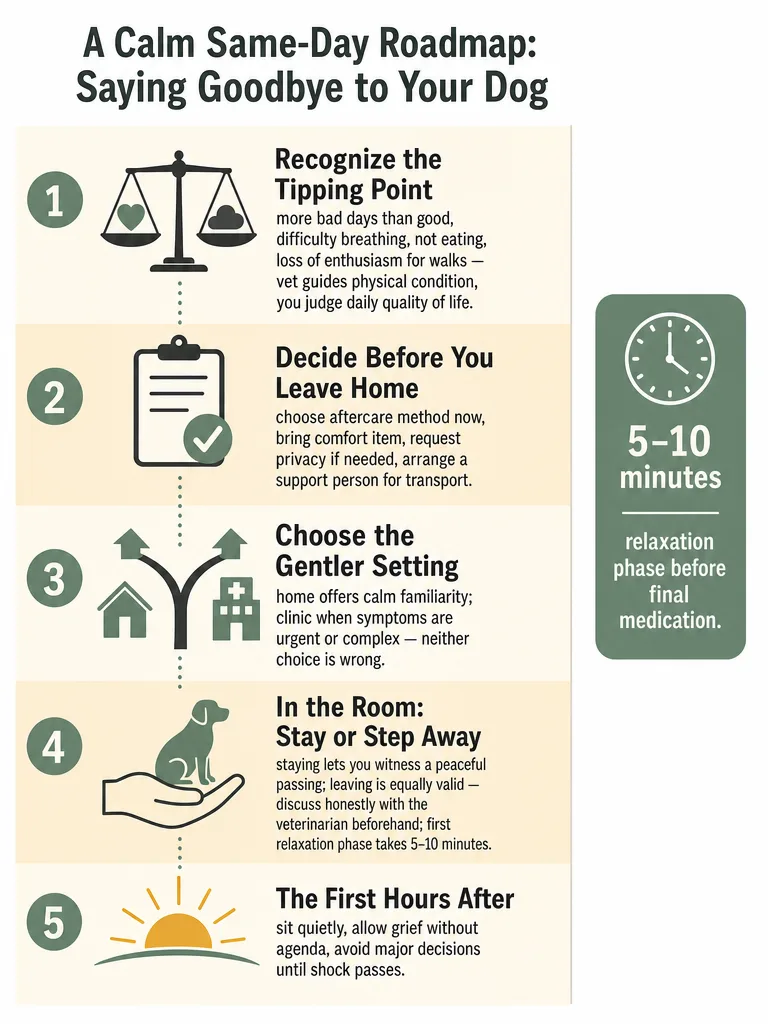
The right time to say goodbye is grounded in your dog's quality of life, not in whether you feel ready, because almost no one ever feels ready. Blue Cross says families often reach this decision when their dog is having more bad days than good, and that setting a time limit with your vet to judge whether treatment is improving things can make the pattern clearer. Lap of Love describes not one perfect moment but a subjective window when euthanasia becomes the appropriate, kind choice.
Pet Meadow draws the line cleanly: your veterinarian is the best judge of your dog's physical condition, but you are the best judge of their day-to-day quality of life. If your dog still has a decent appetite, seeks your company, and finds some pleasure in the day, many owners feel there's life worth living. When the balance tips toward constant pain and withdrawal, the kindest act shifts.
What signs tell me my dog's quality of life has become poor enough?
Poor quality of life shows up as a pattern of suffering that comfort care can no longer hold back, not a single bad afternoon. Blue Cross lists the signs worth taking seriously in a dog: difficulty breathing, regular or persistent vomiting, not eating or drinking, disorientation or confusion, being withdrawn or avoiding contact, crying or yelping, and loss of enthusiasm for walks.
The important caveat from Blue Cross is that some of these overlap with treatable conditions. Signs of old age, like arthritis, can often be relieved, so a dog may still have good years ahead with the right treatment. That's why every one of these signs is a reason to talk to your vet as soon as possible, not an automatic verdict.
A single hard day is not a decision; a steady run of more bad days than good is the signal Blue Cross points to. If you're watching for a shift, the Lap of Love quality-of-life scale for dogs gives you a way to track patterns instead of reacting to one moment.
How should I prepare for my dog being put to sleep before you leave home?
Preparing before you leave home means settling every decision that would be painful to make while in shock, so the appointment itself asks nothing of you but presence. Pet Meadow specifically recommends making aftercare arrangements in advance rather than in the midst of grief, weighing burial, cremation, your living situation, finances, and values ahead of time.
Work through this short list before the appointment:
- Write down your remaining questions for the vet: what the process looks like, how long it takes, whether you can stay.
- Decide aftercare now. Burial, cremation, or an urn. Choosing this beforehand spares you a heavy question at the worst possible moment.
- Gather comfort items. Paws At Peace suggests a favorite toy, a familiar blanket, or a special meal for afterward.
- Sort out transport and support if you're going to a clinic, so you aren't driving home alone in shock.
- Ask about privacy if you want it, such as a quiet room or extra time before and after.
For a fuller version, see what to do before a scheduled dog euthanasia appointment.
Home euthanasia vs clinic euthanasia: which setting is gentler for your dog today?
The gentler setting is the one where your dog feels safest, which for many dogs is home, though a clinic becomes the right call when symptoms are urgent or a vet needs to be involved quickly. Paws At Peace says an in-home procedure can happen wherever your dog is happiest and most relaxed: their bed, a sofa, a patio, or a garden, as long as the place helps them feel calm. Blue Cross emphasizes involving your vet urgently when signs are concerning, which sometimes means the fastest option matters more than the setting.
| Factor | Home euthanasia | Clinic euthanasia |
|---|---|---|
| Setting | Wherever your dog is calm: bed, sofa, garden (Paws At Peace) | Familiar to some dogs, stressful to others |
| Best when | Your dog fears the car or clinic | Symptoms are sudden or urgent, per Blue Cross |
| Family present | Any people or animals your dog loves (Paws At Peace) | Depends on clinic policy |
| Availability | Requires scheduling a home visit | Often available same-day |
There's no better or worse choice here, only the one that fits your dog and your circumstances today. Pet Meadow notes some vets will come to the home or even administer the injection in the owner's car, so ask what your practice offers.
Should I stay during euthanasia, or is it okay if I can't?
Staying in the room is a personal decision, not a moral test, and either choice can be an act of love. Pet Meadow says many owners feel comforted by staying because they see for themselves that their pet didn't suffer and passed gently, and that not witnessing it can make the loss harder to accept later. In the same breath, Pet Meadow acknowledges this is a traumatic ordeal, and you have to ask honestly whether you're emotionally prepared.
The reason this matters for your dog is practical, not just emotional. Pet Meadow points out that if your own emotions won't stay in control, you're more likely to upset your dog than comfort them, and those feelings are natural and no cause for shame. Some owners find a middle path: present for the sedation, then stepping out, or waiting nearby.
Some have felt relief and comfort by staying; for others, not witnessing the death made it more difficult to accept that the pet was really dead. — Pet Meadow
Whatever you choose, discuss it with your veterinarian in advance. If you're weighing this, should you be in the room during dog euthanasia walks through the options without pressure.
What happens during euthanasia, and when does my dog stop feeling pain?
Euthanasia is designed to be a gentle, staged process where your dog relaxes into sleep before the final step, so suffering ends before anything else happens. Paws At Peace describes many in-home visits using two injections: the first helps the dog become sleepy and relaxed over 5-10 minutes, and only after that calm has settled in is the final medication given. When an oral calming gel is used first, they say it relaxes the dog over about five minutes.
By the time of the final step, your dog is already deeply asleep and no longer aware. Clinic details vary by practice, so ask your vet to walk you through their exact sequence, but the principle of sedation first is standard. Knowing this ahead of time removes much of the fear of the unknown, which Dr. Julie Buzby, who has guided families through this hundreds of times, calls one of the hardest parts for owners.
The point of the first injection is that your dog drifts into sleep before anything final happens, so the peaceful part comes first. If you're preparing for a home visit, what to bring to an at-home dog euthanasia visit covers the practical side.
How can I honor my dog that day without making it a performance?
Honoring your dog well means following their comfort level, not staging an event they're too sick to enjoy. Paws At Peace suggests low-key ways families spend the final time: cuddling on the couch or in bed, sitting outside if the dog enjoys fresh air, a short walk or car ride or visit to a favorite place if they're comfortable, and a few simple "bucket list" activities the dog still likes. Their guidance is plain: there's no right or wrong way, so follow your dog's energy.
Small keepsakes can be gathered gently, without ceremony:
- A photo of the two of you together
- A clipping of fur to save
- A favorite toy kept nearby
- A special meal or treat, saved for the right moment
- A short reading, a candle, or simply being present
Paws At Peace notes some families include readings or rituals, while others choose simply to be with their dog in love. Both are complete. The quiet version counts just as much as anything elaborate. If you want ideas that stay grounded, how to plan your dog's last day keeps the focus on comfort over spectacle.
What do I need to arrange for my dog's body, ashes, or burial?
Aftercare decisions are best made before or right after the appointment, while you can still think, rather than in the raw hours that follow. Pet Meadow lists the real options: home burial, a pet cemetery, cremation, scattering ashes, a columbarium, or keeping ashes in a decorative urn, and it urges owners to weigh their finances, values, living situation, and future plans since burial is a poor choice if you rent or move often.
Dogster adds the practical logistics people rarely think about in advance. A dog's body begins to decompose immediately after death, so if burial or cremation will take 24 hours or longer to arrange, refrigeration or freezer storage is ideally used in the meantime. If you're considering home burial, Dogster says to check your local laws first, and offers at least 3 feet below ground as a general depth guide where it's permitted.
Our corpus doesn't cover specific US state-by-state rules or exact pricing, so confirm both locally before committing. If you're torn between the two main paths, how to choose between cremation and burial for a dog lays out cost, permanence, and portability.
What do I do if my dog dies at home before the appointment?
If your dog dies at home before the scheduled appointment, contact a veterinarian first, before handling anything else. Dogster says the vet can confirm the death, arrange care for the remains, or recommend an aftercare provider, which turns a shocking moment into a set of clear next steps.
A few grounded points from Dogster:
- Call your vet or an emergency line first for guidance on confirming death and next steps.
- Handle the body as little as needed and keep it cool, since decomposition begins immediately and refrigeration helps if arrangements take 24 hours or longer.
- Check local rules before home burial rather than relying on general advice.
Beyond checking local law, our sources don't cover specific legal requirements for body handling or transport, so lean on your vet and local providers for the details that apply where you live.
What should I do in the first few hours after my dog is gone?
In the first few hours, expect numbness, guilt, and a sense that the world has gone quiet, and treat all of it as normal grief rather than something to fix. Pet Meadow states plainly that intense grief after losing a pet is completely normal, and that grieving a dog doesn't make you overly sentimental, weak, or foolish, especially when you may have shared 10 or 15 years together.
You don't have to do anything productive today. If someone minimizes your loss with "it's just a dog," that reflects their limits, not the size of what you lost. When you're ready for the next small step, these fit the moment:
- Deciding whether to see your dog's body after euthanasia
- Handling your dog's collar when you're ready, not before
- Getting through the first week after your dog dies and the first 30 days
- Finding pet-loss support that takes dog grief seriously
Right now, being present and gentle with yourself is enough. The rest can wait.
Frequently asked questions
How do I know when it's the right time to put my dog down?
The right time centers on your dog's quality of life, not your readiness — almost no one ever feels ready. Blue Cross points to a steady pattern of more bad days than good as the clearest signal, and suggests setting a time limit with your vet to judge whether treatment is actually improving things. Lap of Love describes it as a subjective window — not one perfect moment — when euthanasia becomes the kind choice. Your vet reads the physical condition; you read the daily joy.
Should I stay in the room when my dog is put to sleep?
Staying is a personal decision, not a moral test. Pet Meadow notes that many owners find comfort in witnessing because they can see their dog passed gently and without suffering — and that not being present sometimes makes the loss harder to accept later. The honest caveat: if your emotions won't stay steady, you're more likely to distress your dog than comfort them. A middle path — present for the sedation, then stepping out — is always an option worth discussing with your vet in advance.
Does my dog feel pain during euthanasia?
Suffering ends before the final step. Paws At Peace describes a two-injection process where the first medication eases the dog into a sleepy, relaxed state over roughly 5–10 minutes; only after that calm has settled does the final medication follow. By that point, your dog is deeply asleep and no longer aware. The specific sequence varies by practice, so ask your vet to walk you through theirs — but sedation first is standard, and knowing this removes much of the fear of the unknown.
What signs tell me my dog's quality of life has become too poor?
Blue Cross lists the pattern worth watching: difficulty breathing, persistent vomiting, refusing food or water, disorientation, withdrawal from contact, crying or yelping, and loss of enthusiasm for walks. One bad afternoon isn't a decision — a steady run of more bad days than good is the signal. Blue Cross also cautions that some signs, like arthritis, overlap with treatable conditions, so every item on that list is a reason to call your vet promptly, not an automatic verdict.
Is it better to have my dog euthanized at home or at the clinic?
The gentler setting is wherever your dog feels safest. Paws At Peace says an in-home procedure can happen in your dog's bed, on the sofa, or in the garden — anywhere they're calm and relaxed. A clinic is the right call when symptoms are sudden or urgent and speed matters more than setting. Pet Meadow notes some vets will come to your home or even administer the injection in your car, so it's worth asking your practice what they offer before assuming the clinic is the only option.
What should I do to prepare before leaving for the euthanasia appointment?
Settle every decision that would be painful to make while in shock. Pet Meadow specifically recommends arranging aftercare — burial, cremation, or an urn — before the appointment rather than in the midst of grief. Write down your remaining questions for the vet, gather a comfort item or favorite toy, arrange a driver so you're not going home alone, and ask about a private room if you want one. Paws At Peace adds: no need to fast your dog if they're still eating, but save especially exciting foods for when the vet arrives to avoid nausea.
Sources
- Ten Tips On Coping With The Loss Of Your Petwww.bluecross.org.uk
- Euthanasia and how To Say Goodbye To Your Dogtoegrips.com
- Preparing for Your Dog's Euthanasia: 10 Thoughts for Peacepawsatpeace.com
- How to prepare for your dog's home euthanasia appointmentwww.lapoflove.com
- How Will I Know It's Time | In-Home Euthanasiascan2remember.com
- What to Do the Day You Put Your Dog Down – Scan2Rememberwww.dogster.com