
How to talk to your vet about dog quality of life
The most useful thing you can do before this conversation is stop treating it as a yes-or-no euthanasia meeting. Bring what you've seen at home and ask your vet to turn those observations into options. PDSA is direct about this: a declining quality of life doesn't automatically mean it's time to say goodbye, because there may be other medications or management techniques that can help.
Open with what has actually changed. Something like: "Over the last two weeks, Franki has stopped climbing the stairs, and he's panting at rest. Help me understand what that means." That gives your vet a pattern to work with, not a single bad morning.
Then ask for the shape of the road ahead, not just today's snapshot. PDSA notes that your vet only sees your dog during an appointment, and that you're best placed to understand how they're doing day to day. Your job is to supply the day-to-day; theirs is to translate it into medical next steps.
If your vet does eventually raise euthanasia, know that PDSA frames it as a last resort, recommended only when it would prevent further suffering. That's the frame to hold onto walking in.
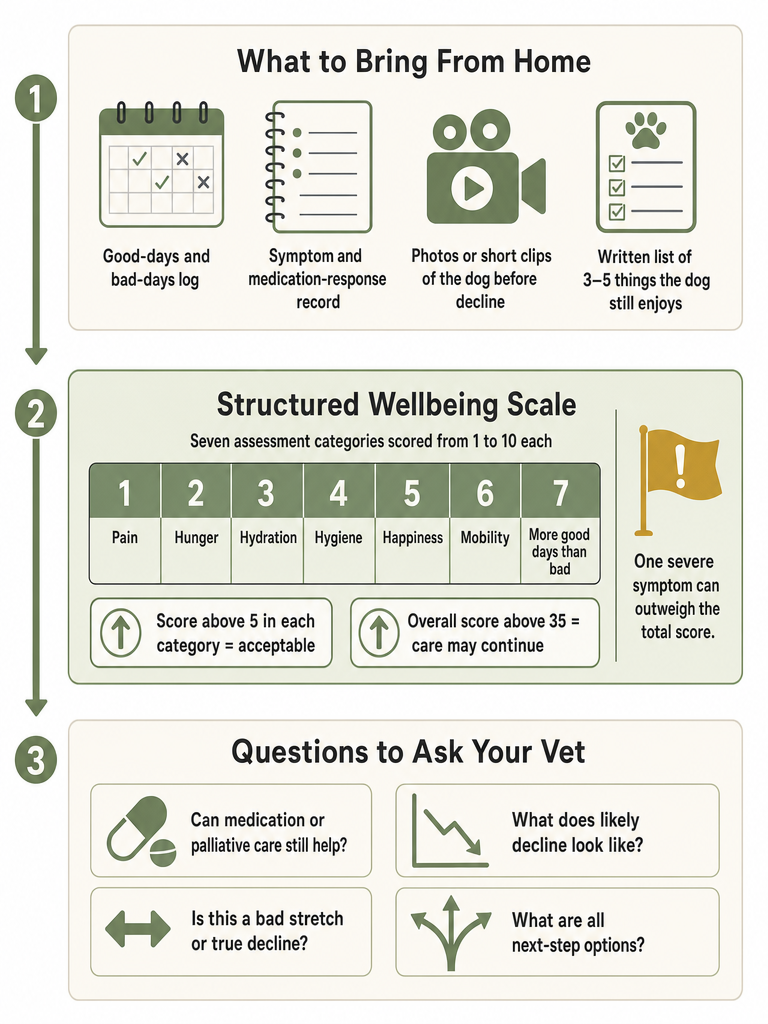
What information should I bring to my vet so we can assess my dog's quality of life more objectively?
Bring evidence, not just impressions. A symptom log, a record of how your dog responded to current medications, and a good-days-and-bad-days calendar turn a vague "he seems worse" into something your vet can act on. Small Door Veterinary recommends performing a quality-of-life assessment and keeping a daily activity log to gauge health and well-being more objectively.
The LSU School of Veterinary Medicine fact sheet gives four concrete prep steps worth copying:
- Enlist your veterinarian. Your vet can't decide for you, but LSU says it helps them to know you're weighing these questions.
- Compare to before. Changes are often gradual and hard to see, so LSU suggests looking at photos or videos of your dog from before the illness.
- Mark good and bad days on a calendar. LSU recommends a simple happy or sad face for each day, and adds that if the bad days start to outweigh the good, it may be time to discuss euthanasia. Some owners track morning versus evening separately.
- List three to five things your dog loves to do. LSU advises writing this down; when your dog can no longer enjoy those things, it's a trigger to talk with your vet.
Bring the calendar and the list to the appointment on paper or your phone. They anchor the whole conversation.
Is there a way to objectively measure my dog's quality of life?
Structured quality-of-life tools give you a shared number to discuss, but they support the vet conversation rather than replace it. PDSA explains that quality of life takes into account all parts of a pet's mental and physical wellbeing, which is why it's hard to reduce to one thing. The best-known scale is the HHHHHMM scale, developed by Dr. Alice Villalobos.
VCA Animal Hospitals says Dr. Villalobos designed the scale to help owners and veterinarians work together to maintain a healthy human-animal bond and to measure whether a palliative care or hospice plan is working. Here's how VCA describes the scoring:
| Element | What it stands for | How VCA says it's scored |
|---|---|---|
| Seven categories | Hurt, Hunger, Hydration, Hygiene, Happiness, Mobility, More good days than bad | Each parameter scored 1 to 10, 10 being best |
| Per-category threshold | A single category's health | Above 5 in each category suggests acceptable quality of life |
| Overall threshold | The combined picture | An overall score greater than 35 suggests it's reasonable to continue end-of-life care |
Bring the scale to your vet as a starting point for discussion. The number opens the conversation; it doesn't hand down a verdict on its own.
LSU offers its own assessment chart where higher numbers mean better quality of life, and Small Door Veterinary points owners toward a quality-of-life assessment and daily activity chart. If you want a walkthrough of one common tool, our guide to the Lap of Love quality of life scale for dogs explains how to read patterns over time. Whichever scale you use, VCA's point stands: score it, then talk it through.
How can I tell if my dog is suffering?
Suffering shows up in body language and daily habits, and translating what you see into plain talking points helps your vet act on it. PDSA lists specific signs to watch for pain: does your dog shake, tremble, or pant even at rest? Do they hide away and not want to be touched or stroked? Does it seem their pain medication has stopped working?
Mobility is the other big signal. PDSA asks whether your dog struggles to get up without help, can't exercise even gently, lies in the same place all day, or often falls over and loses balance.
Turn each observation into a sentence a vet can use. Instead of "he's not himself," say: "He pants while lying still, he flinches when I touch his hip, and the gabapentin doesn't seem to hold him like it did last month." That last point matters most, because PDSA specifically names medication that seems to have stopped working as a sign to reassess.
For a calmer read on which changes may be treatable versus which point to real decline, see what dogs understand at the end of life.
Dog quality of life score vs one severe symptom: which matters more?
One severe, uncontrolled symptom can outweigh an otherwise decent total score. The LSU fact sheet is explicit: even one item on the left-hand side of its chart, such as pain, may indicate a poor quality of life even if many other items are still positive. A dog who's eating, drinking, and greeting you at the door can still be suffering if pain isn't controlled.
This is where a scale can mislead you if you read only the bottom-line number. VCA's HHHHHMM guidance says a score above 5 in each category suggests acceptable quality of life, and above 35 overall. But an average hides a single low score. A dog scoring well on hunger, hydration, and happiness while scoring a 2 on hurt is still in trouble, whatever the total says.
Say this plainly to your vet: "His total looks okay, but his pain score is terrible and it's not responding. Does that one thing outweigh the rest?" That question forces the conversation past the arithmetic.
A single unmanaged problem like uncontrolled pain can define quality of life, even when most other categories still look positive.
Ask your vet which symptoms, in your dog's specific condition, are the ones that override everything else.
How do I ask my vet whether medication or palliative care can still help?
Ask directly whether the decline is still reversible or manageable before you assume goodbye is the only path. PDSA is clear that worsening quality of life doesn't always mean it's time, because there may be other medications or management techniques to help. Small Door Veterinary adds that even if you're not ready to euthanize, your veterinarian can help create a palliative care plan to keep your pet as comfortable as possible.
Useful phrasing for the exam room:
- "Is this symptom treatable, or is it part of the disease we can't change?"
- "Can we adjust the current medication, or add something, before we talk about anything final?"
- "If we can't cure this, what would a comfort-focused plan look like day to day?"
- "Some of what I'm seeing, is that the illness or a side effect of the treatment?"
That last question comes straight from LSU, which notes that some symptoms may be expected side effects of treatment and should be discussed with your veterinarian. A dog who seems worse may actually be reacting to a drug, not just declining.
The goal here isn't to delay a hard decision. It's to make sure you've asked whether comfort is still achievable before you move to the next option.
More treatment, palliative care, hospice, or euthanasia: what should you ask your vet?
These are four separate paths, and it helps to weigh them side by side rather than jumping from "keep treating" to "put down." Ask your vet to lay out each option with its likely benefit and its cost to your dog. LSU frames end-of-life questions around whether a condition will only worsen with time and whether palliative care has been exhausted or isn't an option.
| Path | What you're asking your vet | Key question to raise |
|---|---|---|
| Continued treatment | Can we still improve the underlying disease? | "What's the realistic prognosis, and what does treatment ask of my dog?" |
| Palliative / comfort care | Can we keep him comfortable without curing this? | Small Door notes your vet can build a palliative care plan even if you're not ready to euthanize |
| Hospice planning | How do we manage the final stretch at home? | "What decline should I expect, and what will signal a turn?" |
| Euthanasia | Is it time to prevent further suffering? | PDSA says vets recommend this only as a last resort |
If euthanasia becomes relevant, ask about the procedure so it holds no surprises. Small Door describes it as a two-part process: a sedative first, then the euthanasia solution, after which pets become unconscious within seconds and typically pass within a few minutes.
Public detail on specific cost ranges for these options is limited in the sources here, so ask your own clinic directly. Our guide on when to euthanize your dog walks through the decision itself in more depth.
How Do I Know When It's Time, and how do I tell a bad stretch from true decline?
Patterns over time separate a rough patch from a real end-of-life slide, which is exactly why the calendar matters. LSU's core method is to mark good and bad days over weeks; when the bad days start to outweigh the good, that trend is your signal to discuss euthanasia. A single terrible Tuesday isn't a trend. Three bad weeks against two good days is.
The activities list is the second read. LSU recommends noting three to five things your dog loves, then watching whether they still enjoy them. When those favorites drop away and don't return, you're likely looking at decline rather than a dip.
Diagnosis matters too. VCA's guidance on euthanasia decisions for dogs says that when a life-limiting diagnosis is made, it's time to begin measuring your dog's quality of life. A dog with a progressive condition and a falling trend is telling you something different from a dog recovering from a treatable flare-up.
Bring the calendar to your vet and ask the plain question: "Looking at these six weeks, does this read like a temporary dip we can pull him out of, or the start of the end?" Let the pattern, not a single hard morning, frame the answer. For the broader signals, see our guide to the signs a dog is nearing end of life.
How do I bring up guilt, finances, and caregiver limits without feeling like I failed?
Your limits belong in a humane decision. They aren't proof that you failed your dog. LSU builds this directly into its end-of-life questions, asking owners to consider whether financial limitations prohibit treatment and whether palliative care has been exhausted or isn't an option. Money and capacity aren't taboo in that framework. They're part of the assessment.
Say it plainly to your vet. Something like: "I want to be honest that I can't sustain the medication schedule he needs," or "The diagnostics are beyond what I can afford, so I need to know what's realistic for us." A good vet has heard this and won't judge it.
Guilt tends to arrive uninvited no matter what you choose. Naming it out loud, to your vet or to someone who understands, takes some of its power. Caring for a declining dog is genuinely exhausting, and admitting that is honesty, not failure.
If the guilt is heavy, anticipatory grief support can help you carry it. You are allowed to factor your own life into a decision made entirely out of love.
Frequently asked questions
How can I tell if my dog is suffering?
Panting at rest, trembling, hiding from touch, and pain medication that no longer holds are the clearest signs. PDSA also flags inability to get up without help, lying in one place all day, and loss of balance as key signals. Because dogs are built to mask pain, the absence of yelping doesn't mean the absence of suffering. Track patterns over days, not single moments — gradual change is easy to miss until you're looking at a week's worth of notes side by side.
What information should I bring to my vet to assess my dog's quality of life more objectively?
A good-days-and-bad-days calendar, a symptom log, and a written list of three to five things your dog loves to do. The LSU School of Veterinary Medicine recommends marking each day with a happy or sad face and noting when those favorite activities drop away — when bad days consistently outnumber good ones, that pattern becomes a concrete talking point. Short phone videos of your dog walking and eating a few times a week add even more clarity than memory alone.
Is there an objective scale I can use to measure my dog's quality of life before talking to my vet?
The HHHHHMM scale, developed by Dr. Alice Villalobos, scores seven categories — Hurt, Hunger, Hydration, Hygiene, Happiness, Mobility, and More good days than bad — on a 1-to-10 scale. VCA Animal Hospitals explains that a score above 5 in each category suggests acceptable quality of life, and an overall score above 35 suggests it's reasonable to continue end-of-life care. Bring it to the appointment as a starting point; the number opens the conversation, it doesn't replace clinical judgment.
Can a single severe symptom outweigh an otherwise decent quality-of-life score?
Yes. The LSU School of Veterinary Medicine is explicit: even one item on the left-hand side of its quality-of-life chart — such as uncontrolled pain — can indicate poor quality of life even when most other categories remain positive. A dog eating well and greeting you at the door is still suffering if pain isn't managed. Don't read only the total score; ask your vet directly whether one uncontrolled symptom overrides the rest of the picture.
How do I ask my vet whether palliative care or medication changes can still help before considering euthanasia?
Ask directly whether the decline is reversible or manageable. PDSA is clear that worsening quality of life doesn't automatically mean it's time to say goodbye — there may be other medications or management techniques available. Small Door Veterinary confirms that even if you're not ready to euthanize, your vet can build a palliative care plan focused on comfort. Useful phrasing: "Is this symptom treatable, or part of the disease we can't change?" and "Can we adjust medication before we discuss anything final?"
How do I tell a temporary bad stretch from true end-of-life decline?
Patterns over weeks separate a rough patch from a real slide. LSU's method is simple: mark good and bad days on a calendar over time. When bad days consistently outnumber good ones, that trend — not a single terrible morning — is the signal to discuss euthanasia. The activities list works alongside it: if the three to five things your dog loves have dropped away and don't return, you're likely looking at decline rather than a temporary dip. Bring the calendar to your vet and ask them to read the trend with you.
Sources
- How can I tell if my pet still has a good quality of life?www.pdsa.org.uk
- Euthanasia and Quality of Life Assessmentwww.smalldoorvet.com
- Pet Quality of Life Calculatorwww.euthabag.com
- Assessing Quality of Life & Euthanasia in Companion Animalsveterinarypartner.vin.com
- Using a Quality of Life Scale for Dogstoegrips.com
- Quality of Life at the End of Life for Your Dogvcahospitals.com