
What do dogs understand at the end of life?
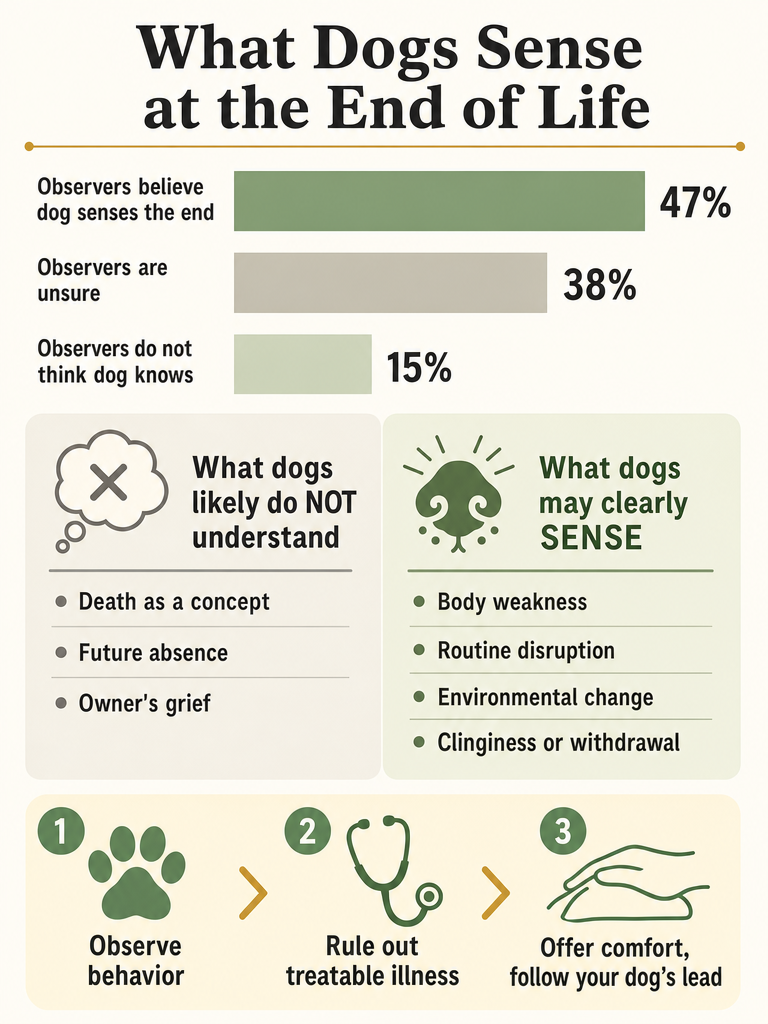
Dogs likely do not understand death as a concept, but they often show noticeable physical and behavioral changes as their bodies decline. According to PetMD, dogs may not grasp mortality the way humans do, yet illness brings real shifts in how they act, rest, and interact. Marc Bekoff, writing in Psychology Today, put it plainly: we really don't know what dogs know and feel about death and dying.
It helps to separate three things owners tend to blur together. First, what a dog probably cannot conceptually understand—the idea of its own death. Second, what a dog may genuinely sense—weakness, discomfort, a body that no longer works, a household that suddenly feels different. Third, what those observations should prompt you to do, which is to bring your veterinarian into the conversation and shift the goal toward comfort.
Horizon Palliative Vets describes it as an "instinctive awareness that something is changing" rather than a human-style understanding of the end. That distinction matters. It lets you honor what your dog is actually experiencing without projecting fear or dread they may not carry.
Your dog may not understand dying, but they can feel that their body and their world have changed—and that is what you can respond to.
If you're watching your dog decline right now, the 7 signs your dog is nearing end of life can help you read what you're seeing with steadier eyes.
Do dogs know when they are dying?
There is no scientific consensus that dogs know they are dying, and the people closest to the question disagree. In a 2023 Psychology Today review of 50 items, animal behavior expert Marc Bekoff found that 47% said a dying dog knows the end is near, 38% were unsure and had no idea what a dog was thinking, and 15% said they don't think a dog knows they're dying.
Bekoff asked a follow-up group of 100 people the same questions and reported very similar results. On the broader question of whether dogs know when they or other dogs are approaching the end of life, around 30% said yes, 48% were unsure, and 22% said no.
Those splits are the honest answer. Most people, including many who love and study dogs, land in the "unsure" column.
Bekoff's conclusion is worth sitting with: only by keeping an open mind will we make progress, and this might not be the last word.
Can dogs sense their own death?
It is not scientifically proven that dogs detect their own impending death. PetMD is direct on this point: whether dogs can pick up cues in their own bodies during their final weeks, days, or hours "isn't known or scientifically proven." What dogs clearly do have is remarkable sensory range.
Dogs detect far more smells, sounds, and movements than people can. Because of their acute sense of smell, PetMD notes, dogs may pick up on biological and chemical changes in scents from a person or animal nearing death. Dogs have been trained to detect cancer, abnormal blood glucose, and imminent seizures in humans.
But detecting change in someone else's body is not the same as understanding your own mortality. The evidence that dogs sense death-specific odors in themselves remains speculative, not established.
What is real: as they near death, dogs experience changes in physical ability, comfort, routine, environment, and their owners' emotions. They notice the shift. Whether they interpret it as "dying" is a question the sources simply do not answer.
How do dogs act when they're near death?
Dogs near death commonly show clinginess or withdrawal, altered sleep, appetite and thirst changes, confusion, weakness, and shifts in vocalization. Paws Into Grace describes these as unusual behaviors that "signal discomfort or cognitive decline." None of them prove a dog understands death—but together they tell you the body is declining and comfort should become the priority.
PetMD, Horizon Palliative Vets, Paws Into Grace, and Daily Paws describe an overlapping set of signs:
- Less interest in activities they once loved—toys, walks, car rides, belly rubs
- Reduced hunger and thirst, or picky eating and refusal of food
- Seeking alone time and unusual resting places, or conversely seeking extra closeness
- Altered sleep, either sleeping much more or restless and unable to settle
- Discomfort shown as panting, pacing, trembling, or whining
- Weakness, difficulty standing or walking, and general tiredness
- Confusion, disorientation, or repetitive behaviors
- Changes in breathing, including labored breathing
- Loss of bladder or bowel control
Confusion can be especially hard to read. Paws Into Grace cites research finding 14.2% of older dogs showed signs of canine cognitive dysfunction, while only 1.9% had a formal clinical diagnosis. Daily Paws' Haylee Bergeland describes some dogs whining and barking with bursts of "almost hyperactivity, then suddenly becoming quiet and still."
Clinginess vs withdrawal: how can I tell what my dog needs?
Watch the individual dog rather than the label. As Daily Paws' Haylee Bergeland describes it, many dogs become "more 'clingy' or attached, following you around consistently," while others "distance themselves and want to be alone more than they normally would." Both are normal near the end of life, and neither is the correct one.
Your job is not to interpret the behavior as a message about death. It's to notice what your particular dog is doing and meet it.
If your dog is seeking you out, offer calm closeness—a hand resting on them, a quiet presence in the room, familiar routines kept gentle and short. If your dog is retreating to a closet, under a bed, or an odd corner, resist the urge to pull them back into the center of things. Give them a secure, quiet spot and check on them without hovering.
Don't force affection on a dog who is withdrawing, and don't leave a clingy dog alone to "toughen up." Reading the dog in front of you matters more than any rule about what dying dogs supposedly want. PetMD frames the response simply: quiet, reassuring attention, familiar routines, and allowing alone time if they want it.
Possible end-of-life decline vs treatable illness: what should you ask the vet?
End-of-life signs can look almost identical to signs of a treatable condition, which is why veterinary evaluation comes before assuming your dog is actively dying. PetMD is explicit: the changes that appear near the end of life "can look similar to signs of treatable conditions, so veterinary evaluation is essential." Appetite loss, weakness, confusion, and breathing changes all have causes that can sometimes be managed or reversed.
This is the gap most articles leave open. They list decline signs, then let owners conclude the worst without a checkpoint.
| What you observe | Could be dying decline | Could also be treatable | What to ask the vet |
|---|---|---|---|
| Refusing food, drinking less | Yes | Nausea, dental pain, infection | Is there a reversible cause? Anti-nausea options? |
| Confusion, disorientation | Yes | Cognitive dysfunction, dehydration | Is this manageable? Should we test? |
| Weakness, trouble standing | Yes | Pain, arthritis, anemia | Would pain relief change this? |
| Breathing changes | Yes | Fluid, heart or lung issues | Does this need urgent evaluation? |
The signs of a dying dog and a sick-but-treatable dog overlap so much that a vet's read—not your fear—should decide which one you're facing. Planning ahead with your veterinarian, PetMD notes, is what makes a peaceful, comfortable end-of-life experience possible.
How can I tell if my dog is in severe distress?
Labored, shallow, or abnormal breathing is a medical emergency. Horizon Palliative Vets is unambiguous: if you notice labored, shallow, or abnormal breathing, or believe your dog is struggling to breathe, call your veterinary team, your regular clinic, or your nearest emergency center immediately. Breathing distress is the clearest threshold the available sources support for urgent action.
Alongside breathing, the sources describe discomfort that reads as distress: persistent panting, pacing, trembling, whining, or an inability to settle. Paws Into Grace lists vocalization—whining, howling, or barking, often without an apparent cause—as a sign to consult a vet about pain management.
A fuller checklist of validated pain thresholds—the kind of formal scoring some owners look for—is thin in the sources here. For a structured, vet-backed way to track comfort over time, the Lap of Love quality of life scale for dogs, explained offers a framework built for exactly this uncertainty. When in doubt about severe pain or distress, your veterinarian is the right first call.
What can I do to comfort a suffering dog?
Comfort at the end of life comes down to a quiet space, warmth, familiar things, reduced stress, and pain relief guided by your veterinarian. Horizon Palliative Vets and PetMD converge on a practical plan. Small, thoughtful actions—not grand gestures—are what help a dog feel safe.
Work through these in order:
- Create a quiet, comfortable space where your dog can rest undisturbed, away from foot traffic and noise.
- Keep them warm with soft, orthopedic bedding and familiar items that carry your scent.
- Reduce noise, stress, and sudden changes in the environment; keep the household calm around them.
- Offer water and maintain hydration where possible, without forcing it.
- Give gentle, reassuring attention—your presence, a soft voice, a hand resting on them.
- Allow alone time if that's what your dog is seeking; don't insist on closeness.
- Keep familiar routines short and gentle rather than abandoning them entirely.
- Provide pain relief with veterinary guidance—never dose from a human medicine cabinet.
PetMD frames comfort as the whole goal near the end: alleviate discomfort, prevent suffering, and let the dog feel safe in the time that remains.
How long does the dying process take in dogs?
The dying process in dogs varies too much for a fixed timeline. The sources describe changes unfolding over "final days or weeks," and both PetMD and Horizon Palliative Vets stress that these changes "can vary from one dog to another." The available sources do not support a precise 24-to-72-hour dying window, and any article claiming one is filling a gap the evidence doesn't fill.
What the sources do describe is a trajectory rather than a clock: interest in activities fades, appetite and thirst decline, sleep shifts, weakness increases, and breathing may change. Some dogs move through this quickly. Others linger in a slow decline that tests every ounce of an owner's patience and heartbreak.
The absence of a timeline is itself useful information. It means you cannot schedule grief, and you cannot fail by "missing the moment." What you can do is track comfort day to day and stay in close contact with your veterinarian.
If you're bracing for these final days, how to say goodbye to your dying dog walks through reading the signs and creating a peaceful goodbye.
Euthanasia vs waiting for a natural death: how should comfort guide the decision?
Let the question be "is my dog suffering?" rather than "am I doing this right?" PetMD frames end-of-life decisions around a single priority: alleviating the dog's discomfort and preventing suffering. Horizon Palliative Vets names both paths—palliative care or euthanasia—and says to consider euthanasia "when it is the kindest option."
| Consideration | Waiting for natural death | Euthanasia |
|---|---|---|
| Primary question | Can comfort be maintained day to day? | Is suffering outpacing what comfort can hold? |
| Control over pain | Depends on palliative options | Prevents prolonged distress |
| Owner role | Sustained caregiving, close monitoring | A planned, guided goodbye |
| What the sources emphasize | Alleviate discomfort, plan with vet | The kindest option when suffering can't be eased |
Neither choice is a failure of love. The measure the sources point to is comfort, not the calendar and not your own guilt about "giving up."
For a structured walk through this decision, when should you euthanize your dog and how to cope with anticipatory grief as a pet owner can steady you before and after the choice. This is not a test you pass or fail.
What should you discuss with your veterinarian before a crisis?
Have the hard conversation before the panic, not during it. PetMD's central guidance is that planning ahead with your veterinarian is what makes a peaceful, comfortable end-of-life experience possible. Decisions made in calm daylight are almost always kinder than ones made at 2 a.m. in fear.
Bring these to your veterinarian while you still can:
- Comfort goals — what "a good day" looks like for your specific dog
- Pain relief — what's available, how to give it, and how to tell if it's working
- Breathing changes — what counts as an emergency and exactly whom to call
- Palliative or hospice options — including in-home care if that fits your dog
- Euthanasia questions — what the process involves and whether it can happen at home
- Emergency contacts — the number for after-hours and the nearest emergency center
- Quality-of-life tracking — an agreed way to measure decline over time
An agreed way to measure decline gives you and your vet a shared vocabulary, so you're reading the same signals rather than arguing with your own fear.
Ask your vet directly, "What will you want me to watch for, and when do you want me to call?" A clear answer now spares you guesswork later.
What does your dog feel in their final moments?
We cannot know exactly what a dog feels in its final moments—and honesty about that is kinder than false certainty. Marc Bekoff's conclusion holds: there are real limits to what science can tell us about death and dying in dogs. What owners can shape is not the dog's understanding, but the conditions around them.
You can make the final time calmer. Familiar surroundings, a quiet space, soft bedding, your steady presence, and veterinary support—these are the things the sources consistently point to, and they are entirely within your reach.
Dogs live in the present, as Horizon Palliative Vets notes. That may be the most comforting fact available. Your dog is not dreading a future they cannot conceive of. They are in this room, this moment, with you—and your calm presence is part of what that moment holds.
If you're moving from the end of your dog's life into grief, the first 30 days after losing a dog offers a survival guide for what comes next. You did not fail your dog by not knowing everything. You stayed. That is what they could feel.
If you want a companion for this passage—one that blends a real owner's story with practical guidance for anticipatory grief and end-of-life decisions—To Lose A Dog was written to sit with you through exactly these questions. When the time feels right, you're welcome to reserve a copy.
Frequently asked questions
How can I tell if my dog is suffering?
Persistent panting, pacing, trembling, whining, or an inability to settle are the clearest behavioral signals of pain. Labored or shallow breathing is a medical emergency — call your vet or an emergency clinic immediately, don't wait to see if it passes. Paws Into Grace also flags unprompted vocalization (whining, howling, barking) as a reason to consult your vet about pain management. When in doubt, a veterinary quality-of-life assessment gives you a structured, shared vocabulary for what you're seeing.
Do dogs know when they are dying?
No scientific consensus exists. In a Psychology Today review by animal behavior expert Marc Bekoff, 47% of respondents believed a dying dog knows the end is near, 38% were unsure, and 15% said no. A follow-up group of 100 people returned nearly identical splits. Bekoff's conclusion: only by keeping an open mind will we make progress, and this may not be the last word. Most people — including many who study dogs — land in the "unsure" column, and that honest uncertainty is the best answer available.
What are the most common signs of pain in dogs?
Reduced appetite, withdrawal or unusual clinginess, altered sleep, weakness or difficulty standing, confusion, and changes in breathing are the signs most consistently named across veterinary sources including PetMD, Horizon Palliative Vets, and Paws Into Grace. None of these alone confirms a dog is dying — PetMD is explicit that end-of-life signs can look nearly identical to signs of treatable conditions, making veterinary evaluation essential before drawing conclusions.
When should I take my dog to an emergency vet?
Labored, shallow, or abnormal breathing is the threshold named by Horizon Palliative Vets: if your dog is struggling to breathe, call your veterinary team, your regular clinic, or your nearest emergency center immediately. That's the moment to act, not observe. Alongside breathing distress, persistent inability to settle, uncontrolled pain signals, or sudden loss of consciousness also warrant immediate contact — don't wait for a scheduled appointment when those appear.
Why does losing a dog hurt so much?
Dogs are present for daily routines in a way most human relationships aren't — mornings, meals, walks, quiet evenings — so their absence reshapes the entire shape of a day, not just a single relationship. That loss is real bereavement, not a lesser form of grief, even when others treat it that way. The social dismissal — the "it's just a dog" response — adds a layer of isolation on top of genuine mourning, which is part of why the pain feels so disproportionate to people who haven't experienced it.
What is the best book for guilt after choosing euthanasia for a dog?
Guilt after euthanasia is one of the most specific and least-served emotional spaces in pet loss — the decision itself becomes the wound. The most useful books for this are ones that treat euthanasia as an act of love rather than a failure, and that address the "what ifs" directly rather than offering reassurance alone. To Lose A Dog blends a real owner's end-of-life story with practical guidance for exactly this passage, including anticipatory grief and the decisions that follow. You can reserve a copy at toloseadog.com.
Sources
- Do Dogs Know When They're Dying?www.petmd.com
- Do Dogs Know When They Are Dying | Horizon Palliative Vetswww.horizonpalliativevets.com.au
- Do dogs know the concept of death/dying?pawsintograce.com
- End-of-Life Behavior in Dogs: What's Normal vs. What's Notwww.dailypaws.com
- Do Dogs Know When They're Dying? Here's What Experts Saywww.psychologytoday.com
- Do Dogs Understand When They're Dying?www.psychologytoday.com
- Do Dogs Understand When They're Dying? | Psychology Todaywww.psychologytoday.com