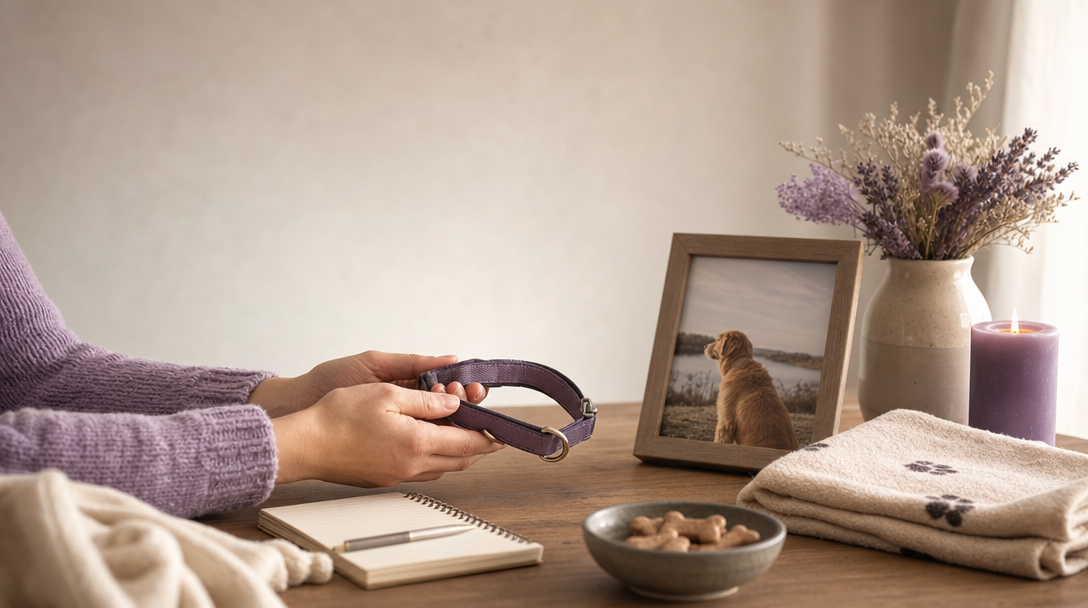
What to do before a scheduled dog euthanasia appointment today
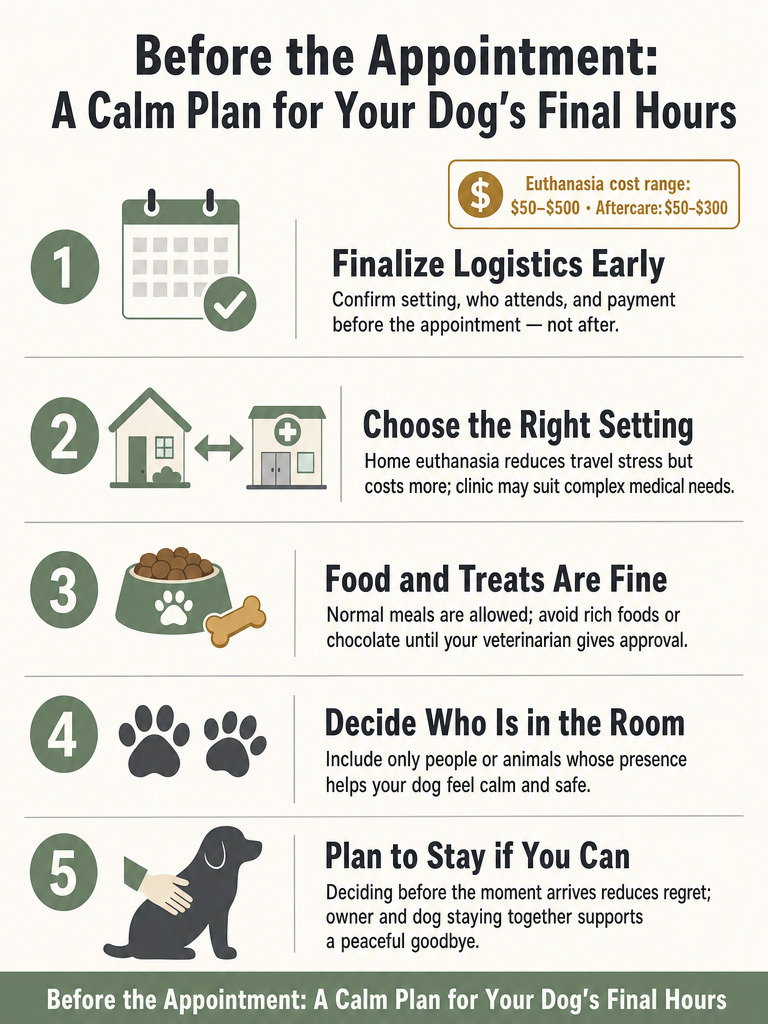
The kindest thing you can do before the appointment is make fewer decisions on the day itself. Veterinary sources agree that preparation lowers fear and regret, so the remaining hours belong to your dog, not to logistics. Royal Canin Academy notes that a good euthanasia begins with client preplanning, and PetMD advises settling aftercare and payment ahead of time.
Here is a simple order to work through before the day arrives:
- Choose the setting — home or clinic, and the exact spot your dog feels calmest.
- Confirm who will be present, including whether other pets or children should be there.
- Plan food and comfort — favorite blanket, familiar bed, a treat you know your dog still loves.
- Settle aftercare and payment so no one is signing forms while sobbing. PetMD says euthanasia generally runs $50 to $500, with at-home services at the top of that range.
- Decide who answers the door or greets the veterinary team, if the appointment is at home.
For the hardest logistics, planning your dog's last day in advance keeps the focus on comfort rather than second-guessing.
How do I know when it is time to put my dog down?
Quality of life is the single most important factor when deciding about euthanasia. PetMD frames it simply: a dog should have more good days than bad days, and when that balance reverses, it is time to start thinking about a peaceful passing. There is no universal formula. PetMD states there is no one-size-fits-all approach, and the decision should always be made through careful discussion with your veterinarian.
The doubt you feel is normal, and it does not mean you are getting it wrong. Dr. Julie Buzby of ToeGrips, who has helped families through euthanasia hundreds of times, describes the timing as rarely a black-and-white moment. She calls it a grey zone. Even for dogs she knows well, she avoids telling owners there is one obvious hour when the choice becomes clear.
That grey-zone honesty matters. Waiting for certainty can mean waiting past your dog's comfort. If you are struggling to read the pattern rather than a single bad day, talking to your vet about your dog's quality of life with a symptom log can turn a vague fear into a clearer picture you can both act on.
What quality-of-life checklist should I use before euthanasia?
The most useful checklist tracks what you can observe day to day: pain, appetite, mobility, breathing, and whether your dog still finds joy in familiar things. PetMD anchors the whole decision in one comparison — are there more good days than bad days, or has that reversed? Bring that pattern to your veterinarian rather than a single rough afternoon.
A practical way to organize the final conversation is to write down what you actually see:
- Pain and comfort — is your dog resting easily, or restless and guarded?
- Eating and drinking — normal interest, or refusing meals?
- Mobility — moving freely, or unable to stand, walk, or reach the yard?
- Good days versus bad days — count them over a week or two, not one day.
- Moments of joy — greeting you, a favorite spot, a tail wag that still means something.
Named scoring tools exist, and readers often search for the Lap of Love quality of life scale. Whichever frame you use, the goal is the same: give your veterinarian observable detail so the decision rests on your dog's comfort, not on one hard moment or your fear of choosing too soon.
Can at-home dog euthanasia be an option, or is a clinic better?
At-home euthanasia is widely available and can offer a calmer setting than a clinic. PetMD confirms several organizations provide the service, and that a home appointment offers a more relaxed, comfortable environment that reduces some of the stress. The trade-off is cost. PetMD says at-home euthanasia is more expensive than the same procedure at a veterinary practice.
Choosing between the two comes down to your dog's stress, pain, size, and how hard transport would be.
| Factor | At-home euthanasia | Clinic euthanasia |
|---|---|---|
| Dog's stress | Familiar surroundings; reduces stress (PetMD) | May cause anxiety in vet-averse dogs |
| Transport | None required; good for large or painful dogs | Requires moving the dog |
| Privacy | High; your own space | Varies by practice |
| Cost | Higher end of $50 to $500 (PetMD) | Lower; sometimes free for existing clients (PetMD) |
| Access | Depends on local providers | Broadly available |
How to prepare for your dog's home euthanasia appointment
Set up the physical space before the veterinarian arrives so the appointment feels gentle instead of rushed. Paws at Peace says the procedure can happen anywhere your dog is happy and relaxed — in their bed, on a sofa, in a human bed surrounded by loved ones, or outside on a patio or in a garden if your dog enjoys being there. Royal Canin Academy frames this as preplanning: deciding where to gather and what will make the pet most comfortable ahead of time.
A short setup list before the appointment:
- Pick the spot where your dog naturally settles and rests.
- Gather comforts — favorite blanket, bed, a toy, a familiar-smelling shirt.
- Clear a path so the veterinary team can reach your dog without moving them.
- Decide who answers the door so an unexpected knock does not startle your dog.
- Keep the room calm — soft light, low noise, the people your dog trusts.
Royal Canin Academy lists preplanning questions worth answering in advance: where the family wants to gather, when they want the appointment, who should be there, what will make the pet most comfortable, and how they want to handle aftercare. Answering those before the day means you can simply be present.
Can my dog eat before the euthanasia appointment?
Dogs do not need to fast before a home euthanasia appointment if they are still eating. Paws at Peace is direct about this: normal meals are fine, special treats are welcome, and there is no fasting requirement. Eating and enjoying treats right up to the appointment is completely acceptable for a dog who still has an appetite.
Timing matters for the richest foods. Paws at Peace recommends saving especially exciting foods — burgers, fries, ice cream — for when the veterinarian arrives, so your dog can enjoy a special feast without overdoing it beforehand and risking nausea or vomiting. Chocolate is a separate case: it is toxic to dogs within about 30 minutes of ingestion, so Paws at Peace says to avoid it until the veterinarian arrives and gives the go-ahead. Only then, if you want to, may you offer it.
The last meal can be a celebration. The timing simply protects your dog from feeling sick in their final hours.
Who should be in the room, including other pets?
Include people and animals only if their presence keeps your dog calm. Paws at Peace states the rule plainly: any humans or animals your dog loves may be present, provided their presence makes your dog happy and relaxed. Let comfort decide, rather than obligation or tradition.
The corpus is honest that there is no single rule for other pets. Paws at Peace welcomes loved animals if they are calming. CodaPet takes a slightly different route, suggesting other pets come in once the process is completed. Both can be right depending on your dog and your other animals' temperaments.
Think it through in advance:
- A steady, bonded companion animal may soothe your dog by simply lying nearby.
- An anxious or reactive pet may add tension — better to have them present afterward, if at all.
- Children should be included based on what your family can hold, not what feels expected.
Royal Canin Academy includes "inclusion of loved ones" among the 14 components of good euthanasia, which signals presence is worth planning rather than improvising. Decide who belongs in the room while you are calm, so no one is negotiating it at the door.
Should I stay with my dog during euthanasia?
Weigh whether to stay before the appointment, not in the moment when you are least able to think clearly. PetMD raises a specific caution: many pet parents later regret not being present, so owners should consider carefully beforehand whether they would carry that regret. Royal Canin Academy reinforces the same instinct, noting modern approaches focus on reducing fear and distress by keeping owner and patient together throughout the appointment.
Staying is a personal choice. Some people find deep comfort in being the last voice their dog hears. Others cannot bear it, and that is allowed too. There are also middle paths — being present for the sedation, then stepping out for the final medication.
What the sources agree on is timing your decision. Fear in the moment can push you toward the door before you have thought it through. If you weigh it now — knowing PetMD's warning about later regret — you protect your future self. For a fuller look at the options, whether you should be in the room during dog euthanasia walks through the middle-path choices in detail.
What will the dog euthanasia procedure look like step by step?
Knowing the flow removes most of the fear of the unknown. Royal Canin Academy describes 14 essential components of good euthanasia, including thorough consent, privacy before and after, sedation or anesthesia, adequate time, narration of the process, and body-care assistance. Providing sleep for the patient before euthanasia has become the gold standard worldwide, according to the same source.
Here is the likely sequence:
- Consent and rapport — the veterinary team confirms your wishes and settles your dog.
- Sedation first — Paws at Peace says an oral calming gel, used first, relaxes the dog and makes them sleepy over about five minutes.
- Falling asleep — after the first injection, Paws at Peace says most dogs slowly fall asleep over 5 to 10 minutes.
- Final medication — given once your dog is fully asleep and unaware.
- Body care — Royal Canin Academy lists assistance with body care as part of a good appointment.
Modern euthanasia is built around sleep first, so your dog is already resting peacefully before the final step.
Medication names, dosages, and exact protocols vary by veterinarian and are not something to script in advance — your veterinary team will explain their approach. The comfort here is the shape of it: quiet, gradual, and unhurried.
What practical decisions should I finalize before the appointment?
Move the hardest logistics out of the raw minutes after your dog dies. PetMD is explicit: finalize aftercare details and payment arrangements before the appointment so you are not making those decisions in the emotional moments after your pet has passed. Deciding now protects a version of you who will not want to talk numbers.
Settle these ahead of time:
| Decision | What to confirm | Source detail |
|---|---|---|
| Aftercare | Cremation or burial preference | PetMD |
| Cost | Euthanasia range | $50 to $500 (PetMD) |
| Cremation | Ashes returned or not | $50 to $300 (PetMD) |
| Payment | Pre-pay if possible | Pre-pay at the start (ToeGrips) |
| Paperwork | Consent, forms signed early | Thorough consent (Royal Canin Academy) |
| Body care | Any wishes the team should know | Body-care assistance (Royal Canin Academy) |
ToeGrips specifically recommends pre-paying at the beginning of the appointment, so no transaction interrupts your goodbye. If you are weighing final arrangements, how to choose between cremation and burial for a dog lays out cost, permanence, and portability calmly. Note that legal rules for home burial vary by state and local jurisdiction and are worth checking with your municipality.
Which rituals and keepsakes are worth choosing before the appointment?
The rituals worth choosing are the ones that fit your dog and your family, not a performance. Paws at Peace says some families include readings, prayers, candles, flowers, or other objects, while others simply choose to be with their pet in love — and that there is no right or wrong way. ToeGrips suggests a "best day" beforehand, built around your dog's favorite comforts.
Grounded options worth deciding in advance:
- A quiet best day — a favorite walk, a sunny spot, a slow morning.
- Familiar comforts nearby: their bed, a beloved toy, your worn shirt.
- A short reading, a prayer, or a candle if that reflects your family.
- Flowers or a photo, if a keepsake helps you hold the moment.
- Simply being present, hand on their fur — which is enough.
If you want lasting tributes to plan after, dog memorial ideas to honor your pet gives grounded, non-cliché options.
Why do I feel guilty for putting my dog down?
Guilt before and after euthanasia is one of the most common feelings dog owners carry, and it does not mean you made the wrong choice. ToeGrips reports that its post on grieving euthanasia drew more reader comments than any other, and the dominant theme was grief wrapped in guilt — sometimes lasting years. Dr. Buzby's response is worth holding onto: those owners had done the best they could with the information they had, and had nothing to feel guilty about.
The guilt is fed by the grey zone. Because there is rarely a clear, black-and-white moment, part of you will always wonder if it was too soon or too late. That uncertainty is the nature of the decision, not evidence of failure.
Choosing a peaceful passing for a suffering dog is one of the last kindnesses you can give.
Preparation is one of the few things that eases this. Royal Canin Academy links preplanning directly to reduced fear of the unknown and less regret. And the social dismissal — the "it's just a dog" — is a separate wound that does not diminish yours. If the guilt is heavy, why you feel guilty for putting your dog down and grounded grief support can help you carry it. To Lose A Dog, Isaac H's memoir about his 1,820 days with Franki, was written partly for this exact ache — companionship for the guilt no one else seems to understand.
Frequently asked questions
How do I know when it is time to put my dog down?
More bad days than good days is the clearest signal. PetMD frames the whole decision around that balance: when it reverses — when your dog is suffering more than they're comfortable — it's time to have a serious conversation with your vet. Dr. Julie Buzby of ToeGrips, who has guided hundreds of families through this, is honest that a clear, black-and-white moment rarely comes. Tracking a symptom log over one to two weeks gives your vet something concrete to work with.
Why do I feel guilty for putting my dog down?
Guilt after euthanasia is one of the most common feelings dog owners carry — and it doesn't mean you made the wrong choice. ToeGrips reports that a post on grieving euthanasia drew more reader comments than anything else they'd published, with guilt as the dominant theme, sometimes lasting years. Dr. Buzby's response: those owners had done the best they could with the information they had, and had nothing to feel guilty about. The grey zone of timing — rarely a clear moment — is what feeds the doubt, not evidence of failure.
How can I stop feeling guilty after euthanizing my dog?
Replacing guilt with the fuller picture helps most. Royal Canin Academy links preplanning directly to reduced fear and less regret — meaning preparation is one of the few things that genuinely eases it. Dr. Buzby's framework is also useful: choosing a peaceful passing for a suffering dog is one of the last kindnesses you can give, not a betrayal. If the guilt is heavy and persistent, a pet-loss counselor or support group focused specifically on dog loss offers more than general grief resources can.
What quality-of-life checklist should I use before deciding on euthanasia?
Track five things daily: pain and rest, eating and drinking, mobility, moments of joy, and the ratio of good days to bad days over one to two weeks — not a single rough afternoon. PetMD anchors the whole decision in that good-day/bad-day comparison. Named scoring tools exist, including the Lap of Love quality of life scale, but whichever framework you use, the goal is the same: bring observable detail to your vet so the decision rests on your dog's comfort, not on fear or a single hard moment.
Can my dog eat before the euthanasia appointment?
No fasting is required. Paws at Peace is direct: normal meals are fine, special treats are welcome, and a dog who still has an appetite can eat right up to the appointment. Save the most exciting foods — burgers, fries, ice cream — for when the veterinarian arrives, to avoid nausea beforehand. Chocolate is the one exception: it's toxic to dogs within about 30 minutes of ingestion, so Paws at Peace says to wait until the vet arrives and gives the go-ahead before offering it.
Can at-home dog euthanasia be an option, or is a clinic better?
At-home euthanasia is widely available and often calmer for the dog. PetMD confirms it offers a more relaxed, comfortable environment that reduces stress — especially for dogs who are vet-averse, large, or too painful to transport. The trade-off is cost: euthanasia generally runs $50 to $500, with at-home services at the top of that range, while some practices offer the clinic procedure at no charge for existing clients. If transport would cause your dog distress or pain, pricing a home visit early is worth doing before the appointment is scheduled.
Sources
- How to prepare for your dog's home euthanasia appointmentpawsatpeace.com
- Pet Euthanasia: Everything You Need to Knowwww.petmd.com
- How Do I Prepare My Dog for Euthanasia?www.codapet.com
- How I approach… A meaningful euthanasia appointmentacademy.royalcanin.com
- What to Expect During a Dog Euthanasia Appointmentsiriusvets.com