
What kind of pet loss book works when you can't concentrate?
A pet loss book for someone who cannot concentrate may suit best if it can be read in short sessions and asks for no writing, though that is a preference to check, not a proven format. Struggling to focus after a dog dies is understandable. Page count alone won't tell you if a book is gentle.
Losing a dog is real bereavement, and a mind that rereads the same paragraph four times is not failing at it. The sources behind this article offer no clinical explanation for concentration trouble, so this piece doesn't offer one either. It is about choosing a book that asks little of you.
Purdue University Veterinary Hospitals' pet loss reading list keeps adult books in one list and journals and workbooks in another, which is a useful first filter. Purdue labels its titles "recommendations and not endorsements" and advises reading reviews to confirm fit. Treat the list as a map of what exists. It can't tell you what will feel manageable at your kitchen table tonight.
Here, "gentle" means a book whose sample pages show breaks you can stop at without losing the thread. You can check that in a preview before buying.
Daily reflections, memoir, or journal: which format fits a foggy mind?
The main difference among pet loss book formats is whether you follow continuous text or do writing tasks. Formats worth comparing include daily reflections, continuous memoirs, and guided journals. The listings reviewed for this article don't establish entry length, reading order, or whether prompts are optional, so verify those in a preview.
In the table, "Documented" means a listing or author page says it. "Unknown" means none of the sources reviewed do.
| Format | Reading demand | Writing demand | What to verify |
|---|---|---|---|
| Daily reflections, such as Life After Pet Loss: Daily Reflections for Working Through Grief by Judith Eve Rosen, LCSW (2025; Purdue lists it for teens and adults) | Documented: daily-reflection format, by title. Unknown: entry length, and whether each entry stands alone | Unknown: Purdue's entry describes none | Read a sample entry and see whether it depends on the ones before it |
| Continuous memoir, such as Saying Goodbye To Benson | Documented: a chronicle of one dog's life. Unknown: reading order and whether sections work independently | No writing tasks described in the listing | Where chapters break, and what the story covers |
| Guided journal or workbook, such as Griffin's Heart (242 pages) | Documented: the author's story mixed with quotes and exercises | Documented: journal prompts at the end of each chapter, guided exercises, and a keepsake pocket. Unknown: whether they are optional | Whether the prompts can simply be skipped |
Healing Solutions for Pet Loss by Kenda Summers is the one listing here that describes a reading pace. Its author site says you can read it slowly, a few pages at a time, and calls it educational and supportive rather than medical or psychological treatment. The other listings don't establish a comparable reading-session demand. That doesn't make them worse choices. Some readers may welcome writing prompts. The point is knowing which kind of book you are buying.
A short page count does not make a book gentle, and a long one is not automatically heavy.
How do you tell if a pet loss book is gentle before you buying it?
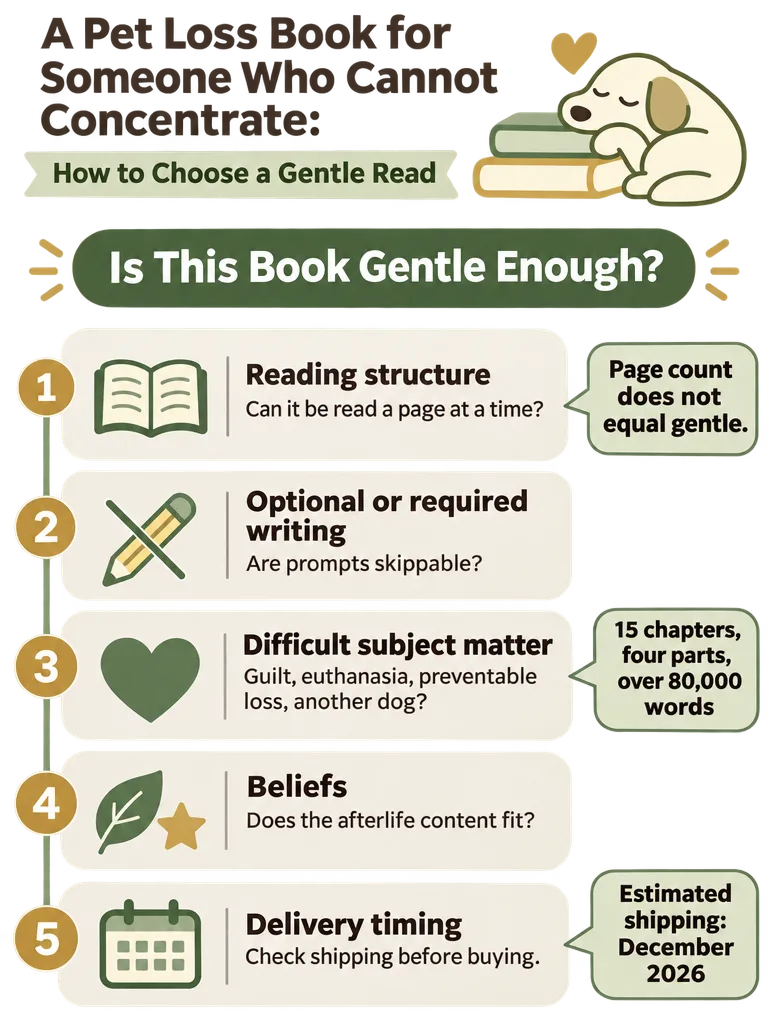
A gentle pet loss book is one whose listing and preview show how much it asks of you. Five practical checks help: reading structure, optional versus required writing, difficult subject matter, beliefs, and availability. None guarantees fit. They narrow the choice before you spend money on a book you can't use right now.
- Check how it breaks up. Look for daily entries, short sections, or chapters with natural stopping points. Chapter length, font size, layout, and readability aren't documented for the books in this article's sources, so a sample page or the "look inside" preview is a useful way to check.
- Separate optional writing from required writing. A journal prompt you can skip is different from a workbook that builds on earlier answers. The Griffin's Heart listing describes prompts at the end of each chapter but doesn't say whether they're optional.
- Scan the description for hard scenes. The descriptions reviewed here name the day of euthanasia, guilt, preventable loss, and welcoming a new dog. Decide which of those you can meet right now.
- Check beliefs. The Saying Goodbye To Benson listing describes Buddhist-inflected practices: mindfulness meditation, bodhichitta, and maitri. Purdue lists Saying Goodbye to Lulu by Corinne Demas, a children's book, as one "for those needing a book without religious discussion." That title doesn't answer an adult's search, but it shows spiritual framing is worth checking before you buy.
- Confirm you can get it. Listings can be out of print or on preorder, and editions differ. Check before you count on a title.
The Association for Pet Loss and Bereavement (APLB) offers help choosing a book from its recommended-reading collection. It is worth using before you spend money on a guess.
Which pet loss books include euthanasia, guilt, or another dog, and should you read them now?
Charlie's Last Walk, Saying Goodbye To Benson, and Coping with Sorrow on the Loss of Your Pet all name euthanasia and guilt in their descriptions, and two mention another animal. Whether to read them now is yours to decide. If the loss is recent, a book that avoids the final day may be easier to start with, and the harder ones can wait.
| Title | Length and format | Difficult content named in the description |
|---|---|---|
| Charlie's Last Walk by Paige Cummings | Amazon lists 75 pages in four parts, published January 24, 2026, marked out of print with limited availability | The 24 hours before euthanasia, 17 months of illness, and welcoming a new dog |
| Saying Goodbye To Benson by Chris and Deb Paslay | Amazon lists 184 pages and more than 50 original photographs | The decision to put Benson down, guilt, and being stuck in the "bargaining" stage, worked through with mindfulness |
| Coping with Sorrow on the Loss of Your Pet by Moira Anderson Allen (2015, per Purdue) | Page count not given in the sources | Per APLB: guilt, changes to surroundings and schedules, memorials, euthanasia, anticipatory grief, and whether to bring another animal home |
One naming caution: K9Hearts sells a memoir by the same author called Why Losing a Heart Dog Is So Hard. The sources don't establish that it is the same book as Charlie's Last Walk, so check which one you're buying.
This site's guide to pet loss books for someone who just lost a dog covers the first-days question more broadly.
Is To Lose A Dog a gentle read for someone who can't concentrate?
To Lose A Dog is a memoir with 15 chapters in four parts and over 80,000 words, according to its own product page. Those specifications don't show whether it works in short reading sessions, and the page describes emotionally direct material. Editorially, that makes it a possible later companion rather than an easy first read.
The four parts are the love, the loss and grief, the healing, and the survival. The book is by Isaac H about his English Bulldog, Franki, who died at five while Isaac was six thousand miles away. The page says it is honest about guilt, distance, and whether the loss was preventable, and states plainly that it is not a sugarcoated pet loss story. It also says the science sits inside the story rather than in a chapter you have to endure.
The page describes the book as for readers "drowning in fresh grief or carrying the ache years later," so it doesn't rule out an early read. The supplied sources do not establish whether its sections work independently. The assessment above is an editorial reading of the published specifications, not a statement from the publisher.
The comments on the page are public responses to Franki's death on Instagram, not book reviews, and the page says nobody has read the book yet. The page contains no reviews and no independently assessed low-concentration reading experience.
The product page presents the book as a preorder with shipping estimated for December 2026. That is an estimate, not a delivery guarantee, and it matters if you are choosing something to read this week.
How can you give a pet loss book without pressuring someone to finish it?
Give a pet loss book with a note that sets no deadline. K9Hearts' gift FAQ says that if you're unsure someone is ready, a card saying "read this whenever you want to" takes the pressure off. That wording suits a recipient who can barely focus.
Here is a short script (an original example, with an invented dog name):
"I've been thinking about Cooper. This book is here whenever you want it, and it's fine if that's not for a while. You don't need to read it or tell me about it."
Use the dog's name. Skip any timetable for feeling better. Don't ask how far along they are. Search-grounded answers gathered for this article's research (Exa, November 6, 2026) point the same way for holiday support: use the pet's name, send a low-pressure text that needs no reply, and set no timeline.
Check stock and delivery before you buy. Amazon marks the paperback of Charlie's Last Walk out of print with limited availability, so a title you want to give may be hard to send. A book that arrives late or not at all can feel like one more thing to manage, for you and for them.
For wording that fits early grief, see what to write inside a pet loss book you're giving as a gift.
Frequently asked questions
Where can I buy a book for someone who lost a dog?
Amazon lists most of the titles reviewed here, including Saying Goodbye To Benson (paperback $12.99 at the time of writing). Some authors also sell directly: Kenda Summers' paperback is $17.97 on petsorrow.com, and K9Hearts sells an instant PDF for $9.99. Check stock before ordering, since Amazon marks Charlie's Last Walk out of print with limited availability.
Is there a pet loss book you can read a few pages at a time?
Yes. The author site for Healing Solutions for Pet Loss by Kenda Summers says you can read it slowly, a few pages at a time, and describes it as educational and supportive rather than medical or psychological treatment. The paperback is listed at $17.97. The site doesn't give chapter lengths, so preview a sample before buying.
Is a digital copy easier than a paperback when you're grieving?
It can be, depending on the person. K9Hearts says its instant PDF of Why Losing a Heart Dog Is So Hard ($9.99) suits readers who want to start tonight or who find a physical book in the house too much right now. The paperback ($14.99 on Amazon) suits readers who want to hold or mark up the pages. The text is the same in every format.
Do pet loss journals make you write?
Journals ask for writing by design, so check how much. Griffin's Heart places journal prompts at the end of each chapter, alongside guided exercises and a keepsake pocket, but its listing doesn't say whether the prompts are optional. K9Hearts' guided journal can be used without reading its companion memoir first.
Are there pet loss books without religious content?
Purdue University Veterinary Hospitals lists Saying Goodbye to Lulu by Corinne Demas (2009) as a book for those needing no religious discussion, though it is a children's title. Saying Goodbye To Benson, an adult memoir, describes Buddhist-inflected practices including mindfulness meditation, bodhichitta, and maitri. Read the description or preview before buying to see what spiritual framing a book uses.
When will To Lose A Dog ship, and what does it cost?
To Lose A Dog is a preorder with copies estimated to ship December 2026. The price is $24.99, marked down from $29.99, plus $4.90 US shipping, and the page says you can cancel any time before it ships. An estimate isn't a delivery guarantee, so the book won't suit someone who needs a read this week.
Sources
- Pet Loss Books | Purdue University Veterinary Hospitalsvet.purdue.edu
- www.amazon.comwww.amazon.com
- www.petsorrow.comwww.petsorrow.com
- www.amazon.comwww.amazon.com
- www.k9hearts.comwww.k9hearts.com