What is the best pet loss book for a man who wants grief support without platitudes?
The best pet loss book for a grieving man is one that validates the loss and matches how he actually copes, rather than pushing sentimental language he'll bounce off. The Pet Loss Studio built an entire title, "Pet Loss for Men," around silent grief, workplace pressure, euthanasia guilt, and coping through action or solitude rather than talking about feelings. That framing matters more than bestseller rank.
There's no single right answer, because "grief without platitudes" means different books for different men. Some want a clinical explanation of why it hurts. Others want a story that mirrors their own.
The Association for Pet Loss and Bereavement (APLB) sorts its recommended reading by need, using categories like Adult, Dog Lovers, Euthanasia, Guide, Great Gift, and Self-Help. Start there: name the need first, then pick the book.
For a man who wants both a real story and a usable map, To Lose A Dog by Isaac H is one restrained example. It chronicles his 1,820 days with Franki, an English Bulldog, across four parts: The Love, The Loss & The Grief, The Healing, and The Survival. It reads as a memoir that also functions as a practical guide, including a chapter on the science of why the bond hurts to lose.
How should a grieving man choose between a memoir, a clinical guide, a workbook, or a spiritual book?
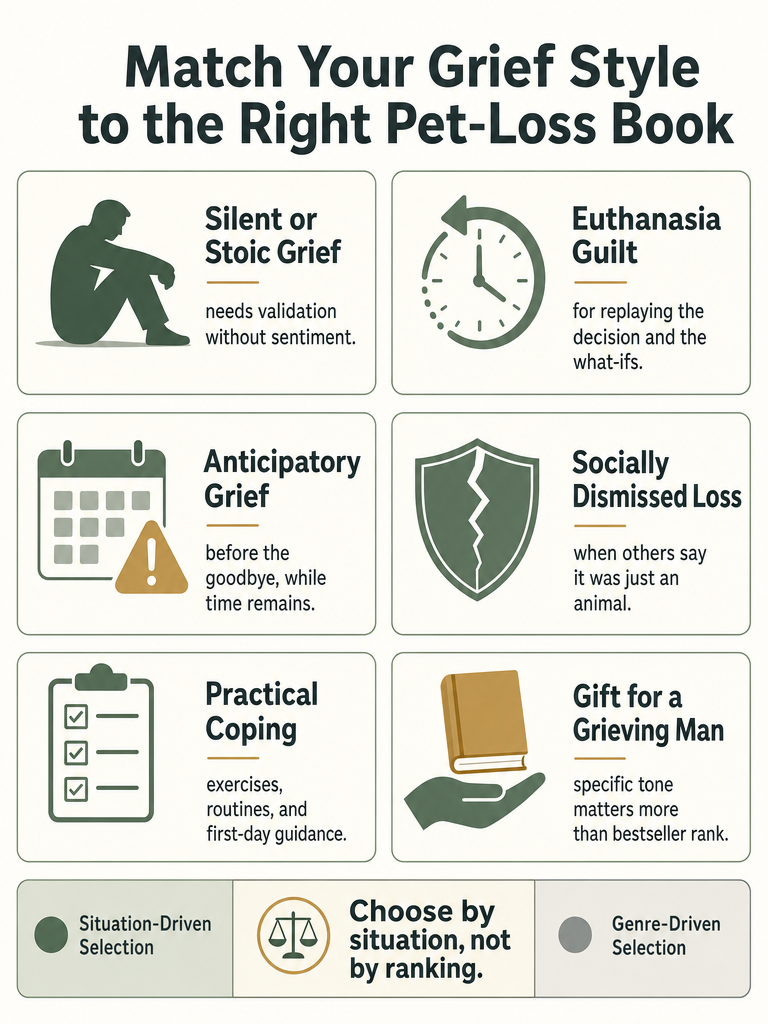
Choose by what your grief needs to do next, not by what ranks highest. Memoirs offer company and recognition; clinical guides explain the mechanics of grief; workbooks give you something to actually do; spiritual books offer comfort about what comes after. Amazon's Best Sellers in Pet Loss Grief shows all four styles crowded together, which is exactly why rank alone misleads.
The pet-loss shelf is not one category. Amazon's list runs from spiritual titles like Gary Kowalski's "Goodbye, Friend" (ranked #7 at the time of the crawl) to practical ones like "The Dog Grief Guide" (#15). Meanwhile, Heaven At Home Pet Hospice frames its adult reading list as part of a support system, leaning toward validating, practical titles.
Here's a plain way to match category to moment:
| Book type | Best when you want | Sourced example |
|---|---|---|
| Memoir | Company and recognition in a real story | To Lose A Dog by Isaac H (Franki, English Bulldog) |
| Clinical guide | To understand why it hurts this much | Wallace Sife's The Loss of a Pet, 328 pages, first published January 1, 1993 |
| Practical guide | Comfort plus strategies you can use | Coping With Sorrow On The Loss of Your Pet, Moira Anderson |
| Spiritual | Comfort about the afterlife | Goodbye, Friend, Gary Kowalski |
If you tend to process by doing rather than talking, skip the purely reflective titles and go straight to a guide or workbook. For a fuller breakdown, see how to choose between memoirs, therapist guides, and manuals.
What is the best pet loss book for guilt after euthanasia?
For guilt after euthanasia, the most direct book is one written specifically about that decision and its aftermath, not a general grief title. Kymba Nijuck's "Goodbye My Pet: Grief and Guilt After Choosing Euthanasia" focuses on exactly the doubt, replayed "what ifs," and second-guessing that follow the choice. Goodreads lists it at 73 pages, published November 4, 2025, which makes it short enough to read when your focus is shot.
Euthanasia guilt has its own shape. It runs as a loop of wondering whether you acted too soon, too late, or for the wrong reasons.
Two other sources speak to it directly. The Pet Loss Studio's "Pet Loss for Men" includes a chapter on euthanasia guilt written for men who carry that decision quietly. And APLB describes Dr Rachel Megahy's "Pet Bereavement and Grief" (Published On February 11, 2026) as a clinically grounded guide that draws on attachment theory and grief research to address guilt, shock, trauma, and persistent "what ifs," without pressuring you to move on.
If the decision is the wound, a book built around euthanasia will help more than a general grief title that treats it as one chapter among many.
If the guilt is loud enough to affect sleep or function, pair the reading with human help; see how to choose a pet loss grief counselor who gets dog loss.
Which pet loss books help when people say it was just a dog?
When people minimize your loss, look for books that explicitly name that dismissal and call your grief normal. Heaven At Home Pet Hospice describes "Pet Loss" by Herbert A. Nieburg and Arlene Fischer (Harper & Row, 1982) as acknowledging that owners are "often inhibited in their very real grief," and encouraging them to grieve as they would any significant loss.
The "just a dog" comment is its own injury. It tells you that the size of your pain is wrong. Several sourced titles counter that head-on.
- Coping With Sorrow On The Loss of Your Pet by Moira Anderson (Alpine Blue Ribbon Books, 1996): Heaven At Home says it shows you're not "crazy" or "over-reacting," using the experiences of dozens of pet owners.
- When Your Pet Dies by James E. Quackenbush and D. Graveline (Simon and Schuster, 1985): written by the nation's first full-time pet-bereavement counselor, examining the emotions individuals and families feel.
- The Grief Recovery Handbook for Pet Loss by Russell Friedman, Cole James, and John W. James: Heaven At Home says it's for people whose family and friends "don't seem to understand the level of your grief."
- IT WAS NEVER JUST A DOG: Amazon ranks this validation-focused title at #26 in Pet Loss Grief.
For handling the comment itself, how to comfort someone who lost a dog and what never to say works in reverse, too.
Best dog grief books with practical advice for the first days after loss
In the first days, pick a short, practical book over a long emotional one, because acute grief wrecks your ability to concentrate. Numbness, disorganization, and an inability to read more than a page at a time are common early on. A concise, therapist-written guide meets you there better than a 300-page memoir.
Two sourced options fit acute grief well. "The Pet Loss Companion" by Ken Dolan-Del Vecchio and Nancy Saxton-Lopez is described as a concise guide from experienced therapists. Alan D. Wolfelt's "When Your Pet Dies" validates grief and offers ways to navigate the emotions rather than suppress them.
Amazon ranks "The Dog Grief Guide" by Nate Aframian at #15 in Pet Loss Grief, a dog-specific option among a list that otherwise skews spiritual. Heaven At Home's framing is worth holding onto: books are part of a support system, not the whole thing.
For the practical logistics of these early days, the first 30 days after losing a dog and what to do when your dog dies in the first 24 hours cover the tasks a book usually won't.
Can pet loss books help during anticipatory grief before saying goodbye?
Yes, books can help before the death, and many readers reach for them exactly then. One Reddit post from a dog owner whose dog was diagnosed with terminal cancer asked directly for books "that deal with the loss of a pet and grief" before the loss had happened. Anticipatory grief is real grief; it just arrives early.
Name the stage you're in first. Anticipatory grief is what you feel while your dog is still alive but declining. Palliative and hospice care is the practical support during that window. Post-loss reading comes after. A book can serve more than one of these, but knowing which stage you're in helps you choose.
Penguin Random House describes Judith Eve Rosen's "Life After Pet Loss," written by a psychotherapist and veterinary social work specialist, as a one-day-at-a-time guide structured for grief that changes over time. APLB's need categories, including Euthanasia and Guide, also help you find something suited to the decisions still ahead.
For the season before goodbye, anticipatory grief in dog owners: what helps right now and how to plan your dog's last day sit alongside any book you choose.
What book offers exercises for coping with pet loss?
If you want exercises rather than only comfort, look for guides that build in reflection and emotional-regulation tools. APLB describes Dr Rachel Megahy's "Pet Bereavement and Grief" (Published On February 11, 2026) as offering practical exercises for reflection and emotional regulation, without pressuring readers to "move on" or replace the pet.
Two other sourced titles carry structured work. "The Grief Recovery Handbook for Pet Loss" by Russell Friedman, Cole James, and John W. James applies a recognized recovery method to pet loss. And Wallace Sife's "The Loss of a Pet," which Goodreads lists at 328 pages and first published January 1, 1993, includes practical suggestions and brief case histories from a pioneer in pet bereavement counseling; reviewers note prompts like writing a letter to a deceased pet or listing memories.
| Book | What the exercises do | Length |
|---|---|---|
| Pet Bereavement and Grief (Dr Rachel Megahy) | Reflection and emotional regulation | Published Feb 11, 2026 |
| The Grief Recovery Handbook for Pet Loss | Structured recovery method | Guide format |
| The Loss of a Pet (Wallace Sife) | Practical suggestions, letter-writing, memory lists | 328 pages |
Prefer a hands-on process over reading? Journaling vs. meditation for pet loss healing compares two approaches you can start tonight.
What is the best non cheesy pet loss gift for a grieving man?
A non-cheesy gift for a grieving man is a book that matches his grief stage and reads as specific rather than sentimental, not a generic sympathy object. APLB even keeps a "Great Gift" category in its recommended reading, and it offers to help you choose a title if you're unsure. That's a better starting point than defaulting to a spiritual or afterlife book he may not connect with.
Match the book to what he's carrying. If he made a hard euthanasia call, "Goodbye My Pet: Grief and Guilt After Choosing Euthanasia" speaks to that at 73 pages. If he processes through action and silence, The Pet Loss Studio's "Pet Loss for Men" is built for exactly that temperament, with chapters on workplace pressure and practical coping.
For men who need words for grief others keep dismissing, To Lose A Dog reads as a story first and a guide second, which lands better than a card. See To Lose A Dog book gifts that don't feel generic and best sympathy gifts for someone whose dog died for how to time the gift to the moment.
When a book is not enough: support groups, counselors, and dog-loss resources
A book helps, but some grief needs a human voice. When reading isn't enough, add a support group, a counselor who takes pet loss seriously, or a hotline. Heaven At Home Pet Hospice hosts the West Michigan Pet Loss Support Group on the second Tuesday of each month, 6:30–8 p.m., a reminder that structured, in-person support exists specifically for pet loss.
APLB goes further, offering to help readers choose a book and pointing toward its bereavement resources. Use both: read for understanding, talk for relief.
If you're deciding what kind of human support fits, these guides break it down:
- Pet loss support groups online: which type helps most
- How to choose a pet loss grief counselor who gets dog loss
- Pet loss hotlines: when a support group is not enough
- The first 30 days after losing a dog: a survival guide
A book can be the thing you hold at 2 a.m. A person is the thing you reach for when holding isn't enough. If you're looking for a book that carries a man through both the story and the survival, To Lose A Dog was written to do exactly that, and you can reserve a copy when the time feels right.
Frequently asked questions
What is the best pet loss book for guilt after euthanasia?
Kymba Nijuck's "Goodbye My Pet: Grief and Guilt After Choosing Euthanasia" (73 pages, published November 4, 2025) is the most focused option — it's built entirely around the doubt, replayed "what ifs," and second-guessing that follow the decision. For a clinically grounded companion, APLB describes Dr. Rachel Megahy's "Pet Bereavement and Grief" (February 11, 2026) as addressing guilt and trauma through attachment theory, without pressuring readers to move on.
What is the best non-cheesy pet loss gift for a grieving man?
A book matched to his specific grief stage lands better than any generic sympathy object. The Association for Pet Loss and Bereavement maintains a "Great Gift" reading category and offers to help you choose. If he made a hard euthanasia call, "Goodbye My Pet" at 73 pages is short enough to actually read in acute grief. For men who process quietly, a memoir-plus-guide that reads as a real story — not a self-help title — tends to get finished.
Best pet loss books for grieving dog owners who want practical advice, not just comfort
For practical guidance over emotional reassurance, three sourced titles stand out: "The Pet Loss Companion" by Ken Dolan-Del Vecchio and Nancy Saxton-Lopez (concise, therapist-written), "Coping With Sorrow On The Loss of Your Pet" by Moira Anderson (Alpine Blue Ribbon Books, 1996), and "The Grief Recovery Handbook for Pet Loss" by Friedman, James, and James, which applies a structured recovery method. Amazon ranks "The Dog Grief Guide" by Nate Aframian at #15 in Pet Loss Grief as a dog-specific option.
What is the best pet loss book for grief support when people say it was just a dog?
Look for books that name that dismissal directly. "The Grief Recovery Handbook for Pet Loss" by Russell Friedman, Cole James, and John W. James is described by Heaven At Home Pet Hospice as written for people whose family and friends "don't seem to understand the level of your grief." Moira Anderson's "Coping With Sorrow On The Loss of Your Pet" (1996) explicitly tells readers they're not "crazy" or "over-reacting." Amazon also ranks "IT WAS NEVER JUST A DOG" at #15 in Pet Loss Grief as a validation-focused title.
What pet loss book offers exercises for coping, not just reading?
Dr. Rachel Megahy's "Pet Bereavement and Grief" (published February 11, 2026) includes practical exercises for reflection and emotional regulation, grounded in attachment theory, without pushing readers to replace the pet or move on. Wallace Sife's "The Loss of a Pet" (328 pages, first published 1993) includes prompts like writing a letter to a deceased pet and listing memories. "The Grief Recovery Handbook for Pet Loss" applies a structured, step-by-step recovery method to pet bereavement specifically.
Can pet loss books help during anticipatory grief before a dog dies?
Yes — many readers reach for them before the loss, not after. Penguin Random House describes Judith Eve Rosen's "Life After Pet Loss," written by a licensed psychotherapist and veterinary social work specialist, as a one-day-at-a-time guide structured for grief that shifts over time, covering heartbreak, guilt, anger, and numbness. The Association for Pet Loss and Bereavement also sorts its recommended reading by need, with an "Euthanasia" category designed for decisions still ahead.
Sources
- Recommended Readingwww.aplb.org
- Best Pet Loss Griefwww.amazon.com
- books about pet loss? : r/suggestmeabookwww.euthabag.com
- Books About Pet Loss and Griefwww.pethospicevet.com
- Best Pet Loss Books of 2026: 12 Books That Actually Help When ...www.thepetlossstudio.com
- Pet Loss for Menwww.aplb.org