
What Should You Write Inside a Pet Loss Book?
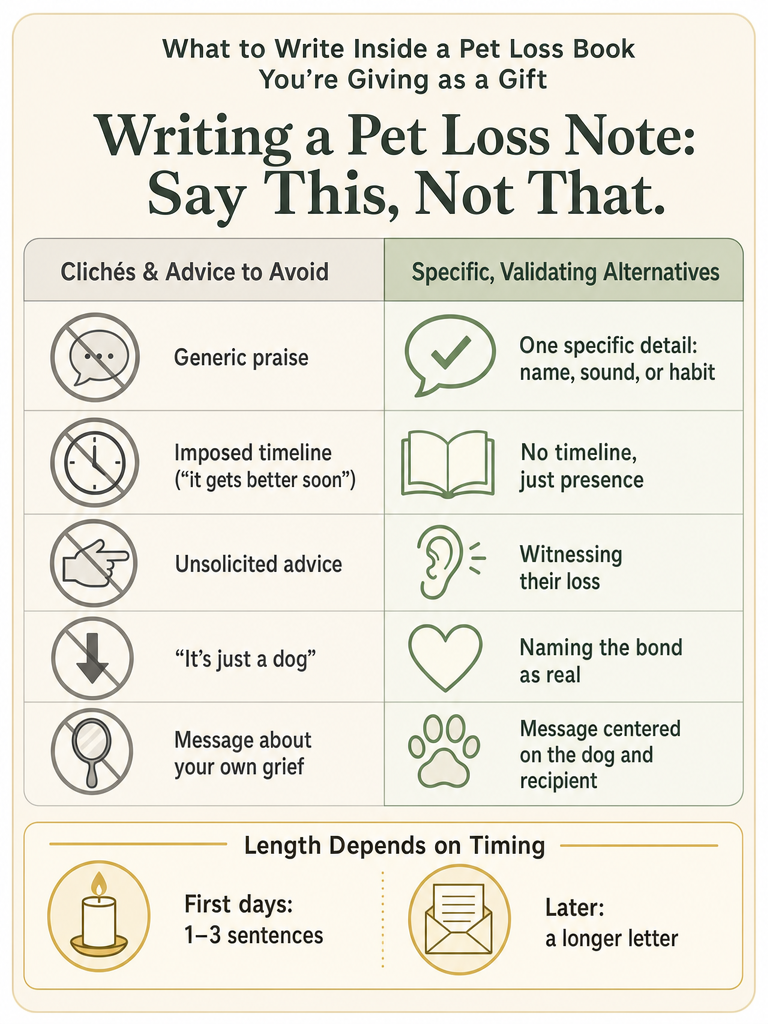
Opening a blank page inside a dog grief book can feel harder than choosing the gift itself, especially when you don't want to get the words wrong. What to write inside a pet loss book comes down to three moves: name the dog once, add one specific detail only the recipient would recognize, and skip any advice or timeline for grief, according to memorial-writing guidance from Sunday Fawn and Humane World for Animals.
Sunday Fawn's guidance on pet memorial writing and FindPetCremations' journal prompts both point the same direction: start with the dog's name and nicknames, the sounds they made, a favorite spot, or one ordinary day described from start to finish. That approach works as well inside a gift inscription as it does in a private journal. A line like "I still think about how Max thumped his tail against the door every time you walked in" proves you actually knew him, or that you paid attention when the recipient talked about him, in a way a general compliment can't.
Humane World for Animals makes a related point: pet grief often goes unacknowledged by other people, and it's normal, and important, to mourn the relationship itself. An inscription that names the loss plainly, "I'm so sorry about Max," does more to validate someone than a card that dances around the word "died" or leans on a euphemism. A specific, true sentence about the dog tends to land better than a generic one, because it shows you were paying attention rather than reaching for a script.
How Do You Honor the Dog Without Making the Note About Your Own Grief?
Keep the spotlight on what the recipient lost, not on how the news affected you. Humane World for Animals frames pet grief as mourning a specific relationship, so the strongest inscriptions describe the texture of that bond, what the dog meant to this particular person, rather than narrating the writer's own reaction to hearing about it.
The difference shows up fast on the page. Self-centered: "I can't believe Bella is gone, it's been so hard to process." Other-centered: "Bella used to wait by your car every evening, and that kind of loyalty doesn't happen by accident." The second version keeps the attention where the recipient's grief actually lives.
Humane World for Animals also notes that grief doesn't move in a straight line: people shift back and forth between denial, anger, guilt, and sadness rather than progressing through a fixed order. A note that honors the dog without prescribing how the recipient should feel next leaves room for whatever shape their grief takes, instead of asking them to follow yours.
What Should You Avoid Writing in a Pet Loss Book?
Steer clear of any line that minimizes the loss, imposes a timeline, or compares one dog's death to another's, since these are the phrases most likely to make a grieving person feel dismissed. The sting readers describe most often starts with some version of "it's just a dog," which trades the writer's comfort for the reader's reality.
| Instead of writing | Try writing | Why it lands better |
|---|---|---|
| "It was just a dog" | "Your grief for Max matters, full stop" | Names the loss as real instead of minimizing it |
| "He's in a better place now" | "I'm thinking of you and Max today" | Doesn't impose a belief the recipient may not share |
| "It gets easier soon" | "There's no schedule for this, and I'm here anyway" | Matches Humane World for Animals' description of grief as nonlinear |
| "You should get another dog" | "Whenever you're ready for anything, I'm around" | Skips advice nobody asked for |
| "At least you had him for ten years" | "Max was lucky to have you" | Avoids turning the dog's life into a silver lining |
The pattern underneath all five swaps is the same: say what's true about the dog and the person, and stop short of managing their recovery.
How Long Should the Note Be in the First Days After a Dog Dies?
Match the length of the note to how raw the loss still feels, not to a fixed number of days. If the loss is very fresh, a short message of a line or two reads as support; a long letter in that same moment can feel like homework the recipient isn't ready to open. Humane World for Animals describes grief after a pet's death as moving back and forth rather than settling into one feeling at a time, which is part of why a flexible approach works better than a rule.
- When the loss is very fresh: keep it short. Name the dog, add one detail, and close with something that asks nothing of them: "Thinking of you and Max. I'm here whenever you want to talk, or don't."
- Once the initial intensity has eased: a longer letter has more room to work. This is when memories, a shared story, or a fuller tribute can land without competing with the person's bandwidth.
If you're choosing the book itself rather than just the inscription, matching length and tone to how raw the grief still is matters there too. Pet loss books for someone who just lost a dog breaks down which titles fit the earliest days versus the months that follow.
What If You Didn't Know the Dog Well? Writing for Coworkers and Distant Relatives
You don't need to have met the dog to write something that helps. You need to witness that the person in front of you is hurting, and sending an imperfect, honest line beats staying silent while you wait for a memory you don't actually have.
"The one thing I want people to know is that it is better to send or do something, anything. Don't worry about the specifics so much that you do nothing." (Morgan Weber, pet sitter and founder of Memory Flame Candle, via Wear Wag Repeat)
That principle applies directly to the blank page inside a gift book. Fallback language that doesn't require firsthand knowledge of the dog: "I never got to meet Max, but I could tell from how you talked about him how much he meant to you." Or simply: "I'm sorry for your loss. I know Max was family." Either line does more good on the page than a card left blank because you were waiting for the right memory you don't have.
How Should the Note Change If They Feel Guilt or Weren't There at the End?
Guilt after a dog's death needs to be witnessed, not corrected or argued away. Humane World for Animals names guilt, about what caregivers did or didn't do, as a normal part of grief, not proof that someone failed their dog.
Isaac, the author of To Lose A Dog, writes about being six thousand miles away when his English Bulldog Franki died, and about grief compounded by guilt, distance, and the suspicion that it was preventable, according to the book's own description of that section. That framing is useful for an inscription because it doesn't try to talk someone out of guilt. It names the feeling as real without agreeing that it's deserved.
A line like "Not being there doesn't mean you weren't devoted to him every other day" says more than "you did everything you could," because it doesn't ask the person to accept your verdict on their decisions. It just sits with them in it. If the recipient is specifically wrestling with euthanasia guilt, what is the best pet loss book for guilt after euthanasia covers books built around that exact feeling.
What About Writing in a Pet Loss Book for a Grieving Child?
The same formula works for children, scaled to their age: name the dog once, add one detail they'll recognize, and keep sentences short. Published guidance on child-specific condolence wording is thin, so the safer approach is sticking to language that's concrete rather than softened.
Avoid euphemisms that can confuse children about what actually happened. Plain, gentle honesty tends to serve them better than a vague phrase that raises more questions than it answers. A workable line: "Max loved it when you ran around the yard with him. I know you miss him so much, and that's okay."
Belief framing matters as much as reading level here. Some families want faith-based language about where a pet "goes"; others want strictly secular wording. Matching the book itself to both the child's age and the family's beliefs is worth doing before you write anything inside it. Best pet loss books for kids, ranked by age sorts options by both.
When Is a Pet Loss Book the Right Gift, and When Should You Wait?
Timing determines whether a grief book feels like comfort or like homework. A book tends to land best once the sharpest shock has eased and the person has some attention to spare for a page; some people may want conversation or practical help before they're ready to read anything at all.
Humane World for Animals points to a few specific options for that early window: the Pet Compassion Careline, which offers 24/7 grief support with trained pet grief counselors, and Lap of Love, which runs 50-minute one-on-one sessions with a grief counselor. Love, Baxter and the Association for Pet Loss and Bereavement are named alongside these as additional places people turn for support.
Signals to wait rather than guess: the person has said outright they're not ready to read anything, or everything still feels too raw to hold a page in their hands. When in doubt, ask before giving a book at all, or let them know it's there for whenever they want it.
If you want to compare options across grief stages rather than guess, best pet loss books of 2026 rounds up 12 titles by what they're actually good for, and 24 hour pet loss hotline separates true around-the-clock lines from scheduled callbacks for the nights a book can't help.
Frequently asked questions
How do you write a pet obituary or death announcement for a dog?
Start with the dog's name and the dates that matter, then add one concrete detail, a favorite spot, a sound, a habit, that proves you knew who he was, following the memorial-writing pattern recommended by Sunday Fawn and Humane World for Animals. Skip euphemisms like "crossed over"; naming the loss directly, "Max died on [date]," tends to validate grief more than softened language does. Close with a single line about what he meant, not a full biography.
What do you write in a personal grief journal after your dog dies?
Write directly to your dog, not about the event, saying what you wish you'd said or how you'd have spent one more day together, a format Humane World for Animals recommends because it gives feelings somewhere concrete to go. Focus on memories you shared rather than replaying the final moments, which can keep guilt and rumination on a loop. A few sentences a day works better than forcing one long entry while grief still feels raw.
What's a comforting pet loss gift besides a book?
Paw print keepsakes, custom pet portraits, and memorial jewelry rank among the most common comforting gifts, according to Wear Wag Repeat's roundup of dog loss gestures, because they give grief a physical object to hold onto. Pet sitter Morgan Weber, founder of Memory Flame Candle, says the specific gift matters less than simply sending something rather than staying silent while searching for the perfect gesture. A small, imperfect gift beats no gift at all.
What are the best dog grief books to read in the first 30 days?
There's no single best title for the first month; the right fit depends on how much attention the reader can spare, not the calendar. Short, prompt-based workbooks tend to suit the rawest days because they ask for only a few sentences at a time, while a full memoir, like the 15-chapter To Lose A Dog, tends to land once the initial shock eases enough to sit with a longer story. Match the book's length to the reader's capacity, not their timeline.
How do you survive the first few days after your dog dies?
Give yourself permission to feel whatever comes; grief after a pet's death moves back and forth through denial, anger, guilt, and sadness rather than in a fixed order, according to Humane World for Animals. Avoid replaying your dog's final moments on a loop and focus instead on the life you shared. If you need to talk to someone immediately, the Pet Compassion Careline offers 24/7 grief support with trained pet grief counselors, and Lap of Love runs 50-minute one-on-one sessions.
Why does losing a dog hurt as much as losing a person?
Oxytocin, the same bonding hormone that attaches a parent to a newborn, has been measured rising in both dogs and their owners after nothing more than sustained eye contact, which is part of why grief after a dog's death registers as real bereavement, not a lesser loss. Two nervous systems spend years tuning to each other, so the body treats the separation like any close attachment. That science is part of what To Lose A Dog devotes a chapter to explaining.