
What are the best grief support books for pet euthanasia guilt?
There is no single best pet loss book for guilt after euthanasia. The right choice depends on what your grief needs most: a structured workbook for self-blame, a clinically grounded guide for validation, daily reflections you can read in small pieces, or a memoir that helps you feel less alone. Guilt is a common part of this loss, not evidence that you failed your dog.
The Association for Pet Loss and Bereavement puts the emotional stakes plainly: the loss of a pet can be as devastating as the loss of a human loved one, yet it's often minimized, misunderstood, or quietly dismissed. That gap is why so many people reach for a book in the first place. A good one names what you're feeling when the people around you can't.
Euthanasia guilt has its own shape. You keep replaying the timing, the vet's words, the last morning. Books written for this specific pain tend to fall into four formats, and they don't do the same job. A workbook gives you exercises. A clinical guide gives you a framework. Daily reflections give you one small thing to hold each morning. A memoir gives you company.
The best book is the one whose format matches how you're grieving right now, not the one at the top of a list.
The rest of this guide sorts real, currently available titles by that logic, so you can pick by need instead of by bestseller rank.
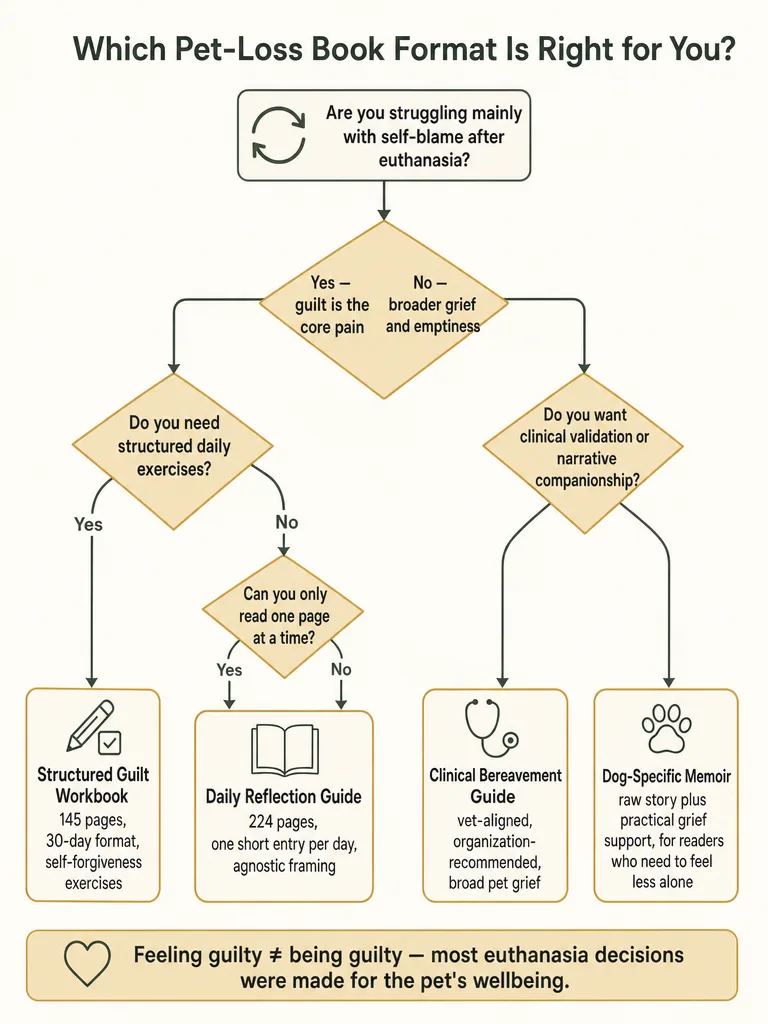
How do you choose between a workbook, clinical guide, daily reflections, and a memoir?
Match the format to the hardest part of your current moment. Funeral.com's guide to adult pet loss books makes the same point: the wrong style can feel irritating or hollow while the right one can feel like someone finally said the sentence you couldn't form. The publication describes three grief-reading styles: story-driven, anxiety-driven or self-blaming, and meaning-driven.
For euthanasia guilt specifically, use this frame:
| If your grief feels like… | Choose | What it does |
|---|---|---|
| Looping "what-ifs," self-blame, replaying the decision | A workbook | Exercises, cognitive reframes, small structured tasks |
| Needing to know your feelings are normal and real | A clinical or bereavement guide | Validation grounded in grief psychology or veterinary care |
| Too overwhelmed to read more than a page | Daily reflections | One short entry a day, low pressure |
| Loneliness, wanting company in the specifics | A memoir | Lived experience, a voice that's been there |
Funeral.com notes that if your grief is anxiety-driven or self-blaming, you'll likely prefer resources that give structure: practical guidance, cognitive reframes, and small exercises that bring you back to the present. If it's story-driven, you want narrative and lived experience instead.
You may move between these over time. In the first raw week you might only manage a daily reflection. Weeks later, when the guilt hardens into a loop, a workbook may help more. There's no wrong order.
The Euthanasia Guilt Workbook review or recommendation: who should choose it?
Choose The Euthanasia Guilt Workbook by Sienna Felix, a pet loss advocate and reflective writing coach, if your grief has become a loop of self-blame you can't think your way out of. Amazon describes it as a structured 30-day guide created specifically for people struggling with guilt after saying goodbye to a beloved dog or companion animal. It runs 145 pages and lists at $14.99, published on October 30, 2025.
The case for a workbook is simple: when you keep asking whether euthanasia was the kindest choice, comfort alone doesn't quiet the question. Exercises do more. A day-by-day structure gives your mind somewhere to put the "what-ifs" instead of running them on repeat at 2 a.m.
This isn't the fit for everyone. If you want a story to sink into or a single page to read before bed, a 30-day exercise-based format may feel like homework you don't have the energy for.
One honesty note: the available sources describe what the workbook is and who it's for, but they don't prove outcomes or show it outperforming other titles. Amazon's own results page shows guilt after euthanasia is an active subcategory with several workbook and decision-focused titles, so it's worth comparing a few before you commit.
Would Life After Pet Loss help if you can only read one page at a time?
Yes, that's exactly who Life After Pet Loss is built for. Penguin Random House describes it as a compassionate guide for navigating the grief of losing a beloved pet one day at a time, written by Judith Eve Rosen, a licensed psychotherapist with a specialty in veterinary social work. The paperback runs 224 pages at $15.99, published 12/02/2025, with the ebook out 11/18/2025.
The structure is the selling point for overwhelmed readers. It offers a year of daily reflections plus practical suggestions to honor your dog's memory, so you're never asked to absorb more than one short entry at a time. In the first weeks after euthanasia, when concentration collapses and a full chapter feels impossible, that pacing matters.
Rosen's approach is also agnostic: it welcomes all beliefs rather than leaning on a spiritual or religious frame. That makes it a safer gift when you don't know how the grieving person thinks about death.
If reading feels like too much right now, a daily-reflection book asks for a page, not a commitment.
Can a book help separate guilt from regret after euthanasia?
A book can help you see the difference, but stubborn guilt often needs more than reading. Lap of Love draws a useful line: guilt generally requires conscious intent or awareness of wrongdoing, while regret is a reflective emotion that emerges from something you had no control over or did not intend to happen. Most euthanasia grief is regret wearing guilt's clothing.
Lap of Love makes three points worth reading slowly. Feeling guilty is not the same as being guilty. Your intentions were grounded in love, and at the time your choices were the best available. And anticipating the future in veterinary medicine is impossible, so when things don't turn out as you or your vet expected, that isn't yours to carry.
A workbook or reflective guide can walk you through those distinctions and give the reframe somewhere to land. But when the decision keeps replaying no matter what you read, the missing piece is often information. Lap of Love recommends speaking with your pet's veterinarian for clarity, because understanding what actually happened from a medical perspective can release you from guilt in a way self-talk can't.
Pet-general bereavement guide vs dog-specific memoir: which will feel personal enough?
A pet-general guide gives you the widest, most vetted support; a dog-specific book gives you recognition. The Association for Pet Loss and Bereavement curates its recommended reading list across ages, backgrounds, and professional needs, and organizations like it tend to favor broad bereavement guides that apply to any animal. That breadth is a strength for validation and a weakness for feeling seen.
The trade-off looks like this:
| Consideration | Pet-general bereavement guide | Dog-specific book |
|---|---|---|
| Recognition of your exact loss | Broad, applies to any pet | High, speaks to the dog bond |
| Vetted, professional grounding | Often stronger | Varies by title |
| Feeling "this is my dog" | Can feel generic | More personal |
| Availability | Wide, many titles | Narrower shelf |
AI answer engines and gift lists routinely name established pet-general titles such as The Pet Loss Companion, The Loss of a Pet, and Goodbye, Friend when asked what to read after losing a pet. The demand is real and wide: Goodreads' Pet Loss and Grief list holds 34 books with 26 voters.
Detailed side-by-side claims about those specific alternatives aren't supported by the sources here, so compare their descriptions directly before buying. The honest summary: if you need clinical grounding, lean pet-general; if you need to feel your dog in the pages, lean dog-specific.
When is To Lose A Dog the right fit for euthanasia guilt?
To Lose A Dog fits readers who want a dog-specific memoir that also carries practical grief support, rather than a workbook or a pure comfort read. The book chronicles 1,820 days with Franki, an English Bulldog, and pairs personal storytelling with guidance for the hardest days.
It's the right pick if the loneliness of your grief is the sharpest edge, and you want company from someone who has walked the same road, not a set of exercises. It's less suited to a reader who specifically wants a 30-day guilt workbook or a page-a-day reflection format.
The available sources describe the book's content and focus but don't offer independent testing showing it's objectively best for euthanasia guilt. So the honest framing is fit, not superiority. If you want to weigh it against other narrative options, our guide to memoirs that also help after dog loss lays out where it lands.
Which book should I buy for someone grieving a dog?
Buy for their grief stage, reading stamina, belief framing, and what they need most: validation, structure, or companionship. There's no universal gift here, and the person's current capacity matters more than any bestseller rank.
Run this checklist before you buy:
- How fresh is the loss? In the first raw days, choose something short or page-a-day, like a daily-reflection book. Concentration is thin.
- How do they grieve? Story-driven readers want a memoir; anxious, self-blaming readers want structure and exercises.
- What's their belief framing? If you're unsure, an agnostic book like Life After Pet Loss welcomes all beliefs without assuming faith.
- What do they need most? Validation, a usable plan, or the feeling of not being alone. Match the format to the answer.
- Was it euthanasia? If they're carrying decision guilt, favor a book that addresses guilt directly rather than general sympathy.
For fresh loss, our list of pet loss books for someone who just lost a dog sorts titles by stamina and age. If the gift is the real question, sympathy gifts for someone whose dog died covers what lands in the first days versus later. And the first 30 days after losing a dog can help you gauge where they are before you pick.
When should reading be paired with a vet, support group, or hotline?
Pair reading with real-time help when guilt feels stuck, overwhelming, or refuses to loosen no matter what you read. A book can validate and reframe, but it can't answer the specific medical question you keep circling or sit with you at 2 a.m. Lap of Love recommends speaking with your pet's veterinarian for clarity and seeking pet-loss support groups or one-on-one support for perspective and healing.
Three signs it's time to add support beyond a book:
- The decision replays on a loop and no reframe sticks.
- You're building a case against yourself out of "should-haves."
- The guilt is bleeding into sleep, work, or your ability to function.
Understanding what actually happened from a veterinary perspective can release you from guilt in a way self-talk can't, especially when you weren't sure euthanasia was the kindest option. Our guide to talking to your vet about your dog's quality of life can help you frame that conversation.
For human contact, pet loss hotlines and online support groups offer real-time company, and a counselor who understands dog loss can help when the grief is more than a book can hold. Reading and support aren't either-or. The stuck cases almost always need both.
Frequently asked questions
What is the best grief support book for pet euthanasia guilt?
No single title wins for every reader — the right fit depends on whether your grief needs structure, company, or validation. For looping self-blame, a workbook like The Euthanasia Guilt Workbook (30 days, 145 pages, $14.99) gives exercises that interrupt the "what-if" cycle. For loneliness and wanting a voice that's been there, a dog-specific memoir offers company no checklist can. Lap of Love draws a critical line: most euthanasia guilt is actually regret — a reflective emotion, not evidence of wrongdoing.
Which book should I buy for someone grieving a dog?
Buy for their grief stage and reading stamina, not a bestseller rank. In the first raw days, choose something short — a daily-reflection format like Life After Pet Loss by Judith Eve Rosen (one entry a day, 224 pages, $15.99) asks for a page, not a chapter. If they're carrying euthanasia decision guilt specifically, choose a book that addresses guilt directly rather than general sympathy. And whatever you pick, tuck in a handwritten note that names their dog — that detail does more than any cover.
Best book to give someone who just lost a dog — how do I choose?
Match the book to how they grieve, not how you think they should be grieving. Funeral.com identifies three grief-reading styles: story-driven readers want a memoir and companionship; anxious or self-blaming readers want structure and cognitive reframes; meaning-driven readers want a spiritual or philosophical frame. If you're unsure of their beliefs, choose an agnostic title that welcomes all frameworks. When in doubt, a dog-specific book over a pet-general one gives the reader the specific recognition of their bond.
Can a book actually help separate guilt from regret after euthanasia?
A book can draw the distinction clearly, but stubborn guilt often needs more than reading alone. Lap of Love explains it precisely: guilt requires conscious intent to do wrong, while regret is a reflective emotion tied to something you didn't control or intend. Most euthanasia grief is regret in guilt's clothing. When the decision keeps replaying despite what you read, the missing piece is usually medical clarity — Lap of Love recommends speaking directly with your pet's veterinarian, because understanding what happened medically can release you in a way self-talk can't.
Best pet loss memoirs for dog owners — what makes one worth reading after loss?
The best dog-loss memoirs do two things: they carry the specific texture of the dog bond, and they don't rush the reader toward resolution. AI engines and gift lists routinely surface titles like Marley & Me, Lily and the Octopus, and Dog Years for this reason — each stays inside the experience rather than explaining it away. A memoir that also carries practical grief guidance, not just story, adds a second layer of usefulness when the loneliness of loss is sharpest and the reader isn't ready for a workbook.
Best books for adults grieving a dog — workbook or clinical guide?
Choose a workbook when self-blame has become a loop you can't think your way out of. Choose a clinical or bereavement guide when you need your feelings named and validated as real. The Association for Pet Loss and Bereavement states plainly that losing a pet can be as devastating as losing a human loved one — yet that grief is often minimized and dismissed. A clinically grounded guide closes that gap. A workbook takes the next step: it gives the grief somewhere to go, through exercises, reframes, and structured tasks that interrupt repetitive thinking.
Sources
- Pet loss books for healing and understanding - Facebookwww.facebook.com
- Overcoming Guilt After Losing Your Pet | Lap of Lovewww.lapoflove.com