
What are the best pet loss books for kids by age?
The best pet loss book for a child depends on age and what kind of help they need, not on a single ranking. Common Sense Media organizes titles by developmental stage, from age 3+ through age 12+, and multiple pet-loss guides split their picks into early childhood, elementary, and older readers. When a Pet Dies by Fred Rogers, for example, is listed by Penguin Random House Retail for ages 4-8.
Here's an honest caveat before the quick picks: the sources support age-fit groupings far better than a strict best-to-worst order. No single list in the research ranks every title from toddler to teen, so treat the bands below as fit, not a leaderboard.
| Age band | Strong picks (sourced) | Why it fits |
|---|---|---|
| 3-5 | The Goodbye Book, Big Cat Little Cat, Koko's Kitten | Simple, concrete, short |
| 4-8 | Bear Island, The Rough Patch, I'll Always Love You, When a Pet Dies | Room for grief, dog-relevant |
| 6-8 | Bluebird, Short | Early realism |
| 9-12 | Welcome to Dog Beach, Where the Red Fern Grows, Paper Wishes | Fuller story, harder truths |
| 10-12+ | Wonder, The Twistrose Key, Sounder | Older, more complex loss |
Big Cat, Little Cat, Koko's Kitten, and The Goodbye Book appear at age 3+ on Common Sense Media's list, with Bluebird at 6+, Short at 8+, and Sounder at 12+. Match the book to your child first, then to the shelf.
How do I choose an age-appropriate pet loss book for my child?
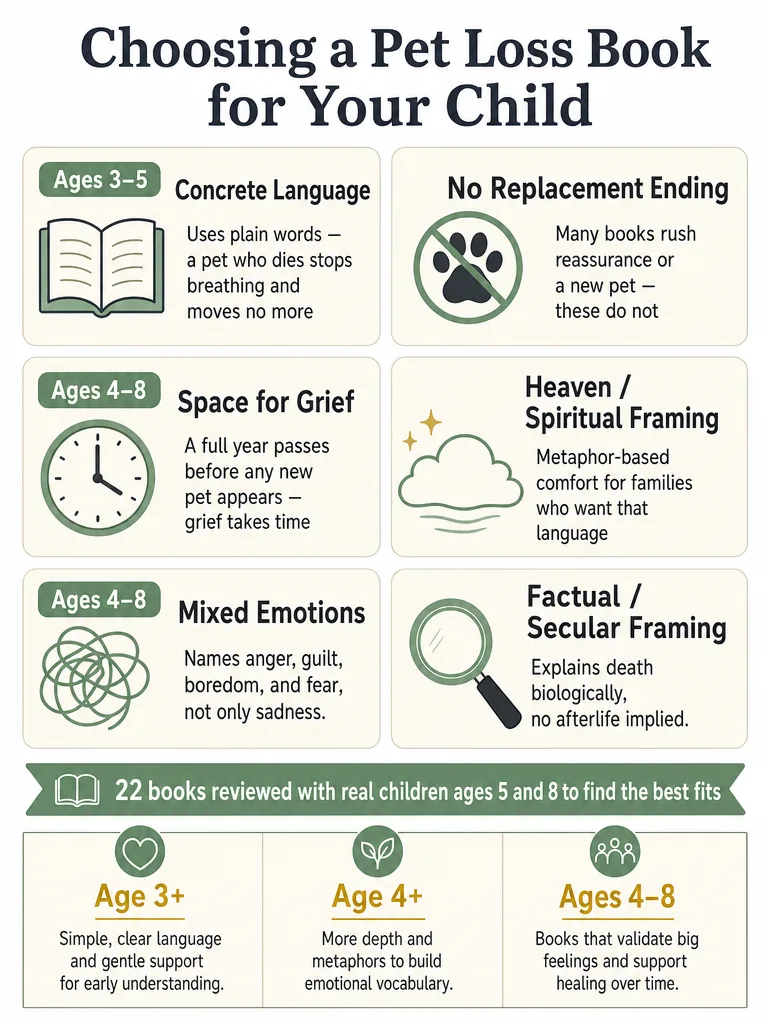
Choose a pet loss book by matching two things at once: your child's developmental stage and the emotional moment they're in. A good fit uses language your child can actually understand and makes room for grief instead of rushing past it. Funeral.com advises pairing any soothing metaphor with one concrete sentence about death, so a child isn't left confused about what happened.
Timing matters as much as age. Screenwise notes that not every book works for every child, and that some kids want a book the day the pet dies while others need weeks or months first.
Run each title through these questions:
- Does it use concrete words about death? For young children, "stopped breathing and moving" beats "went to sleep."
- Does it make space for sadness, or rush to reassure? What to Read to Your Kids warns that many books distract, replace, or over-comfort.
- Could it deepen guilt? Watch for stories that imply the child could have done something.
- Does it match your family's beliefs? Factual, spiritual, and continuing-bond framings are all here; pick one on purpose.
- Is it dog-specific enough to feel relevant? Many lists blend cats, fish, and birds.
Which pet loss books are best for preschoolers?
For a preschooler who barely grasps what death means, the best books stay short, plain, and concrete. Titles for this age keep sentences simple and don't ask a 3- or 4-year-old to hold abstract ideas about the afterlife. Common Sense Media lists Big Cat, Little Cat, Koko's Kitten, and The Goodbye Book at age 3+.
The Goodbye Book by Todd Parr tells its story through the lens of a pet fish who has lost his companion. A staff list from Greenwich Library describes it as touching the host of emotions children experience while reminding readers that it's okay not to know everything.
- The Goodbye Book (Todd Parr): accessible, emotion-first, reassures without pretending grief is simple.
- Big Cat, Little Cat (Elisha Cooper): a friendship between two cats until the older one "has to go" and doesn't come back, per the Greenwich Library annotation.
- Koko's Kitten (Dr. Francine Patterson): nonfiction, gentle, listed at age 3+.
- When a Pet Dies (Fred Rogers): direct nonfiction that states the facts plainly.
A hospice-veterinarian guide from Serene Passages names The Goodbye Book and When a Pet Dies among direct, concrete options for younger children. For preschoolers, plain beats poetic.
What age is When a Pet Dies for?
When a Pet Dies by Fred Rogers is listed for ages 4-8 by Penguin Random House Retail, though other guides place it lower, closer to ages 2-6, which tells you it skews toward the youngest end of the picture-book range. The disagreement isn't a flaw; it reflects that this book works best for children who don't yet understand death at all.
What makes it useful for that age is how plainly it explains what death is. Read Brightly quotes the book directly: "When a pet dies, it isn't alive anymore, so it can't wake up again. A pet that dies stops breathing and moving." That's the concrete sentence young children need, without euphemism.
It doesn't stop at the facts. Read Brightly notes that the book connects death to a child's emotional life, telling readers there will come a time when sadness and anger fade and they can feel happy again about the good times they shared.
When a Pet Dies is the book to reach for when your child doesn't understand death yet and needs it named clearly, not softened into "sleeping." If your child is already asking harder questions, pair it with a title further down this article.
Which books are best for ages 4-8 after losing a dog?
For a child aged 4-8 grieving a dog, the strongest picks let sadness sit on the page instead of tidying it away. Several dog-specific picture books in this band handle real grief without rushing to a new puppy. What to Read to Your Kids points to Bear Island for exactly this, a story where a full year passes between losing a dog and welcoming a new one.
In Bear Island by Matthew Cordell, the loss opens with two words, "Goodbye, Charlie," and the color palette drops to browns to mark the emptiness. Cordell won the Caldecott Medal in 2018 for Wolf in Snow, and What to Read to Your Kids credits Bear Island with the same visual storytelling.
Not every title here carries equal source depth. Some appear only on staff lists or roundup mentions, so weigh them accordingly.
| Book | Author | Age fit | What it does |
|---|---|---|---|
| Bear Island | Matthew Cordell | 4-8 | Non-linear grief over a full year |
| The Rough Patch | Brian Lies | 4-8 | Loss, anger, slow return to life |
| I'll Always Love You | Hans Wilhelm | 4-8 | A nightly promise that outlives the dog |
| Harry & Hopper | 4-8 | 4-8 | Letting go of a dog gradually |
| The Tenth Good Thing About Barney | Judith Viorst | 4-8 | Naming good memories |
The Rough Patch and The Tenth Good Thing About Barney both appear on What to Read to Your Kids for ages 4-8. Harry & Hopper appears on the Greenwich Library staff list, where Harry has a hard time letting go after his dog Hopper dies. I'll Always Love You, per Read Brightly, turns a nightly promise into comfort after Elfie the dachshund dies.
Which children's books about pet loss do not end with getting a new pet?
If you don't plan to replace your pet and don't want a book that suggests it, a handful of titles deliberately make room for grief instead of a new puppy. This is a real concern for many families: one parent on Reddit put it plainly, saying they didn't want any book that implies replacing a pet is an appropriate response. What to Read to Your Kids is blunt about the trap, noting that many picture books rush to reassure, distract, or offer replacement ("Let's go pick out a new puppy!").
The clearest counterexample in the research is Bear Island. A new dog does arrive, but only after a full year of grief unfolds across the pages, so the book models time rather than a quick swap.
Books that make space for grief instead of rushing to replace:
- Bear Island (Matthew Cordell): a year of anger, sadness, and boredom precedes any new pet, per What to Read to Your Kids.
- The Goodbye Book (Todd Parr): stays with the feelings; the Greenwich Library annotation notes it reminds readers it's okay not to know everything.
Source coverage here is thinner than the demand for it, so read the ending of any title yourself before sharing it.
The Invisible Leash vs When a Pet Dies: factual language or continuing-bond comfort?
The core choice between these two books is factual versus metaphorical. When a Pet Dies explains death as a plain, physical fact; The Invisible Leash offers a continuing-bond image of connection that outlasts the body. Neither is better in the abstract; the right one depends on your child's age and your family's beliefs. Read Brightly describes When a Pet Dies as clarifying that a pet who dies "stops breathing and moving."
The Invisible Leash by Patrice Karst comes from the author of the 2 million-copy-bestselling The Invisible String, per Hachette, and uses the image of an unseen bond that stays after a pet dies. Common Sense Media lists it at age 4+.
| Book | Framing | Best when |
|---|---|---|
| When a Pet Dies | Factual, physical | Child needs death named plainly |
| The Invisible Leash | Continuing bond | Child needs an image of lasting connection |
| Lifetimes | Natural life cycle | You want death explained as universal |
| Dog Heaven / Cat Heaven | Spiritual, afterlife | Your family holds a heaven belief |
| God Gave Us Heaven | Spiritual, faith-based | Faith framing fits your home |
Lifetimes is described by Read Brightly as a lyrical explanation that all living things have lifetimes that begin and end. Dog Heaven and Cat Heaven by Cynthia Rylant offer afterlife imagery, per the Greenwich Library list. Pick one framing on purpose; mixing "he's just gone" with "he's in heaven" in the same week confuses young children.
Which books help children grieve guilt, anger, and mixed feelings?
Some children need a book that validates hard, unflattering feelings, not just one that comforts. The strongest example in the research is Bear Island, which names the full messy range of grief. What to Read to Your Kids describes the story unfolding "in the physical and mental space of the girl's anger, sadness, boredom, regret, and fear," which is a wider emotional map than most picture books attempt.
That matters because grief in children rarely arrives as neat sadness. Anger and regret show up too, and a book that only offers reassurance can leave a child feeling their harder feelings are wrong.
- Bear Island (Matthew Cordell): anger, sadness, boredom, regret, and fear, all held without judgment.
- The Rough Patch (Brian Lies): listed for ages 4-8 by What to Read to Your Kids; centers a character's loss and slow return.
- The Goodbye Book (Todd Parr): the Greenwich Library annotation notes it touches the host of emotions children feel and reassures them it's okay not to know everything.
Bear Island stands out because it lets a child be angry and bored and regretful, not just sad, which is closer to how grief actually feels. If your child is stuck on "it's my fault," a book that names anger and regret out loud can be the permission slip they need.
Which books are best before an elderly or sick dog dies?
Anticipatory grief, the grief that starts before a dog dies, calls for different reading than after-the-fact books. Screenwise makes the timing point directly: some children want a book right after a loss, while others need weeks or months, and the same logic runs the other way for a dog who is clearly declining. The research is thin on titles built specifically for the "before" window, so lean on books that name death honestly and give a family language to prepare.
A hospice-veterinarian guide from Serene Passages recommends matching books to a child's age and emotional need rather than picking by title alone, which is the right frame when the goal is preparation rather than mourning.
For the pre-death window, factual books like When a Pet Dies help a child understand what's coming in plain terms, so the day itself is less of a shock. If you're the one preparing, our guide on helping a child understand a pet's death covers the conversation itself, not just the reading list.
Which pet loss books fit older elementary and middle-grade readers?
Older kids can handle realism a picture book can't hold, and several sourced titles are written for that maturity. Common Sense Media bands these clearly: Bluebird at 6+, Short and The Penderwicks in Spring at 8+, Paper Wishes and Welcome to Dog Beach and Where the Red Fern Grows at 9+, The Twistrose Key and Wonder at 10+, and Sounder at 12+.
For a child grieving a dog specifically, the dog-centered titles will land hardest.
| Book | Age fit | Notes |
|---|---|---|
| Bluebird | 6+ | Loss for younger elementary readers |
| Short | 8+ | Realistic grief |
| The Penderwicks in Spring | 8+ | Family story touching loss |
| Paper Wishes | 9+ | Historical, loss woven in |
| Welcome to Dog Beach | 9+ | Dog-centered |
| Where the Red Fern Grows | 9+ | Classic dog loss |
| The Twistrose Key | 10+ | Fantasy framing of loss |
| Wonder | 10+ | Includes a dog's death |
| Sounder | 12+ | Older, harder realism |
Where the Red Fern Grows and Welcome to Dog Beach are the most directly dog-focused choices here, which makes them a better match for a child mourning a dog than a general grief novel. For an older reader who wants to sit with the loss quietly, these give language and story where a short picture book would feel too small.
Choosing a book for yourself as much as your child is normal in a grieving house. If you want a dog-specific read for the adults in the family, our roundup of pet loss books for someone who just lost a dog sorts titles by grief moment rather than age.
If you're preparing your own heart alongside your child's, To Lose A Dog by Isaac H blends memoir with practical guidance for anticipatory grief and the days after. You can reserve your copy today when the time feels right.
Frequently asked questions
What age is When a Pet Dies by Fred Rogers for?
Penguin Random House lists When a Pet Dies for ages 4–8, though other guides place it as low as age 2, meaning it skews toward children who don't yet understand death at all. Its value is in plain language: it tells children that a pet 'stops breathing and moving' — no euphemism, no 'went to sleep.' Read Brightly notes it also connects death to a child's emotional life, reassuring them that sadness and anger will eventually give way to happy memories.
Which children's books about pet loss don't end with getting a new pet?
Bear Island by Matthew Cordell is the clearest example: a full year of anger, sadness, boredom, and regret unfolds before any new dog arrives, modeling time rather than a quick swap. The Goodbye Book by Todd Parr also stays with the feelings throughout, without replacing the lost pet. What to Read to Your Kids warns that many picture books rush to reassure or offer replacement — screening the last few pages yourself before reading aloud is the simplest safeguard.
Which pet loss books are best for preschoolers ages 3–5?
Common Sense Media lists The Goodbye Book, Big Cat, Little Cat, and Koko's Kitten at age 3+. The Goodbye Book by Todd Parr works through the lens of a pet fish and names emotions without pretending grief is simple. Big Cat, Little Cat follows two cats until the older one 'has to go and doesn't come back.' A hospice-veterinarian guide from Serene Passages recommends When a Pet Dies alongside The Goodbye Book for this age as direct, concrete options — plain beats poetic for a 3-year-old.
Which books help children grieve guilt, anger, and mixed feelings after a dog dies?
Bear Island by Matthew Cordell is the strongest sourced option here. What to Read to Your Kids describes it as unfolding 'in the physical and mental space of the girl's anger, sadness, boredom, regret, and fear' — a wider emotional map than most picture books attempt. The Rough Patch by Brian Lies (ages 4–8) centers a character's slow return from loss. The Goodbye Book by Todd Parr reassures children it's okay not to know everything, which matters when a child is stuck on 'it's my fault.'
Should I choose a factual or continuing-bond pet loss book for my child?
The choice depends on your child's age and your family's beliefs. When a Pet Dies (Fred Rogers) explains death as a plain physical fact — a pet 'stops breathing and moving' — and works best when a child needs death named clearly. The Invisible Leash by Patrice Karst, from the author of the 2-million-copy-selling The Invisible String, offers an image of a bond that persists after death. Common Sense Media lists The Invisible Leash at age 4+. Mixing both framings in the same week can confuse young children, so pick one on purpose.
Which pet loss books work best for older elementary readers ages 9–12 grieving a dog?
Common Sense Media places Where the Red Fern Grows and Welcome to Dog Beach at age 9+, making them the most dog-focused choices for this age band. Both carry more story and harder truths than a picture book can hold. Wonder and The Twistrose Key are listed at 10+, and Sounder at 12+ for older, more complex realism. For a child mourning a specific dog, the dog-centered titles will land harder than a general grief novel.
Sources
- Losing a Dogwhattoreadtoyourkids.com
- Children's books about pet loss that don't end with getting a ...www.readbrightly.com
- Books To Help Children Grieve the Death of a Petwww.facebook.com
- Recommendations for kid-friendly pet loss booksgreenwichlibrary.bibliocommons.com
- Recommended Readingscreenwiseapp.com
- Books About Pet Loss: Helping Kids Grieve with Stories That Heal – Guide | Screenwisewww.commonsensemedia.org
- Books About the Death of a Pet | Common Sense Mediawww.reddit.com