
How Many Days Off Is Normal After Your Dog Dies?
If you're asking this question, you're probably exhausted, maybe guilty, and wondering if wanting time off makes you dramatic. It doesn't. There's no set number of days considered normal after a dog dies. No federal law and no widely adopted employer standard names a specific figure, so the right amount depends on your job, your grief, and whatever your company already offers.
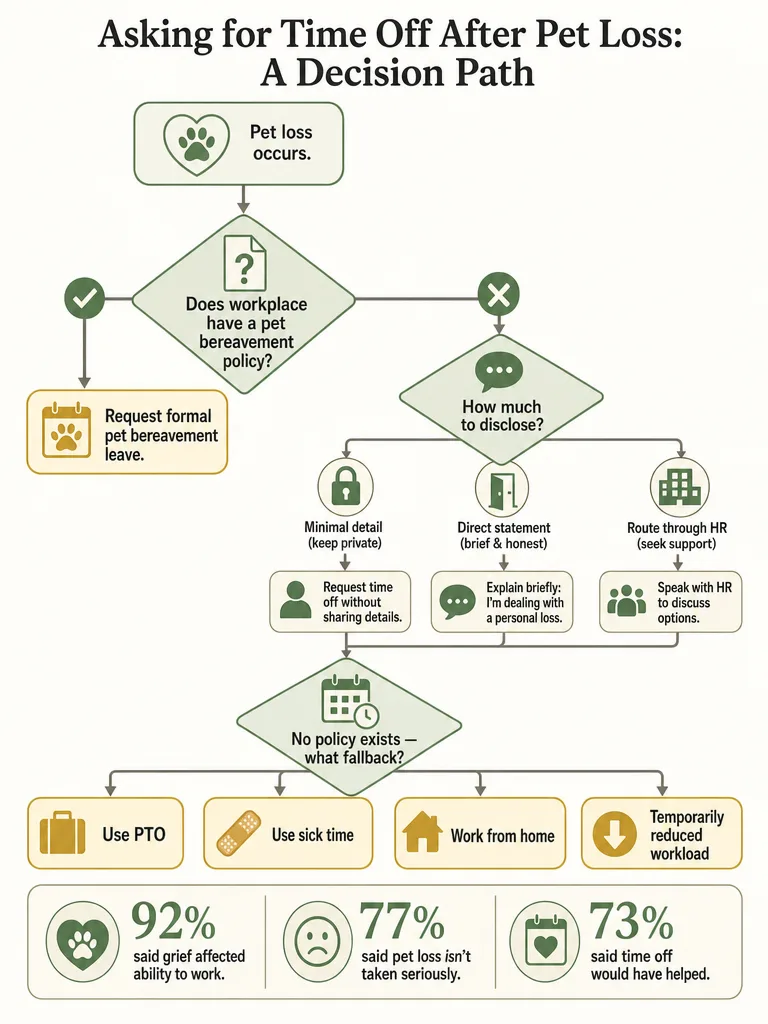
The Royal Society for the Prevention of Cruelty to Animals (RSPCA) found in its Pet Grief Survey that 92% of employed respondents said their grief affected their ability to work to some extent.
Pet bereavement leave, where it exists, is time off an employer grants specifically for the death of a pet, separate from standard sick or vacation days. Few companies have a formal version of it. Most pet owners end up borrowing from whatever leave categories already exist: sick time, personal days, or unpaid leave.
That gap matters more than it should. The same RSPCA survey found that 73% of respondents said time off work would have helped them while grieving their pet, and 77% believed pet loss isn't taken seriously enough in workplaces. Most grieving pet owners believe time away from work would have eased their grief, even though few employers offer it as a named option.
One in ten respondents didn't tell their employer about the loss at all, according to the RSPCA. Deciding how much to ask for and how much to disclose matters more here than finding a universal number. The sections below give you language for both.
How Do I Ask My Boss for Time Off After My Dog Dies?
Keep the request short: state what happened, how it's affecting you, and exactly what you need. The RSPCA recommends a Fact-Feel-Want structure for employees who struggle to explain their needs to a manager: "My pet died. I feel heartbroken. I'd appreciate a little space and time to process this."
That three-part shape works because it removes the guesswork for your manager while keeping disclosure minimal. It states a fact, names the impact, and makes a specific request, nothing more. Honor Pet, a pet-loss resource, offers a similar direct script: "I wanted to let you know that my pet passed away, and I'm finding it particularly challenging. I'd like to use [X] days of my [personal/sick] time to process this loss."
Both versions work because they name the leave category instead of leaving your manager to guess. Say "personal day," "sick time," or "PTO," not just "time off." If you work remotely, Honor Pet suggests adding one line about how your dog's absence affects your workspace: your pet was a constant presence during the workday, and their absence is significantly impacting your ability to focus in your usual space.
Send it in writing if a face-to-face conversation feels like too much right now. A short email or message gives you room to say what you need without managing your manager's reaction in real time.
Do I Have to Tell My Manager My Dog Died?
No, you don't have to disclose details. You can request personal or sick time without naming the reason in most workplaces, since standard leave categories don't usually require an explanation. How much you share is a choice about your own comfort, not an obligation.
Three levels work depending on what feels manageable:
- Minimal-detail: "I need to use a personal day tomorrow for a family matter." No mention of a pet at all.
- Direct: "My dog died yesterday. I'd like to take [X] days using my sick time." Names the loss plainly, similar to the Honor Pet and RSPCA scripts above.
- HR-routed: If your manager relationship feels difficult, route the request through HR instead, framed the same way, and let HR communicate the leave category to your manager without you repeating the story.
None of these is more correct than another. Some people find it easier to name the loss because hiding it takes energy they don't have. Others would rather keep the detail out of a work relationship entirely. Whichever you choose, keep the request itself specific: name the leave category and the number of days, even if you say nothing else about what happened.
What If My Company Has No Pet Bereavement Policy?
Not having a named policy doesn't mean you have no options, and it doesn't mean your loss counts for less. Most companies still lack a pet bereavement policy, according to Indeed's guidance for employers, so you're usually working from whatever leave categories already exist rather than a named benefit. Indeed notes that regular bereavement leave for human family members commonly runs three to five days, which gives you a reasonable reference point when deciding what to request, even though it isn't guaranteed to apply to pet loss.
| Option | When it fits | What to say |
|---|---|---|
| PTO / personal days | You want full days away, no explanation required | "I'd like to use two personal days starting tomorrow." |
| Sick time | Your leave policy is broad, or you're comfortable naming the loss | "I need to use sick time to process a personal loss." |
| Unpaid leave | You've used up paid leave but still need days away | "I'd like to request two unpaid days, understanding this affects my pay." |
| Remote work | Your job allows it and you can function at a slower pace from home | "Could I work from home the rest of this week?" |
| Reduced workload | You need to stay present but can't sustain a normal pace | "Can we push non-urgent deadlines? I'll focus on essentials this week." |
Indeed points out that even without a formal policy, employers can extend an existing bereavement policy to cover pets, or simply approve vacation time, unpaid days, or temporary flexible arrangements case by case. Ask for the option that matches your actual week, not the one that sounds most reasonable. If you also have a cremation or burial decision to make, a fixed appointment is easier for a manager to plan around than an open-ended request. How much dog cremation costs in 2026 can help you settle that logistics piece before you ask.
Can My Employer Deny Time Off for a Pet's Death?
It's a hard thing to hear, but yes, an employer can legally deny time off for a pet's death. That doesn't mean your grief is less real, only that the law hasn't caught up to it yet. Pet bereavement doesn't fall under a federal or state protected leave category the way family and medical leave does, so unless your workplace has a specific written policy, granting time off is generally a matter of manager discretion, not a legal entitlement. Indeed's guidance for employers notes there's no federal requirement for standard bereavement leave, and separately observes that pet bereavement policies don't typically extend from that baseline, which means coverage for a dog's death depends entirely on what a given company chooses to offer.
Public detail on state-level pet bereavement statutes is limited as of this writing, so don't assume a specific state protection exists without checking your own employee handbook first.
That means your request usually rests on existing PTO, sick leave, or unpaid leave rather than a right you can assert. If your manager says no to a specific day, ask whether a different leave category might work instead. The denial may be about which bucket the time comes from, not a refusal to acknowledge the loss at all.
What to Say If Your Manager Minimizes the Loss
A flat or awkward reaction from your manager says something about their comfort with grief, not about whether your dog mattered. Redirect the conversation to logistics rather than defending your grief. You don't need your manager to understand the depth of the bond to get what you need, you need approval for a specific, small ask. The RSPCA's data gives useful context here: 77% of grieving pet owners believed pet loss isn't taken seriously enough in workplaces, so a lukewarm reaction is common, not a sign you asked for something unreasonable.
A useful reply keeps the request in view rather than the reaction: "I understand this might not be something you've dealt with before. I just need to confirm coverage for my [X] days off, are we set?" That sentence acknowledges the awkwardness without asking your manager to feel differently, and it pulls the conversation back to something concrete: coverage, hours, or a deadline.
One account shared on Quora described a manager who, after learning an employee's dog had died suddenly over a weekend, responded with a short note of condolence and told the employee to take three days without being asked. Not every manager responds that way, and you can't control which kind you have. What you can control is keeping your request specific enough that a distracted or uncomfortable manager has an easy yes to give: a number of days, a leave category, and who covers what while you're out.
How to Manage Your Workload While You're Grieving
If you have to keep working through grief, lower the bar for how much you get done and protect focus in short blocks. Honor Pet recommends splitting larger projects into 30-minute chunks, so a foggy, distracted week still produces visible progress instead of one long stalled task.
A few adjustments make the difference:
- Break projects into 30-minute chunks and track small completions instead of judging the whole task.
- Focus on essential work first and communicate adjusted timelines to your team for the rest.
- Document your work more carefully than usual. Grief affects memory, and notes now save confusion later.
- If you work in an office, arrive 15 minutes early on days you need a few quiet minutes to compose yourself.
- If you work remotely, consider working from a different room temporarily or resetting your break patterns, since the disruption to routine is often harder to manage than the tasks themselves.
These aren't productivity hacks so much as damage control for a brain running on less than usual. Give close colleagues a short heads-up too: "I'm currently dealing with a personal loss. I appreciate your understanding if I'm less responsive than usual." That one line, adapted from Honor Pet's guidance, buys patience without requiring an explanation.
Getting Through Your First Day Back at Work
Your first day back rarely feels normal, and it isn't supposed to. Expect concentration lapses, sudden waves of emotion at ordinary moments, and a strange split between functioning fine and feeling like nothing is fine. The same RSPCA finding that 92% of employed respondents felt their grief affect their ability to work applies just as much to day one back as it does to the days you spent away.
Keep that first day light on decisions if you can. Save anything that needs sharp judgment for later in the week, and let the Fact-Feel-Want language from earlier cover what colleagues need to know, nothing more. If a specific task or meeting feels like too much, it's fair to ask a colleague to cover it, using the same short, logistics-first approach you used to request the leave itself.
If concentration and memory lapses continue past the first week, that's common enough to plan around rather than push through. For a fuller plan on the return itself, see going back to work after you put your dog down or getting through the first week back at work.
To Lose A Dog, the memoir by Isaac H about his 1,820 days with Franki, was written for exactly this stretch, the ordinary hours you still have to get through while carrying something enormous. It won't get your leave approved, but it can sit on your desk as company for the parts of grief nobody schedules around.
Frequently asked questions
How many days off is normal after your dog dies?
There's no fixed number—no federal law or standard employer policy sets a specific figure for pet loss leave. The RSPCA's Pet Grief Survey found 92% of employed pet owners said their grief affected their ability to work, and 73% said time off would have helped them cope. Most people end up borrowing from sick days, personal time, or unpaid leave rather than a dedicated pet bereavement category. Ask for what your week actually requires, not a number that sounds reasonable.
How do I ask my boss for time off after my dog dies?
Use a short Fact-Feel-Want structure: state what happened, how it's affecting you, and exactly what you need. The RSPCA recommends language like, "My pet died. I feel heartbroken. I'd appreciate a little space and time to process this." Name the specific leave category—personal day, sick time, or PTO—rather than just asking for "time off." Sending it in writing works if a face-to-face conversation feels like too much right now.
Do I have to tell my manager my dog died?
No, most workplaces let you request personal or sick time without explaining why. You can keep it minimal ("I need a personal day for a family matter"), name the loss directly ("My dog died yesterday, I'd like to use sick time"), or route the request through HR if talking to your manager feels too hard. None of these approaches is more correct than another—choose whichever costs you the least energy to say.
Can my employer legally deny time off for my dog's death?
Yes, an employer can legally deny it—pet bereavement isn't a federal or state protected leave category the way family and medical leave is. Indeed's guidance for employers confirms there's no federal requirement for standard bereavement leave, so unless your company has a written pet bereavement policy, granting time off is generally manager discretion, not a legal right. If a specific day gets denied, ask whether a different leave category, like sick time or unpaid leave, might work instead.
What if my company has no pet bereavement policy?
You still have options—most companies lack a formal pet bereavement policy, according to Indeed, so you're working from existing leave categories rather than a named benefit. Indeed notes standard bereavement leave for human family members commonly runs three to five days, a reasonable reference point even though it isn't guaranteed to cover pets. Ask for PTO, sick time, unpaid leave, remote work, or a reduced workload—whichever matches your actual week.
What should I say if my manager doesn't take my dog's death seriously?
Redirect the conversation to logistics instead of defending your grief. The RSPCA found 77% of grieving pet owners believe pet loss isn't taken seriously enough at work, so a flat reaction is common, not a sign you asked for too much. Try: "I understand this might not be something you've dealt with before. I just need to confirm coverage for my days off, are we set?" That keeps the request concrete without needing your manager's sympathy.