Why Writing a Eulogy for Your Dog Helps You Grieve
A eulogy for your dog is a personal tribute, spoken or written, that honors who your dog was and what your relationship meant, rather than a factual list of dates and habits. Writing one is a legitimate way to move through grief, not a sentimental extra step you tack on after the "real" mourning is done. The Center for Pet Loss Grief describes writing a pet eulogy as therapeutic, a chance to process grief and find closure by naming specific memories instead of sitting with vague sadness.
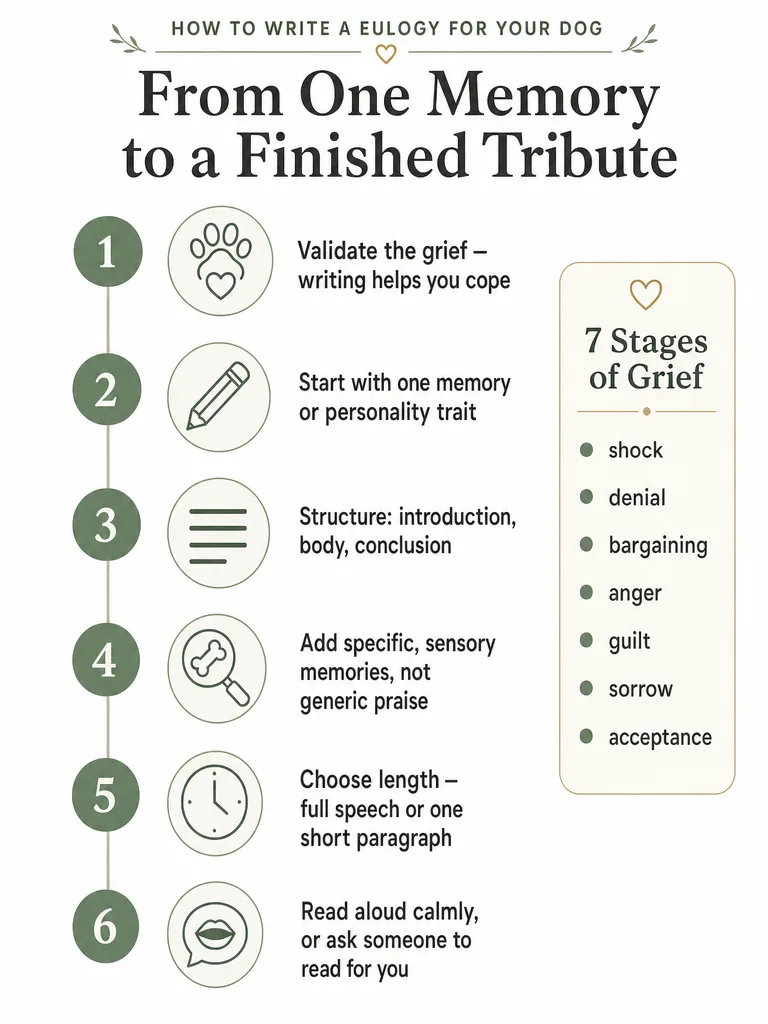
LSU's veterinary hospital explains that grief often moves through seven stages, shock, denial, bargaining, anger, guilt, sorrow, and acceptance, in an order and pace that differs for every person. That same guidance notes that losing an animal can disrupt your sense of home, safety, purpose, and identity, because the bond was that intimate. Writing gives you one concrete task while the rest of your feelings refuse to follow a schedule.
How Do You Start Writing a Eulogy When You Can't Find the Words?
Start smaller than a eulogy. Pick one moment or one habit, not your dog's whole life. Pet Passages recommends opening with your dog's personality instead of their breed, age, or appearance, because a single defining quirk pulls you into the writing faster than trying to summarize thirteen years in a paragraph.
Ask yourself one direct question: what did your dog do every single day that only they did? Maybe they claimed the same chair, greeted you with a paw on your shoulder, or barked at the mail carrier like it was a personal betrayal. Write that one thing down as a sentence, nothing else. That sentence becomes your first line, and everything else can build outward from it once the page isn't blank anymore.
You don't need the perfect opening line before you start. You need one true detail, and the rest follows from there.
What Should You Include in a Eulogy for Your Dog?
A dog eulogy needs three parts: an introduction that names your dog and your love for them, a body built from specific stories, and a conclusion that says thank you and goodbye. The Center for Pet Loss Grief lays out this structure directly, and it works because each part does a different job in the grieving process.
The body is where most people default to generic praise, "loyal, loving, best friend," and that's where Pet Passages' advice matters most: specific stories bring a dog's spirit to life far more than general descriptions ever could. A silly daily habit or the time your dog made you laugh at the worst possible moment says more than any adjective.
| Part | What it does | Prompt to fill it |
|---|---|---|
| Introduction | Names your dog, states your love | "This is about my dog, [name], who..." |
| Body | Specific stories and personality | One habit, one funny memory, one hard time they got you through |
| Conclusion | Gratitude and farewell | What you're thankful for, and your goodbye |
Pet Passages also makes a point worth sitting with: a pet eulogy is as much about your relationship as it is about your dog's life. Don't just describe your dog, describe what they changed in you. Then close by naming what you're grateful for and saying the goodbye plainly. That combination, specific memory plus honest thanks, is what makes a eulogy feel complete instead of unfinished.
What Is the Difference Between a Pet Eulogy and a Pet Obituary?
A pet eulogy and a pet obituary aren't the same thing, though people often use the words interchangeably when they're grieving and just want to write something down. The Center for Pet Loss Grief and Pet Passages both describe the eulogy format in detail, an introduction, specific stories, and a closing built around personality and the bond you shared, meant to be felt when read aloud or kept privately. Neither source covers pet obituaries directly, so the framing below is general, not something drawn from those guides.
An obituary works more like an announcement: the basic facts of your dog's life and death, shared so the people who cared about them know what happened. A eulogy carries the feeling. An obituary carries the news. Most people writing for themselves or close family only need the eulogy.
How Long Should a Dog Eulogy Be, and Can It Be Short?
There's no required length for a dog eulogy, and a single paragraph is a complete, legitimate version. Pet Passages notes explicitly that you can keep your eulogy as a private remembrance rather than something you read publicly, which means the pressure to write a polished, multi-page speech isn't real unless you put it there yourself.
If a full speech feels impossible right now, write three sentences: one memory, one thing you loved about your dog, one line of thanks. That's a finished eulogy. You can always add to it later, when grief loosens its grip a little and more memories surface. Length is not the measure of how much you loved your dog. A short tribute written through tears counts exactly as much as a long one you had time to polish.
How Do You Read a Eulogy for Your Dog Aloud Without Falling Apart?
You can read a dog eulogy aloud at home, at a crematorium viewing room, or at the vet's office. Patch & Purr Pet Cremations suggests that reading a poem or eulogy can be part of the viewing-room farewell during a private cremation, offered as something you may want to do in those final moments, not a step every owner takes. If you're planning to speak the words out loud, prepare for the physical part of it, not just the writing.
Print it in large font or write it by hand where you can see it clearly through tears. Read it through once alone before the day itself, so the first time you hit the hard lines isn't in front of other people. Pause when you need to; nobody expects a smooth delivery.
You do not have to be the one who reads it. If speaking feels like too much, ask a partner, friend, or family member who knew your dog to read your words for you. The eulogy still belongs to you even if someone else's voice carries it. And if you decide, in the moment, that you can't read it at all, that's fine too. The words exist. That's what matters.
For more on shaping the day itself around what actually helps, see what are some good bereavement rituals for a dog.
Dog-Specific Memory Prompts to Bring Your Eulogy to Life
Generic pet eulogy templates ask about favorite toys and how you met. Dog-specific prompts go further, and Patch & Purr's dog eulogy questions, favorite walk, naughtiest thing they ever did, biggest irrational fear, special quirks, are a stronger starting point because they force a real story instead of a vague trait.
Organize your memory search into a few categories so you're not staring at a blank page trying to remember everything at once:
- Routines: What did your dog do at the same time every day, the 6 a.m. demand for breakfast, the spot by the door at 5 p.m.?
- Sensory memories: What did they smell like after the rain, feel like asleep against you, sound like coming down the hallway? My Beloved Pet's guide to eulogy writing, by Madeleine St Johnston-Romano, notes that sensory detail, touch, smell, sight, sound, is especially effective for making a tribute feel alive.
- Nicknames and quirks: What did you call them when no one else was around, and why?
- Fears: What made them hide, the vacuum, thunder, the vet's parking lot?
- Favorite walks: Which route, which park, which season did they love most?
- Household role: Were they the greeter, the guard, the one who slept between you and the door?
Pick two or three categories, not all six, and write one true sentence in each. That's usually enough material for a eulogy that sounds like your dog and no one else's. If you want more language to draw from for a headstone, card, or urn once the eulogy is written, dog memorial quotes that don't sound generic can help you finish the thought.
Writing this eulogy is its own kind of company through a hard week, but you don't have to sit with the grief alone afterward either. To Lose A Dog by Isaac H follows 1,820 days with his English Bulldog Franki and pairs that story with practical grief guidance for the days that come next. If you want more words for what you're feeling, you can reserve your copy today.
Frequently asked questions
How do you start writing a eulogy for your dog when you can't find the words?
Start with one specific detail, not your dog's whole life story. Pet Passages recommends opening with your dog's personality instead of breed, age, or appearance — a single habit like claiming the same chair or greeting you with a paw on your shoulder pulls you into writing faster than trying to summarize years at once. Write that one sentence first; everything else builds outward from it.
What should you include in a eulogy for your dog?
A dog eulogy needs three parts: an introduction naming your dog and your love for them, a body built from specific stories, and a conclusion offering thanks and goodbye. The Center for Pet Loss Grief outlines this structure directly. Specific memories, one habit, one funny moment, one hard time your dog got you through, carry more weight than generic praise like 'loyal' or 'loving.'
What's the difference between a pet eulogy and a pet obituary?
A eulogy carries feeling; an obituary carries news. A pet eulogy is a personal tribute built from an introduction, specific stories, and a closing that captures your dog's personality and the bond you shared, meant to be read aloud or kept private. An obituary states the basic facts of your dog's life and death so others who cared know what happened. Most people writing for themselves only need the eulogy.
How long should a dog eulogy be?
There's no required length, and a single paragraph counts as a complete eulogy. Pet Passages notes you can keep it as a private remembrance rather than something read publicly, which removes any pressure to write a polished, multi-page speech. Three sentences, one memory, one thing you loved, one line of thanks, forms a finished tribute. Length doesn't measure how much you loved your dog.
Do you have to read your dog's eulogy out loud?
No, reading it aloud is optional. Patch & Purr Pet Cremations notes that reading a poem or eulogy can be part of a private cremation's viewing-room farewell, something you may choose to do, not a required step. If speaking feels too hard, ask a partner or friend who knew your dog to read your words instead. The eulogy still belongs to you either way.
Why does writing a eulogy help you grieve a dog's death?
Writing a eulogy gives grief one concrete task to hold onto. The Center for Pet Loss Grief describes the exercise as therapeutic, helping you process loss and find closure by naming specific memories instead of sitting with vague sadness. LSU's veterinary hospital identifies seven stages of pet grief, shock, denial, bargaining, anger, guilt, sorrow, and acceptance, that unfold at a different pace for everyone; writing offers structure while feelings refuse to follow a schedule.