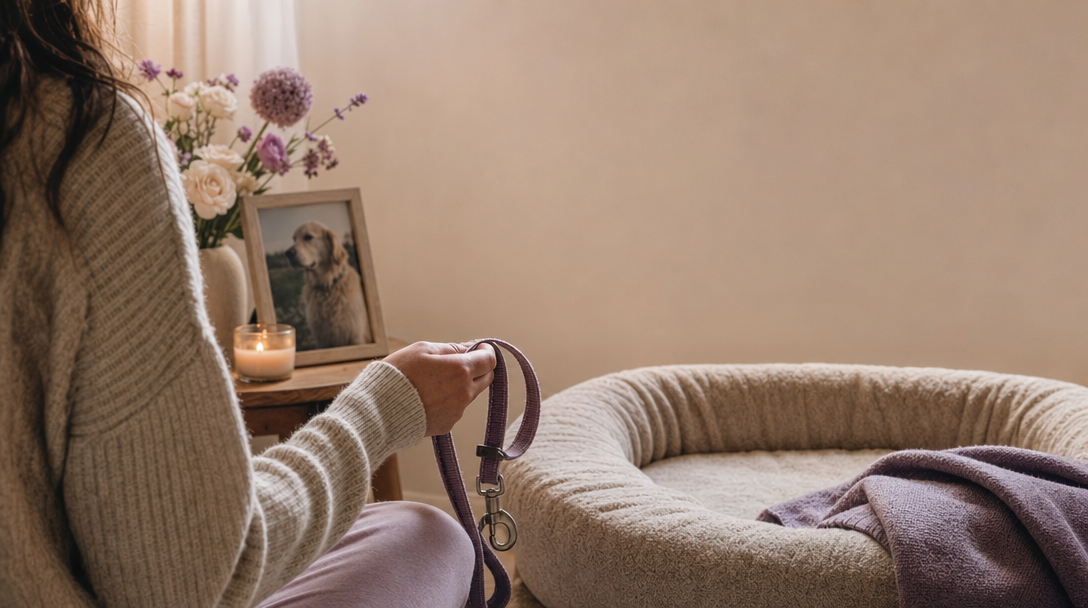
Am I Still a Dog Mom After My Dog Died?
Yes, you are still your dog's mom after they die. The American Veterinary Medical Association (AVMA) says part of a person's self-identity can come from being a pet owner, and adjusting to that change is one of grief's central mourning tasks. Mother's Day after losing a dog next falls on May 9, 2027.
The word "mom" was never a social media affectation. It described feeding schedules, vet bills, 3 a.m. worry, and years of showing up for a dog who depended on you completely. The AVMA's guidance on coping with pet loss treats that role as real: part of who you are can come from being a pet owner, and losing the job you did for your dog is one of the actual tasks of mourning, not a side effect to push through fast.
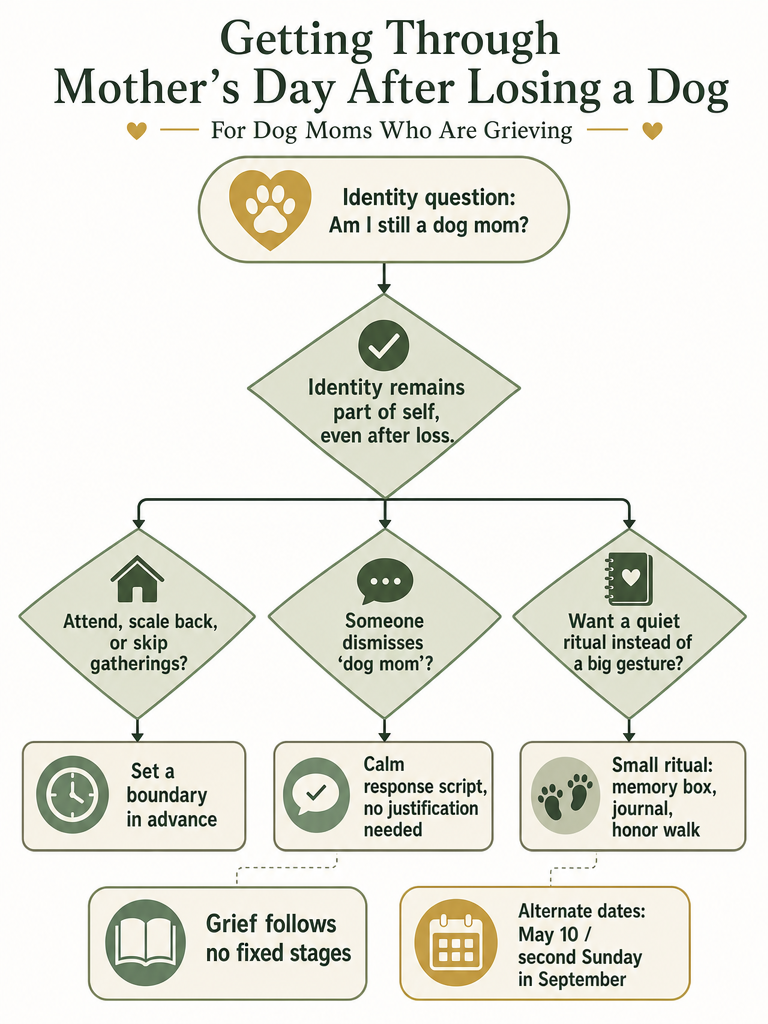
You don't stop being a mom because the dog you cared for is gone. The love and the labor both still count. That Mother's Day will ask you to sit with a title nobody revoked, even though the reason you earned it is no longer in the next room. Holding both things at once, the grief and the identity, is not a performance. It's the actual work.
Why Does Mother's Day Hurt So Much After Losing a Dog?
Grief has no script, but Mother's Day does, and that mismatch is what makes the day so hard. The AVMA says grief after a pet's death does not take on a prescribed pattern or series of stages. There is no calendar telling you when "dog mom" grief is supposed to have faded enough to enjoy brunch.
A holiday built around one fixed identity, mother, caretaker, the person who got up in the night, works like a floodlight. It points straight at the role you built around your dog and shows you the role is now empty. Other grief days let you quietly skip the thing you used to do. Mother's Day puts a name on the role itself and asks you to claim it or not, often in front of relatives who don't know what to do with the answer.
The mechanism here is identity disruption, not simple nostalgia: a title you still hold without the dog who gave it meaning. The AVMA's point that grief has no fixed shape means there's no wrong way to feel it, including dread, numbness, or relief that the day will be over by dinner.
What Do I Say When Someone Mocks "Dog Mom"?
You don't need to defend the word "mom." You need a short, calm line that ends the conversation instead of starting a debate. The debate over whether dog owners belong on Mother's Day is real and ongoing, playing out across social feeds and family group chats every spring. At the center of it is a question about whose caretaking gets counted, not a disagreement about grammar.
You can acknowledge that tension without arguing it out loud. A few options that hold a boundary without picking a fight:
- "I'm not claiming your holiday. I'm just having a hard day and I'd rather not joke about it right now."
- "I know it's not the same thing. It still hurts, and I'd appreciate not hearing that today."
- "You don't have to call me that. I know what they meant to me."
None of these ask the other person to agree with you. They just protect the five minutes you're standing in front of them. The goal isn't winning the argument about who counts as a mother; it's getting through the conversation without having to perform composure you don't have. If someone keeps pushing after you've said your line once, it's fine to walk away from the topic entirely.
Should I Go to Family Gatherings on Mother's Day, or Is It Okay to Skip Them?
Yes, it's okay to skip Mother's Day gatherings entirely, leave early, or attend with firm boundaries in place. Which option fits depends on three things: what specific moment at the event triggers you, whether you've set an exit plan in advance, and how you've prepared for the hour right after the gathering ends, when the grief often lands hardest.
- Name the actual dread. Is it the gathering itself, or one specific moment, like a toast or a round of "happy Mother's Day" that will skip over you? Naming the trigger tells you whether to skip the whole event or just prepare for one part of it.
- Set a boundary before the day, not during it. Tell the host in advance: "I might need to step outside for a few minutes" or "I'm skipping the toast this year." Advance notice removes the need to explain yourself in the moment.
- Build in an exit. Drive yourself, or confirm a ride that can leave early. Knowing you can leave in twenty minutes often makes it possible to stay for two hours.
- Give yourself permission to decline entirely. Skipping a gathering is not avoidance. It's pacing. You can send a message instead and see people another week.
- Plan the hour after, whichever choice you make. The quiet after a gathering, or after choosing not to go, can hit harder than the event itself. Have something simple lined up: a call, a show, an early night.
If this is one of several "firsts" stacking up this year, it helps to read how those early anniversaries tend to work in general; surviving the "firsts" after losing a dog covers the pattern in more depth.
How Can I Honor My Dog on Mother's Day Without a Big Performance?
Honoring your dog on Mother's Day doesn't require a ceremony. The Royal Society for the Prevention of Cruelty to Animals (RSPCA) points to small, repeatable routines, not elaborate rituals, as what actually helps people carry grief day to day. A few minutes of something private can do more than a public gesture built for an audience.
- Use a grounding object. Keep a collar, tag, or photo somewhere you'll touch it that morning. The RSPCA's guidance frames this kind of physical anchor as a legitimate coping tool, not sentimentality.
- Start or add to a memory box. A few photos, a favorite toy, the vet tag. You don't have to finish it in one sitting.
- Write for ten minutes. No structure required. One memory, one sentence about what you miss, whatever comes.
- Take a walk in their honor. Walking was probably part of daily life with your dog, and repeating that motion alone can feel steadying when everything else about the day feels unfamiliar.
If their birthday is coming up too, how to handle your dog's birthday after they die walks through similar choices for that specific day.
What If Mother's Day Already Carries Other Losses, Too?
For some readers, Mother's Day was already hard before a dog died. Infertility, pregnancy loss, or the loss of a child can sit underneath the day for years, and a dog's death can surface that older grief without warning. None of this needs to be sorted into a hierarchy to be real.
Grieving a dog alongside a human loss is not a competition for which one counts more. You're allowed to feel the full weight of losing your dog on a day that may also mark an unrelated loss. One grief doesn't borrow legitimacy from the other, and it doesn't need to.
Public information specific to dog-mother identity and infertility together is limited as of this writing. What's solidly supported is simpler: grief doesn't need a single cause to be valid, and a day that already hurt for one reason is allowed to hurt for a second one too.
How Can I Support a Grieving Dog Mom on Mother's Day?
If someone you love is a grieving dog mom this Mother's Day, the most useful thing you can do is say their dog's name out loud and let the sentence stop there. "I'm thinking about you and [dog's name] today" does more work than a card, because it confirms the loss is real and specific, not a vague sympathy you're managing.
Skip questions that ask them to perform being fine, like "Are you doing okay with everything?" asked in front of the whole table. Ask privately, or don't ask at all, and just sit next to them instead.
If they cry, withdraw, or leave early, that's not a sign something's wrong with how they're handling it. Crying unexpectedly or needing to step away are ordinary responses to grief resurfacing on a day built around the exact identity they lost. If the tears catch them off guard, that reaction is common enough that it's worth reading why it happens, covered in why you can't stop crying over your dog.
Practical help beats sentiment. Offer to drive them home early, cover their part of the toast, or just text afterward instead of checking in mid-event. Small, specific gestures tell them you noticed without putting them in a position to reassure you back.
Getting Through This Mother's Day and the Ones After It
The first Mother's Day after a dog dies is one of the hardest "firsts" on the calendar, not because it's the saddest day objectively, but because it arrives with an audience and a script you no longer fit. It doesn't get erased by getting through it once. It gets carried, a little differently each year, which is a real kind of progress even when it doesn't feel like one.
If you're still early in this, before Mother's Day, before any of the firsts, the first 30 days after losing a dog covers the stretch most people find hardest to describe to anyone who hasn't lived it.
For readers who want company written by someone who has been through a holiday first like this one, To Lose A Dog includes a section specifically on surviving the firsts after a dog's death: birthdays, holidays, the first time you see a dog that looks like the one you lost.
Accepting support from other people, even when it doesn't look like a perfectly worded card, is one of the things the AVMA's own grief guidance names as useful: acknowledging the death, moving toward the pain instead of away from it, keeping the relationship alive through memory, searching for meaning, and letting other people help. Mother's Day after losing a dog can hold all of that at once, badly done and still real.
Frequently asked questions
When is Mother's Day after losing a dog in 2027?
Mother's Day falls on May 9, 2027, the next occurrence after this year's holiday. It's observed on the second Sunday of May in the United States, so the exact date shifts annually while the identity disruption it triggers for grieving dog moms does not. Marking the date on a calendar in advance, rather than being caught off guard by it, gives you time to plan boundaries or rituals ahead of the day itself.
What is National Dog Mom Day, and when is it?
National Dog Mom Day falls on May 10, the day after Mother's Day, according to pet-holiday calendars. It gives dog moms a separate date to mark their bond without the competing associations Mother's Day carries, whether that's family pressure, older losses, or debates about who the holiday belongs to. Using it as a quieter, private alternative is one option if Mother's Day itself feels too loaded this year.
What is National Pet Remembrance Day, and how is it different from Mother's Day?
National Pet Remembrance Day falls on the second Sunday of September, months away from Mother's Day's second Sunday in May. The separation matters because it lets you grieve or honor your dog on a date with no other emotional baggage attached, no family expectations about motherhood, no social debate about who counts as a mom. Some people save a bigger remembrance ritual for that September date instead of Mother's Day.
What are the five grief tasks the AVMA recommends after a dog's death?
The American Veterinary Medical Association names five tasks: acknowledging the death, moving toward the pain instead of avoiding it, keeping the relationship alive through memory, searching for meaning, and letting other people help. None of them require a card or a perfectly worded sentence, including on Mother's Day. Accepting an imperfect gesture of support, like someone simply saying your dog's name out loud, counts as completing that last task, not settling for less.
Is it common for a dog to die on or near Mother's Day?
There's no data tracking how often dogs die on or around Mother's Day specifically, but pet loss communities discuss this overlap every year, people whose dog died on the holiday itself or in the weeks leading up to it. When the date of death and the holiday collide, the grief doesn't need to be sorted into separate categories. It's still one loss, carrying two kinds of weight on the same day.
Should I send a card or say something else to a friend whose dog just died before Mother's Day?
Skip the generic card and say the dog's name instead. A sentence like "I'm thinking about you and [dog's name] today" confirms the loss is real and specific, which does more than a sympathy card managing vague feelings. Avoid asking if they're doing okay in front of other people; ask privately or not at all, and offer something practical, like a ride home or covering part of a toast.