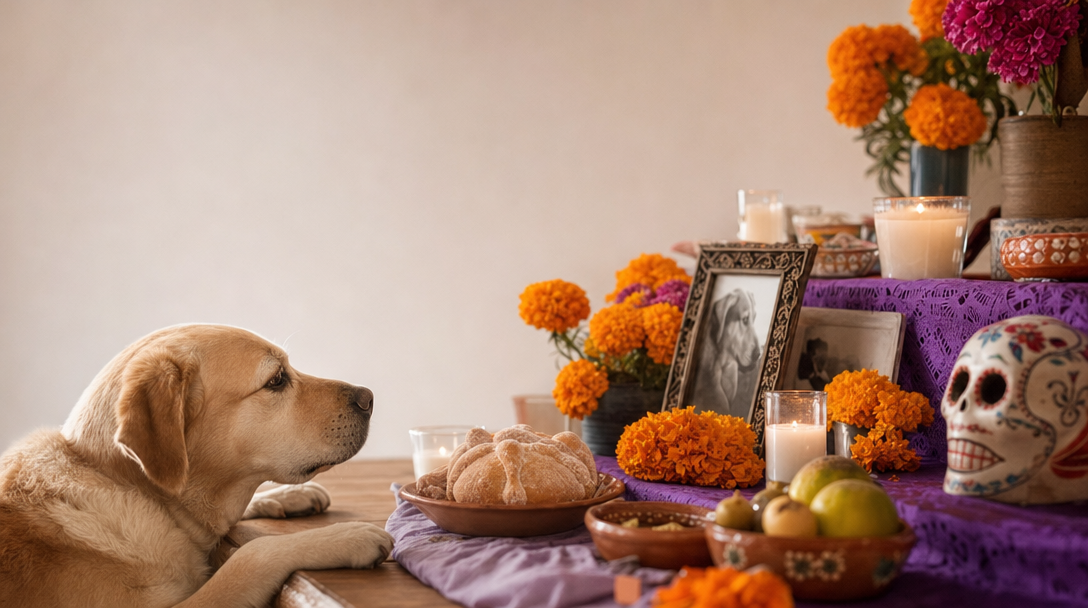
Are Marigolds Toxic to Dogs?
Marigolds are safe for dogs only if you mean Calendula officinalis, the garden marigold the ASPCA lists as non-toxic to dogs and cats. The cempasúchil (Tagetes) marigold on most Día de los Muertos altars is a different plant with no such confirmation, so whether marigolds are toxic to dogs depends on which species is on your altar. If you're trying to honor a dog who died while keeping a living dog safe near the same altar, that uncertainty is worth taking seriously, not brushing off.
That distinction matters more than it sounds. The ASPCA's non-toxic classification applies to Calendula, not to cempasúchil. Public veterinary toxicology data specifically on Tagetes marigolds is limited as of this writing, which is a gap, not a clean bill of health.
The practical answer holds regardless of the botany: keep cempasúchil, and any altar flower you haven't personally verified, away from where a dog can chew it. Animal Emergency & Referral Center of Minnesota's general guidance on holiday altars notes that marigolds are "generally safe" while warning that other common altar flowers, like chrysanthemums and lilies, are highly toxic. Treat the uncertainty around cempasúchil the same way: assume caution until you've checked, not after.
Cempasúchil vs. Calendula: Is the Marigold on Your Altar Actually Safe?
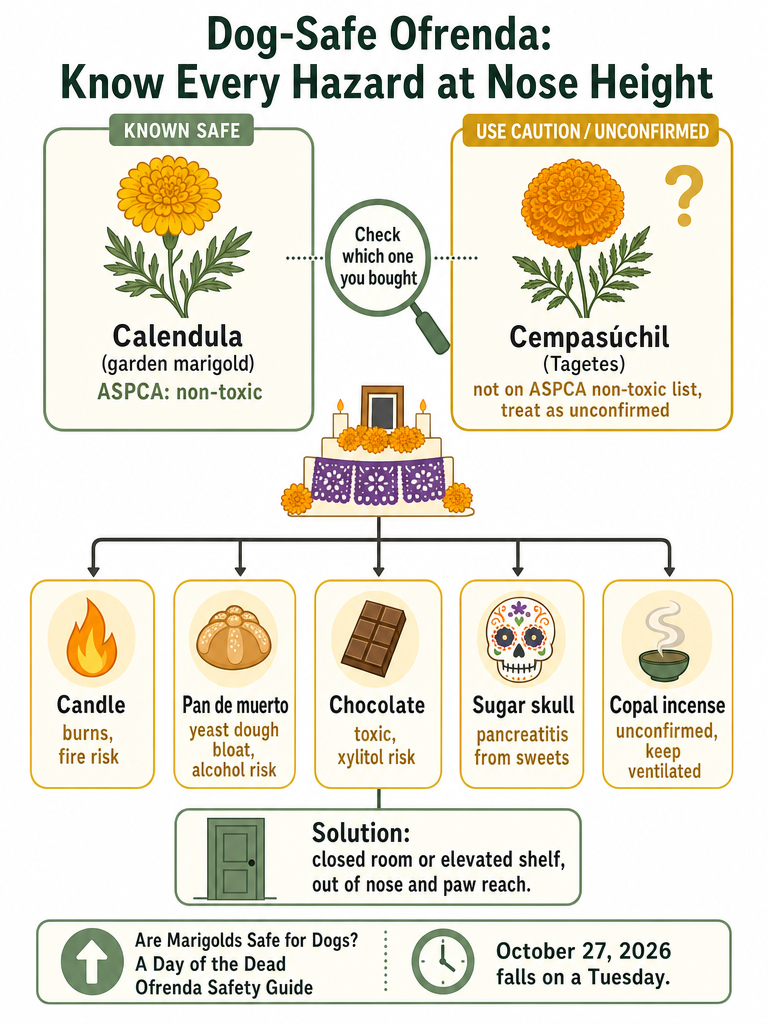
Cempasúchil and Calendula are both called "marigold" in English, but they are different plants with different safety records. Cempasúchil is Tagetes, the tall, deep-orange flower that is the traditional Día de los Muertos marigold. Calendula officinalis is a shorter, often yellow flower sometimes called pot marigold, and it is the plant behind the ASPCA's "Garden Marigold" entry.
The ASPCA's Toxic and Non-Toxic Plant Guide names Calendula officinalis specifically and rates it non-toxic to both dogs and cats. It does not list Tagetes, the cempasúchil species, under that same entry. A report from Ace Flowers Houston makes this gap explicit: cempasúchil is "not on the ASPCA list," and its non-toxic garden marigold entry covers a different plant.
That is not the same as proof that cempasúchil is dangerous. It is an absence of data, which is a different thing than a clean non-toxic rating, and the honest move is to treat it as unverified rather than assume it's covered by Calendula's record.
A second reason to stay cautious either way: Ace Flowers notes that eating any plant material, toxic or not, can cause vomiting and gastrointestinal upset in dogs and cats. A non-toxic rating is not a safety guarantee against stomach upset. Even Calendula petals chewed in quantity can cause a dog to vomit.
Is Pan de Muerto, Chocolate, or Sugar Skulls Bad for Dogs? An Item-by-Item Ofrenda Hazard Guide
The flowers are rarely the biggest risk on a Día de los Muertos altar. Candles, bread dough, chocolate, and sweets create more immediate hazards for dogs than cempasúchil does, according to the Animal Emergency & Referral Center of Minnesota (AERC MN), which published a Day of the Dead pet-safety article on October 30, 2024.
Raw pan de muerto dough is a particular risk most people don't expect. AERC MN explains that yeast dough can expand inside a dog's stomach after it's swallowed, which can cause bloating or a stomach twist, a life-threatening emergency. The yeast also keeps fermenting inside the dog, producing alcohol that can cause alcohol poisoning on top of the physical blockage risk.
| Ofrenda item | Risk to dogs | Why |
|---|---|---|
| Lit candles | Burns, house fire | A tail or paw can knock over an open flame; AERC MN recommends battery-operated flameless candles instead |
| Pan de muerto (raw dough) | Bloat, stomach twist, alcohol poisoning | Yeast expands in the stomach and ferments, producing alcohol, per AERC MN |
| Chocolate (offerings or candy) | Chocolate toxicity | Severity scales with chocolate darkness, amount eaten, and the dog's weight, per AERC MN |
| Calaveras (sugar skulls) | Pancreatitis; possible xylitol poisoning | Any sweet treat can trigger pancreatitis; some sugar-free versions contain the toxic sweetener xylitol, per AERC MN |
| Copal incense | Unconfirmed | Public veterinary toxicology data on copal smoke exposure in dogs is limited as of this writing; no primary source in this review addresses it directly |
Beads, ribbons, and papel picado round out the list as choking and intestinal-blockage risks rather than poisoning risks, which is why AERC MN's core advice is less about any single item and more about where the whole altar sits in the house.
How Do You Build a Dog-Safe Ofrenda? Altar Layout Tips That Actually Work
The single most effective fix for a dog-safe ofrenda is physical separation, not substitution: put the whole altar behind a closed door your dog cannot open, not just out of nose range on a counter. Animal Emergency & Referral Center of Minnesota recommends keeping the altar in a room a dog can't access at all, which removes the need to dog-proof every candle, flower, and sweet one by one. The steps below cover what to do when a fully closed room isn't an option.
- Pick a room with a door, not a tabletop. A closed-off room beats a kitchen counter or hallway shelf, since dogs can jump, climb, or wait out an open door in ways they can't wait out a closed one.
- Swap open flame for battery-operated candles. AERC MN specifically recommends flameless candles so the altar keeps its glow without the burn and fire risk a knocked-over flame creates.
- Put cempasúchil and food offerings above counter height if the room can't be fully closed. Treat both the flowers and the pan de muerto, chocolate, and calaveras as items that need height, not just distance.
- Secure ribbons, beads, and papel picado so they can't be pulled down or chewed. Tack or tape decorative elements rather than letting them hang loose at nose or paw height.
- Check on the altar daily if it stays up through November 2. Ofrendas for the season often go up well before October 27 and stay through the following days, so a daily glance catches anything that's shifted or fallen.
The full rundown on what traditionally goes on a pet-honoring altar, and when to set it up this year, appears in Day of the Dead for Pets 2026.
What Should You Do If Your Dog Eats Something From the Altar?
What you do next depends on what your dog ate, and acting fast matters more than figuring out the exact species of marigold involved. If your dog eats cempasúchil or Calendula petals in a small amount, Ace Flowers' guidance that any plant material can cause vomiting or gastrointestinal upset means mild stomach signs are the likely outcome, not poisoning.
- Note what was eaten and roughly how much. Flower petals, raw dough, chocolate, and candy call for different responses, so this detail matters when you call anyone for advice.
- Call your veterinarian or an animal poison control line immediately for raw dough, chocolate, or anything containing xylitol. These carry the hazards AERC MN flags, bloat, alcohol poisoning, chocolate toxicity, and pancreatitis, and timing affects treatment options.
- Watch at home for a small amount of plant material only, with no chocolate or sweets involved. Mild vomiting that resolves quickly is consistent with the general plant-irritation effect Ace Flowers describes; vomiting that continues, or any lethargy, is not something to watch and wait on.
- Remove the rest of the altar from reach before you do anything else. One incident often means the dog found a gap in the setup, and that gap is still open until you close it.
When in doubt, call. A quick question to a veterinarian or poison control line costs far less than a wrong guess about which kind of marigold, or how much raw dough, your dog actually got into.
Why Are Dogs Part of Día de los Muertos in the First Place?
Dogs sit at the center of Día de los Muertos for two reasons that are centuries apart, and both explain why a dog-safe altar matters this time of year. The newer one is a specific date: October 27 is widely kept as the day for pets within the broader observance. El Informador reported on October 7, 2026, that October 27 is "the day dedicated to the return of deceased pets," crediting the date to records from Mexico's Secretaría de Cultura. This year, October 27 falls on a Tuesday, and animal-welfare groups quoted by El Informador on October 10, 2026, advise having the altar ready before that date, exactly when the safety steps above need to already be in place.
That date is younger than it looks. La Jornada reported on October 27, 2025, that the custom arose around 2019 from an advertising campaign, and El Imparcial described it as recently as 2024 as a date that "has been proposed." The older layer underneath it runs through Mexica belief: Mictlán was the underworld souls traveled through, guided by the god Xólotl, whose associated animal, the xoloitzcuintle, helped souls cross the river of Mictlán. The date on the calendar is new. The idea that a dog walks beside the dead is not, which is part of why so many ofrendas now set a pet's photo next to a person's.
How to Honor a Dog on Your Ofrenda Without Risking the Dogs Still With You
You can give a dog who has died a real place on your ofrenda without putting a living dog at risk, and the two goals don't actually conflict once you separate memory from material. A photo in a frame, a favorite toy set on the altar, or a few spoken words said at the same time each evening all honor a dog fully, and none of them carry the hazards a flower, a candle, or a plate of pan de muerto does.
Put the photo and the toy on the altar itself, inside the closed room or above counter height with everything else. If you want the toy to matter the way it mattered to the dog you lost, that meaning comes from choosing it deliberately, not from where it physically sits in the house. A toy on a high shelf still says who it belonged to.
Grief for a dog deserves the same altar space as any other loss on this holiday, not a smaller or quieter version of it. If your dog's death is recent, the days around October 27 through November 2 can be a legitimate place to put that grief, rather than something to minimize because it's "just a pet." Guidance on All Souls' Day for pets and on blessing of the animals traditions covers ways to extend that remembrance past a single ofrenda.
If you're building an altar this season for a dog who died and you're looking for company in that particular grief, not just ritual ideas, Isaac's book To Lose A Dog sits with the loss of an English Bulldog named Franki across the same territory this holiday touches: memory, guilt, the firsts, and what's left standing after.
Frequently asked questions
What day is Día de los Muertos for pets in 2026?
October 27, 2026, falls on a Tuesday, and it's the day widely observed as the return of deceased pets within the broader Día de los Muertos calendar. El Informador reported on October 7, 2026, that the custom traces to records from Mexico's Secretaría de Cultura, and animal-welfare groups quoted on October 10, 2026, advise having the pet altar ready before that date, not scrambling to assemble it the same day.
Are marigolds toxic to cats as well as dogs?
Calendula officinalis, the garden marigold, is rated non-toxic to both dogs and cats by the ASPCA's Toxic and Non-Toxic Plant Guide. That rating doesn't extend to cempasúchil, the Tagetes marigold used on most Día de los Muertos altars, which the ASPCA's list doesn't cover at all. If you're not sure which marigold is on your altar, treat it as unverified for cats and dogs alike rather than assuming the Calendula rating applies.
What ofrenda flowers are more dangerous than marigolds for dogs?
Chrysanthemums and lilies are highly toxic to dogs, a bigger risk than marigolds according to the Animal Emergency & Referral Center of Minnesota's Day of the Dead pet-safety guidance. AERC MN calls marigolds "generally safe" by comparison, while flagging those two as flowers to keep off any altar a dog can reach. If a loved one's favorite flower isn't marigold, check the ASPCA's plant guide before placing it, or use an artificial version or a photo instead.
Is copal incense safe to burn around dogs?
There's no confirmed answer yet: public veterinary toxicology data on copal smoke exposure in dogs is limited as of this writing, and none of the primary sources on Day of the Dead pet safety address it directly. That gap is a reason for caution, not reassurance. Until a veterinary source weighs in specifically on copal, burn it in a room your dog can't access, the same separation recommended for candles, flowers, and food offerings.
Can a non-toxic flower still make a dog sick?
Yes. Eating any plant material, toxic or not, can cause vomiting and gastrointestinal upset in dogs, according to veterinary guidance cited by Ace Flowers Houston. Even Calendula officinalis, the marigold the ASPCA rates non-toxic, can trigger vomiting if a dog chews through a mouthful of petals. A non-toxic rating means a plant won't poison your dog, not that it won't upset his stomach, so keeping flowers out of reach still matters regardless of species.
How dangerous is chocolate from an ofrenda to a dog?
Chocolate's danger to a dog scales with three things: how dark the chocolate is, how much was eaten, and the dog's weight, per the Animal Emergency & Referral Center of Minnesota. Darker chocolate carries more risk than milk chocolate at the same amount. Because ofrenda offerings often include chocolate alongside calaveras and pan de muerto, treat any chocolate on the altar as something to call a veterinarian or poison control about immediately rather than wait out.