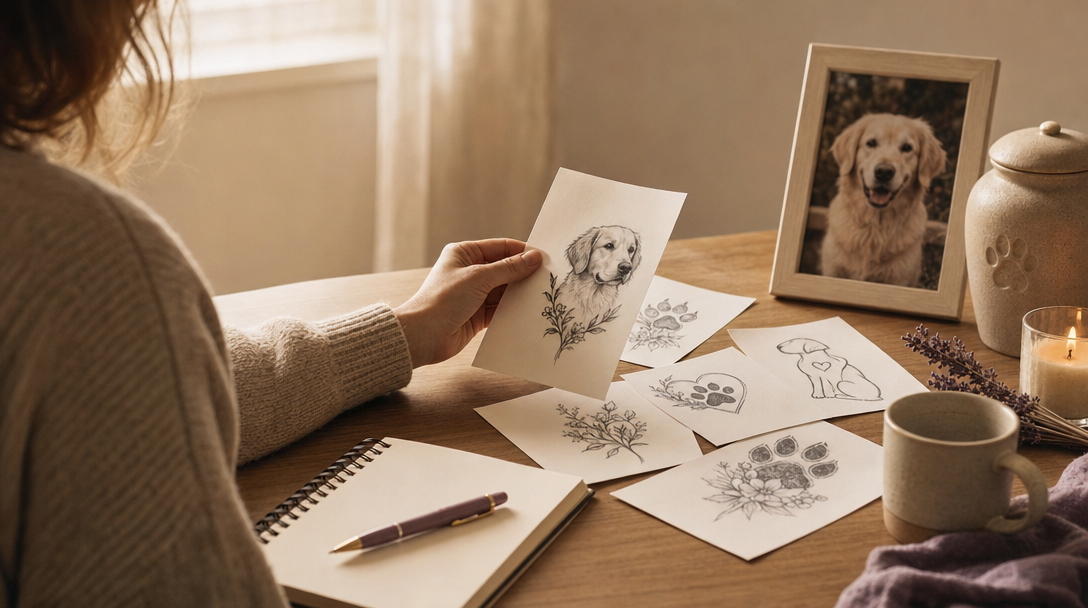
How to choose a tattoo you won’t regret?
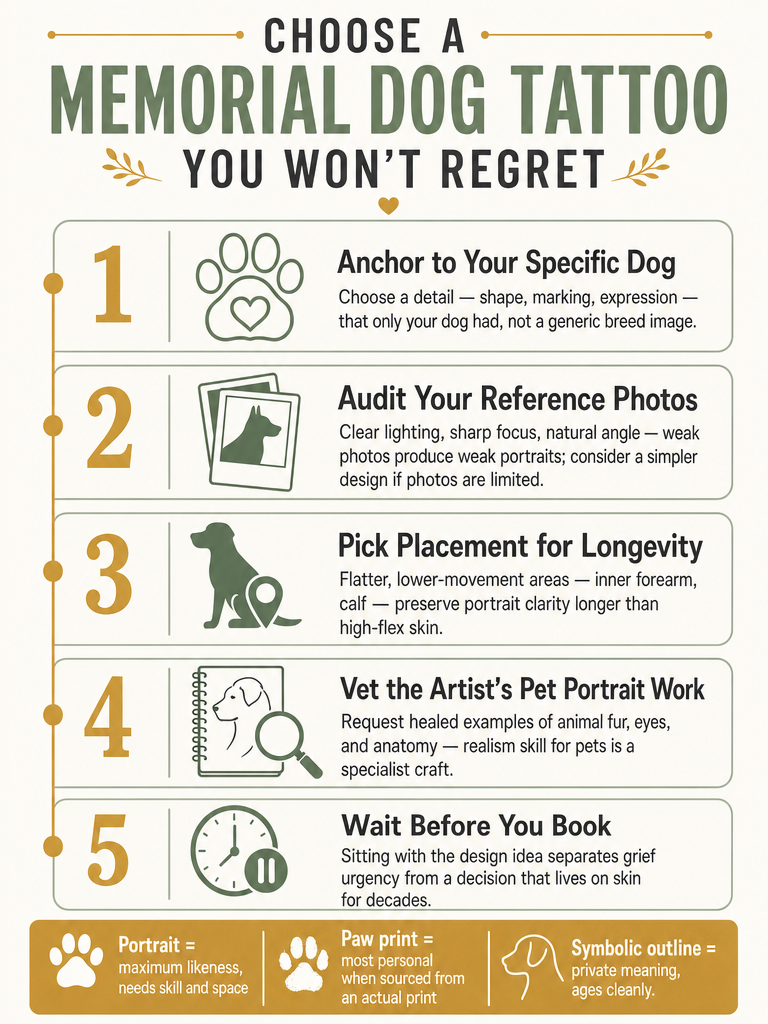
The safest memorial tattoo is one tied to your specific dog, not a trend, and one you've sat with long enough to trust. Regret usually traces back to a rushed decision or a design that could belong to any dog. Adrenaline Studios frames memorial tattoos as one of five concepts people rarely regret, because the meaning outlasts any passing phase.
A tattoo artist's regret-prevention advice, posted on Instagram, comes down to three moves you can apply to a dog memorial directly:
- Avoid overly trendy designs. Trends fade; a piece tied to your dog's actual likeness or paw print won't.
- Choose something meaningful. Memorial pieces, including a loved one's handwriting, are the example the artist gives for tattoos that are hard to regret later.
- Don't rush it. Sit with the idea. If you still love it after a year, there's a much better chance you always will.
Two more things matter for a memorial specifically. Match visibility to what your grief needs: some people want a piece they see every day for comfort, others want something private. And ask how the design will age before you book, because line weight and placement change how readable it stays over years.
The rest of this guide walks each decision, one at a time.
Do people regret getting memorial dog tattoos?
The fear of regret is common, and it's usually pointed at the wrong thing. On Reddit's r/Petloss, owners ask whether a memorial tattoo will keep making them sad every time they see it. On a pet loss Facebook group, first-timers ask whether a paw print tattoo is worth doing at all. The worry is real. But the sources that address regret directly locate the risk in execution, not in the memorial idea itself.
Adrenaline Studios puts it plainly: future remorse is only likely "if you choose the wrong design and tattooist." The regret drivers are rushing the decision, chasing a trend, working from weak reference material, or picking an artist who can't do the work. None of those is the memorial itself.
A memorial tattoo rarely becomes the regret; a rushed design or the wrong artist does.
The firsthand accounts point the other way. Pant the Town's writer, after losing her dog Kota in August 2022, describes her forearm portrait as cathartic, saying it triggers happy memories rather than fresh pain. The Lemon8 writer describes her fine-line ear outline as a way to keep her dog close, not a wound she reopens daily.
That said, honest limit: the corpus doesn't include reliable independent data on how often people regret pet memorial tattoos. What the sources do agree on is where regret comes from, which is exactly what the rest of this guide helps you avoid.
What should you get for a memorial tattoo?
Dog memorial tattoo ideas work best when they preserve something specific about your dog rather than a generic pet symbol. The sources circle the same handful of options: a realistic portrait, an actual paw print, the dog's name, a meaningful quote, handwriting, a simple outline, ears, or a silhouette. The right one depends on whether you want a literal likeness or a quieter tribute only you fully read.
A dog memorial tattoo is a permanent tattoo that preserves a specific dog who has died, using that dog's real likeness, print, name, or a detail that felt like them.
Here's how the supported options compare:
| Design | What it preserves | Best when |
|---|---|---|
| Realistic portrait | Your dog's actual face and expression | You have strong reference photos and want a literal likeness |
| Actual paw print | A physical trace of your dog | You have a vet card, clay, or ink print of the real paw |
| Name or dates | The identity and timeline | You want something clean and unmistakable |
| Quote or phrase | The feeling of the loss | A line already repeats in your head, like "forever in my heart" |
| Handwriting | A person's or moment's texture | You have handwriting worth keeping (an artist's example of a hard-to-regret piece) |
| Simple outline / ears / silhouette | One recognizable detail | You want minimal and private, like the Lemon8 writer's ear outline |
Two notes from the sources. Pant the Town's writer chose a realism portrait and plans to add Kota's paw print later, so these aren't either-or. And a paw print gets far more personal when it uses your dog's actual print, which the writer's in-home euthanasia vet offered as both ink and clay when Kota's ashes came back.
Realistic portrait vs paw print vs symbolic detail: which fits your grief?
Choose between a literal likeness and a private symbol based on what you actually need to feel when you look down at your arm. A realistic portrait preserves your dog's true appearance in fine detail, according to Trees For Pets, but it usually demands a skilled artist, more time, and a larger space. A symbolic detail asks nothing of strangers and everything of you.
The Lemon8 writer's story is the cleanest example of the symbolic route. She'd planned a "pretty, aesthetic" first tattoo she could explain in one sentence. After her dog died, she went back through her camera roll and landed on the detail she loved most: his ears, one of which "always did its own thing." She got a fine-line ear outline. "It wasn't about everyone else understanding it," she writes. "It was about me looking down and feeling like he was still here."
Pant the Town took the literal route, wanting Kota "looking right into my soul" from her forearm.
| Option | Recognizable to strangers? | Space needed | Sourced caution |
|---|---|---|---|
| Realistic portrait | Yes | Larger area | Needs a skilled artist and strong photos |
| Actual paw print | Somewhat | Small | Best with your dog's real print |
| Symbolic detail (ears, silhouette) | Only to you | Small, fine-line | Discuss line weight so it ages well |
Neither is more valid. The portrait says this was my dog; the symbol says this was ours.
Do you have strong enough reference photos for a portrait tattoo?
Reference photo quality matters more than most people expect, and it decides whether a portrait is even a wise choice. Tattoo Shop TX says clear lighting, sharp focus, and natural angles are what let an artist capture true proportions and expression. Weak photos force the artist to guess, and small guesses about eye placement or shading can change your dog's whole expression.
Run your camera roll through this before you commit:
- Sharp focus and clear lighting. Blurry or dim shots hide the details that make the face read as your dog.
- Natural angles. A straight-on or gentle angle preserves true proportions; extreme angles distort them.
- Multiple photos. More than one image lets an artist combine features into a single cohesive design, per Tattoo Shop TX.
- Real expression. Pick the look that felt like your dog, not just the most flattering pose.
Pant the Town's writer did exactly this, reviewing photos taken across 11 plus years of life with Kota before choosing one image where the dog looked straight at the camera. She cried through the process and felt every feeling, then picked the frame that met her eyes.
Where should you get your tattoo on your body?
Placement affects both emotional comfort now and readability later, and those two goals sometimes pull in different directions. Tattoo Shop TX says portraits placed on flatter, lower-movement areas tend to hold their clarity longer. Grief-centered accounts point the other way, toward spots you can see without effort. An AEO snippet lists the five most-referenced placements from owner threads: wrist, inner forearm, ankle, ribcage, and calf.
The forearm sits at the intersection of both goals, which is why it shows up so often. Pant the Town's writer describes moving her placement so she wouldn't have to turn her head to see the dog: she wanted the tattoo visible all the time, because the point was comfort during grief.
| Placement | Daily visibility | Clarity over time | Fits when |
|---|---|---|---|
| Wrist | High | Moderate | You want comfort within eyeshot |
| Inner forearm | High | Good | You want both visibility and a flat surface |
| Ankle | Moderate | Moderate | You prefer something you can cover |
| Ribcage | Low | Good | You want it private and mostly hidden |
| Calf | Moderate | Good | You want space for detail |
Ask yourself the real question here: do you want to see this dog every day, or keep the tribute private? Both are right. Just don't let a hidden placement undercut a tattoo you got specifically for daily comfort, and don't put a fine detail on a high-movement joint if long-term sharpness matters to you.
How to choose a tattoo artist?
Not every skilled tattoo artist can do a portrait, and choosing the wrong one is where regret actually starts. Tattoo Shop TX is direct about this: slight inaccuracies in symmetry, eye placement, or shading can change your dog's expression entirely. An experienced pet portrait artist understands anatomy, lighting, and how ink settles into skin over years, none of which a generalist necessarily has.
Vet a memorial artist against this checklist:
- Portfolio fit. Look for pet portraits or fine-line work in their actual gallery, not just clean lettering.
- Healed examples, not just fresh. Fresh ink always looks crisp; ask to see photos of the same piece months later.
- Line weight and aging. For fine-line work, the Lemon8 writer says her artist helped narrow the design into something "clean and readable" and talked through how it would age. That conversation matters more than people admit.
- Expression protection. Ask directly how they'll preserve your dog's specific look from your references.
Pant the Town's writer treated this seriously. She began searching for an artist before her dog died, because she already knew she wanted a portrait and needed someone strong in intricate detail. She chose Cesar Perez, a professional tattoo artist since 2009, and drove 2 hours each way to reach him.
The willingness to travel for the right realism specialist is a feature of a tattoo you won't regret, not an inconvenience.
If the best portrait artist isn't local, that's normal. A memorial you'll wear for life is worth a drive.
What makes a dog memorial tattoo different from a regular dog tattoo?
A memorial tattoo carries grief, so the stakes are different from an ordinary dog tattoo. A regular dog tattoo can be stylized, generic, or fun. A memorial has one job: to preserve one specific dog who is gone, in a way you can live with on hard days. Adrenaline Studios groups memorial tattoos with its emotional-healing category precisely because the piece is a vessel for grief, not decoration.
That changes three things. Permanence stops being a design concern and becomes an emotional one, since this is the version of your dog you'll carry forever. Daily visibility matters more, because the tattoo is often chosen to comfort you in the exact moments the loss hits. And specificity is the whole point: a cartoon bulldog is a dog tattoo, but your dog's actual ears, print, or face is a memorial.
The Lemon8 writer names this shift exactly. She'd planned an aesthetic first tattoo, "but grief doesn't really care about plans." What she needed wasn't inspo. It was "a tiny, permanent promise that nothing loved is ever lost." That's the line between the two.
When a tattoo is one part of remembering your dog
A tattoo doesn't have to carry the entire weight of remembering. Funeral.com describes the best memorials as giving grief "a safe place to set the collar, the tag, the photo, the ashes, or the feelings." A tattoo is one such place, not the only one, and it works better as part of a larger set of ways you keep your dog close.
Pant the Town's writer models this. Alongside her forearm portrait, she built a memorial shrine at the top of her stairwell with photos, cards, painted stones, and Kota's ashes in a lotus urn. The tattoo didn't replace those things. It joined them.
If you're deciding how the tattoo fits your whole memorial, these guides go deeper on the surrounding choices:
- dog memorial ideas that honor your pet, for the full range beyond ink.
- how to choose between a dog urn and cremation jewelry, if you want something you can carry.
- surviving the "firsts" after losing a dog, for the days a tattoo can't fix.
- beautiful ways to honor your dog's life, for rituals and living tributes.
Letting several small tributes share the load takes pressure off any single one, including the tattoo. Grief needs more than one place to rest.
A final pre-booking checklist for a dog memorial tattoo
Before you book, run one honest pass through these questions. If every answer is steady, you're likely choosing a tattoo you won't regret. If several wobble, the sources agree the fix is to wait, revise, or gather more, not to push ahead.
- Is this design specific to my dog, or would it fit any dog? Specificity is what makes it a memorial.
- Have I sat with the idea long enough? The Instagram artist's rule: if you still love it after a year, you probably always will.
- Do I have strong reference photos, or should I choose a paw print or symbol instead?
- Is my artist actually skilled at portraits or fine-line work, with healed examples to show?
- Does my placement match my goal, daily comfort or privacy, without undercutting either?
- Have I discussed line weight and aging so the piece stays readable?
A few honest gaps to plan around: the sources here don't cover pricing, pain, healing timelines, or ash-in-ink safety, so ask your artist and, for medical questions, a professional before booking.
If you're not ready yet, that's not failure. Sometimes the decision needs to wait until the shock eases. While you sit with it, To Lose A Dog offers companionship and plain language for grief that others keep dismissing, so you're not choosing a permanent tribute in the middle of the loudest week. The tattoo can come when it feels meaningful, not impulsive.
Frequently asked questions
Do people regret getting memorial dog tattoos?
Regret is rare when the decision is made carefully — Adrenaline Studios puts it plainly: future remorse is only likely "if you choose the wrong design and tattooist." The risk lives in rushing, chasing trends, or working with weak reference photos, not in the memorial idea itself. Firsthand accounts back this up: one owner describes her forearm portrait of her dog Kota as cathartic, saying it triggers happy memories rather than reopening pain.
What are the best dog memorial tattoo ideas that won't feel generic?
The designs least likely to feel generic are ones tied to your specific dog: an actual paw print (ideally from a vet card or clay impression), a realistic portrait built from sharp reference photos, or a small detail only you'd recognize — like the outline of your dog's ears. One owner chose a fine-line ear outline because one ear "always did its own thing," making it instantly personal. A name, date, or quote works best when a particular phrase already repeats in your head unprompted.
Realistic portrait vs. paw print tattoo — which is better for a dog memorial?
Neither is better; they preserve different things. A realistic portrait captures your dog's face and expression but demands strong reference photos and a skilled portrait artist — slight inaccuracies in eye placement or shading can change the whole look. A paw print works best when it uses your dog's actual print, not a stock shape. One owner plans to add Kota's paw print to an existing forearm portrait, so these aren't an either-or choice.
How do I choose a tattoo artist for a pet portrait?
Look specifically for artists with pet portraits or fine-line work in their portfolio — not just clean lettering. Ask to see healed examples, not just fresh ink, because fine lines thin and shift over time. One owner drove 2 hours each way to reach Cesar Perez, a professional tattoo artist since 2009, because she needed someone strong in intricate realism detail. The willingness to travel for the right specialist is a feature of a tattoo you won't regret.
Where on your body should you get a dog memorial tattoo?
Placement depends on whether you want daily comfort or privacy. The inner forearm appears most often in owner accounts because it sits on a flatter, lower-movement surface — good for long-term clarity — and stays visible without effort. One owner specifically repositioned her tattoo so she wouldn't have to turn her head to see her dog. The wrist, ankle, ribcage, and calf are common alternatives, each trading some visibility for discretion or detail space.
When is the right time to get a memorial tattoo after a dog dies?
The clearest guidance from tattoo artists: sit with the idea for at least a year. If you still love the specific design after that time, there's a much better chance you always will. A memorial tattoo chosen in the loudest weeks of grief can still be right — but rushing is the single most cited driver of regret. If you can't write down in one plain sentence what you want the tattoo to preserve about your dog, that's a signal to wait.
Sources
- Has anyone gotten a memorial tattoo of their pet? : r/Petlosswww.facebook.com
- Do people regret getting memorial dog tattoos?pantthetown.com
- Memorialize Your Dog With The Perfect Tattoowww.instagram.com
- Dog Memorial Tattoo Ideas: Paw Prints, Ear Outlines & Simple Tributesadrenalinestudios.com
- 5 Tattoos You Won't Regret - Adrenaline Studiostattooshoptx.com
- Dog Memorial Tattoos: Honoring Loyalty, Love & Life in Inktreesforpets.com.au