
Can You Fly With Your Dog's Ashes? The Short Answer
Deciding to bring your dog's ashes with you on a flight, rather than leaving them behind or shipping them separately, is already a small act of care in a week that likely doesn't have many easy decisions left in it.
Flying with dog ashes means carrying your dog's cremated remains through airport security and onto a commercial flight, either as carry-on or checked luggage. Yes, this is allowed. The Transportation Security Administration permits cremated remains in both carry-on and checked bags, but the container has to pass security screening, and your airline's own rules can be tighter than TSA's baseline. The real obstacle isn't whether ashes are permitted; it's whether the urn or box you packed can be screened without an officer needing to open it.
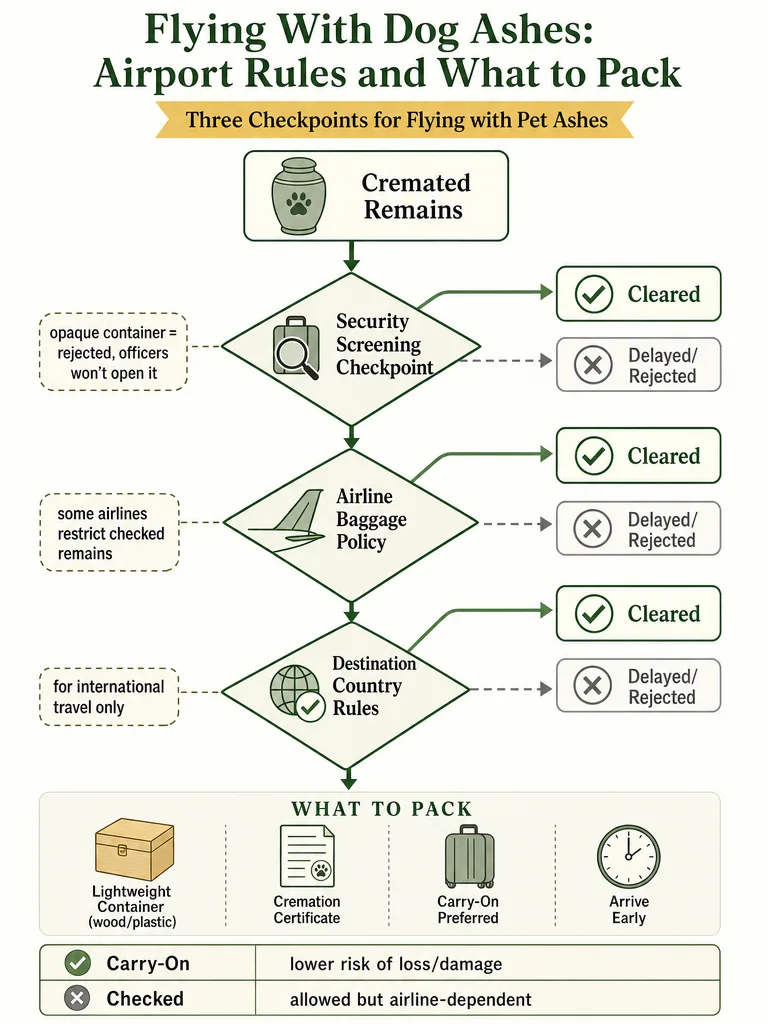
That distinction matters more than most guides admit. TSA sets the floor. Your airline sets the ceiling. And if you're flying internationally, the destination country adds a third layer you have to clear before you ever reach the gate. Get the container and the paperwork right, and the rest of the trip is manageable, even on a day that already feels impossibly hard.
What Does TSA Actually Require When You Fly With Cremated Remains?
TSA lists cremated remains as permitted in both carry-on and checked baggage, according to its official guidance page, though the agency notes some airlines restrict checked transport even when TSA does not. The screening itself is where families run into trouble, not the rule allowing the ashes in the first place.
At the checkpoint, the container goes through an X-ray machine like any other item. TSA is explicit that if the container produces an opaque image, the officer cannot determine what's inside, and the container will not be allowed through security. Just as important: TSA states that out of respect for the deceased, officers will not open a cremated-remains container, even if you ask them to.
That single rule reshapes the entire packing decision. There is no override, no manager you can request, no way to argue your way past a container the X-ray can't read. TSA's own guidance suggests using a temporary or permanent container made from a lighter-weight material such as wood or plastic specifically to make screening easier.
TSA's cremated-remains page was last substantively updated in 2018, so treat it as the baseline and confirm current airline-specific policy separately before you travel.
Carry-On or Checked Bag: Which Is Safer for Cremated Remains?
Carry-on is the safer choice for most travelers, even though TSA technically allows both. Funeral.com notes that TSA permits cremated remains in checked bags but reminds travelers that airlines may restrict checked transport, and the final call at the checkpoint always belongs to the TSA officer. In practice, families overwhelmingly choose to keep the container with them.
The reasoning is straightforward. Checked bags get handled by more people, sit in cargo holds, and occasionally get lost, delayed, or damaged, none of which you want happening to your dog's ashes. Occasional Sage frames the decision as three separate checks travelers need to run: whether the container clears TSA screening, what the operating airline allows, and, for international trips, what the destination requires.
Carrying the ashes on your person, rather than checking them, removes an entire category of risk that has nothing to do with airport security and everything to do with baggage handling. Carry-on solves that problem by keeping the container visible and under your control the entire trip.
The tradeoff is that carry-on space is limited, so a compact, screenable container matters even more if you're keeping it with you.
Which Airlines Allow Dog Ashes in the Cabin, and Which Don't?
Airline policy on cremated remains varies enough that TSA's baseline answer isn't the final word. JetBlue and Southwest Airlines accept dog ashes only as carry-on and refuse them as checked baggage, while Delta Air Lines allows either format once the container clears screening. Confirming your specific carrier's current rule before you book prevents a problem you can't fix at the counter.
Occasional Sage's airline comparison, checked on July 28, 2026, lays out current policy for five major carriers. Velora Peace adds useful detail specifically on Southwest Airlines' recommendation to use the crematorium's temporary container rather than a decorative urn.
| Airline | Cabin Allowed | Checked Allowed | Documents Named |
|---|---|---|---|
| American Airlines | Yes, treated as the carry-on bag | Unconfirmed; sources disagree on whether checked transport is permitted | None for domestic travel |
| Delta Air Lines | Yes | Yes, if remains pass screening | Death certificate or cremation certificate |
| JetBlue | Yes, must fit under the seat | No, carry-on only | Certified death certificate plus a letter from the funeral director or crematorium |
| Southwest Airlines | Yes, carry-on only | No, not accepted as checked baggage | Recommends the temporary plastic or cardboard container from the crematorium |
| WestJet | Yes, up to 350 ml | Over 350 ml goes in checked baggage | Volume-based rule under Canadian screening guidance |
American Airlines' checked-baggage policy for cremated remains is the one row worth double-checking yourself. Available guides disagree on whether it permits or forbids checked transport, so call the airline directly before you decide how to pack, rather than assuming either answer holds.
That WestJet volume threshold, reported by the Winnipeg Free Press, is a good example of why the TSA answer isn't the whole answer: a rule like that has nothing to do with U.S. federal screening and everything to do with the specific carrier and country you're flying through.
Southwest's guidance is a useful pattern to notice. It doesn't just state a policy; it recommends the plain temporary container your crematorium likely already gave you, because that's what tends to scan clean.
What Kind of Urn Can You Fly With Dog Ashes In?
Wood, plastic, and the simple temporary box most crematoriums provide are the containers most likely to clear airport screening. Metal, thick stone, and dense ceramic are the ones that tend to cause problems, because they can produce an X-ray image too solid or opaque for an officer to clear.
Occasional Sage's guidance is direct on this: TSA suggests a lighter material such as wood or plastic, and does not promise that any specific brand or material labeled "TSA-approved" will actually pass. There is no certification that guarantees screening success. The screening result on the day you travel is what matters, not a label on the box.
Checkin-Carryon.com makes the same point from the traveler's side: metal, thick stone, and dense ceramic can block X-ray visibility, and a container can be perfectly respectful and still a poor fit for the checkpoint if it reads as a solid mass on the scan.
The workaround most families use, described in Funeral.com's guidance, is a two-container plan: a simple, temporary container for the actual travel day, and the permanent, decorative urn kept at home or shipped separately, empty, to be filled again once you land. If your dog's remains are already sitting in a decorative urn, consider transferring them into the crematorium's original temporary box just for the flight.
What Documents Should You Carry for Your Dog's Ashes?
TSA does not formally require paperwork to fly with cremated remains, but carrying a few key documents can prevent delays at the counter or checkpoint. Checkin-Carryon.com recommends keeping a small, easily reachable set: a cremation certificate from the crematory or funeral home, a receipt or letter naming the remains and container details, and your itinerary with the name on your ticket.
Airline staff need that paperwork to match the traveler standing in front of them, and a name mismatch is one of the more common, quiet causes of delay. If the paperwork lists a different family member's name than the one flying, bring a short note explaining your relationship or role in the transport.
Some airlines go further than TSA and name specific documents outright. Delta Air Lines names a death certificate or cremation certificate, and JetBlue names both a certified death certificate and an original or certified letter from the funeral director or crematorium, per Occasional Sage's airline comparison. Check your specific carrier's page before you pack, since these requirements aren't universal and TSA won't ask for them even if your airline does.
Flying Internationally: What Else You Need to Check Before You Board
International travel adds a layer TSA screening doesn't cover: what the destination country, and any country where you change planes, actually permits. Occasional Sage frames this as the third of three checks every traveler needs to run, alongside container screenability and airline policy.
New Zealand's Civil Aviation Authority states that cremated human and pet remains can be brought on a plane, but for international flights, pet remains specifically have to travel in checked luggage rather than the cabin, a stricter rule than TSA's general carry-on allowance. Canada shows a different version of the same complication: the Winnipeg Free Press reports that WestJet accepts up to 350 ml of cremated remains as carry-on, with anything larger routed to checked baggage.
Public detail on requirements for most other destination countries is limited as of this writing. The sources available cover New Zealand and Canada in specifics, but general guidance from Petdeparted.com is the safest fallback for anywhere else: check with the embassy or consulate of your destination country, since some nations have different rules for transporting animal remains, and confirm the same for any transit country if you're connecting through one. Do this well before travel, since document and customs requirements for animal remains can differ sharply from those for personal belongings.
A Packing Checklist for Flight Day
A dog-ashes packing checklist for flight day comes down to three things: a container that will actually clear X-ray screening, paperwork that matches your ticket, and enough buffer time that a short security pause doesn't feel like a crisis. TSA cannot open a container that fails screening, so confirming these details the night before, not at the counter, is what actually prevents a problem.
- Confirm the container the night before. Use the temporary wood, plastic, or crematorium-issued box rather than a decorative metal, stone, or ceramic urn, since lighter materials are far more likely to clear the X-ray.
- Gather your documents in one folder. Include the cremation certificate, the crematory's receipt or letter naming the remains, and your itinerary, so nothing needs to be found under pressure at the counter.
- Check your specific airline's cremated-remains policy again, not just TSA's, since carriers like JetBlue and Southwest restrict cremains to carry-on only and some name documents TSA doesn't.
- Pack the container in your personal bag, not checked luggage, so it stays with you and avoids the risk of loss or damage in cargo handling.
- Build in extra time at security. A short pause while an officer reviews the X-ray image is normal; rushing only adds stress to a moment that's already hard.
- Know your backup plan. If the container can't clear screening, ask your airline agent about options before you're at the front of the line, not after.
What to Do With Your Dog's Ashes After You Land
What to do with your dog's ashes after you land becomes the real decision once the flight itself is behind you: keep the permanent urn, scatter the remains somewhere meaningful, or divide them between an urn and a piece of memorial jewelry. Airport security and airline rules solve the logistics of the trip; deciding where your dog's ashes belong long-term is still yours to make, on your own schedule.
Some people are traveling specifically to scatter ashes somewhere meaningful, a choice that comes with its own legal and practical questions depending on whether you're on private land, public parkland, or water; a fuller breakdown of what's legal and what feels right when scattering dog ashes can help you sort that out before you pick a spot. Others are simply relocating the permanent urn, or planning to divide the ashes between a home urn and a piece of memorial jewelry to carry with them going forward, a decision covered in more depth in this guide to choosing between dog ashes jewelry and an urn.
There's no deadline for deciding. If the trip itself took everything you had, it's fine to put the ashes somewhere safe and revisit the bigger decision once the travel stress has passed. If you're not ready to decide anything else yet, that's fine too. Books like To Lose A Dog, which follows one owner's 1,820 days with his English Bulldog Franki, exist for exactly that space between finishing the trip and feeling ready for what comes next.
Frequently asked questions
Can you fly with your dog's ashes on a plane?
Yes, the Transportation Security Administration permits cremated remains in both carry-on and checked baggage. The container has to pass X-ray screening without an officer needing to open it, and individual airlines can set tighter rules than TSA's baseline. International flights add a third layer: rules from the destination country and any transit country you pass through.
Will airport security open my dog's urn to check what's inside?
No. TSA states that out of respect for the deceased, officers will not open a cremated-remains container, even if you ask them to. If the X-ray image comes back opaque and the officer can't see what's inside, the container simply won't be allowed through the checkpoint. There's no manager to appeal to and no exception process.
Is it safer to carry my dog's ashes on the plane or check them as luggage?
Carry-on is the safer choice for most travelers. Checked bags pass through more hands, sit in cargo holds, and can occasionally get lost or damaged, which is why families overwhelmingly choose to keep the container with them rather than check it. TSA technically allows cremated remains in both, but keeping the urn visible and under your control removes an entire category of risk.
Which airlines allow dog ashes in the cabin, and do any restrict it to carry-on only?
JetBlue and Southwest Airlines accept cremated remains only as carry-on and refuse them as checked baggage, while Delta Air Lines allows either format once the container clears security screening. American Airlines treats the urn as your carry-on bag, but sources disagree on its checked-baggage policy, so call the airline directly before deciding how to pack.
What type of urn or container works best for flying with pet ashes?
Wood, plastic, or the plain temporary box most crematoriums provide are the containers most likely to clear airport screening. Metal, thick stone, and dense ceramic tend to cause problems because they can produce an X-ray image too solid for an officer to read. No label or brand guarantees a container will pass; the screening result on travel day is what actually decides it.
Do I need to bring any documents when flying with my dog's ashes?
TSA doesn't formally require paperwork, but carrying a cremation certificate, a receipt or letter from the crematory naming the remains and container, and an itinerary matching your ticket name helps prevent delays. Some airlines go further: Delta names a death certificate or cremation certificate, and JetBlue requires a certified death certificate plus a letter from the funeral director or crematorium.