
Should I read a dog-loss memoir when the ending feels too close?
Dreading the ending of a dog-loss memoir is a reasonable response to real bereavement, and reading one can still be right if you want company in someone else's story. Nothing requires you to finish it or begin today. Four checks help: a story or not, what's inside, whether you can pause, who else is with you.
The University of California, Davis veterinary school describes grief as a personal response to loss: the hurt is there because the relationship with your pet mattered. It also says the grieving process has no time limits. Your dog may be gone, or may still be here and failing. Either way, you decide how close to the ending you stand when reading a dog-loss memoir.
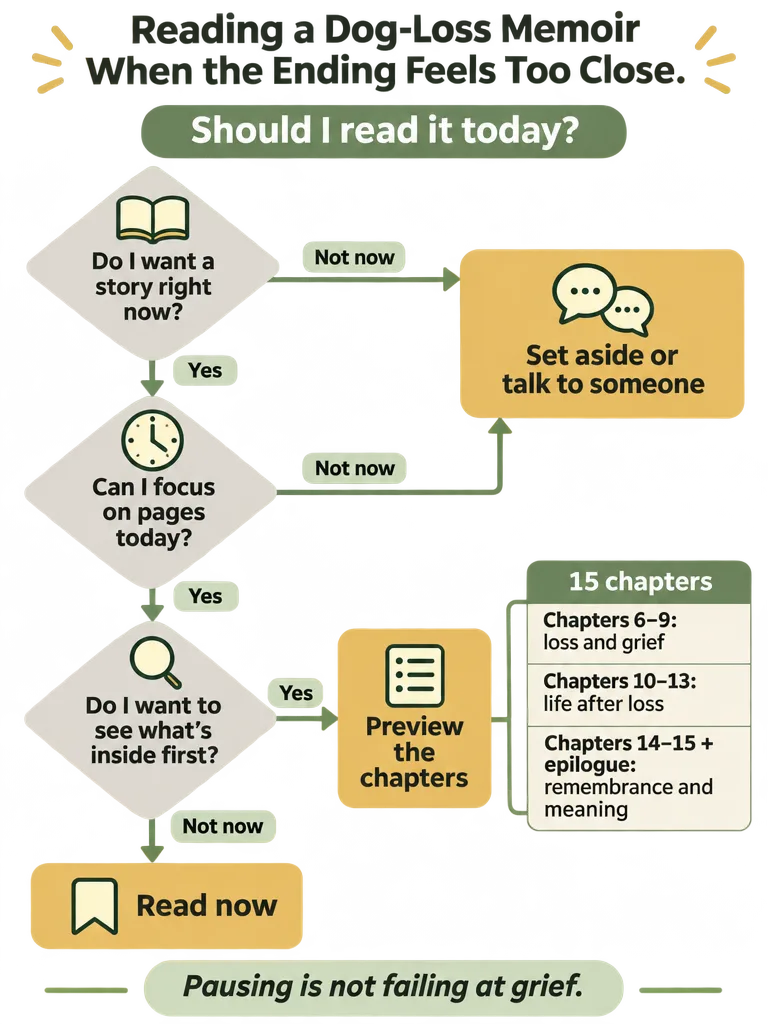
Do I want another person's story right now, or someone to talk to?
Story companionship fits when you want someone else's account of a loss like yours. Practical guidance fits when you need steps for decisions or the first days. A person fits when you want to be heard by someone who understands pet loss. The worksheet below is original and nonclinical. It is not research-backed and it is not a readiness test, and the sources reviewed here include no validated readiness test for grief reading.
| Question | If yes | If no |
|---|---|---|
| Do I want company in someone else's story? | Read now, or preview the contents first | Set the book aside |
| Do I want practical steps more than a story? | Look for a guide, or talk to someone | A memoir may fit |
| Do I want quiet today? | Set it aside; it will still exist later | Continue to the next row |
| Can I follow pages today? | A continuous memoir is possible | Try brief vignettes, a journal, or a few pages |
Your answers point to one of four moves: read now, preview, set aside, or talk to someone. None is a failure.
If a continuous story feels like too much, the format can change. Griffin's Heart by Reagan Pasternak is a 242-page example that combines memoir with guided journaling, with journal prompts at the end of each chapter. A guide to pet loss books for dog lovers who hate self-help tone sorts dog bereavement books by tone, grief stage, and reading stamina. For the first days after a death, there is also a list of pet loss books for someone who just lost a dog.
Is a dog-loss memoir right for me if I feel guilty, and how can I check what it covers?
Check the book's own description and contents outline first, since publishers often disclose structure and difficult themes up front. A description can itself be hard to read, so stop whenever you need to. The comparison below is about structure only and does not claim that either format is safer.
| Book | Structure as described | What the description discloses |
|---|---|---|
| To Lose A Dog | 15 chapters in four parts: The Love (prologue and Chapters 1 through 5), loss and grief (Chapters 6 through 9), The Healing (Chapters 10 through 13), and The Survival (Chapters 14 and 15 plus an epilogue) | Guilt, distance, and whether the death was preventable, per the publisher page |
| Love Letter to My Dog by Christine Lamoureux | 119-page softcover published in 2025; Best Friends Animal Society describes it as a nonchronological memoir told in brief, interrelated vignettes | Structure only is documented in the material reviewed here |
| Charlie's Last Walk by Paige Cummings | 75 pages in four parts: the last walk, the medical reality, the grief, and the return to love | An account of the 24 hours before euthanasia, and seventeen months of illness |
| Saying Goodbye To Benson by Chris and Deb Paslay | 184 pages, with over fifty photographs | Euthanasia after Benson lost mobility, and guilt over that decision; the authors had him for fourteen years |
The publisher page for the first book also says up front that the dog at the center of the story, Franki, dies, so the ending is not something you have to brace for blind.
If guilt is what you carry, look for it by name in descriptions. The publisher page above lists guilt, distance, and preventability as themes. The Amazon description of Charlie's Last Walk lists struggling with guilt or second-guessing a euthanasia decision among reasons to read it. K9Hearts answers yes when asked whether its book suits a reader who feels guilty. These are descriptions of contents, not evidence that reading eases guilt. Whether another person's guilt on the page feels like company is your call.
What no source here verifies: the full manuscript of the first book, where exactly its death material sits, or the graphic-content boundaries of any of these books.
Is it okay to put a grief memoir down halfway?
Yes. Putting a grief memoir down halfway is not failing at grief. The UC Davis guidance says the grieving process is individualized and has no time limits, and that self-care matters more than ever. It also warns against letting guilt or shame convince you that you don't deserve to be taken care of during this period.
If concentrating is difficult today, pace the book:
- Read a few pages, then stop.
- Check the contents outline, if the book publishes one, to see where later chapters begin. The outline discussed above places life after loss in Chapters 10 through 13. An outline shows structure only, not what any single page contains, so use it as a map and not a guarantee.
- Return in a week or a month, or not at all.
A guide to choosing a pet loss book when you cannot concentrate compares reflections, memoirs, and journals.
Can I read a dog-loss memoir while my dog is still alive and sick?
Anticipatory grief is grief that begins before a death, and UC Davis notes that a terminal diagnosis can bring it. Secondary losses count too: not being able to walk your dog the way you used to, or changes to your daily routine. A memoir can speak to that stage, but its ending can also feel like a preview of your own.
You may choose to read only about the life before the loss, or wait until the hardest decisions have passed. No source reviewed here shows that reading helps or harms during illness, so the timing is yours to set.
Some authors write directly about this stage. On a page titled Why Losing a Heart Dog Is So Hard, Paige Cummings says her dog Charlie was sick for seventeen months and that much of the story is about grieving while your dog is still here. That is the author's description, not independent evidence. For readers whose dog's cancer ended in loss, a piece on Pet Cancer Awareness Month and loss describes how that season can feel like a wound reopened.
When is a book not enough, and who can I talk to instead?
A book is not enough when you want to be heard, when guilt or isolation stays heavy, or when grief shows up in your body or daily life. A book can't answer back or notice how you're doing. UC Davis points to trusted people, pet-loss support groups, and mental health professionals or grief counselors. The options below match different needs. They are not stages you must pass through.
- Trusted people who won't minimize the loss. UC Davis says pet loss is sometimes disenfranchised, meaning others may not grasp the depth of your relationship. It advises choosing who you share with.
- A pet-loss support group. UC Davis suggests joining one. Best Friends Animal Society lists a Michigan State University Veterinary Medical Center group that meets by phone or computer.
- A mental health professional or grief counselor. UC Davis says some types of grief need one and advises you not to hesitate to reach out. It also suggests following up with your doctor about physical symptoms of grief.
- Help choosing what to read. The Association for Pet Loss and Bereavement keeps a recommended reading collection and invites readers to contact the organization for help choosing a book.
Confirm each organization's current details with the organization itself.
How do I offer a grief memoir to someone else, or wait until the timing is right?
Ask first whether the person wants a book, and make clear they can read it whenever they like, with no reply, review, or deadline. K9Hearts' FAQ suggests a card saying "read this whenever you want to" when you're unsure someone is ready. If the book you have in mind hasn't shipped yet, waiting for it is a separate matter from getting support now.
- Ask first. Some people want a story, some a practical guide, and some nothing on paper yet.
- Remove the obligation. Put the "read this whenever you want to" line on the card.
- Match the format to their capacity. A guide to choosing a gentle pet loss read compares reflections, memoirs, and journals for someone who has trouble focusing.
- Add human contact. A meal or a text that asks for no reply can matter as much as the book. A piece on book gifts that don't feel generic starts from what the person needs most: validation, practical help, or something to hold onto.
On timing, an estimated ship date for a preorder is not confirmation that copies have shipped. A book that hasn't arrived can't help tonight. The people, groups, and professionals listed above are available regardless of any book.
Frequently asked questions
How long is it normal to grieve the loss of a dog?
There is no normal length of time. UC Davis's veterinary school says the grieving process is individualized and has no time limits. Some losses are never fully "gotten over"; people adjust to life in a new way instead. A question like "aren't you over it already?" reflects other people's expectations, not a measure of your grief.
What is anticipatory grief when a dog is sick?
Anticipatory grief is grief that begins before a death, and UC Davis's veterinary school notes a terminal diagnosis in a pet can bring it. It can also include secondary losses, such as no longer being able to walk your dog the way you used to or changes to your daily routine. Those losses are real grief, even while your dog is still alive.
Is it normal to grieve this hard for a dog?
Yes. UC Davis's veterinary school says the hurt you feel is there because the relationship with your pet mattered. Pet loss is sometimes a disenfranchised loss, one that society does not treat as important, so some people will minimize your feelings. Choosing who you share with, such as trusted people or a pet loss support group, helps you find the support you need.
Can grief over a dog cause physical symptoms?
Yes. UC Davis's veterinary school says grief can express itself physically as well as emotionally and mentally. Because physical symptoms could have another cause, it recommends following up with your doctor to make sure they aren't something more serious. It also says some types of grief need a mental health professional or grief counselor, and advises you not to hesitate to reach out.
Are there dog loss books with journaling prompts instead of a straight story?
Yes. Griffin's Heart by Reagan Pasternak combines memoir with guided journaling, with journal prompts at the end of each chapter, guided exercises, and a keepsake pocket for notes and cards. The second edition is 242 pages. A format like this lets you answer one prompt, stop, and come back later, rather than following one continuous story to its ending.
When will To Lose A Dog ship, and how much does it cost?
To Lose A Dog is estimated to ship in December 2026, according to its publisher page. It is available to preorder at $24.99 (the page lists $29.99, a $5 savings) plus $4.90 US shipping. The page says you are charged at preorder and can cancel any time before it ships. An estimated ship date is not confirmation that copies have shipped.
Sources
- Journey of Grief and Loss | Weill School of Veterinary Medicinebehavior.vetmed.ucdavis.edu
- www.amazon.comwww.amazon.com
- www.amazon.comwww.amazon.com
- www.amazon.comwww.amazon.com
- www.k9hearts.comwww.k9hearts.com