When Is Pet Cancer Awareness Month, and What If Your Dog Already Died of Cancer?
Pet Cancer Awareness Month runs November 1 through November 30, 2026. Most coverage of it targets owners whose dogs are still healthy, with early-detection checklists and warning-sign lists. If your dog already died of cancer, or is dying of it now, this month means something else: a reason to sit with your grief, not a reminder to book a checkup.
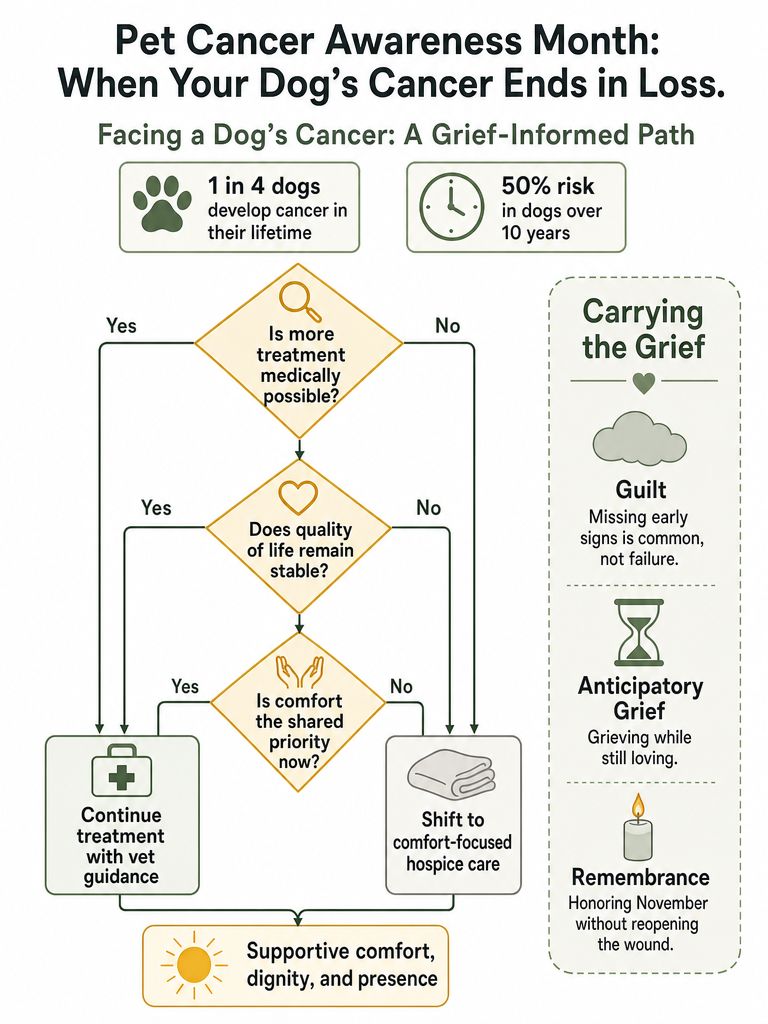
That distinction matters because of how common this loss actually is. According to the American Veterinary Medical Association, as cited by BluePearl, one in four dogs will develop cancer at some point in its life, and that risk climbs to one in two for dogs over 10 years old. For cats, BluePearl puts the lifetime risk between 25 and 35 percent. Cancer isn't a rare tragedy that singled you out; it's one of the most common diagnoses an aging dog receives.
How Do I Live With the Guilt That I Missed My Dog's Cancer Signs?
Many grieving owners carry guilt over missed signs, and that guilt says nothing about whether you were a careful or careless owner. Early cancer symptoms in dogs are frequently subtle by nature, not because you weren't paying attention.
Blue Ravine Animal Hospital's list of warning signs includes lumps or bumps that grow or change over time, unexplained weight loss, persistent lameness, decreased energy, and changes in bathroom habits, the kind of shifts that look exactly like normal aging in the early weeks. BluePearl's veterinary oncologists, Dr. John Farrelly and Dr. Joshua Lachowicz, describe watching for lameness, discomfort, and changes in body composition or symmetry, the same category of change a tired, busy, loving owner can easily read as "getting older" rather than "getting sick." That's how subtly this disease can behave, regardless of how closely you were watching.
Replaying the weeks before diagnosis, looking for the moment you "should have known," is a common response to this kind of loss. It rarely reflects what was actually knowable at the time, and letting it run unchecked can turn grief into self-interrogation.
If the guilt isn't easing on its own, that's a reasonable thing to bring to a professional who understands pet loss specifically, rather than grief in general. How therapists help with pet loss grief covers what that support can look like and how it differs from general bereavement counseling.
More Treatment or Comfort Care: How Do You Decide When to Stop Fighting the Cancer?
Deciding between more cancer treatment and comfort-focused care is a staged decision, not a single verdict, and it belongs to you and your veterinarian together rather than to a generic checklist. The Dog Cancer Foundation frames this as end-of-life planning that should start before a crisis arrives, while the International Association for Animal Hospice and Palliative Care (IAAHPC) frames the shift itself as a move toward comfort and symptom management once curative treatment is no longer the best option for that dog.
A few steps make the conversation clearer rather than harder:
- Ask your vet for the plain version of the prognosis. Not percentages pulled from memory, but what they actually expect for your specific dog, with your specific cancer type and stage.
- Check quality of life as it stands today, not as a forecast. IAAHPC's palliative framing centers pain, mobility, appetite, and happiness in the present, not projections of what might happen next month.
- Watch your dog's visible comfort, day by day. Is he still greeting you, still eating on his own, still choosing to be near you? These are the kinds of everyday signs worth tracking, alongside the broader pain, mobility, appetite, and happiness factors IAAHPC points families toward.
- Name what your family can sustain. Time, money, your dog's tolerance for clinic visits, and your own capacity to administer care at home are all legitimate parts of the decision, not selfish ones.
- Build the plan with your vet, not alone. The Dog Cancer Foundation specifically recommends creating this plan ahead of a crisis, so a hard moment doesn't force a rushed decision.
Timing is often the hardest part of this decision, and there's no fixed rule for when hospice or euthanasia is too soon, too late, or for the wrong reasons. IAAHPC frames quality-of-life scales, covering pain, mobility, appetite, and happiness, as a tool built for exactly this kind of uncertainty: a way to check whether today's suffering outweighs today's good days, rather than guessing based on fear of the future or guilt about not acting sooner. Your veterinarian is the other half of that read, since they can separate treatable discomfort from a sign the disease has moved past what comfort care can manage.
Breed-specific and stage-specific judgment calls belong to your veterinarian. No source in this guide, or anywhere credible, can substitute for an exam of your actual dog.
What Does Hospice or Palliative Care for a Dog With Cancer Actually Look Like Day to Day?
Hospice and palliative care for a dog with cancer is comfort-focused support that replaces the goal of a cure with the goal of a good quality of life for the time remaining. The Dog Cancer Foundation describes it as centered on comfort, dignity, and meaningful time together once remission is no longer possible or no longer the right choice for that dog.
In practice, IAAHPC describes this care as covering a specific set of daily tasks rather than abstract comfort:
| Day-to-day focus | What it typically involves |
|---|---|
| Pain management | Medication, and sometimes acupuncture or physical therapy, to keep discomfort controlled |
| Nutritional support | Adjusted diet or appetite stimulants when cancer affects eating |
| Mobility help | Assistance getting up, moving, or positioning as strength declines |
| Medication routines | Scheduled dosing built around the dog's tolerance and comfort, not a treatment protocol |
This care focuses on comfort, not cure, keeping the dog's remaining days as easy as possible and giving the family room to be present instead of consumed by crisis management. The Dog Cancer Foundation notes that families who build this plan with a veterinarian ahead of time generally have more space to focus on their dog instead of logistics once the final days arrive.
How Do Quality-of-Life Scales Help Without Reducing Your Dog to a Checklist?
Quality-of-life scales give a grieving or anticipating family a structured way to talk with their veterinarian about pain, mobility, appetite, and happiness, rather than a cold score that decides a dog's worth. The International Association for Animal Hospice and Palliative Care (IAAHPC) describes these scales as a tool for guiding conversations about palliative care, hospice, or euthanasia, not a verdict delivered by a form, and recommends using them specifically to anchor those conversations in what's observable today rather than in fear of what's coming.
The discomfort many owners feel scoring a scale is real and worth naming: it can feel wrong to reduce a living, loving animal to a set of numbers on a page. That discomfort doesn't make the tool wrong. The tool is translating something you feel into something you and your vet can discuss concretely, on a day when emotion alone makes it nearly impossible to see clearly.
A quality-of-life scale isn't asking you to decide how much your dog matters. It's asking you to notice what's actually true today, separate from fear about tomorrow. Used that way, alongside your veterinarian rather than instead of them, it becomes less a checklist and more a shared language for one of the hardest conversations a dog owner ever has.
What Is Anticipatory Grief When Your Dog Is Dying of Cancer?
Anticipatory grief describes grief that can begin before a death happens, while your dog is still alive and still in your care. If your dog has been diagnosed with cancer, the exhaustion, dread, and guilt you're carrying right now don't have to wait for an ending to count as grief.
This kind of grief carries its own particular weight. You're still caring for your dog, still making decisions, still hoping in small ways, while also absorbing where things are likely headed. That combination, active caregiving layered over mourning that has already started, is exhausting in a way that's hard to explain to people whose dogs are healthy. Wanting, in quiet moments, for the waiting to end, while still loving your dog completely, is a common and understandable contradiction, not evidence of a lesser love.
If you want language for where you are in this process, the 5 stages of pet loss grief explained walks through how that process tends to move, including the version of it that can start before the death itself.
How Can You Observe Pet Cancer Awareness Month Without Reopening the Wound Every November?
Observing Pet Cancer Awareness Month after your dog has already died works best when you set the terms yourself, rather than letting every post and reminder in your feed decide how hard this month hits. Nothing in the research behind this article covers tested memorial practices for dog loss specifically, so what follows are options this site suggests, not a prescribed ritual: ways to give the month a shape you choose instead of one that chooses you.
- Pick one act, once, and let that be enough. A single donation to a cause you trust, made on a day you choose, closes the obligation instead of leaving it open-ended all month.
- Build one small, repeatable ritual. Lighting a candle, looking at one photo, or saying your dog's name out loud on a specific date gives the month a container instead of letting grief spill across all 30 days.
- Mute or unfollow triggering content without guilt. You don't owe every awareness post your attention, especially the graphic warning-sign lists that can read like a post-mortem of your dog's last months.
- Set a personal time limit. Decide in advance how much of the month you'll actively engage with, whether that's one afternoon or one evening, and let the rest of November be ordinary.
What Can You Say to a Friend Whose Dog Is Dying of or Died From Cancer?
The most useful thing you can say to a friend whose dog is dying of or died from cancer is something that treats the loss as real, specific, and theirs, not something to be fixed or minimized. "It's just a dog" and its softer cousins, "at least he's not suffering anymore," "you can always get another one," land as dismissal even when meant kindly, because they skip past the actual bond being grieved.
A few concrete scripts and actions help more than sentiment alone:
- Say the dog's name. "I'm so sorry about Franki" does more than "I'm sorry about your dog." Specificity tells your friend the loss registered as real.
- Offer a task, not an open-ended "let me know." Picking up food, walking their other dog, or sitting with them during the appointment removes a decision they don't have the energy to make.
- Ask if they want to talk about the cancer, or not. Some people need to narrate every detail of the diagnosis and decision; others need a break from it. Ask rather than assume.
- Don't rush their timeline. There's no fixed schedule for grieving a dog, and suggesting one, even gently, adds pressure instead of comfort.
Part of why this loss lands so hard has a basis in biology. Isaac's own account of his bond with his English Bulldog, Franki, points to oxytocin, the same bonding hormone that rises between a parent and newborn, measured climbing in both dog and owner after nothing more than sustained eye contact. That's part of why losing a dog can hit as hard as losing a person. The human-animal bond covers that science in more depth.
Isaac wrote To Lose A Dog after 1,870 days with Franki, an English Bulldog who died on a Friday in March 2025 while Isaac was six thousand miles away. The book is an account of the guilt, distance, and unanswered questions that followed, written for anyone looking for company in the middle of a loss like this one.
Frequently asked questions
What are the warning signs of cancer in dogs?
Common warning signs include lumps or bumps that grow or change, unexplained weight loss, persistent lameness, non-healing sores, unusual bleeding or discharge, decreased energy, and changes in bathroom habits, according to Blue Ravine Animal Hospital and BluePearl's veterinary oncologists. These signs often look like ordinary aging in the early weeks, which is why many owners miss them without being careless. Any new or changing symptom in an older dog is worth a veterinary exam rather than a wait-and-see approach.
What is the most common type of cancer in dogs?
Lymphoma is the most common cancer diagnosed in both dogs and cats, according to BluePearl veterinary oncologist Dr. John Farrelly. After lymphoma, certain tumor types show up more often in dogs than cats, and vice versa, depending on breed and body system. Knowing this doesn't predict what happened to any individual dog, since type, stage, and treatment response vary, but it explains why lymphoma comes up so often in cancer-loss stories.
Are some dog breeds more likely to develop certain cancers?
Yes, breed can influence which type of cancer a dog develops, though it does not make any individual dog's diagnosis predictable or preventable. BluePearl oncologist Dr. John Farrelly notes that Scottish terriers are more prone to bladder tumors, while brachycephalic breeds like bulldogs are more likely to develop certain brain tumors. That knowledge helps owners watch for breed-specific warning signs; it is not evidence that a past diagnosis could have been caught sooner.
Can a dog live a long time after a cancer diagnosis?
Yes, many dogs go on to enjoy months or even years of good quality time with their families after diagnosis and treatment, according to Blue Ravine Animal Hospital. Outcomes depend heavily on cancer type, stage, and how early it was caught, which is why veterinarians emphasize checkups and at-home monitoring. For a dog already in hospice, the same advances in veterinary oncology mean more pain-management and comfort options exist today than a decade ago.
Why does Pet Cancer Awareness Month exist?
Pet Cancer Awareness Month exists to promote education, early detection, and hope around veterinary cancer care, according to Blue Ravine Animal Hospital, and it runs every November. Most of what gets published during the month targets owners whose dogs are still healthy, pointing them toward checkups and symptom checklists. If your dog already died of cancer, that prevention-focused purpose doesn't have to be yours; marking the month on your own terms is just as valid.
What is To Lose A Dog about?
To Lose A Dog is Isaac H's memoir about his 1,870 days with Franki, an English Bulldog who died on a Friday in March 2025 while Isaac was six thousand miles away. It isn't written specifically about cancer, but it covers the guilt, distance, and unanswered questions that follow a dog's sudden death. Readers grieving a cancer loss often recognize the same patterns: replaying what might have gone differently and missing the daily routines that defined the bond.