What to Do With Leftover Dog Food and Medication Right After Your Dog Dies
Leftover dog food after a dog dies is the unopened kibble, half-eaten bags, and unused prescriptions a family is still holding days or weeks after the loss. None of it needs handling today. In the first hours, the only real task is safe storage: set unopened food aside somewhere you won't have to look at it constantly, refrigerate or freeze any opened wet food if you might donate it later, and move all medications out of reach of other pets and children. Do not flush anything and do not put pills in an unsecured trash can pets can get into. The veterinary team at Dog Cancer recommends a community drug take-back program as the best way to get rid of unused medication, but there's no deadline pushing you toward a bin or a vet's counter this week. Decisions about donating, discarding, or returning items can wait until you're steady enough to make them.
Why It's Okay to Wait Before Touching Your Dog's Food and Medication
Shock can make a five-minute errand feel impossible, and stalling on your dog's food and medication for days or weeks is a normal response to that shock, not a failure to cope. In one pet loss support group, a grieving owner described exactly this kind of paralysis: she wasn't sure whether to bring her dog's leftover medications to a vet or drop them at a pharmacy, and she wrote that she couldn't stay as active in the group as her heart wanted because the ache was too much. That kind of stall is common. Even small logistical tasks can feel enormous in the first days after a death. No rule says food and medicine must be cleared out within a set number of days. If a cabinet or pantry shelf holding your dog's things needs to stay untouched for a week, or a month, that's allowed.
Can You Donate Leftover Dog Food After Your Dog Dies?
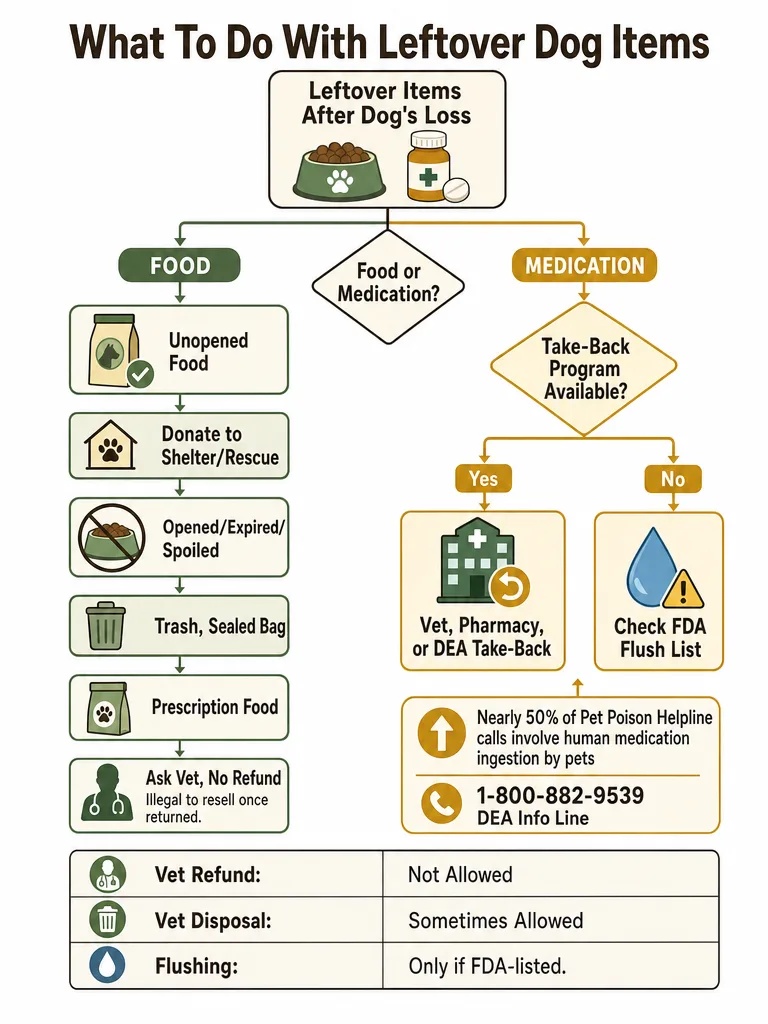
Whether a shelter or rescue will take your dog's leftover food depends on that organization's own policy, and no single national standard covers it. Authoritative guidance on donating dog food specifically after a death is limited as of this writing. What is documented is how one aid organization handles donated pet supplies: WVS, a UK charity that redistributes donated medication into veterinary aid parcels, only accepts items that are unopened, sealed, and in-date, and it can only accept donations sent from within the UK, not the United States. That same sealed, in-date standard tends to hold at the shelter level for food, even without a formal published policy: an unopened bag with time left before the best-by date is far more likely to be accepted than anything opened or partly used. Call the shelter, rescue, or food pantry before you go, and ask exactly what they'll take. Some will accept unopened treats and canned food along with dry kibble; others only want specific brands or sizes.
What Should You Do With Opened, Expired, or Spoiled Dog Food?
Opened, expired, or spoiled dog food has no donation path; the sealed, in-date standard that shelters and groups like WVS apply rules it out. Once a bag is opened or past its best-by date, ordinary trash disposal is the only realistic option. Public disposal guidance aimed specifically at spoiled dog food is limited as of this writing, but standard food-safety handling applies: seal opened bags or cans in a trash bag before putting them in an outdoor bin, especially if other pets or wildlife visit your yard. Wet or spoiled food should go out with regular kitchen trash rather than sit in a garage or pantry. If you're not ready to throw it away yet, closing it tightly and setting it aside for a few days won't hurt anything.
What Should You Do With Leftover Prescription Dog Food?
Leftover prescription dog food is harder to place than regular kibble, and public information on returning or donating it after a dog dies is limited as of this writing. Prescription diets are sold through veterinary clinics or against a prescription on file, and return policies vary by clinic and retailer rather than by any universal rule. The most reliable step is to ask the prescribing veterinarian's office directly whether they accept unopened bags back or know of another dog on the same diet who could use it. Because these foods are formulated for specific medical conditions, such as kidney or digestive disease, they aren't a natural fit for general shelter donation the way regular kibble might be. If no one can use it, treat an unopened bag by the same standard as regular food: sealed, in-date bags have the best chance of being accepted somewhere; anything opened should be discarded.
Is It Safe to Keep Leftover Pet Medications for Another Dog or Later Use?
Holding onto a dog's unused medication for another pet or a future need is riskier than it feels, because animals get into medications that aren't theirs more often than owners expect. The U.S. Food and Drug Administration (FDA) tracks reports of pets accidentally eating medications, including their own leftover pills, another pet's prescription, or a human family member's medication left within reach. Medications flavored to taste appealing make this worse: a dog that sniffs out a bottle can eat an entire supply in one sitting. Even a drug that was safe for the dog who died can be the wrong dose, the wrong compound, or an expired risk for a different dog later. The safer move is disposal, not storage.
How to Dispose of Leftover Dog Medication, Step by Step
Disposing of a dog's leftover medication safely follows a short, specific order: take-back first, household method only as a backup. The veterinary team at Dog Cancer calls a community drug take-back program the best option for unwanted dog medications, and the FDA outlines a fallback method for when no program is available nearby.
- Locate a take-back site. Community drug take-back programs, including pharmacy drop boxes and law enforcement collection sites, accept both human and pet medications and dispose of them without asking questions.
- Check for a scheduled collection. The Drug Enforcement Administration (DEA) sponsors National Prescription Drug Take Back Day each year at sites nationwide, in addition to year-round drop-off locations listed on its website.
- Call ahead if you're unsure a site takes pet meds. Most take-back programs accept veterinary prescriptions the same as human ones, but a quick call avoids a wasted trip.
- Use the household method only if no site exists nearby. The FDA advises mixing pills or capsules, without crushing them, into something unappealing like used coffee grounds or kitty litter, then sealing the mixture in a bag before it goes into the household trash.
- Keep the sealed bag out of an open or outdoor trash can. Medication left loose or in an accessible bin still poses a poisoning risk to pets and children.
Vet, Pharmacy, or DEA Take-Back: Where Should Unused Dog Medication Go?
Vets, pharmacies, and DEA take-back sites serve different roles in disposing of leftover dog medication, and knowing which one applies can save you a wasted trip. A veterinary clinic may accept certain medications back for disposal, but Dog Cancer notes that local and federal law may prohibit vets from taking back specific prescriptions, depending on the drug involved. Pharmacies often host their own take-back kiosks year-round. The DEA runs the broadest option through National Prescription Drug Take Back Day, an annual nationwide collection event, plus a searchable list of year-round drop-off locations.
| Disposal channel | What it typically takes | Watch for |
|---|---|---|
| Veterinary clinic | Some unused prescriptions, case by case | Local or federal law may block certain drugs from being accepted back, depending on the prescription |
| Pharmacy take-back kiosk | Most human and pet prescriptions | Availability varies by store and chain |
| DEA take-back day or year-round site | Nearly all unused medications, including controlled substances | Only active on scheduled days or at listed locations |
If none of the three exist within reach, the household disposal method covered above is the next best step, not flushing.
Can a Vet Legally Reuse, Refund, or Donate Your Dog's Medications?
A vet's willingness to take back your dog's leftover medication for disposal has nothing to do with whether that medication can be resold, refunded, or donated, and confusing the three drives most of the disagreement in pet-loss discussion groups. Dog Cancer draws a clear legal line: once a medication has left the veterinary hospital, it's illegal for a vet to resell or re-dispense it to another patient, because there's no way to verify how it was stored or whether it was tampered with. Refunds are inconsistent for the same reason; some clinics will refund unopened products still sealed in original packaging, but there's no guarantee. Donation is a separate, narrower path, and for most U.S. readers it isn't a real option: WVS, a UK charity, will accept unused medication for veterinary aid parcels, but only from donors in the UK, and only if it's unopened, has more than a month left before expiration, isn't a controlled drug, and doesn't need refrigeration. In pet-loss communities, some owners report their own vet informally passing leftover medication to a shelter or rescue in need. That kind of arrangement depends on the individual clinic's own relationships, not a formal legal channel, so ask directly rather than assuming it's standard practice.
When, If Ever, Is It Okay to Flush a Dog's Medication?
Flushing counts as safe disposal only for a narrow list of drugs published by the FDA, and it should be used only when no take-back option exists nearby. Historically, flushing was the standard advice, but Dog Cancer notes that medications flushed into the water system can contaminate food and water supplies, harm wildlife, and contribute to antibiotic resistance over time. Oral chemotherapy drugs carry particular risk if flushed or handled improperly.
According to Dog Cancer's summary of FDA guidance, the agency built its flush list around medications that carry a high risk of abuse or accidental poisoning if left sitting in a home, judging that risk to outweigh the small environmental cost of flushing them. The University of Illinois veterinary pharmacy program names diazepam, oxycodone, morphine, hydrocodone, fentanyl, and buprenorphine as examples found on it. If your dog's medication isn't on that list, skip the toilet and use a take-back program or the household trash method instead.
What to Do If There's No Drug Take-Back Program Near You
If there's no drug take-back site within reach, start with the DEA's information line at 1-800-882-9539, which the University of Illinois veterinary pharmacy program points to for help locating a disposal option in your area. The DEA's website also lists year-round drop-off locations beyond the annual take-back day, so check there before assuming your area has nothing. If a search still turns up empty, confirm whether the medication is on the FDA's flush list before flushing anything. For everything else, fall back on the household method: mix pills or capsules, without crushing them, into used coffee grounds or kitty litter, seal the mixture in a bag, and place it in your regular household trash rather than an outdoor bin animals can reach.
Handling Your Dog's Belongings When You're Not Ready Alone
A friend or family member can take on tasks like calling a shelter, dropping off medication at a take-back site, or simply standing beside you while you clear a shelf, so sorting your dog's food and medication doesn't have to be a solo job during the week you're least equipped for logistics. There's no order these tasks have to happen in, and no version of grief where handling a pill bottle faster means you loved your dog more. If you're still deciding what to do with the rest of your dog's things, from a collar to a favorite bed, how to handle your dog's bed and toys after they die walks through the same kind of pacing for the harder, more sentimental items.
Frequently asked questions
Can I donate my dog's leftover food to a shelter after they die?
Whether a shelter accepts it depends entirely on that organization's own policy — there's no national standard. Unopened bags with time left before the best-by date have the best chance of being accepted; opened or partly used food almost never is. WVS, a UK charity that redistributes donated pet supplies, only takes items that are unopened, sealed, and in-date. Call the shelter, rescue, or pantry first and ask exactly what they'll take before making a trip.
What should I do with opened or expired dog food after my dog dies?
Throw it out with regular household trash — there's no donation path for it. Once a bag is opened or past its best-by date, the sealed, in-date standard shelters use rules it out. Seal opened bags or cans in a trash bag before putting them in an outdoor bin, especially if other pets or wildlife visit your yard. If you're not ready to toss it yet, closing it tightly and setting it aside for a few days is fine.
What can I do with leftover prescription dog food?
Ask the prescribing veterinarian's office directly — they may take unopened bags back or know another dog on the same diet who could use it. Prescription diets are sold only through clinics or against a prescription, so return policies vary by clinic rather than following any universal rule. Because these foods are formulated for specific conditions like kidney or digestive disease, general shelters rarely have use for them. An unopened, in-date bag has the best shot at being reused.
Is it ever okay to flush my dog's unused medication down the toilet?
Flushing is safe only for medications on a specific FDA list, and only when no take-back program exists nearby. The FDA built that list around drugs with high abuse or poisoning risk if left in a home — diazepam, oxycodone, morphine, hydrocodone, fentanyl, and buprenorphine are examples, per the University of Illinois veterinary pharmacy program. Flushing anything else can contaminate water supplies and harm wildlife. For everything not on the list, use a take-back program or the household trash method instead.
Where should I take my dog's unused medication for disposal?
A community drug take-back program — pharmacy drop boxes or law enforcement collection sites — is the best option, according to the veterinary team at Dog Cancer. The DEA also sponsors National Prescription Drug Take Back Day nationwide each year, plus year-round drop-off locations listed on its website. If nothing's nearby, call the DEA's information line at 1-800-882-9539 for help finding a site. Veterinary clinics sometimes accept certain medications back too, though law can prohibit them from taking specific prescriptions.
Can my vet resell, refund, or donate my dog's leftover medication?
Once medication leaves a veterinary hospital, it's illegal for a vet to resell or re-dispense it to another patient, because there's no way to verify how it was stored or whether it was tampered with. Refunds are inconsistent — some clinics will refund unopened, sealed products, but there's no guarantee. Donation is narrower still: WVS, a UK charity, only accepts unopened medication with more than a month left before expiration and sent from within the UK, which rules it out for most U.S. pet owners.