
What do you do when a friend says no gifts after losing a dog?
When a friend says no gifts after losing a dog, honor it as a boundary and send words, not a package, because a dog's death is real bereavement. The University of Florida's Small Animal Hospital advises listening without judging, and the RSPCA suggests using the pet's name. Offer at most one specific form of practical help that's easy to decline.
BBC Science Focus notes that losing a pet can be as distressing as losing a person. It also reports that a 2021 review of pet bereavement studies found many owners feel others won't see the loss as legitimate. Your friend's "no gifts" asks you to show up differently, and the boundary needs no explanation from them.
What do you text a friend who just lost their dog?
A short, sincere text that uses the dog's name is enough. PetMD quotes veterinarian Seth Schwartz, DVM, who says a simple "I'm so sorry for your loss" is often enough, because it shows you cared enough to reach out. Here are five messages with nothing attached, adapted from the sources:
- "I'm so sorry about [dog's name]. I know how much [he/she] meant to you." (adapted from Everbound)
- "I'm so sorry for your loss. [Dog's name] was lucky to have you." (from the RSPCA, whose advice comes from pet bereavement therapist Andy Hawkins)
- "I've been thinking of you and [dog's name]. No need to reply." (adapted from Everbound)
- "I don't know the right words, but I care about you." (from the AHELP Project, where Michelle Nichols says saying the pet's name helps a grieving owner feel seen)
- "I'd love to hear about [him/her] whenever you feel like talking." (from Everbound)
What not to say: PetMD's list of phrases to avoid includes "It was just a pet," "You can always get another one," and "When are you getting a new pet?" The RSPCA warns against "At least it was just a dog/cat," which it says belittles grief. It also advises against "I know how you feel" unless the person asks, because it moves the focus to you.
Sources disagree on one point. BBC Science Focus suggests that, if it feels right, you might remind a friend whose dog was euthanized that the pet is at peace and no longer suffering. PetMD lists "At least they don't have to suffer any more" among phrases to avoid. The University of Florida's advice is to avoid clichés and listen, so skip the reassurance unless your friend raises it first.
Do cards, flowers, meals, donations, or a grief book count as exceptions?
A card, flowers, a meal, a donation, or a grief book is not an automatic exception to a friend's no-gifts request. The request is your friend's call, so ask before sending anything, including things that feel small or free. The available sources do not test how bereaved owners interpret no-gifts requests, so this is editorial judgment grounded in the guidance cited here, not a measured rule.
Some guidance pushes the other way. PetMD suggests flowers, even a small bouquet on the doorstep, and the RSPCA promotes donations in a pet's memory. Best Friends Animal Society's support article floats doorstep coffee or a care package. Those are general suggestions for grieving people, and none overrides an explicit no.
If your friend reopens the subject, or something genuinely needs clarifying, these questions show how to ask. They are not invitations to negotiate each category after a clear no-gifts request.
| Gesture | What it asks of your friend | What to ask first |
|---|---|---|
| Handwritten card | Opening it, maybe replying | "Would a note from me be okay, or would you rather I just text?" |
| Flowers | Water, a vase, a reminder on the counter | "Would flowers be welcome, or is that more than you want right now?" |
| Meal or groceries | Being available, being seen | "Would you like dinner dropped off Thursday? I'll only do it if you say yes, and you don't need to come to the door." |
| Donation in the dog's name | Possibly acknowledging it | "Would you like me to donate in [name]'s memory? It's completely fine if you'd rather I didn't." |
| Photo or keepsake | Deciding what to do with it | Everbound says to ask before arranging something personal or expensive. |
| Grief book | Reading it, or feeling pressure to | Ask first, and take a no easily. |
A grief book is one more thing to ask about, not a workaround. If you're weighing one, ask before you give. If your friend later says gifts are welcome, these sympathy gift ideas may help.
What can you offer a grieving friend instead of a gift?
A single specific offer, framed so your friend owes you nothing, is the most useful substitute for a gift. Everbound recommends small, concrete offers over "let me know if you need anything," and the University of Florida names shopping, cleaning, and sitting quietly. The RSPCA lists a meal, a lift, or a walk.
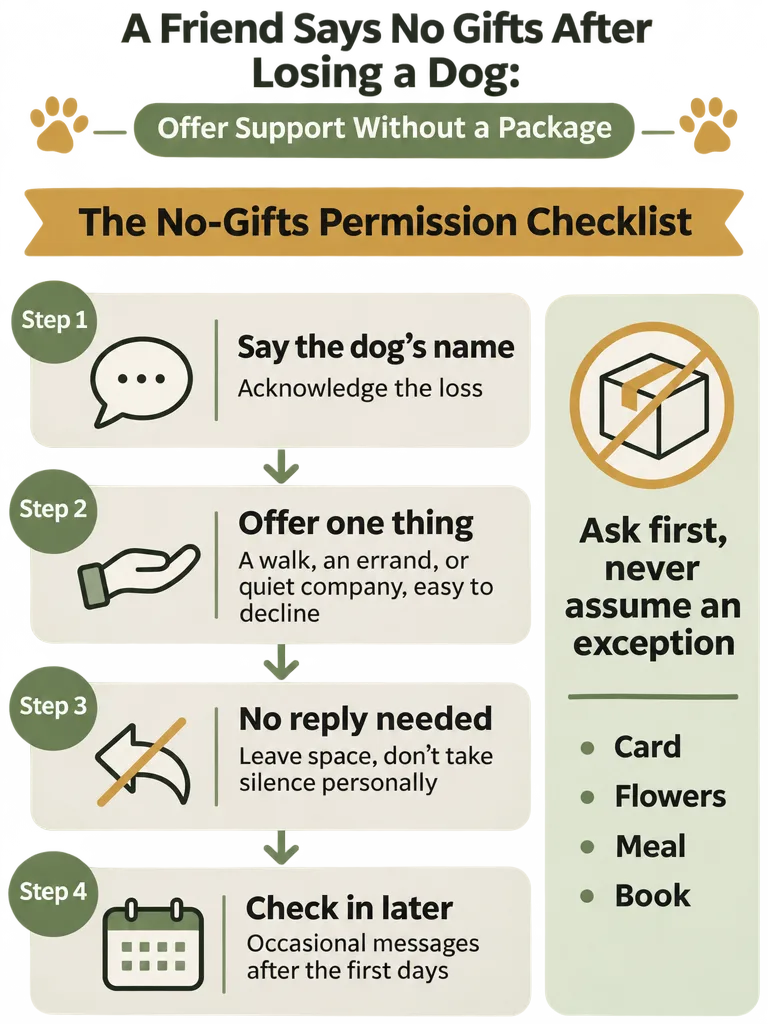
A boundary-first permission checklist (an original editorial tool built from those sources, not a clinical instrument):
- Acknowledge by name. "I'm so sorry about [dog's name]."
- Honor requested space. Re-read what your friend actually said. If they asked for no contact, or no offers, leave the offer and any later message out. A calendar reminder never overrides a request for space.
- Make one specific offer. A walk, quiet company, an errand, or a call after a vet or ashes appointment, which Everbound suggests checking in after.
- State "no reply needed." Say it out loud so silence doesn't feel like rudeness.
- Plan a later check-in. Set a reminder so support doesn't end after the first week, as long as it fits your friend's stated contact preferences.
The AHELP Project describes the underlying skill as being fully present without trying to fix, explain, or rush someone's feelings.
Illustration (not a real case): Your friend Dana has lost her dog, Maple, and said "no gifts, please." She hasn't said she wants no contact. You text: "I'm so sorry about Maple. I'm free Saturday morning if you'd like a quiet walk. It's fine to ignore this, and there's no need to reply." Dana can say yes, no, or nothing, and none of those outcomes is a problem.
What if your friend turns down company or doesn't answer?
A declined offer or an unanswered condolence message is not a rejection to chase or a problem to solve. The RSPCA says to respect when someone needs space and not take it personally, and the University of Florida likewise advises respecting a wish for time alone. Best Friends Animal Society advises the same about unanswered texts, and suggests continuing occasional messages that show you're available.
If your friend says no, accept it without asking why. A sample no-pressure message: "Totally understand. I'm thinking of you and [dog's name], and you never have to answer."
The sources give no evidence-based schedule for how often to follow up, so don't invent one. Use your friend's cues and your own judgment, and keep each message light enough to ignore.
How can you remember the dog without posting photos or moving belongings?
Remembering your friend's dog starts with private gestures and a permission check before anything visible. Everbound advises asking before sharing the death on social media or posting the pet's photographs, and notes that some people welcome public tributes while others want privacy. It also says to touch belongings only with permission and never to remove the bed, toys, or bowls as a surprise, because decisions about belongings belong to your friend. This article's advice is to extend the same courtesy to organizing a tribute with mutual friends.
Safe alternatives:
- A private text with one specific memory. The University of Florida suggests writing down something you remember and liked about the pet and giving it to your friend. A text works too.
- Saying the dog's name. The RSPCA says using the pet's name keeps their memory close, and AHELP says it helps a grieving pet parent feel seen.
- An open invitation. "I'd love to hear a story about [name] whenever you want."
If your friend eventually accepts a book and you want to write in it, here's what to write inside a pet loss book. That only applies once they've said yes.
How can you keep supporting your friend through the holidays and the firsts?
Holiday and meaningful-date support means a light check-in after the first days, with no reply required. Everbound suggests checking in after several weeks or around a significant date. BBC Science Focus warns that pet grief distress can last months or more, and that social isolation can aggravate it, so try to keep your support going past the first conversation.
AHELP's holiday ideas include a no-pressure text that names the season, a favorite photo of your friend and their dog, a short phone call, or a brief coffee if they want one. Best Friends Animal Society's holiday guide supports declining events, changing plans, and leaving early, so don't take a "no" to an invitation personally.
The RSPCA reports, from its Pet Grief Survey 2025, that more than half of pet owners surveyed couldn't find the support they needed and that 28% took no time off to grieve. The RSPCA page gives no sample size, methodology, or reasons for taking no leave, and the RSPCA is a UK organization, so don't read these figures as a measure of US dog owners.
For what your friend may be facing, see surviving the firsts after losing a dog and New Year's Eve after losing your dog.
When should you gently point your friend toward more support?
If your friend seems unable to manage daily life over time, or you're worried about their safety, Everbound says to encourage qualified professional or urgent help and not to diagnose grief yourself. BBC Science Focus similarly says you can gently raise professional support if grief is affecting their ability to function. That is different from ordinary grief, where an optional offer of choices is the gentler route.
The AHELP Project advises against opening with "I have the name of a therapist." Its infographic, "Which Kind of Pet Loss Support Feels Right to You?", helps people explore options such as a trusted friend, a pet loss-informed coach, a licensed therapist, or self-guided resources. Its separate Pet Loss Resource Page brings together pet loss-informed coaches and licensed therapists trained in companion-animal loss, plus educational resources.
Check eligibility before you share anything. Everbound notes that the Ontario Veterinary College's veterinary social work counseling is restricted to qualifying clients of its Health Sciences Centre, so it isn't open to everyone. Contact numbers change, so look them up fresh for your friend's location rather than relying on memory.
Frequently asked questions
What should you never say to someone whose dog just died?
Avoid any phrase that shrinks the loss, such as "It was just a pet," "You can always get another one," or "When are you getting a new pet?" PetMD lists all three among phrases to skip. The RSPCA adds "At least it was just a dog," which it says belittles grief, and "I know how you feel" unless the person asks.
Should you use the dog's name when you reach out to a grieving friend?
Yes. Using the dog's name is one of the simplest ways to show you take the loss seriously. The RSPCA's pet bereavement therapist, Andy Hawkins, recommends it because it keeps the pet's memory close, and AHELP founder Michelle Nichols says it helps a grieving owner feel seen. A short message like "I'm so sorry about [name]" is enough.
Should you tell a friend whose dog was euthanized that the dog is no longer suffering?
Wait until your friend raises it first. Sources disagree: BBC Science Focus suggests that, if it feels right, you could remind them the pet is at peace, while PetMD lists "At least they don't have to suffer any more" among phrases to avoid. Everbound advises against declaring a euthanasia decision definitely right or wrong; acknowledge how hard the choice was.
What is a nice gift for someone who just lost their dog?
Everbound calls a handwritten note with a specific memory of the dog thoughtful, and says to ask before arranging anything personal or expensive, like a keepsake, photograph, or donation. If your friend has already said no gifts, skip the package entirely and send words instead. Their request outweighs general gift suggestions.
When should you check in again after the first few days?
Check in again after several weeks or around a meaningful date, and say no reply is needed. Everbound recommends this because others often stop mentioning the death after the first few days. BBC Science Focus notes that pet grief can last months or more. The sources give no fixed schedule, so follow your friend's cues.
How do you suggest therapy or a support group without pushing?
Offer options instead of leading with a referral. The AHELP Project advises against opening with "I have the name of a therapist," and suggests choices like a trusted friend, a pet loss-informed coach, a licensed therapist, or self-guided resources. If your friend can't manage daily life over time or you worry about their safety, Everbound says to encourage professional or urgent help without diagnosing grief yourself.
Sources
- How to Support a Loved One who is Grieving » Small Animal Hospital » College of Veterinary Medicine » University of Floridasmallanimal.vethospital.ufl.edu
- www.rspca.org.ukwww.rspca.org.uk
- www.sciencefocus.comwww.sciencefocus.com
- www.petmd.comwww.petmd.com
- everbound.caeverbound.ca
- www.ahelpproject.orgwww.ahelpproject.org
- bestfriends.orgbestfriends.org