
Why does New Year's Eve hurt so much after losing a dog?
The sharpest pain of the new year after losing a dog comes from a calendar technicality: once the clock passes midnight, your dog's death shifts from "this year" to "last year," and that single shift in tense can feel like losing them again. The next New Year's Eve falls on December 31, 2026.
Kate LaSala, a pet-loss grief support specialist, described this exact ache in a December 15, 2025 essay on holiday grief. She wrote that she wanted New Year's Eve to "skip over" entirely, because after midnight she would have to start saying her dog "died LAST year" instead of "a few months ago." That shift from recent to retroactive is what makes the night land differently than an ordinary hard day on the calendar.
LaSala also pointed to something her own pet-loss grief counselor had named for her: TUGs, or temporary upsurges in grief. These are predictable days, no matter how much time has passed, when the sadness comes back heavier than usual. She listed her dog's birthday, death day, and big holidays, including New Year's Eve, as recurring TUG days. If this New Year's Eve feels disproportionately brutal compared to an ordinary Tuesday in November, that's not regression. It's a known pattern, not a sign you're grieving wrong.
What does it mean to leave your dog behind in the old year?
That feeling has a name: watching a calendar page turn that your dog will never occupy, even in memory. It differs from missing them on an ordinary day, because the date itself seems to add distance, not just the passing of time. You aren't actually leaving them anywhere. You're watching a number change while they stay fixed at the year they were alive in.
That distinction matters, because the instinct under this feeling is often guilt, as if moving into a new year is itself a kind of abandonment. It isn't. A dog who died earlier this year, or in any year before, did not stop being loved on December 31. The year on the calendar changes; your relationship to them doesn't reset or expire with it.
What tends to help is reframing the motion: you aren't leaving your dog in the old year, you're carrying them into the new one with you, the way you'd carry a photo in a wallet from one year to the next. The guide to surviving the "firsts" after losing a dog covers this same mechanic for birthdays, holidays, and anniversaries, where the date changes but the person you lost does not become any less yours.
What if your dog was scared of fireworks, and now the house is too quiet?
A house that used to shake with a frightened dog during fireworks can feel eerily empty on New Year's Eve after that dog dies, and the quiet is its own grief trigger, not a relief to feel guilty about. If your dog used to pace, pant, or hide at every pop and whistle, the absence of that panic is one of the strangest parts of the first New Year without them.
It's reasonable to notice the quiet and feel two things at once: a flicker of relief that your dog isn't suffering through the noise tonight, and a wave of grief that the reason for the quiet is the one thing you'd undo if you could. Neither feeling cancels the other out, and neither one needs to be resolved before midnight.
If the silence feels like too much, you don't have to fill it with the television or a crowd just to cover it. Sitting with it, even naming it out loud, "it's quiet because you're not scared anymore," can be its own small acknowledgment of the dog who used to need you in that exact room, on that exact night.
Should you keep your old New Year traditions, change them, or skip the night entirely?
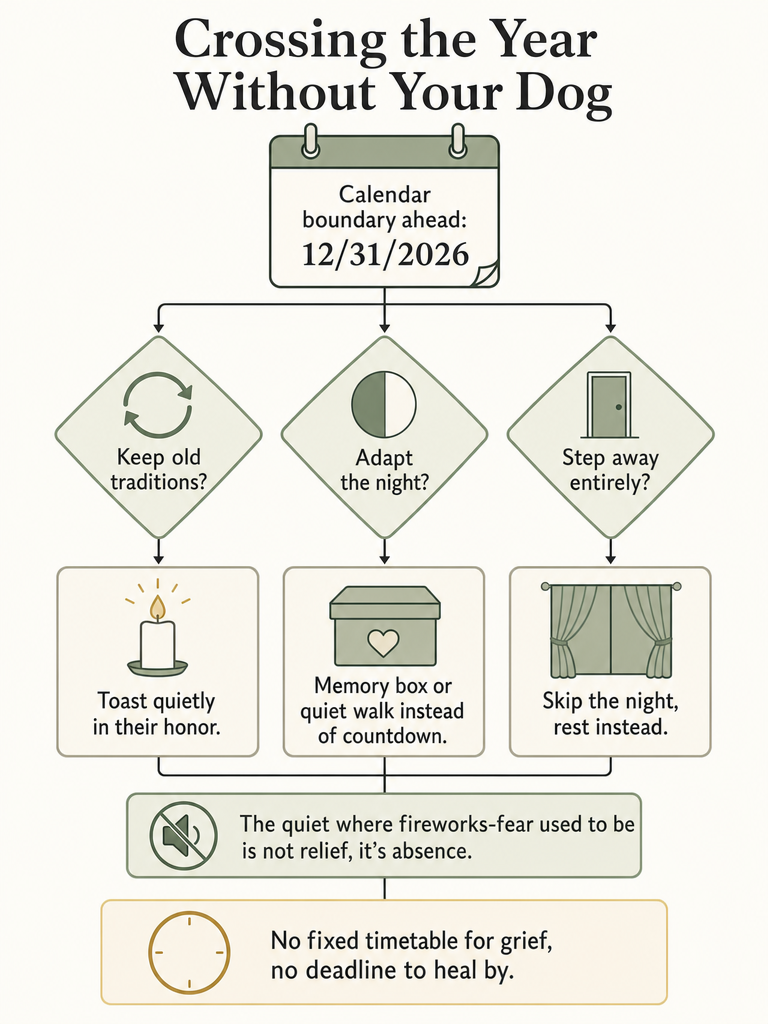
Keeping, adapting, or stepping away from your old traditions are all legitimate choices the first New Year after losing a dog, and the right one depends on what the night actually asks of you this year, not on what you did last year. LaSala's own December 2025 account describes trying a mix: keeping some rituals, like an annual trip to the Christmas tree farm, while deliberately leaving room for new ones so a current pet "isn't just living in the shadow" of the one who died.
A simple way to decide which path fits:
- Ask what the tradition was actually for. If a ritual, like a midnight countdown with your dog on the couch, was about your dog's presence, doing it without them may hurt more than skipping it. If it was about the people in the room, keeping it might still feel right.
- Try a small version before committing to the full one. A quiet toast at home tells you more than deciding in advance whether you can handle a party.
- Give yourself permission to leave early or not go at all. Declining an invitation isn't a failure to cope; it's pacing yourself through a hard date.
- Revisit the decision next year. What feels unbearable this December 31 may feel different by the one after. The first 30 days after losing a dog rarely predict what the first holidays will feel like, and the reverse is true too.
LaSala's source is explicit that there's no right or wrong way to navigate the holidays while grieving a pet. The same holds for the single night of New Year's Eve.
How do you handle resolution pressure when you are grieving a dog?
You're not required to feel resolution-ready just because a dog's first New Year without them happens to land on January 1. Nothing about losing a dog obligates you to arrive at the new year with a clean slate, a fresh goal, or a "new year, new me" posture you don't feel.
A veterinary grief podcast episode on pet loss over New Year's, featuring JoJo and Dr. Angie discussing the loss of JoJo's dog Bodhi, makes a related point about end-of-life decisions that applies just as well here: there's no perfect timing and no "right" amount of anything, only choices made honestly in the moment you're in. The same logic covers resolutions. There's no required amount of forward motion by a specific date.
The Royal Society for the Prevention of Cruelty to Animals (RSPCA) is direct about this in its pet bereavement guidance: there's no rule for how long grief lasts, and healing means learning to live alongside the loss, not clearing it off a schedule. If someone pushes "fresh start" talk on you, a short, true response works better than an explanation: "I'm not doing resolutions this year, I'm just getting through the night." You don't owe anyone optimism on a date that happens to fall on a calendar.
What are some gentle ways to carry your dog into the new year?
A small, concrete action does more than an abstract intention when it comes to carrying a dog forward into a new year, and RSPCA bereavement guidance points toward exactly this kind of practical ritual over vague sentiment. The goal isn't a public gesture. It's a private way of letting them cross the date with you.
A few options, scaled from quiet to shared:
- Write one memory in a journal before midnight. RSPCA's coping guidance names journaling as a concrete grounding tool, not just a sentimental habit.
- Build or add to a memory box. A collar tag, a photo, a favorite toy kept together gives your grief a physical place to live instead of just circling your thoughts.
- Take a walk in their honor, even a short one, at a time of night that would have been theirs: the last walk before bed, or the one they used to beg for at breakfast.
- Raise a quiet toast at midnight, naming them once, out loud, instead of letting the moment pass in silence.
- Use the Fact, Feel, Want structure RSPCA recommends if someone asks what you need tonight: state the fact ("tonight is the first New Year's without my dog"), the feeling ("I'm finding it harder than I expected"), and the want ("I'd rather stay in than go to the party").
None of these require explaining your dog's death to a room full of people. The guide to handling your dog's birthday after they die covers similar small rituals built for a single hard date rather than an ongoing routine, and the same approach scales down easily to a single midnight.
What can you say to a friend grieving a dog over New Year's?
Something specific and non-dismissive helps a friend grieving a dog on New Year's Eve far more than a general sympathy line, because pet grief is frequently minimized in exactly the way that podcast episode about Bodhi's loss describes: as something smaller than it is. Avoid "at least you have good memories" or "you can always get another dog." Both imply the grief has a shortcut.
Better options, drawn from the same framing that pet loss is real and often socially discounted:
- "You don't have to be at the countdown tonight if you don't want to be. I'll check on you tomorrow instead."
- "I know this isn't just a hard night, it's the first New Year's without [dog's name]. That's allowed to be its own kind of hard."
- "Do you want company, or do you want to be left alone tonight? Either one is fine."
If your friend is further along and still crying weeks or months later, that's not a problem to fix. The guide to why you can't stop crying over your dog explains why that reaction is ordinary, not excessive, and is worth reading before you say anything that implies they should be past it by now.
How do you grieve a dog without a deadline?
Grief doesn't come with a deadline, and the honest version of carrying a dog's loss is learning to hold it rather than finish it. RSPCA bereavement guidance says grief doesn't disappear on its own schedule; over time, people learn to carry it in a way that feels more manageable, not in a way that resolves it on a date circled on a calendar. New Year's Eve is one of the dates people expect to deliver closure. It usually doesn't, and that's not a failure on your part.
JoJo says, "Grief looks however it's going to look." She made that point on a podcast episode about losing her dog Bodhi around New Year's, and it applies as well to December 31 as it does to any ordinary Tuesday. There's no "right" amount of time to still be sad about a dog, and no requirement to feel lighter simply because a new year started.
For readers who want company inside that exact ache, rather than advice about getting past it, Isaac wrote To Lose A Dog out of his 1,870 days with his English Bulldog, Franki, according to the book's site. Its chapters on surviving the "firsts," including the first holidays, sit inside that same honest refusal to promise grief on a timeline. It's not a how-to for feeling better by a certain date. It's something to hold onto on a night that doesn't feel like closure, and readers who want it can reserve a copy through To Lose A Dog's site.
Frequently asked questions
My dog died on New Year's Eve. Will that date always reopen the loss?
Yes, if your dog died on New Year's Eve, that date will likely carry extra weight every year, the way any death anniversary does, but it won't feel identical each time. One pet owner who lost her dog on New Year's Eve wrote that the night 'doesn't exactly create the neat emotional reset the calendar promises,' and chose to focus on small things rather than force a fresh start. The ache can soften even as the date stays marked.
What is a TUG, or temporary upsurge in grief?
A TUG, or temporary upsurge in grief, is a predictable day when sadness returns heavier than usual, no matter how much time has passed since your dog died. Pet-loss grief support specialist Kate LaSala learned the term from her own grief counselor, who named her dog's birthday, death day, and holidays like New Year's Eve as recurring TUG days. Expecting one doesn't mean you're grieving wrong.
Is anticipatory grief different from the grief I feel after my dog has already died?
Anticipatory grief is the sadness that builds before a dog dies, often during a terminal illness or declining health, while grief after death is the mourning that follows the actual loss. Anticipatory grief can take over in a dog's final days as owners focus on quality time rather than resolution. Both forms can resurface around the holidays, so feeling sad before a loss and devastated after it are separate, overlapping experiences, not a sign of doing grief wrong.
Is it harmful when someone tells me to 'just get another dog' for the new year?
No, telling a grieving pet owner to 'just get another dog' is not helpful advice, and veterinary professionals who study pet loss name it as one of the comments that causes real harm. A veterinary grief podcast episode on pet loss over New Year's notes that society frequently minimizes pet grief this way, treating a specific bond as interchangeable. A new dog can bring joy later, but it doesn't address the grief for the one who died.
Is the bond with a dog scientifically comparable to other close attachments?
Yes, the attachment between a dog and an owner is measurably similar to other deep bonds: oxytocin, the hormone that attaches a mother to a newborn, has been measured rising in both dog and owner after sustained eye contact, a finding the memoir To Lose A Dog traces in its chapter on why pet loss hurts the way it does. That shared chemistry is one reason grief over a dog doesn't register in the brain as a lesser loss.
What is To Lose A Dog about, and when does it ship?
To Lose A Dog is a memoir by Isaac about his 1,870 days with Franki, an English Bulldog known as the Mayor of Domino Park, who died in March 2025. Its chapters on surviving the 'firsts,' including the first holidays, sit alongside the science of the bond and the reality of anticipatory grief. It's priced at $24.99 for pre-order, with shipping estimated for December 2026, written to keep readers company on hard nights rather than promise closure by a date.