
Why Does Valentine's Day Hurt So Much After Losing a Dog?
Valentine's Day after losing a dog hits hard because the holiday puts love on public display while dog-loss grief usually stays private and gets dismissed as less than real bereavement. Rochelle Price of the grief practice Paw and Soul describes February 14 as built around "visible love," a contrast that lands hardest when the love you're missing wore a collar.
That mismatch isn't abstract. The pet industry already treats this day as pet-centered: Spot & Tango estimated that pet parents spent $1.1 billion on toys and treats for their pets on Valentine's Day in 2022 alone. If your dog used to get a stuffed heart or an extra walk on this date, that cultural backdrop doesn't disappear just because your dog did. You're still surrounded by a version of the holiday built for the exact relationship you lost.
For many dog owners, Valentine's Day was never about a partner. It was about morning walks, a nose pressed into your hand, the dog who greeted the day with you before anyone else did. When that dog is gone, the holiday resurrects those specific rituals right as everyone else's feeds fill with hearts, and the ache behind that is rooted in daily routine and presence, built up over years with your dog.
Is It Okay to Skip Valentine's Day Altogether?
Yes. Skipping Valentine's Day after losing your dog is a legitimate form of self-care, not avoidance or bitterness. Paw and Soul's Rochelle Price is direct about this: grieving pet owners are allowed to mute or avoid social media, decline plans without explaining themselves, and treat February 14 like an ordinary day.
Opting out doesn't mean your love for your dog has faded or that you're handling grief badly. Price notes that guilt often surfaces here anyway: the quiet worry that you're ruining the day for someone else, or that you should feel grateful for the love still in your life instead of grieving what you lost. Both can be true at once. You can care about the people around you and still need this particular day to be quieter, shorter, or skipped entirely. Grief doesn't owe anyone a performance of being fine.
What If You Lived Alone With Your Dog? Why the Loneliness Hits Differently
Losing a dog who was your only daily companion creates a particular kind of loneliness on Valentine's Day, separate from being single. The ache comes from losing the one presence that structured your day: the one who greeted you at the door, slept near you, and asked nothing of you but food, a walk, and your company.
A dog who lived with you alone did more than keep you company. That dog was often the only living being who witnessed your ordinary, unfiltered life: the slow mornings, the talking to yourself, the nights you didn't feel like being anyone in particular. When that dog is gone, Valentine's Day can expose a specific kind of empty house, one where the silence comes from a missing witness, not a missing partner.
This is also where the practical disruption lands hardest. The habits built around your dog, the feeding schedule, the last walk of the night, the spot on the bed, don't quietly fade when your dog dies. They stay as gaps you keep almost filling. If you're still working out how to get through ordinary days without those routines, how to handle daily tasks after losing a dog walks through that disruption directly, separate from any one holiday.
Three Honest Ways to Spend February 14, 2027
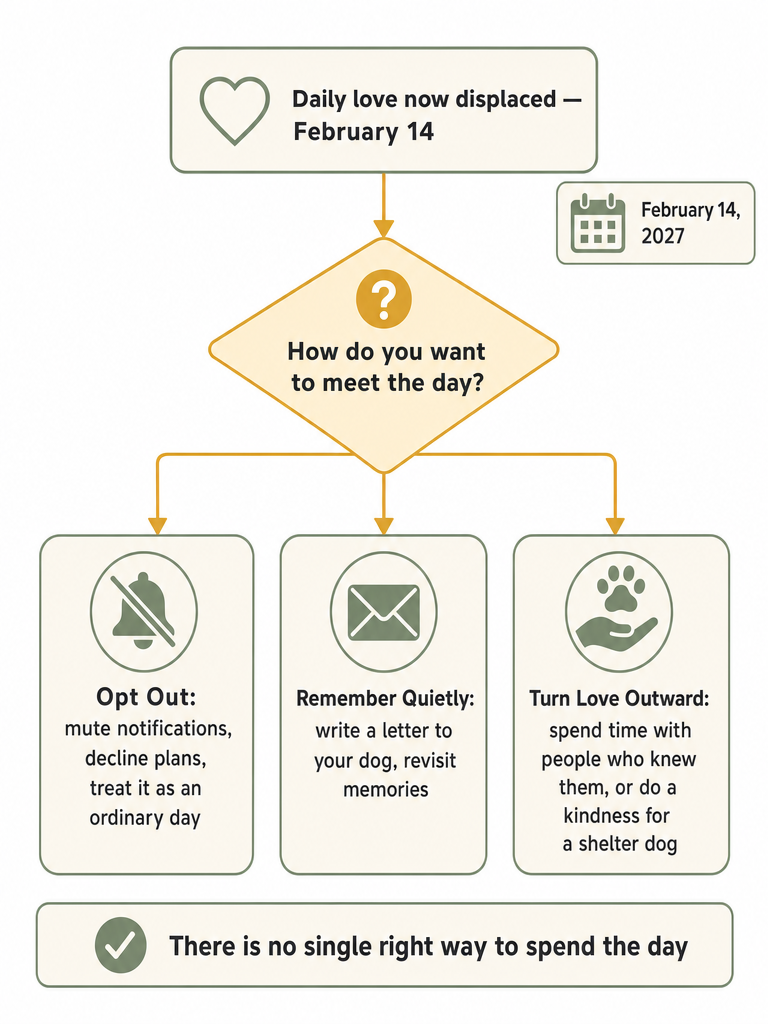
Three honest options cover most of what helps on February 14, 2027, after losing a dog: opting out of the day entirely, marking it with a small private ritual, or redirecting that love toward a person or dog who's still here. None of these is more correct than the others, and guidance from the grief practice Paw and Soul treats all three as valid ways to get through a day built around visible love.
- Opt out entirely. Treat February 14, 2027, like any other day. Skip plans, mute social apps if hearts and couples posts feel like too much, and let the day pass without asking anything of yourself.
- Remember quietly. Light a candle, say your dog's name out loud, or sit with photos for a few minutes before you stop. Paw and Soul lists small, time-limited rituals like this among its gentle options for acknowledging a pet on the day.
- Turn love outward. Spend time with someone who knew your dog, or do something kind for a dog who still needs it, like a shelter animal.
You don't have to pick just one. If this is your dog's first major holiday gone, surviving the "firsts" after losing a dog covers how that first round of anniversaries tends to go.
Would Writing a Letter to Your Dog Actually Help?
Writing directly to your dog can help some people, though it's worth holding loosely rather than treating as a guaranteed fix. Paw and Soul lists writing a short note about what you loved most among its gentle ways to mark Valentine's Day after pet loss, and some people find that addressing a letter to a name, rather than writing about the relationship in the abstract, makes it easier to put down what's been sitting unsaid.
A letter like this can tip into overwhelm without some structure. A few steps can help keep it contained:
- Set a short time limit before you start. You can always write again later.
- Open with one specific memory, not a general summary of the relationship. A particular walk, a particular morning, a particular sound your dog made.
- Say the thing you haven't said out loud, whether that's an apology, a thank you, or a question you know won't be answered.
- Stop when it's done, even mid-thought. You don't owe the letter a tidy ending, and you can pick it back up another year.
If the tears during or after feel like too much, that reaction is ordinary rather than a sign you're handling grief badly. Why you can't stop crying over your dog covers why that response is so common.
Who Should You Spend Valentine's Day With After Losing Your Dog?
The people who knew your dog are often the easiest company on Valentine's Day, because you don't have to explain the loss to them from scratch. They already understand why a specific absence is shaping your day, and you can talk about your dog directly instead of performing small talk around the gap.
Many dogs build a small community around themselves without anyone planning it: neighbors, dog-park regulars, a favorite groomer or sitter, people who knew your dog by sight and would likely welcome the chance to share a memory of them on a hard day. Reaching out to even one of these people can turn the day into something that still has your dog in it, rather than something built entirely around the absence.
If the people who knew your dog aren't close by, or you'd rather direct that love outward instead of inward, spending time with a dog who still needs one is a real option too. Paw and Soul lists donating or volunteering in a pet's honor among its gentle Valentine's Day rituals, and a shift at a shelter, a walk for a dog waiting to be adopted, or a donation in your dog's name serves a similar purpose: it lets love move somewhere, instead of sitting still.
What Can You Say When Someone Expects You to Be Happy on Valentine's Day?
A short, honest line is usually all you need when someone expects cheerfulness you don't have on Valentine's Day. You don't owe anyone a performance of being fine, and you don't have to argue someone out of "it's just a dog" to defend your own grief. A plain, direct response protects you from relitigating your loss in real time, without starting a conflict you didn't ask for.
If someone pushes plans or positivity, a plain "I'm not up for celebrating this year, but thank you for thinking of me" closes the door without conflict. If someone leans on some version of "it's just a dog," something like "he wasn't just a dog to me, and I'm not ready to treat today like nothing happened" states the truth without asking for their agreement.
These scripts aren't about convincing anyone. Comments like this often come from discomfort or a lack of understanding about what pet loss actually involves, not from unkindness. You're allowed to protect your own day without making someone else's understanding a condition of your grief.
When Does a Yearly Crash Around Valentine's Day Mean You Need More Support?
A heavy day each February 14 can be a normal part of grieving a dog. The available sources in this package don't set a firm line for when that recurring grief crosses into needing professional support, and it would be dishonest to pretend otherwise. What Paw and Soul's guidance does establish is that grief takes up space alongside the rest of your life rather than disappearing on a schedule, so some return of sadness around an anniversary date isn't unusual on its own.
Seek extra support if the day itself feels unmanageable or leaves you isolated rather than simply sad. That might mean calling a counselor or support line that focuses specifically on pet bereavement rather than general grief services, or asking a veterinarian to point you toward pet loss resources in your area.
For some people, company comes less from a hotline and more from knowing someone else has stood exactly where they're standing. That's part of what To Lose A Dog is built to offer: Isaac's account of the 1,870 days he shared with his English Bulldog, Franki, who was born on Valentine's Day 2020, written for anyone who needs company in this specific grief rather than a timetable for moving past it.
Frequently asked questions
What if my dog actually died on Valentine's Day?
Losing a dog on Valentine's Day itself compounds the grief, because the anniversary and the holiday land on the same date every year afterward. One grieving dog owner on a pet loss forum described this exact situation within days of her dog's death, and found that writing short letters to her dog helped more than trying to talk through the feeling out loud. There's no set timeline for when that double-weighted date gets easier to sit with.
What if Valentine's Day brings up loneliness even though I have a partner?
Not necessarily easier, because a partner's company doesn't replace what a dog provided day to day. A dog gave you a face at the door, a body curled against yours, hours of undemanding presence that structured your day separately from romantic love. Valentine's Day can surface that specific gap even inside a solid relationship, since the holiday highlights the steady companionship your dog gave, not the kind a partner is built to replace.
How should I handle Valentine's Day if my dog is terminally ill?
Treat Valentine's Day as a day to be present rather than a deadline to brace against. Nobody can know for certain which holiday will be the last one, so an extra slow walk or a quiet hour together now does more than trying to prepare emotionally in advance. Isaac's memoir To Lose A Dog closes on this same note for readers with a living dog: be present now, because the ordinary days are the ones that end up mattering most.
Is there a scientific reason dog grief feels this intense on meaningful dates?
Part of the intensity comes from oxytocin, the same bonding hormone that attaches a parent to a newborn, measured rising in both dogs and their owners after sustained eye contact. That shared chemistry is why a brain that spent years reading your dog's face never filed the relationship under 'pet,' and why a date like Valentine's Day can reactivate that bond's absence sharply instead of fading quietly into the background.
Is it normal for grief to hit harder on the first Valentine's Day after losing a dog?
Yes, the first occurrence of any meaningful date after a loss tends to carry the sharpest reaction, and Valentine's Day is no exception. Birthdays, holidays, and other markers typically produce a spike the first year before settling into something steadier, not because the grief is resolved but because the date stops being a surprise. Expecting that first-year intensity in advance can make it easier to plan a gentler day around it.
Can Valentine's Day be about love without being about happiness?
Yes, love and happiness aren't the same thing on this day, and conflating them is exactly what makes Valentine's Day hard after loss. Grief counselor Rochelle Price of Paw and Soul notes that grief doesn't erase love or gratitude, it just takes up space alongside them. You can let today be about the love you had for your dog, quiet, aching, real, without forcing it into cheerful territory it doesn't need to occupy to count as love.