
Should I ask before sending a grief book to a friend whose dog died?
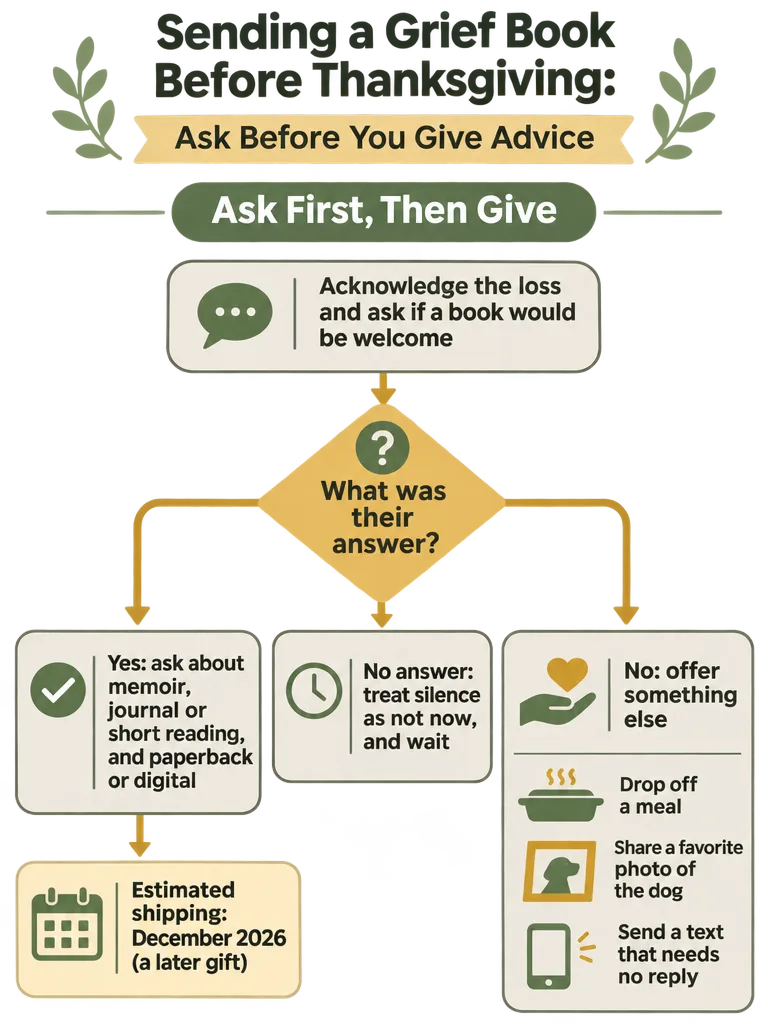
Yes, and your friend's grief is real bereavement, so sending a grief book before Thanksgiving should start with a conversation, not a package. Children's Hospital of Philadelphia's bereavement guidance, written by Elizabeth Spellman, MSW, LCSW, says to avoid sending books or resources without conversation or context. Acknowledge the loss first, then ask whether a book would be welcome.
One caveat belongs here. That guidance is written for people supporting bereaved parents, not for dog loss. It is not pet-specific research, and no published study located for this article tests whether asking first changes how a grieving dog owner feels about a gift. Applying it here is a judgment call, though a reasonable one.
The same guidance makes two points that matter more than any book choice. You cannot fix their sadness, and there is no timeline for "better," so nothing about a pre-holiday gift should hint at one. Your friend's dog was a daily presence. A grief that large doesn't run on a calendar or a holiday.
What do I say to a grieving friend before Thanksgiving to ask if a book would be welcome?
Say the dog's name, call the loss real, make "no" easy, and ask for no reply. Children's Hospital of Philadelphia notes that consistent outreach and presence matter more than finding the perfect words, so a short, plain message beats a polished one. Below are three original examples (not quotations), using a made-up dog named Maple.
- Lightest touch: "I've been thinking about Maple a lot this week. No need to answer. I'm here for the holiday and after."
- Book question, permission first: "I came across a book about losing a dog and thought of you and Maple. Would you want me to send it, now or later? A plain no is completely fine, and you don't have to reply today."
- Book question with a built-in pause: "If a book would ever be welcome, tell me and I'll find one. If not, I'd rather just sit with you and talk about Maple."
Try not to present the book as advice. If you want to share something that helped you, ask first whether suggestions are welcome. The Children's Hospital of Philadelphia guidance suggests acknowledging that your losses and pain will be different. Don't promise the book will make anything better, and don't attach a timeline.
Phrases to avoid
- "It was just a dog."
- "You can always get another one."
- Anything with a timeline, like "it'll get easier soon."
Pet-loss authors describe hearing both of the first two. The Healing Solutions for Pet Loss author lists "You know you can always get another pet" among the phrases grieving owners hear. Children's Hospital of Philadelphia lists lines such as "You are young enough, you can have another child" and "He is in a better place" as well-meant sayings that can still harm. The logic carries over: a replacement or a silver lining brushes past the one who died.
What if my friend says no, or doesn't answer?
Treat a no as a complete answer, a yes as an invitation to ask what they'd like, and silence as "not now," never as a yes. Children's Hospital of Philadelphia's emphasis on continued, reliable outreach is the useful part: you stay present whatever the answer. The table below is an original courtesy aid, not a validated readiness assessment.
| Their response | What you actually know | What to do |
|---|---|---|
| "Yes, that would be nice." | They said a book would be welcome | Ask what kind they'd like, and whether to send now or later |
| "No thanks." | They declined the book | Thank them, drop it, and offer something else |
| "Maybe later." | They named no date | Ask if you may check back at some point, and don't send yet |
| No reply | You have no answer yet | Wait and don't send. Follow up with a text that needs no reply |
If they stay quiet, follow up in a way that fits your relationship: a short, low-pressure text with no question in it, at whatever spacing feels natural to the two of you. No source sets a right interval.
What can I offer before Thanksgiving if a book isn't wanted?
Offer something concrete and low-pressure. Children's Hospital of Philadelphia says grieving people often hear "let us know how we can help" and find it hard to answer, so a specific offer works better than an open one. A holiday can also reopen routines your friend's dog used to fill, which makes small, practical help land well.
- A text that needs no reply. "Thinking of you and Maple today. Nothing needed back."
- A favorite photo of the dog. Saying the loved one's name matters too: Children's Hospital of Philadelphia notes that grieving parents often miss hearing it, and the same instinct likely applies here.
- A dropped-off meal. The guidance suggests leaving a cooler at their door, since families often decline food because they aren't ready to interact with people. A delivery gift card with a note also gives them the choice.
- A specific task. Offer to run an errand or pick up groceries instead of saying "let me know."
- A calendar reminder. Children's Hospital of Philadelphia advises spreading support through the year, because months pass and attention drifts.
Support doesn't have to end when the table is cleared. Your first Christmas without your dog is a natural reason to check in again in December.
If the answer is yes, which kind of book should I ask about?
Ask about preference, not about what a book will do for them. No source supports ranking one format as best for a given grief response, so treat these as questions. Formats people commonly weigh include memoirs, journals or exercises, spiritual or mindfulness material, and short reading.
| What they might want | Format to ask about | What to check first |
|---|---|---|
| Company from someone who has been through it | A memoir, such as Why Losing a Heart Dog Is So Hard by Paige Cummings, the true story of her Labrador, Charlie Brown | Whether another dog's death story feels comforting or too raw right now |
| Something to do with their feelings | Journal or exercises, such as Griffin's Heart, which combines memoir, guided journaling, exercises, and a keepsake pocket | Whether writing feels welcome or like a chore |
| Meditative or spiritual framing | Mindfulness-based memoir, such as Saying Goodbye to Benson | Their beliefs, and whether they'd welcome that lens |
| Just a few lines at a time | Short or daily reading | Their energy for anything longer |
| Something to hold, or something instant | Paperback or digital | Whether a physical book in the house feels like too much right now |
On format, the K9Hearts page for Why Losing a Heart Dog Is So Hard says that title comes as a paperback on Amazon, a Kindle edition, or an instant PDF. Availability varies by title, so check each book on its own.
Add an energy and concentration check: "Do you have the focus to read right now, or would something shorter be easier?" For more on that question, see a pet loss book for someone who cannot concentrate.
What should the note say so the book doesn't feel like homework?
The note should say the book can stay closed for months, carry no advice, and use the dog's name. Children's Hospital of Philadelphia warns against resources sent without context, and a note is the context. The K9Hearts page suggests a similar idea: a card saying "read this whenever you want to" takes the pressure off.
Two original examples, again with a made-up dog:
- Pressure-free: "For you and Maple. Read it in a week, a year, or never. It can sit on a shelf. No need to tell me anything."
- Implies a timeline: "I hope this helps you start to feel better about Maple soon."
The second gives your friend a job and a schedule. The first hands the book over with no strings. Skip "you should read chapter three." If you want to mention what helped you, ask first and say your losses are different. For more on wording, see what to write inside a pet loss book you're giving as a gift.
Will a book arrive before Thanksgiving, or should I reserve it as a later gift?
A physical copy of To Lose A Dog is not confirmed to arrive before Thanksgiving: the book's homepage lists estimated shipping in December 2026, which is an estimate, not a delivery guarantee. Acknowledging your friend's loss can happen today by message, while a physical book is a separate, later gift. The sources reviewed confirm neither a Thanksgiving delivery date nor an immediately available digital edition.
The book is a memoir by Isaac H about his English Bulldog, Franki. Nothing in the sources shows that it treats grief or reduces guilt, so don't promise your friend that it will. The practical split is simple: send the message and any offers of help before the holiday, and treat any physical book as a later gift whose arrival date no source can promise.
Frequently asked questions
Is it appropriate to give a book to someone grieving a dog?
Yes, when the person has said a book would be welcome. Children's Hospital of Philadelphia's bereavement guidance, written for people supporting bereaved parents rather than dog owners, advises against sending books or resources without conversation or context. Acknowledge the loss first, then ask whether they would like a book, and treat a "no" as a complete answer.
When is the right time to send a book to a grieving friend?
No source reviewed sets a correct date, so the timing belongs to your friend: ask, and send only after a yes. A book should still be welcome if it sits unopened for months, so a note like "read it in a week, a year, or never" removes any deadline. Grief has no timeline, and a gift shouldn't imply one.
What should I write inside a pet loss book I'm giving as a gift?
Keep the note short, use the dog's name, and release your friend from any duty to read the book or reply. A line like "For you and Maple. Read it in a week, a year, or never" (Maple is a made-up example) adds no advice and no schedule. Avoid "I hope this helps you feel better soon," which hands your friend a deadline.
What should you not say to someone whose dog just died?
Skip "It was just a dog," "You can always get another one," and any timeline such as "it'll get easier soon." Pet loss author Kenda Summers lists "You know you can always get another pet" among phrases grieving owners hear. Say the dog's name and that you're thinking of them; Children's Hospital of Philadelphia says steady presence matters more than perfect words.
Are dog loss grief books available as ebooks or instant downloads?
Some are, but availability varies by title. The K9Hearts page for Why Losing a Heart Dog Is So Hard lists a paperback ($14.99 on Amazon), a Kindle edition, and an instant PDF ($9.99 on K9Hearts). It says the PDF suits readers who want to start tonight or who find a physical book too much right now. Check each title's own page before ordering.
Will a copy of To Lose A Dog arrive before Thanksgiving?
A physical copy of To Lose A Dog is not confirmed to arrive before Thanksgiving. The book's homepage lists estimated shipping in December 2026, US shipping at $4.90, and cancellation any time before it ships. That is an estimate, not a delivery guarantee, so send your message and offers of help before the holiday and treat the book as a later gift.
Sources
- www.petsorrow.comwww.petsorrow.com
- www.k9hearts.comwww.k9hearts.com
- www.amazon.comwww.amazon.com
- www.amazon.comwww.amazon.com