
What Is Senior Pet Month When Your Dog Is Already Old?
Senior Pet Month carries a quieter ache when your own dog is already old, since the slow losses it marks are already familiar. The 2026 observance runs November 1 through November 30, and for someone living with an aging dog, it works best as a monthly check-in on comfort and routine, not as a shelter adoption push.
Most November coverage encourages adopting older shelter dogs, since they're frequently passed over in favor of puppies. That's a worthwhile cause, but it isn't your question if your dog is already seven, nine, or twelve. Coverage of this observance is also inconsistent: some sources call it Senior Pet Month, others Senior Pet Health Month or National Senior Pet Month, and none point to a single governing body confirming the exact 2026 wording or dates. This article uses November 2026 as the working window because that's where most senior-pet guidance clusters, not because an official sponsor verified that exact phrasing.
What the month is actually useful for is a prompt to look clearly at how your dog is doing: appetite, mobility, mood, pain. Treating November as a deliberate pause gives you one set point on the calendar where ordinary slippage doesn't get to slide past unnoticed.
When Is a Dog Considered a Senior?
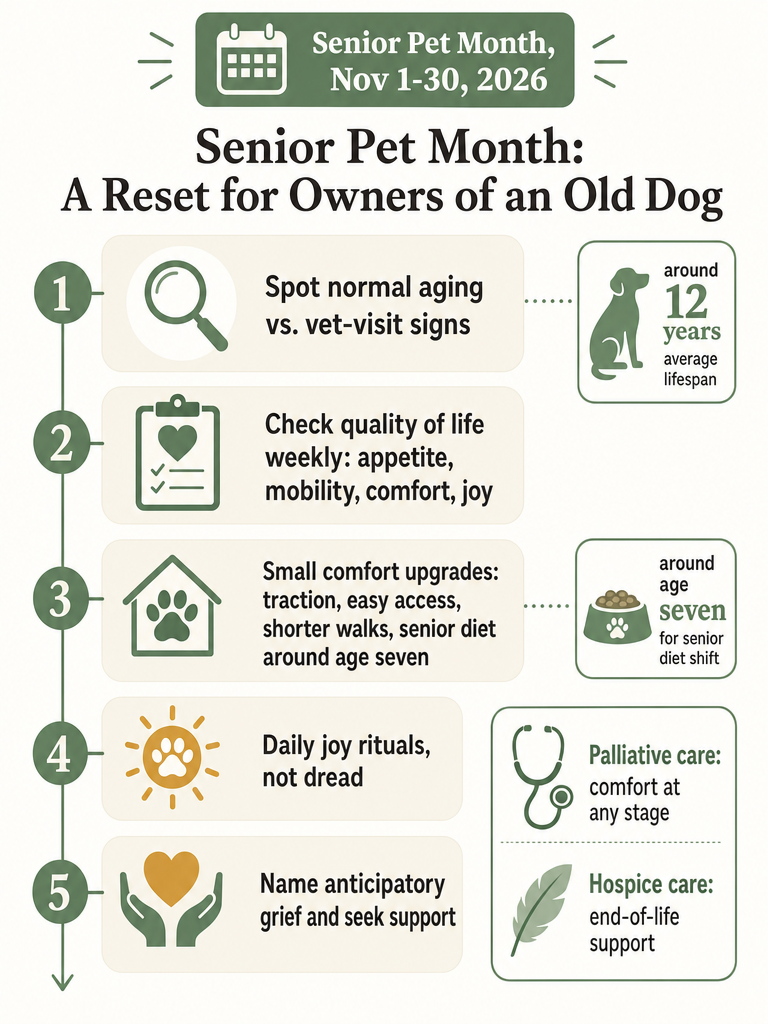
Six or seven years marks the point most veterinary guidance uses to call a dog a senior, according to Oh My Dog's review of that guidance, though the exact age shifts with size. Large breeds tend to age faster than small ones, so a bigger dog can show senior signs well before a toy breed does. The RSPCA puts the average dog lifespan at around 12 years, while noting that many dogs live considerably longer and that individual animals age at very different rates.
That range matters because "senior" describes a stage, not a diagnosis. A seven-year-old giant breed and a seven-year-old small dog aren't standing in the same physical place, even though both just crossed the same calendar line. What matters more than the number on a vet chart is what's actually changing day to day, and that's the harder, more useful question to sit with.
Which Changes Are Normal Aging, and Which Mean You Should Call the Vet?
Slower walks, more napping, and a quieter presence around the house count as ordinary aging in most dogs. The RSPCA treats gradual slowing as expected, since individual dogs age at different rates, but it draws a clear line at stiffness, trouble rising, or difficulty with stairs, all of which it says belong in front of a vet because treatment may help.
| What you're noticing | Usually just aging | Worth a vet visit |
|---|---|---|
| Energy on walks | Slower pace, more rest afterward | Sudden limping or refusing to walk at all |
| Getting up from lying down | Takes a few extra seconds | Visible struggle or crying out when rising |
| Stairs | Slight hesitation before climbing | Avoiding stairs completely or losing balance on them |
| Eating and drinking | Minor shifts in appetite | Skipping meals or a noticeable change in weight |
Keeping a dog comfortable doesn't require fixing everything that aging brings. It requires knowing which changes are the ordinary cost of more birthdays and which ones are a treatable problem wearing the same disguise.
Does Your Dog Need Palliative or Hospice Care Right Now?
Palliative care and hospice care solve different problems, and knowing which one applies to your dog clarifies what kind of help to look for next. The International Association for Animal Hospice and Palliative Care (IAAHPC) defines palliative care as comfort-focused treatment and symptom management available at any stage of a dog's life, not only at the end. Hospice care, by contrast, is reserved for dogs who are terminally ill and nearing the end of life, where the goal has fully shifted from cure to comfort.
If your dog has a diagnosed condition, chronic pain, or reduced mobility but is otherwise stable, you're likely already in palliative territory, something a vet manages alongside ordinary senior care rather than as a last resort. Hospice becomes relevant later, once a terminal diagnosis changes the goal of every decision to comfort rather than cure. IAAHPC notes that quality-of-life tools can help pet parents track a dog's well-being over time, turning vague worry into something concrete to bring to a veterinarian.
For what that actually looks like in practice, including typical costs and how the timeline tends to unfold, see what dog hospice care involves day to day.
How Do You Check Your Dog's Quality of Life Without Becoming Hypervigilant?
There's no clinically validated schedule for checking a senior dog's quality of life at home, so the honest answer is: pick a rhythm you can actually sustain and stay consistent with it. IAAHPC frames quality-of-life tools as a way to track a dog's well-being over time rather than relying on a single gut read taken on a hard day, and that idea works at home without any formal paperwork.
- Appetite. Is your dog finishing meals at the usual pace, or picking at food and walking away?
- Mobility. Can your dog get up, lie down, and navigate stairs or the yard the same way as recently?
- Comfort. Any new panting, restlessness, guarding of a body part, or reluctance to be touched somewhere?
- Joy. Does your dog still greet you at the door, perk up at a leash or a favorite toy, seek out contact?
A short written note beats memory, since memory tends to smooth over slow change until it isn't slow anymore. There's no fixed number of check-ins that turns a dip into a concern. What matters is having enough written down to notice a pattern instead of reacting to one off day. When something looks different across several check-ins in a row, that's worth raising with a vet rather than something to self-diagnose at home.
Small Changes That Make Daily Life Easier for an Old Dog
A few small adjustments at home can noticeably ease an old dog's day without any medical intervention. The RSPCA's guidance for older dogs centers on reducing physical strain and unpredictability, both of which get harder for aging bodies and minds to absorb.
- Keep a predictable routine. The RSPCA says older dogs do better with consistent schedules, since minimizing change reduces stress.
- Add traction to slick floors. A rug or runner on hardwood or tile gives aching joints something to grip instead of slide on.
- Bring food, water, and bed within easy reach. The RSPCA recommends keeping everything a dog needs close by so they don't have to travel far to find it.
- Shorten walks, not activity. Older dogs still benefit from regular exercise, just in shorter, gentler stretches that don't exhaust them.
- Consider a senior diet around age seven. The RSPCA notes that many dogs benefit from gradually switching to a senior-formulated diet at around that age, introduced slowly and in consultation with a vet to avoid stomach upset.
None of these changes fix aging. They remove friction from a day that already asks more of an old body than it used to.
How to Make the Time You Have Left Feel Full, Not Just Survived
The time left with an old dog gets fuller when you fill it with small, repeatable moments instead of bracing for the day it ends. That's a different project than trying to make every day "count" in some grand sense, which usually just produces pressure and guilt when an ordinary Tuesday doesn't feel momentous.
Writer Gene Hill captured the quieter version of this bond: "His head on my knee can heal my human hurts. His presence by my side is protection against my fears of dark and unknown things." That's a dog simply being present, worth noticing now, not retroactively.
Build a few small rituals that fit your actual dog: the same short route at the same slow pace, a specific chair they've claimed, the exact way they wait by the door. Repetition is what makes them meaningful, not scale. Noticing the same small moment day after day, the weight of your dog leaning against your leg, the exact sound of their sigh when they settle, adds up over weeks on its own.
One concrete task matters too: save what you have now, while you have it. Current photos, a video of their walk, their bark, their particular way of sighing when they settle. Memory fades faster than people expect. A practical guide to backing up your dog's videos and photos covers how to do this before anything is lost, not after.
Living With the Anticipatory Grief of an Aging Dog
Grief that starts before a death happens has a name: anticipatory grief, and it counts as real grief, not pessimism or morbid thinking. Loving an old dog while knowing the relationship has a visible edge produces genuine mourning, often mixed with guilt for feeling sad about a dog who is still alive and still, by most measures, having good days.
That guilt deserves acknowledgment rather than correction. You're not failing to be grateful by also grieving in advance. Real joy watching your dog nap in a patch of sun and real dread about the appointment you know is coming eventually can both be true in the same afternoon. Neither cancels the other out, and neither one means you're doing this wrong.
If this stretch feels heavier than you can carry alone, or if the people around you keep minimizing it with some version of "he's just a dog," a counselor who works specifically with pet loss, rather than general bereavement, tends to understand the particular weight of it. A guide to choosing a pet loss grief counselor who gets dog loss walks through what to look for and how to vet someone before you commit to a session.
For readers who want company rather than instruction while they move through this stretch, To Lose A Dog was written from inside exactly this kind of love, the kind that knows its own ending and keeps showing up anyway. It isn't a solution. It's a reminder that you're not the only one who has loved a dog this completely and feared the day it would end.
Frequently asked questions
When is Senior Pet Month in 2026, and what does it actually recognize?
Senior Pet Month falls in November, with the 2026 observance running November 1 through November 30. Coverage of the exact name and dates is inconsistent across sources, with some calling it Senior Pet Health Month or National Senior Pet Month, and no single governing body confirms the precise wording. Most November campaigns focus on encouraging adoption of older shelter dogs, who are frequently passed over in favor of puppies.
What's the difference between Senior Pet Month and Adopt a Senior Pet Month?
Senior Pet Month and Adopt a Senior Pet Month share the same November calendar slot but point in different directions. Adopt a Senior Pet Month pushes specifically toward adoption: senior dogs make up only about 5 percent of shelter populations, yet account for the majority of the roughly 1.2 million dogs euthanized in U.S. shelters each year. Senior Pet Month is the wider umbrella, covering care and awareness for any aging dog, adopted or already home with you.
What is the average lifespan of a dog?
Most dogs live around 12 years on average, according to the RSPCA, though many live considerably longer and individual dogs age at very different rates. Size plays a large role: large breeds tend to age faster and have shorter average lifespans than small breeds. That average is a starting point for conversations about care, not a countdown, since a 12-year-old toy breed and a 12-year-old giant breed are not in comparable health.
Are there quality-of-life scoring tools for senior dogs?
Yes, veterinary hospice organizations use structured quality-of-life tools that track a dog's well-being across categories like appetite, mobility, and comfort over repeated check-ins rather than relying on a single hard day. The International Association for Animal Hospice and Palliative Care recommends this kind of tracking specifically because it turns vague worry into something concrete a veterinarian can act on. Writing down short notes at home works the same way, even without a formal printed scale.
Is it normal to feel guilty about grieving an old dog who is still alive?
Yes, grieving before a death happens is a recognized experience called anticipatory grief, and it is not pessimism or an overreaction. Loving an aging dog while knowing the relationship has a visible edge produces genuine mourning, often tangled with guilt for feeling sad about a dog who is still having good days. That guilt deserves acknowledgment rather than correction: real joy watching your dog nap in the sun and real dread about an appointment you know is coming can both be true in the same afternoon.
How can I support a friend whose senior dog is nearing the end of life?
The most useful thing you can offer is presence without minimizing the loss, since comments like 'he's just a dog' dismiss what functions as real bereavement. Ask about the dog by name, offer concrete help such as vet rides or pet-sitting, and avoid predicting how long their grief should last. If they seem to be carrying this alone, a counselor who specializes in pet loss, rather than general bereavement, tends to understand the particular weight of it.