
What is dog hospice care?
Dog hospice care is end-of-life comfort care for a dog when a cure is no longer possible or no longer the goal. It's a medically supervised, family-centered approach focused on symptom relief and quality of life, not on reversing the disease. The ASPCA describes it as an option when a pet has a terminal illness and a cure is not possible, with the goal of making the final days or weeks more pleasant through pain medication, dietary strategies, and human interaction.
The most important thing to understand: hospice is not a building you drop your dog off at. The ASPCA calls it a personal choice and philosophy, built on the idea that death is part of life and can be dignified. Lap of Love, a nationwide network of hospice veterinarians, defines veterinary hospice as a family-focused, team-oriented service that maintains comfort for terminally ill or senior pets until a natural death or the family elects euthanasia.
According to GoodRx, that care usually includes an at-home visit from a veterinarian to discuss comfort medications and a quality-of-life assessment. Jessica Fragola, VMD, writing for Paws at Peace, frames the choice plainly: hospice is not giving up. It's a shift in what you're fighting for, from length of life to comfort within it.
What is the difference between dog hospice and palliative care?
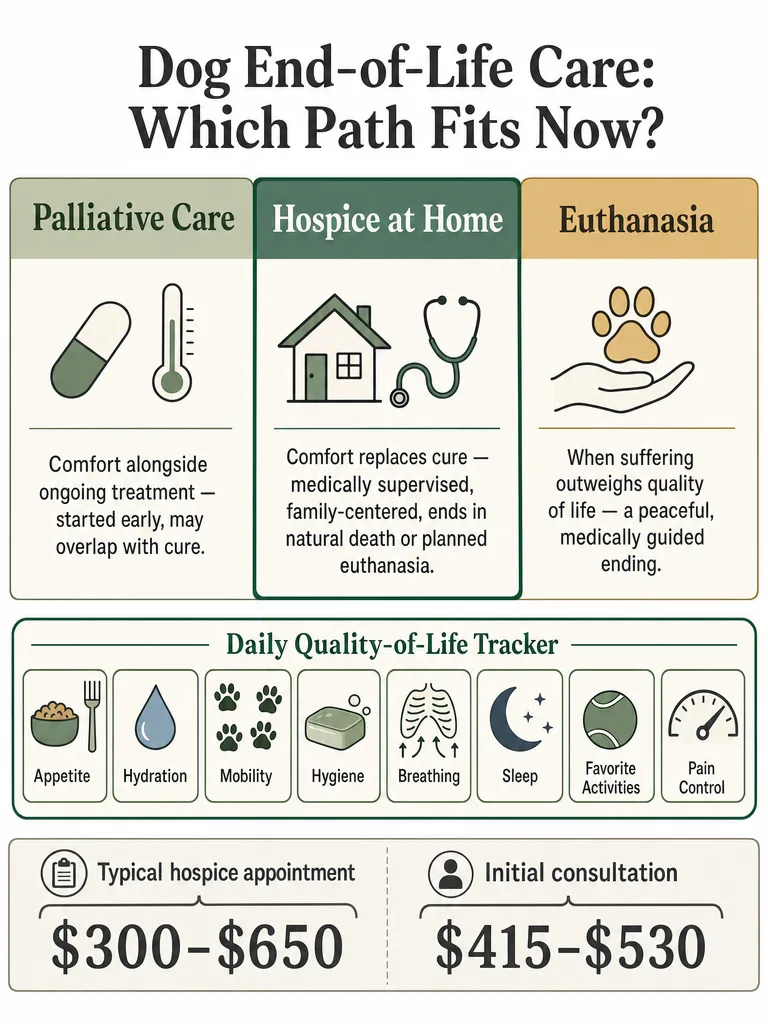
Palliative care can begin earlier and may run alongside treatment; hospice begins when comfort replaces cure as the main goal. The distinction matters because it tells you where you actually are in the illness, not just what to call it. PetMD, in its article dated April 30, 2025, explains that palliative care for dogs can start at any stage of a serious illness and may be provided while you still attempt to treat the underlying disease.
The practical moment of change is when the goal shifts from fixing the problem to easing each day.
| Palliative care | Hospice care | |
|---|---|---|
| When it starts | Any stage of serious illness | End stage, when cure is no longer the goal |
| Runs alongside treatment? | Yes, can overlap with curative care | No, comfort replaces cure |
| Main goal | Reduce symptoms while managing disease | Comfort and quality of life until death or euthanasia |
| Typical setting | Clinic or home | Primarily home, family as caregivers |
Lap of Love notes that hospice appointments are scheduled as needed and do not include routine daily or weekly visits, blood work, or diagnostic services. The focus is symptom management and family education. Confusingly, the ASPCA uses "pet hospice care" and "palliative care" as near-synonyms. That's why the useful question isn't which label your vet uses. It's whether you're still trying to change the disease, or only trying to keep your dog comfortable within it.
What signs mean a dog may need end-of-life care now?
A dog may need comfort-focused care when bad days start outnumbering good ones and pain no longer responds well to management. These are patterns, not single bad afternoons, and reading the pattern is what keeps decisions calm instead of panicked. SpectrumCare lists a cluster of signs that often signal a dog would benefit from hospice or palliative support.
Watch for these together, not in isolation:
- Ongoing pain, or pain that keeps returning between doses
- Repeated bad days that outnumber the good ones
- Trouble getting up or staying steady
- Poor appetite and continued weight loss
- House soiling from loss of bladder or bowel control
- Confusion or disorientation
- Restlessness at night
- Visible effort to breathe
- Fading interest in favorite people and activities
The ASPCA adds a caution worth sitting with: dogs in pain don't always whimper or cry. Some keep eating and drinking despite real discomfort. Instead, watch for excessive panting or gasping, reclusiveness, reluctance to move, and food pickiness.
If you're trying to read the pattern honestly, how to talk to your vet about dog quality of life can help you bring a log instead of a single hard moment.
What does dog hospice care at home include?
At-home dog hospice pairs a veterinarian's medical plan with a family that carries it out day to day. GoodRx, drawing on Mary Gardner, DVM, cofounder of Lap of Love, describes five main components of veterinary hospice: palliative care, environmental management, and caregiver support among them. Palliative care here means medication to relieve pain, anxiety, nausea, and lack of appetite.
In practice, hospice at home usually covers:
- Pain and symptom medication, with clear dosing instructions from your vet.
- Environmental management: a safe, cushioned, warm space, and setup that reduces slips and falls.
- Dietary and nutritional support, adjusted as appetite changes.
- Hygiene and mobility help, including slings or towels to support a dog who struggles to rise.
- Caregiver education, so you understand the disease process and know what to expect.
- Quality-of-life conversations and planning for either euthanasia or an unassisted death.
Lap of Love stresses that education about your dog's condition is where their veterinarians spend the most time, and that families are supported by a hospice care team, including nurses. The ASPCA is direct about what this asks of you: hospice requires active commitment and constant supervision, and you become your dog's primary nurse and the link to the veterinary team.
Hospice is a medical plan you carry out at home, not a hands-off service someone else performs for you.
How much does pet hospice cost?
A pet hospice appointment commonly runs $300 to $650, though total cost depends heavily on services, medications, travel, and where you live. Both GoodRx and Paws Into Grace cite that same $300 to $650 range for a hospice appointment, and both note location drives much of the variation.
Provider-level pricing shows how quickly the pieces add up. Here's what the sources actually list:
| Service | Cost | Source |
|---|---|---|
| Hospice appointment (general) | $300 to $650 | GoodRx; Paws Into Grace |
| Initial consultation once enrolled | $415 to $530 | Paws Into Grace |
| Monthly hospice payment | $200 | Paws Into Grace |
| Quality-of-life assessment, San Diego / Temecula | $325 | Paws Into Grace |
| Quality-of-life assessment, Orange County | $455 | Paws Into Grace |
| Telehealth hospice appointment | $150 to $350 per hour | Paws Into Grace |
| Hospice consultation (US range) | $85 to $450 | SpectrumCare |
| In-home euthanasia | $345 to $600 or more | SpectrumCare |
The wide spread isn't inconsistency. It reflects different things being priced. Paws Into Grace's quality-of-life assessment runs 1.5 hours and carries travel fees, which is why it costs more than a short telehealth check-in. SpectrumCare puts a US hospice consultation as low as $85, while in-home euthanasia commonly starts at $345 or more before cremation or travel.
What drives your bill: the type of service, your region, medication and supplement needs, whether you add therapies like acupuncture or hydrotherapy, and travel distance for in-home visits.
How long does dog hospice care last?
Dog hospice can last days, weeks, or months, depending on the diagnosis and how the dog declines. There's no dependable national timeline, and any page offering a tidy prognosis table across dogs is guessing. GoodRx describes end-of-life care as the care given in the last days, weeks, or months of a pet's life, which is honest precisely because it refuses to be more specific.
That's the useful frame: hospice is measured by reassessment, not by a countdown.
Rather than asking "how long do we have," the steadier question is "how is my dog doing this week compared to last." Lap of Love's model reflects this by scheduling appointments as needed, not on a fixed calendar. Your dog's underlying disease sets the pace, and it can change faster than expected.
The public sources here don't offer breed-specific or disease-specific timelines, so treat any hospice period as open-ended and revisited often. Hospice ends when comfort can no longer be maintained, not on a date you can circle in advance.
What should you track each day during dog hospice?
Tracking a few concrete signals each day turns a vague sense of "worse" into a pattern you and your vet can actually read. SpectrumCare frames quality of life around observable measures, and writing them down daily is what makes end-of-life conversations calmer and less guilt-driven.
Track these each day, ideally at the same time:
- Appetite: eating normally, coaxed, or refusing food
- Hydration: drinking on its own, or needs encouragement
- Mobility: standing and walking, needs a sling, or can't rise
- Hygiene: staying clean, or house soiling and needing help
- Breathing comfort: easy, or effortful and labored
- Sleep: restful, or restless and pacing at night
- Interest: still enjoys favorite people, toys, walks, or has withdrawn
- Pain control: medication holding, or breaking through
A simple good-day / bad-day mark next to each entry is often the most telling column. Over a week, the ratio tells the truth better than any single moment.
For a structured version of this, the Lap of Love quality of life scale for dogs offers a vet-backed way to score and compare days over time.
Dog hospice vs euthanasia: how do you decide?
Hospice is right while comfort can still be maintained; euthanasia becomes the kindest option when discomfort outweighs your dog's capacity to enjoy life. The ASPCA states this as clearly as anyone: if moments of discomfort outweigh a pet's capacity to enjoy life, it is time to euthanize, even if the dog still finds some pleasure in eating or socializing.
That last clause matters. A dog who still wags at dinner can still be suffering more hours than not.
The ASPCA also urges owners not to prolong the suffering of pets in pain or with poor quality of life, and adds that a veterinarian is the best person to advise when euthanasia is the right choice. Medical test information is often more accurate than what you can observe alone, which is one reason this isn't a decision to carry solo.
| Situation | What it points toward |
|---|---|
| Pain controlled, more good days than bad | Continue hospice |
| Still enjoys food, people, familiar routines | Continue hospice, keep tracking |
| Discomfort outweighs enjoyment, even with some good moments | Discuss euthanasia with your vet |
| Pain no longer responds to medication | Discuss euthanasia with your vet |
For context on the procedure itself, the ASPCA notes euthanasia takes about 10 to 20 seconds after the final medication is given. If you're getting close, what to do before a scheduled dog euthanasia appointment can lift some logistics off the hardest day.
What if you hope your dog will die naturally at home?
Many owners hope for a peaceful natural death at home, but Lap of Love is direct that a true natural death is not always quick or painless. The experience depends entirely on the underlying disease, and some conditions end gently while others do not. Hoping for a calm passing is understandable. Planning as though it's guaranteed is where families get hurt.
Because of that uncertainty, the honest move is to talk with your veterinarian before you're in a crisis. Ask specifically what a natural decline could look like for your dog's diagnosis, which distress signs to watch for, and what your emergency options are at 2 a.m. if breathing becomes labored or pain spikes.
The ASPCA's caution about hidden pain applies here too: dogs don't always show suffering in ways we recognize. A "peaceful" appearance isn't proof of comfort.
What does a hospice caregiver need to do each day?
In dog hospice, the owner becomes the primary nurse and the daily link between the dog and the veterinary team. The ASPCA is explicit that hospice requires active commitment and constant supervision, and that you'll work with your vet to make sure your dog's life ends comfortably. This is real work, and knowing that in advance is part of choosing hospice honestly.
Day to day, that role usually includes:
- Supervision: checking on your dog often, not just at feeding times
- Medication routines: giving the right doses on schedule, exactly as prescribed
- Comfort setup: warm bedding, cushioning against pressure sores, easy access to water
- Hygiene checks: watching for wetness or soiling, cleaning gently, using a sling or towel to help your dog up
- Mobility support: assisting to stand, walk, or reach a safe spot to relieve itself
- Symptom notes: recording appetite, breathing, pain, and mood
- Knowing when to call: recognizing when a symptom needs the vet now, not tomorrow
Lap of Love's model backs you here with a hospice care team, including nurses who provide timely support and guidance alongside the veterinarian. You're the primary caregiver, but you shouldn't be the only one.
This is demanding, and caregiver strain is real. If the weight of it is affecting you, anticipatory grief in dog owners speaks to what you're carrying while your dog is still here.
Frequently asked questions
What is dog hospice care and how is it different from regular vet care?
Dog hospice is comfort-focused, end-of-life care for a dog when curing the illness is no longer the goal. The ASPCA describes it as a personal philosophy built on the idea that death can be dignified — not a facility you drop your dog off at, but a medically supervised plan you carry out at home. Unlike routine vet care, hospice stops chasing the disease and focuses entirely on relieving pain, anxiety, nausea, and loss of appetite.
How much does pet hospice care cost?
A pet hospice appointment typically runs $300 to $650, according to both GoodRx and Paws Into Grace. Costs rise with add-ons: Paws Into Grace charges $415–$530 for an initial enrolled consultation plus $200 monthly, and in-home quality-of-life assessments run $325–$455 depending on location. Telehealth options start around $150 per hour. Medications, travel fees, and therapies like acupuncture are separate. Ask your provider and insurer for written figures before enrolling.
What signs mean a dog needs hospice or end-of-life care?
The clearest signal is bad days consistently outnumbering good ones — not a single hard afternoon, but a sustained pattern. Watch for ongoing pain that returns between medication doses, weight loss, trouble standing, loss of bladder or bowel control, confusion, labored breathing, and withdrawal from people. The ASPCA cautions that dogs in pain don't always cry; watch instead for excessive panting, reclusiveness, and reluctance to move.
What does dog hospice care at home actually include?
At-home hospice pairs a vet's medical plan with the owner as primary caregiver. Lap of Love describes the core focus as education about the disease process, symptom management, and pain treatment. Day to day that means giving scheduled medications, providing cushioned bedding to prevent pressure sores, helping with mobility using a sling or towel, adjusting nutrition as appetite changes, and tracking symptoms to report back to the veterinary team.
How long does dog hospice care last?
There's no fixed timeline — GoodRx honestly describes it as care given in the last days, weeks, or months of a pet's life. The duration depends entirely on the diagnosis and how the dog declines. Lap of Love schedules appointments as needed rather than on a fixed calendar, which reflects the reality: hospice is measured by regular reassessment, not a countdown. Treat the period as open-ended and revisit the plan often.
How do you decide between continuing hospice and choosing euthanasia?
The ASPCA frames it clearly: when moments of discomfort outweigh a dog's capacity to enjoy life, euthanasia is the kindest option — even if the dog still wags at dinner. Continue hospice while pain is controlled and good days outnumber bad ones. Move toward euthanasia when pain no longer responds to medication or discomfort dominates daily life. A veterinarian can assess what you can't observe alone, so this decision shouldn't be carried solo.
Sources
- End of Life Care | ASPCAwww.aspca.org
- How Much Does Pet Hospice Cost? | Paws Into Gracepawsintograce.com
- Veterinary Pet Hospice - Lap of Lovewww.lapoflove.com
- Dog & Cat Hospice Care - Kay Animal Hospitalwww.kayanimalhosp.com
- Dog Hospice & Palliative Care:… | SpectrumCarespectrumcare.pet