What happened to Tucker Budzyn?
Tucker Budzyn, a Golden Retriever from Michigan and one of the internet's best-known dogs, died on September 2, 2026, at age 8 after complications from lymphoma. His owner, Courtney Budzyn, announced his death in a video on September 5, three days later. The Straits Times confirmed the timeline, reporting he was diagnosed with lymphoma before dying unexpectedly from a fast-moving infection.
That gap between diagnosis and death is short, and it matters. Courtney had told followers on August 30 that Tucker was responding well to treatment. Six days later she was holding what appeared to be his ashes on camera.
Because so much online coverage now blends her own words with reposts, aggregated screenshots, and secondhand summaries, this piece stays with what Courtney herself said and what named outlets reported. Where sources disagree or go quiet, we say so rather than fill the gap.
Two facts anchor everything below: the death date of September 2, and Courtney's own account of what went wrong medically. Everything else in the wave of "remembering Tucker" content should trace back to those.
Tucker Budzyn died on September 2, 2026, at age 8, and his owner shared the news publicly on September 5.
How did Tucker Budzyn die after the hopeful lymphoma update?
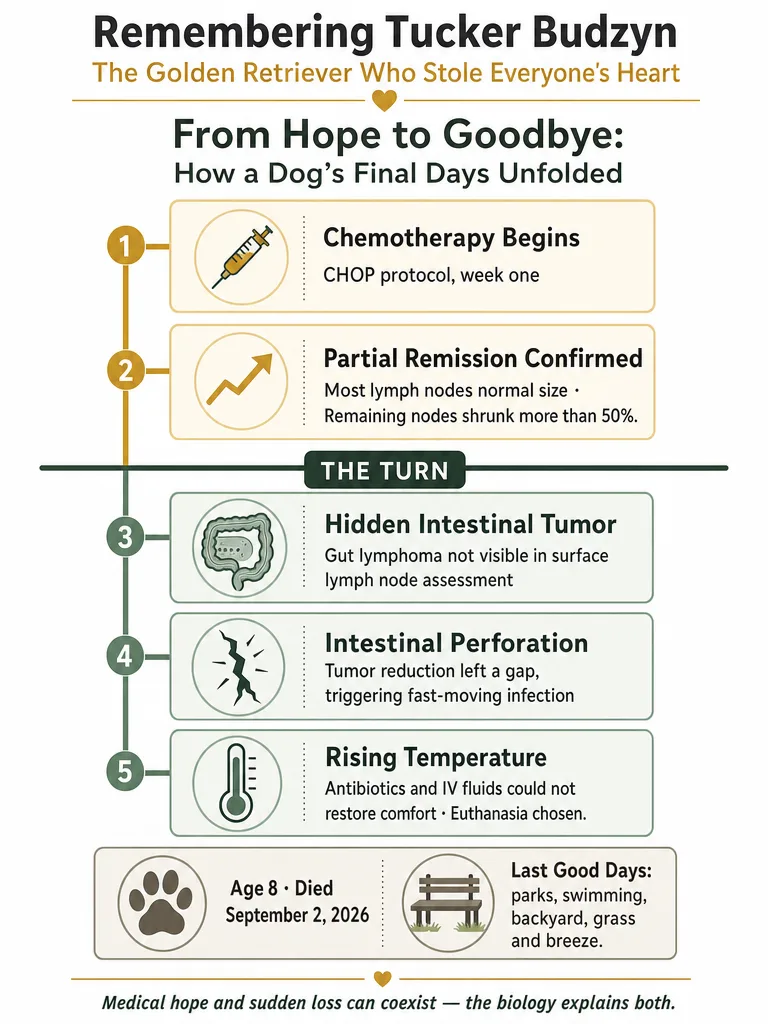
Tucker Budzyn died from a fast-moving infection caused by a perforation in his intestine, a complication of the same lymphoma his family was treating. On August 30, 2026, Courtney Budzyn told followers he was in partial remission. By September 2 he was gone. The whiplash was real, and the explanation sits in the difference between the cancer they could see and the cancer they couldn't.
Here is the sequence, from Courtney's own account:
- Around mid-August 2026, roughly two weeks before the August 30 update, veterinarians found lymphoma.
- Tucker started CHOP chemotherapy plus herbal support under veterinary oncologist Aaron Banick.
- After one week of treatment, he was considered in partial remission.
- What the team did not know early on was that Tucker also had intestinal lymphoma.
- As chemotherapy shrank the gut tumors, it left a hole in his intestine.
- An infection hit, in Courtney's words, "overnight."
- Courtney and Mike Budzyn rushed him in and started antibiotics and IV fluids.
- His temperature kept climbing and would not come down.
- They chose euthanasia on Wednesday, September 2.
Courtney described the medical turn plainly. As she told followers in her announcement video, quoted by The Straits Times: "Since the chemo was working so good and he was going to remission, it left a hole in his intestine where the cancer was, and he got an infection that seemed to hit him overnight."
The treatment working and the treatment causing the fatal complication are not a contradiction. They're the same process. The chemotherapy did what it was supposed to do to the tumor tissue, and the tissue it dissolved happened to be holding an intestinal wall together.
Was Tucker Budzyn in remission before he died?
Tucker Budzyn was in partial remission for his visible lymphoma, not full remission, and not free of disease. Courtney Budzyn said that after one week of CHOP chemotherapy under veterinary oncologist Aaron Banick, most of his lymph nodes had returned to normal size, and the two that hadn't had shrunk by more than 50%. That's a real, measurable response. It is not the same as "the cancer is gone."
The nuance most reposts flatten is this: partial remission of the nodes you can feel says nothing about lymphoma hiding in the intestines. Tucker had both. The shrinking nodes were genuinely good news. The intestinal disease was the part nobody could see responding, and it was the part that killed him when the tumor tissue broke down and perforated the gut wall.
So "was he in remission?" has an honest two-part answer. Yes, his palpable lymph nodes were responding well after one week. No, that did not mean he was safe, and it did not mean the intestinal component had been resolved.
The visible cancer was responding while the hidden cancer was about to end his life, and both were true at the same time.
If you're facing a lymphoma diagnosis with your own dog, the takeaway isn't fear of treatment. It's understanding that "responding to chemo" is a status report, not a finish line, and that questions about staging and where the disease sits are worth asking your oncologist directly.
Did Courtney and Mike Budzyn do everything they reasonably could?
By Courtney Budzyn's own account, yes: Tucker was already in treatment, the family pursued chemotherapy that offered a real shot at more time, and they chose euthanasia only when his rising temperature could not be brought down. If you're a fan feeling shocked or second-guessing on their behalf, the timeline doesn't support the idea that anything was neglected.
Consider the choice they faced. Courtney said she was told that without chemotherapy Tucker might have about six weeks. With CHOP, the hope communicated to her was one to three more years. They chose the treatment that offered years. When the intestinal perforation caused an infection, they rushed him in and started antibiotics and IV fluids, hoping to beat it.
Her words, as reported by the New York Post and The Straits Times, were direct: "We got him on antibiotics and fluids, but it was too late. We tried to save him, but we couldn't." And on the decision to let go: "His temperature kept rising and there was nothing, and nothing was changing it. We had to let him go."
Euthanasia chosen when comfort cannot be restored is not giving up. It's the last kindness. If you've made that call yourself, or are anticipating it, our guide on how to talk to your vet about your dog's quality of life walks through reading the pattern instead of one bad day.
What were Tucker Budzyn's last good days like?
Tucker Budzyn's final three weeks were spent doing the ordinary things he loved, and that is the image Courtney Budzyn asked people to hold onto instead of the clinic. She described parks where he peed on every tree he could reach, swimming trips where his first jump into the pool was still, in her words, "powerful and strong," and mornings and nights with chicken alongside his medication.
The full picture she shared: rollerblading outings, backyard wrestling with his son Todd Budzyn, grass and breeze, and the small daily rituals of a dog who did not know he was famous or sick. He was, she said, having the best time of his life.
This is a deliberate choice worth honoring. Courtney could have led with the emergency, the temperature that wouldn't drop, the last hours. She led with the pool jumps. She told fans he was "dumpier than his normal self" during treatment but still swimming, still walking, still going to parks.
He didn't lie by my side for all those years just for me to give up.
That framing gives grieving fans, and anyone facing a dog's decline, a usable model. The last chapter doesn't have to be the clinic. If you're planning for that time with your own dog, ideas for a gentle final stretch live in our guide on how to plan your dog's last day.
Who was Tucker Budzyn's owner, and how did his online life begin?
Tucker Budzyn's owner was Courtney Budzyn, who ran his accounts with her husband, Mike Budzyn, from their home in Michigan. Courtney appeared on camera as "Linda," a running joke from an old YouTube meme; Mike often worked behind the camera. Tucker was an AKC Golden Retriever and the family's first dog, purchased as a purebred puppy rather than rescued, a detail that shaped both the household and the business that grew around him.
He was born in Michigan in early May 2018. Most bios list May 2; some fan pages list May 3. The one-day discrepancy has never been formally resolved, so treat either as approximate rather than certain.
Tucker came home at about eight weeks old in June 2018, and Courtney created his Instagram the day she brought him home. The main YouTube channel followed on July 14, 2018. Her 2019 anniversary video, The Day I Got My Puppy, later passed 12 million views.
The first viral moment wasn't a produced skit. Within about a month, they gave him an ice cube and he pawed at it. Courtney later said she was floored that strangers cared as much as she did. By six months old, Tucker had roughly 60,000 Instagram followers.
Before Tucker went full-time, Courtney has said she cleaned houses and Mike worked as a civil engineer. They eventually quit both jobs to run the account. What started with a puppy and an ice cube became the family's livelihood.
Why are people so upset about Tucker Budzyn's death?
People who never met Tucker Budzyn feel real loss because his videos worked as daily comfort, not as spectacle. For years, millions used his taste tests, park routines, and dad-and-son bits the way people lean on any familiar house-pet account during lonely stretches of internet life. The grief in condolence threads isn't performative. It's the response to losing a small, reliable source of ease.
His persona was specific and consistent. Tucker "spoke" in comic captions written in baby-talk spelling: "Henlo frens," "hekkin Linda," vegetables written off as "garbage," chicken as the one true food. The joke was always the same slightly grumpy Golden who thought he was a person, with Courtney supplying the voice and Tucker supplying the timing and the face.
Fans knew his details. The thick golden coat, the dark muzzle, and the black spot on his tongue that commenters still mention in condolence posts. His taste-test videos were a franchise; the December 13, 2020 episode Dog Reviews Food With Baby Puppy | Tucker Taste Test 20 topped 25 million views.
The speed of the ending sharpened the shock. Followers had one week of "partial remission, we're hoping for years," then a Saturday video revealing he'd already been gone three days. In the r/goldenretrievers thread, one commenter summed up the mood plainly: Tucker "was one of the best dog YouTubers and he was loved."
If the intensity of that grief surprises you, our piece on the neuroscience of why pet loss hurts so much explains why the bond registers as real bereavement, even at a distance.
Tucker Budzyn as a family dog vs an internet character
Tucker Budzyn was both a real household dog in Michigan and a carefully produced character, and a faithful memorial holds both without letting either erase the other. The comic "thoughts" in his captions were written by humans. The performance, the timing, the face, was the dog. Courtney Budzyn directed and co-starred; Mike Budzyn was often behind the camera. Naming that production doesn't diminish the grief. It clarifies what people are grieving.
The character served a purpose. A sarcastic golden who hated vegetables and plotted walks was easier to love, share, and return to than raw footage would be. But behind every skit was an actual dog who swam, wrestled with Todd, and slept beside Courtney for eight years.
This matters for anyone trying to remember him honestly. The temptation is to treat the persona as the whole truth or to dismiss it as "just content." Neither is right. The persona was a shared invention. The bond underneath it was not.
Tucker was a produced internet character voiced by his humans, and a real dog whose death left a real hole in the home that made him.
That dual nature is part of why the loss landed so widely. The character belonged to millions. The dog belonged to a family.
How big was Tucker Budzyn's audience near the end?
Near the end of his life, Tucker Budzyn's audience ran into the tens of millions across platforms, though exact figures drift by source and week. The family's own 2025–26 talking point was a combined reach of "28 million+ worldwide." The per-platform numbers below come from the user-supplied research brief and are approximate.
| Platform | Approximate size near death |
|---|---|
| TikTok | ~11.8 million followers |
| YouTube (main channel) | ~5.93–5.94 million subscribers, ~2 billion lifetime views, 340+ videos |
| YouTube Shorts channel | ~785,000 subscribers, ~238 million views |
| ~4.4 million followers | |
| ~4.9 million followers | |
| X | ~69,000 followers |
Treat these as estimates, not audited counts. Public sources don't provide verified follower totals frozen at the exact moment of his death, and the numbers moved constantly.
After the September 5 announcement, YouTube Social Blade data showed a spike in views as people returned to watch old videos. That surge is its own kind of eulogy: grief expressed by rewatching the taste tests one more time.
What should be remembered about Todd Budzyn, Journey, and Tucker's wider world?
The most important surviving figure is Todd Budzyn, Tucker's on-camera son, a Golden the family brought home around August 2021. Todd is the dog Courtney Budzyn said she now has to take care of, and he anchored the father-son videos, the wrestling matches, and the "sharing one brain cell" bits that defined Tucker's later years. In her goodbye, Courtney said moving forward meant caring for Todd.
Tucker was also paired on camera with a female Golden often called Journee or Journey, referred to as "wifey" in older coverage, with 2023 pieces describing the two as parents of Todd and two other pups. Other dogs, including names like Posie, Bubbles, Gator, Fenway, and Flutter, appear in older episode lists as supporting cast.
A careful note: public sources don't confirm which of these dogs were still in the household when Tucker died. Treat them as past appearances rather than a documented current roster. Speculating fills space but risks getting it wrong.
Todd is the one clearly still present, and he's now navigating the absence of the dog he grew up beside. If your own surviving dog seems unsettled after losing a companion, our guide on how to tell your other dog that their companion died offers grounded steps for those first confusing days.
What parts of Tucker Budzyn's business are solidly sourced?
Tucker Budzyn anchored a genuine business, though the sharpest revenue figures are owner-reported rather than audited. Courtney Budzyn was widely quoted saying the brand did about $1 million a year by 2023, with a single YouTube paid pre-roll in the $40,000–$60,000 range and Instagram story packages around $20,000. The research brief flags all three as figures Courtney gave in interviews, not independently verified accounting.
The solidly documented pieces of the operation:
- Merchandise through the official store, including Tucker & Todd Co. products, plushies, and calendars.
- Brand deals over the years with BarkBox, King Kanine, Vessi, Furbo, Google, and ButcherBox, among others.
- A game and app era, including the "Tuckermoji" period and later snack-style games.
- A picture book, Of All the Sniffs I Love the Most, framed as Tucker's story through his eyes and announced in 2026 as a preorder for around November 2026. The book was already in motion before he died. The Straits Times confirmed a picture book about him would be released in November.
- Rescue donations, with a portion of some merchandise sales going to groups such as Golden Bond Rescue.
The point of listing this isn't to make the memorial about money. It's proof of scale: a house-cleaner and a civil engineer built a full-time livelihood around one dog's face, and millions of people bought in. That's how large his reach actually was.
What is the most faithful way to remember Tucker Budzyn?
The most faithful way to remember Tucker Budzyn is to keep the medical truth honest, refuse to invent a backstory, and let the last image be the dog who gave ordinary joy to millions for eight years. That means saying plainly that the visible cancer was responding while hidden intestinal lymphoma caused the perforation that killed him, and resisting the urge to turn a sudden loss into a mystery or a failure.
It also means restraint. In her goodbye, Courtney Budzyn said Tucker "literally saved my life" and described him attaching himself to her through hard times she hasn't explained publicly. That statement belongs to her. A faithful remembrance quotes it and stops there, without supplying a story she chose not to tell.
What's left is the image she picked on purpose: the park, the trees, the powerful first jump into the pool, chicken with his meds, Todd waiting at home. Not the clinic.
He's home now.
If Tucker's death has stirred grief over your own dog, or fear of a loss still ahead, you're not overreacting. That's real bereavement, and it deserves company and language rather than a shrug. The book To Lose A Dog was written for exactly that, a science-backed survival guide folded into one dog's story, for the days when "it's just a dog" is the last thing you need to hear.
Frequently asked questions
What did Tucker Budzyn die from?
Tucker Budzyn died on September 2, 2026, from a fatal infection caused by a intestinal perforation — a direct complication of his lymphoma treatment. CHOP chemotherapy successfully shrank his visible tumors, but as it dissolved the cancer in his gut wall, it left a hole in his intestine. An infection set in overnight. Courtney and Mike rushed him in, started antibiotics and IV fluids, but his temperature kept climbing and wouldn't come down. They chose euthanasia when nothing could stabilize him.
Was Tucker Budzyn in remission when he died?
Tucker was in partial remission for his palpable lymph nodes — after one week of CHOP chemotherapy, most had returned to normal size, and the remaining two had shrunk by more than 50%. That was a real, measurable response. What partial remission didn't capture was the lymphoma hiding in his intestines. Those gut tumors were also responding to chemo, which is exactly what caused the fatal intestinal perforation. The visible cancer was improving while the hidden disease was becoming deadly — both were true at the same time.
When did Courtney Budzyn announce Tucker's death?
Courtney announced Tucker's death on Saturday, September 5, 2026 — three days after he died on September 2. She waited rather than post a single photo, then shared a video while holding what appeared to be his ashes. She told followers she felt she owed them an honest account of what happened medically, saying: "I thought that was the last sad video I was gonna make, but it's not. Tucker's gone." The Straits Times confirmed the timeline in coverage published September 6.
Did Courtney and Mike do everything they could to save Tucker?
By every available account, yes. They pursued CHOP chemotherapy, which offered a hoped-for one to three more years versus roughly six weeks without it. When the intestinal infection hit overnight, they rushed Tucker in immediately and started antibiotics and IV fluids. Courtney said plainly: "We got him on antibiotics and fluids, but it was too late. We tried to save him, but we couldn't." Euthanasia came only after his rising temperature proved unresponsive to treatment. That's not giving up — it's the last kindness available.
What were Tucker Budzyn's last weeks like before he died?
Courtney described Tucker's final three weeks as genuinely joyful. He visited parks where he peed on every tree he could reach, went swimming — his first jump into the pool was, in her words, "powerful and strong" — and had chicken morning and night alongside his medication. He wrestled with his son Todd in the backyard and went rollerblading with the family. Courtney said he was having the best time of his life. She chose that image deliberately: not the clinic, but the park and the pool.
Why do so many people who never met Tucker Budzyn feel genuinely devastated by his death?
For years, millions used Tucker's taste tests, park videos, and dad-and-son wrestling clips as daily comfort during lonely stretches — the same way people lean on any familiar, consistent presence. The grief in condolence threads isn't performative. It's the loss of something small and reliable. The shock is also about speed: followers had one week of "he's in partial remission, we have years," then a Saturday video revealing he'd already been gone three days. One commenter on r/goldenretrievers put it plainly: Tucker "was one of the best dog YouTubers and he was loved."
Sources
- Tucker Buzdyn, beloved Golden Retriever, passes awaywww.facebook.com
- R.I.P Tucker Budzyn : r/goldenretrieverswww.straitstimes.com
- Rest in Paradise Tucker 💔🕊 : r/goldenretrieverswww.facebook.com